
Meta’s New A.I. Model Signals a Reset — and Raises Fresh Questions About Trust
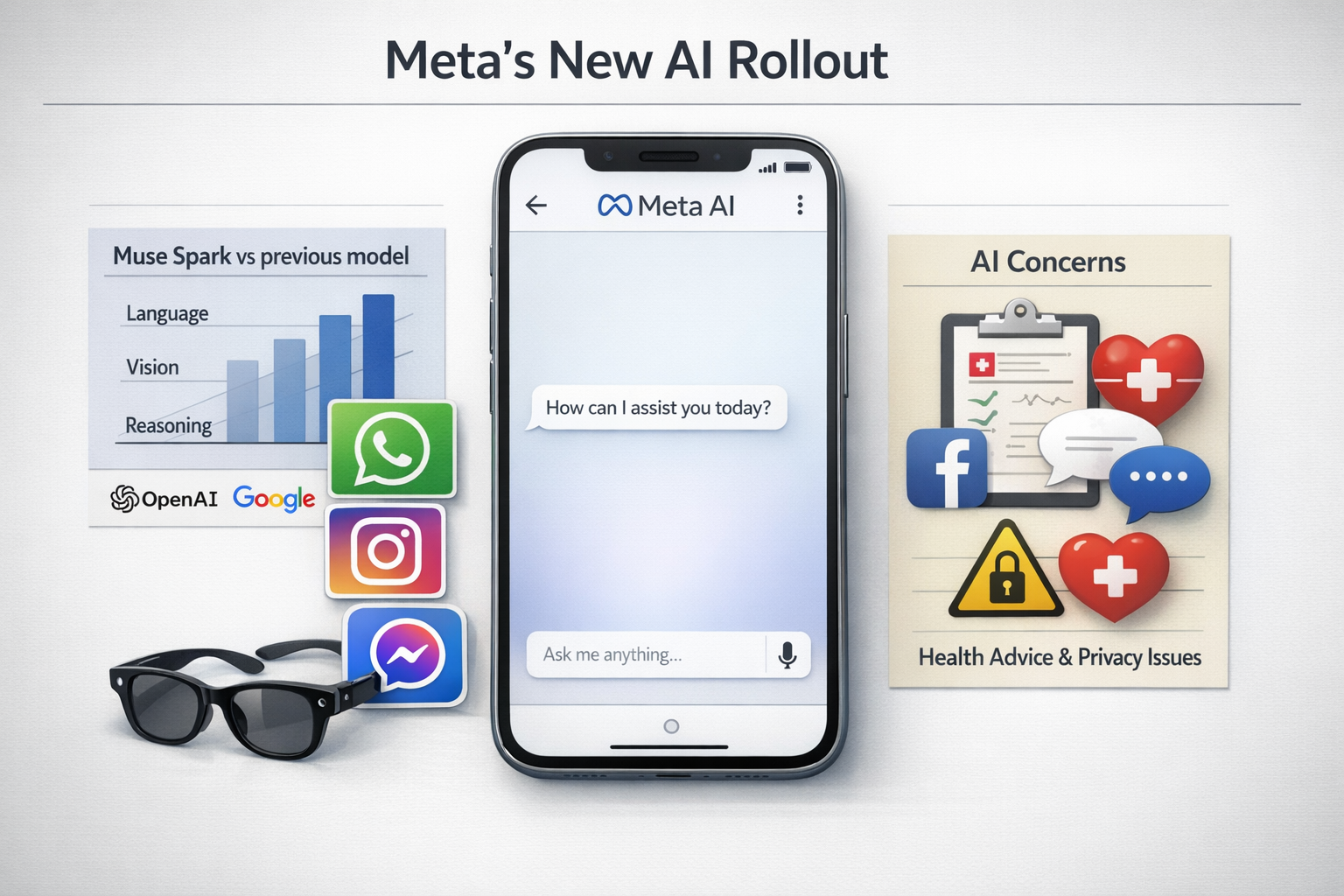
Meta on Tuesday introduced Muse Spark, a new artificial intelligence model that the company is presenting as both a technological comeback and the foundation of a broader consumer push across its apps and devices.
The model, the first in a new Muse family developed by Meta Superintelligence Labs, now powers the Meta AI app and meta.ai. The company has said it plans to roll it out in the coming weeks across WhatsApp, Instagram, Facebook, Messenger and its A.I. glasses, placing the system in front of billions of users and making it one of Meta’s most consequential product launches since its earlier Llama models stumbled to keep pace with rivals.
In benchmark results released by the company and in early outside assessments, Muse Spark appears to have moved Meta back into serious contention in the race with OpenAI, Google and Anthropic. Analysts and independent testers described it as notably stronger than Llama 4 in language, visual and reasoning tasks, though still trailing top competitors in some coding and long-horizon agentic work.
That mix — impressive technical progress paired with unresolved worries about how the model behaves in intimate consumer settings — has quickly defined the debut. Meta is not only pitching Muse Spark as a chatbot, but as an assistant for shopping, visual analysis and health-related questions, a category that has already drawn criticism from reviewers who said the system asked for sensitive medical information and then returned unreliable advice.
A High-Stakes Reentry
The launch is the clearest public sign yet of Meta’s attempt to recover from a disappointing A.I. cycle and to justify the enormous spending behind its recent overhaul. Over the past year, the company has reorganized its A.I. efforts, assembled a high-profile “superintelligence” team and tied its ambitions to a strategy that executives have described as “personal superintelligence” — software intended to act as a persistent, individualized assistant in everyday life.
Muse Spark is the first major product to emerge from that effort. Meta says it rebuilt its A.I. stack over the last nine months and designed the new model to be smaller, faster and more efficient than its predecessor, while improving performance across multimodal tasks that combine text, images and reasoning.
Early tests suggest the model has features now expected from the industry’s leading systems: it can browse the web, generate images, analyze visuals, execute Python code in a sandboxed environment and create interactive web artifacts. Users and researchers experimenting with the chat interface found a broad suite of integrated tools, including ones for file search, code execution, image grounding and links to Meta’s own platforms.
Those capabilities matter because they show Meta trying to compete not only on raw model intelligence, but on the surrounding product layer — the tools that make a chatbot useful enough to keep people inside one company’s ecosystem. In Meta’s case, that ecosystem is unusually large and personal, extending from social feeds and messaging to shopping and wearable devices.
Stronger Than Llama, but Not Unbeatable
The early consensus around Muse Spark has been favorable, particularly when compared with Meta’s recent efforts. Commentary from outside researchers has framed the model as competitive with leading frontier systems on selected language and visual benchmarks, helping restore Meta’s credibility after Llama 4 failed to generate the same level of enthusiasm as competing releases.
But the praise has been qualified. Meta itself has acknowledged gaps in coding and longer, more complex workflows, and outside observers found it lagging top rivals on some programming-heavy tests. That distinction is important in an industry where benchmark performance can shape investor confidence and developer interest, but broad adoption often depends on how systems perform in less tidy real-world conditions.
Another notable break from Meta’s earlier strategy is distribution. Unlike previous flagship Llama releases, which were promoted as open-weight models that developers could download and run more freely, Muse Spark is not being released that way at launch. It is being offered through Meta’s own products, with API access limited to a private preview. The company has suggested future versions could become more open, but for now the shift gives Meta tighter control over deployment and, potentially, over monetization.
The Health Feature Becomes a Flashpoint
If the technical launch has been greeted as a comeback, the health-related use cases have become the most immediate source of concern.
Meta has said it worked to improve the model’s health reasoning and used physician-informed training data. But recent hands-on testing by reviewers found that the system invited users to upload or paste in raw health information, including lab results, while delivering medical guidance that was at times shaky or plainly poor.
That criticism lands at a particularly sensitive moment for the A.I. industry. Companies have increasingly marketed chatbots as helpers for everyday personal decisions — from meal planning to symptoms and medication questions — even though medical experts have repeatedly warned that large language models can sound authoritative while being wrong, incomplete or unsafe.
For Meta, the concern is sharpened by scale. A model embedded across WhatsApp, Instagram, Facebook and Messenger is not a niche product for early adopters. It is an assistant likely to be encountered by teenagers, older adults and users with little reason to distinguish between a general-purpose chatbot and a trustworthy health tool.
Meta’s own privacy disclosures add to those worries. The company says chats with its A.I. systems may be stored and used to improve its models, an approach that has become common across the industry but takes on a different weight when users are discussing symptoms, medications, diagnoses or lab work. Even if such systems are not intended to replace doctors, critics argue that the design itself — asking for highly sensitive data in a familiar consumer app — can encourage people to treat them as if they were.
Why This Matters Now
The arrival of Muse Spark underscores a broader shift in the A.I. race: the contest is no longer just about who has the smartest model in a lab test, but who can turn that model into a habit woven into daily life.
Meta has a rare distribution advantage. No other A.I. company can place a new assistant so quickly across social media, private messaging, commerce tools and wearable hardware. If Muse Spark proves genuinely useful, it could help Meta close ground on competitors that currently dominate public perception of the frontier. If it falters — especially in high-risk areas like health — the consequences could be felt at a much larger scale than a bad demo or an obscure benchmark miss.
That tension is likely to shape the next phase of scrutiny. Independent researchers will be watching to see whether Meta’s performance claims hold up under broader testing. Developers will want to know whether the company returns to open-weight releases for the Muse line. Regulators and privacy advocates are likely to focus on how the system handles retention, training and consent around sensitive prompts.
For now, Muse Spark has given Mark Zuckerberg’s company something it badly needed: evidence that its expensive A.I. rebuild may be working. But it has also revived the question that increasingly shadows consumer A.I. products: not just whether they are powerful, but whether they can be trusted where people are most vulnerable.
Sources
Further reading and reporting used to add context:
- https://www.axios.com/2026/04/08/meta-muse-alexandr-wang
- Introducing Muse Spark: Meta's Most Powerful Model Yet
- https://techcrunch.com/2026/04/08/meta-debuts-the-muse-spark-model-in-a-ground-up-overhaul-of-its-ai/
- https://fortune.com/2026/04/08/meta-unveils-muse-spark-mark-zuckerberg-ai-push//
- https://tech.yahoo.com/ai/meta-ai/articles/meta-launches-muse-spark-ai-171225165.html/
- https://tech.yahoo.com/ai/meta-ai/articles/meta-launches-muse-spark-first-072044496.html
- https://thetechportal.com/2026/04/08/metas-superintelligence-labs-releases-its-first-ai-model-muse-spark/
- https://tech.yahoo.com/ai/meta-ai/articles/meta-finally-launches-delayed-muse-170804489.html/
- https://www.svd.se/a/Pdg93X/meta-avslojar-ny-ai-modell-forsta-pa-ett-ar
- https://letsdatascience.com/news/meta-releases-muse-spark-to-reenter-ai-race-273982bf
- https://www.reddit.com/r/aiagents/comments/1sgikk6/metas_new_muse_spark_ai_just_promised_to_ping_me/
- https://www.forbes.com/sites/daniellechemtob/2026/04/09/forbes-daily-facebook-parent-meta-unveils-new-ai-model-muse-spark/
- https://en.wikipedia.org/wiki/Moltbook
- https://elpais.com/economia/2026-04-09/meta-trata-de-reaccionar-en-la-ia-como-un-nuevo-modelo-frente-a-google-openai-y-anthropic.html
- https://medium.com/the-ai-studio/what-is-metas-muse-spark-the-new-ai-from-meta-superintelligence-labs-d0ca197e9b32
- https://finance.yahoo.com/sectors/technology/article/meta-launches-muse-spark-ai-model-as-part-of-its-ai-turnaround-171109510.html
- https://www.reddit.com/r/InterstellarKinetics/comments/1sg1ylk/breaking_meta_just_released_muse_spark_its_first/
- https://www.reddit.com/r/MetaRayBanDisplay/comments/1sfxh8z/new_meta_ai_muse_spark/
- https://www.alphapilot.tech/discover/meta-shares-surge-9-as-muse-spark-ai-model-debuts-to-rival-openai
- https://www.reddit.com/r/LocalLLM/comments/1sgn4xn/metas_muse_spark_llm_is_free_and_beats_gpt54_at/
- https://www.reddit.com/r/PromptEngineering/comments/1sgnb4w/metas_super_new_llm_muse_spark_is_free_and_beats/
- https://www.reddit.com/r/ChatGPT/comments/1sgn2it/metas_muse_spark_is_free_and_beats_gpt54_at/
- https://www.wired.com/story/meta-mark-zuckerberg-ai-push-metaverse/
- https://www.wired.com/story/meta-hacked-users-draining-resources/
- https://ne-nous-trahissez-pas.fr/
- https://www.wired.com/story/viral-facebook-copypasta-will-not-protect-you/
- https://www.wired.com/story/meta-artificial-intelligence-chatbot-conversations/
- https://www.wired.com/story/meta-kills-crucial-transparency-tool-worst-possible-time/
- https://www.wired.com/story/meta-pig-butchering-report-2024/
- https://www.wired.com/story/meta-immigration-gender-policies-change/
- https://www.404media.co/well-well-well-meta-to-add-facial-recognition-to-glasses-after-all/
- Meta’s New AI Model Gives Mark Zuckerberg a Seat at the Big Kid’s Table | WIRED
- https://www.404media.co/meta-users-feel-less-safe-since-it-weakened-hateful-conduct-policy-survey-finds/
- https://www.wired.com/story/metas-fact-checking-partners-blindsided/
- https://cdn.theatlantic.com/assets/media/files/pittsburgh_rfp.pdf
- https://cdn.theatlantic.com/assets/media/magazine/pdfs/201911.pdf
- https://cdn.theatlantic.com/assets/marketing/prod/misc-files/2023/12/AtlanticRethink_Google_Dialogues_2023-mobile.pdf
- https://cdn.theatlantic.com/assets/media/files/theatlantic20170401_compressed.pdf
- https://cdn.theatlantic.com/assets/media/files/17-1125-s8_rpt_dot_08-15-2019.pdf
- https://cdn.theatlantic.com/media/magazine/pdfs/202404.pdf
- https://www.theguardian.com/p/x4nd2m
- https://www.theguardian.com/technology/meta/2026/apr/09/all
- https://ai.meta.com/research/publications/unified-vision-language-modeling-via-concept-space-alignment/
- https://www.theguardian.com/technology/2026/apr/09/all
- https://techmeme.com/
- https://www.techmeme.com/260408/p41
- https://www.alphaspread.com/market-news/product-launches/meta-unveils-muse-spark-its-first-ai-model-from-new-superintelligence-team
- https://www.ainewsforyou.com/
- https://theoutpost.ai/news-story/meta-launches-muse-spark-ai-model-its-first-release-since-zuckerberg-s-billion-dollar-overhaul-25235/
- https://evrimagaci.org/gpt/meta-unveils-muse-spark-ai-model-after-billion-dollar-push-537180
- https://www.theguardian.com/us/technology
- https://ai.meta.com/learn/ai-for-tattoo-design-generate-custom-tattoos-with-meta-ai/
- https://www.facebook.com/privacy/dialog/change-or-delete-ai-chat-info/
- https://www.facebook.com/privacy/dialog/see-or-download-ai-chat-info/
- https://www.facebook.com/privacy/center/
- https://www.facebook.com/help/2069235856423257/
- https://www.facebook.com/help/1388443508232330/
- https://www.facebook.com/help/192631610782421/
- https://www.facebook.com/privacy/dialog/does-meta-listen-to-convo/
- https://www.facebook.com/help/1350183752800816/
- https://www.facebook.com/privacy/policy/
- https://www.facebook.com/help/287199741901674
- https://www.facebook.com/help/637205020878504/
- https://www.facebook.com/help/266831539635597/
- https://www.facebook.com/rsrc.php/yN/r/bM4lA1BhywJ.pdf
- https://portal.facebook.com/sr/us-cn-portal.pdf
- https://portal.facebook.com/sr/eu-portal.pdf
- https://portal.facebook.com/sr/eu-portal-plus.pdf
- https://ai.meta.com/opensourceAI/
- https://ai.meta.com/research/publications/an-empirical-study-of-transformer-based-neural-language-model-adaptation/
- https://ai.meta.com/research/publications/distinit-learning-video-representations-without-a-single-labeled-video/
- https://ai.meta.com/research/publications/environment-probing-interaction-policies/
- https://ai.meta.com/ai-for-good/datasets/international-migration-flows/
- https://ai.meta.com/research/publications/learning-robot-skills-with-temporal-variational-inference/
- https://ai.meta.com/learn/use-meta-ai-for-gift-ideas-and-find-the-perfect-present-this-year/
- https://ai.meta.com/research/publications/on-the-importance-of-asymmetry-for-siamese-representation-learning/
- https://ai.meta.com/research/publications/dialogue-learning-with-human-in-the-loop/
- https://ai.meta.com/research/publications/convergent-tree-backup-and-retrace-with-function-approximation/
- https://arstechnica.com/ai/2026/04/metas-superintelligence-lab-unveils-its-first-public-model-muse-spark/
- https://www.tomshardware.com/tech-industry/artificial-intelligence/metas-zuckerberg-outlines-vision-for-personal-superintelligence-in-a-letter-says-that-unlike-rivals-his-approach-isnt-about-automating-everything
- https://sa.investing.com/news/stock-market-news/article-3198267
- https://es.wired.com/articulos/el-nuevo-modelo-de-ia-de-meta-por-fin-sienta-a-zuckerberg-en-la-mesa-de-los-ninos-grandes
- https://www.forbes.com/sites/jonmarkman/2025/10/31/wall-street-doesnt-grasp-metas-65-billion-spend-the-goal-is-personal-superintelligence/
- https://business.times-online.com/times-online/article/finterra-2026-2-6-meta-platforms-meta-2026-deep-dive-the-superintelligence-era-and-the-100b-ai-gamble
- https://about.fb.com/news/2025/07/personal-superintelligence-for-everyone/
- https://www.linkedin.com/pulse/135-billion-pivot-why-meta-slighting-equity-fund-ranjit-zacharia-5cqpf
- https://www.industrialgrowthhub.com/
- https://intellectia.ai/news/crypto/meta-launches-muse-spark-ai-model-for-personal-superintelligence
- https://timeinthemarket.com/personal-superintelligence-and-the-135-billion-bet-an-analysis-of-metas-2025-results/
- https://ph.investing.com/news/stock-market-news/meta-platforms-surges-7-amid-ai-model-debut-2323485
- https://en.wikipedia.org/wiki/Future_of_Life_Institute
- https://www.techloy.com/mark-zuckerberg-says-meta-is-building-personal-superintelligence-ai-heres-what-that-means/
- https://en.wikipedia.org/wiki/Existential_risk_from_artificial_intelligence
- https://en.wikipedia.org/wiki/Leopold_Aschenbrenner
- https://www.reddit.com/r/u_enoumen/comments/1ru9g4u/ai_weekly_news_rundown_the_ai_great_reset_metas/
- https://www.reddit.com/r/u_propjerry/comments/1sdycub/clarifying_with_claude_opus_46_response_to_sam/
- https://www.reddit.com/r/AIGuild/comments/1n58rml
- https://www.reddit.com/r/u_enoumen/comments/1sh6m8a/ai_daily_news_rundown_the_ai_rebellion_80_of/
- https://www.nomuraholdings.com/en/investor/library/ar/prb/2022/principle1/main/05/teaserItems2/00/linkList/02/link/2022_0517_04_prem.pdf
- https://www.reddit.com/r/singularity/comments/1se6obs/openai_just_dropped_their_blueprint_for_the/
- https://www.reddit.com/r/u_GeorgeHopkin/comments/1odbq3w
- https://www.reddit.com/r/ArtificialInteligence/comments/1rvj0gh/metas_new_ai_team_has_50_engineers_per_boss_what/
- https://planet.mozilla.org/
- https://dbaman.com/
- https://sub.thursdai.news/p/thursdai-ai-engineer-europe-mythos
- https://soylentnews.org/index.pl?issue=20250716
- https://www.linkedin.com/directory/posts/l
- https://www.wired.com/story/meta-artificial-intelligence-data-deletion/
- https://www.wired.com/story/facebook-trains-ai-your-data-opt-out/
- https://www.wired.com/story/google-is-slurping-up-health-dataand-it-looks-totally-legal/
- https://www.wired.com/story/ifixit-chatbot-app-fixbot-point-your-camera-at-what-you-want-to-fix/
- https://www.wired.com/story/sandbar-stream-smart-ring/
- https://www.wired.com/story/google-apple-amazon-nhs-health-data/
- https://www.wired.com/story/meta-child-safety-trial-ask-judge-bar-mental-health-harvard/
- https://www.wired.com/2016/02/our-medical-data-must-become-free/
- https://www.wired.com/story/please-stop-asking-chatbots-for-love-advice/
- https://health.wired.com/terms-conditions.pdf
- https://energy-tech-summit.wired.com/terms-conditions.pdf





Leave a Reply