
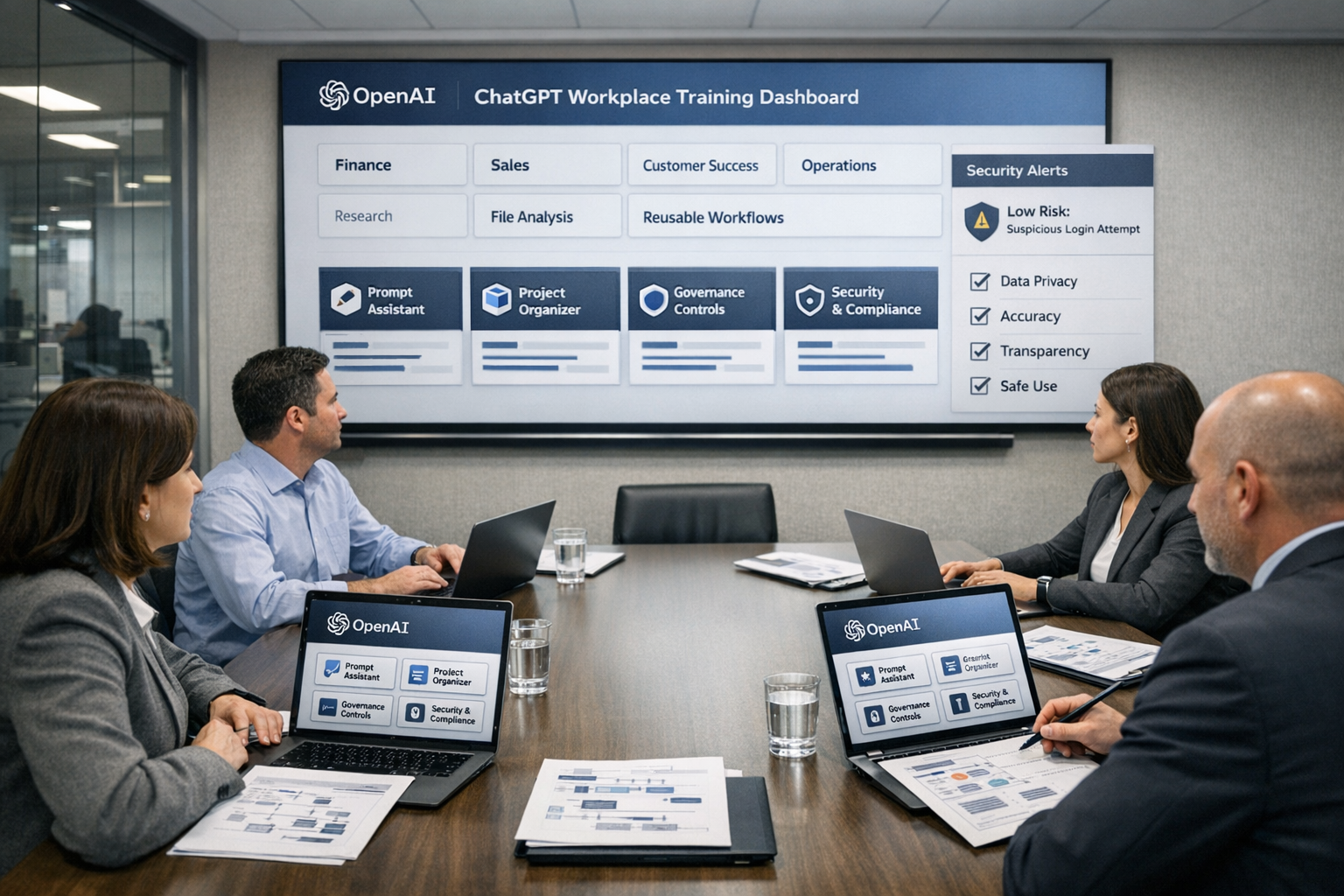
OpenAI Tries to Turn ChatGPT Use at Work Into a Repeatable System
OpenAI has released a sweeping set of workplace guides for ChatGPT, laying out how employees and managers can use the tool across a wide range of business tasks, from financial reporting and sales outreach to customer retention, data analysis and research.
The materials, published through OpenAI Academy and related company channels in early April, amount to more than a collection of tutorials. Taken together, they read like a playbook for broad adoption inside companies: how to begin using ChatGPT, how to write better prompts, how to organize projects and files, how to build reusable workflows, and how to apply the technology to specific roles and industries.
The push comes as OpenAI seeks to deepen its hold on the workplace, where it is increasingly competing not simply as a maker of advanced artificial intelligence models, but as a provider of day-to-day business software and institutional know-how. In February, the company said more than 9 million paying business users were relying on ChatGPT for work, a sign that corporate demand is moving beyond experimentation and into routine operations.
What is notable about the latest release is its breadth. The company published beginner-oriented materials explaining what A.I. is and how ChatGPT works, alongside practical guides on writing, brainstorming, analyzing data, working with files, generating images and conducting research with search and “deep research” tools. It also rolled out role-based instructions aimed at finance teams, marketers, sales staff, operations groups, managers and customer success teams, as well as industry-focused resources for healthcare and financial services.
In effect, OpenAI is trying to answer a question that has loomed over workplace A.I. adoption for the past two years: after the demo, what exactly should a company do next?
From Experiment to Procedure
For many businesses, generative A.I. adoption has so far been uneven. Individual workers have often found their own uses for chatbots, while executives have struggled to translate scattered enthusiasm into companywide systems that are safe, reliable and measurable.
The new OpenAI materials appear designed to close that gap. They emphasize repeatable patterns rather than one-off clever prompts: setting up projects to manage ongoing work, using files to analyze documents and spreadsheets, personalizing ChatGPT with instructions and memory, and creating custom GPTs or reusable “skills” to standardize outputs across recurring tasks.
That framing matters for enterprise buyers. Businesses have shown growing interest in using generative A.I. not just as a general assistant, but as a way to codify internal processes: preparing forecasts, drafting reports, summarizing meetings, researching accounts, planning campaigns and producing structured analyses that can be shared across teams.
The company’s role-specific guides reflect that shift. Finance teams are encouraged to use ChatGPT to streamline reporting and sharpen forecasts; sales teams to research accounts and personalize outreach; customer success teams to improve communication and reduce churn; managers to prepare feedback and stay organized; and operations groups to standardize workflows and speed execution.
OpenAI has also been steadily reinforcing the message that these uses can fit within regulated or high-stakes environments. The new resource push includes material for healthcare, where documentation and clinical support are a major target for A.I. vendors, and for financial services, where institutions are under pressure to modernize while meeting stringent compliance requirements.
Teaching the Tool, and the Rules
Just as important as the use cases is the governance language surrounding them.
Among the new materials are guides on responsible and safe use of A.I., accuracy, transparency and prompting fundamentals — a sign that OpenAI is trying to present adoption not as a free-form exercise, but as something that can be managed with policy and training. That is likely to resonate with corporate administrators who have spent months worrying about data leakage, hallucinations, inconsistent outputs and employee misuse.
OpenAI’s enterprise strategy has been evolving in this direction for some time. Earlier messaging focused heavily on security, privacy and business controls, as the company tried to distinguish workplace offerings from consumer chatbot use. The latest academy-style rollout adds a practical training layer: not only that businesses can use ChatGPT securely, but also how they can do so in concrete, repeatable ways.
That may be especially important now, as generative A.I. becomes embedded in ordinary knowledge work. Features like file analysis, reusable workflows and research tools move the product closer to a work platform, where success depends less on novelty than on reliability and habit.
A Security Reminder Alongside the Sales Pitch
The release of the workplace materials was accompanied by a very different kind of message: a security notice about what OpenAI described as the “Axios developer tool compromise.”
In a statement published April 10, the company said it had found no evidence that ChatGPT products were compromised or that user data had been exposed. It said no passwords, API keys or existing installations were affected. But it also said it was rotating macOS app-signing certificates and requiring users to update affected Mac applications.
Even without evidence of customer harm, the notice underscored how central trust has become to OpenAI’s enterprise ambitions. As A.I. tools move deeper into business processes, buyers are evaluating not only model performance but also software supply-chain risks, desktop app integrity and incident response.
For large organizations, that kind of operational discipline can matter as much as the model itself. Security teams increasingly want assurances that vendors can detect compromises, communicate clearly and contain potential fallout quickly. OpenAI’s decision to pair an expansive workplace-education campaign with a visible security response, however coincidental in timing, highlighted the two tracks on which enterprise adoption now depends: usefulness and trust.
The Larger Bet
There are still open questions about the scope of this rollout. Some of the pages mix newer 2026 materials with resources that have been available in earlier forms, making it difficult to tell how much is genuinely new and how much is a repackaging of existing features for a larger audience. It is also unclear how quickly companies will turn these guides into organizationwide practices rather than leaving them as optional reading for curious employees.
But the direction of travel is becoming clearer.
OpenAI is no longer behaving like a company that expects users to discover the workplace value of A.I. on their own. It is trying to define the best practices itself — by function, by industry and by workflow — and in doing so, to make ChatGPT feel less like an experimental assistant and more like standard office infrastructure.
That shift matters because the next phase of the A.I. race may be decided not only by who builds the strongest model, but by who makes that model easiest for businesses to deploy, govern and trust.
Sources
Further reading and reporting used to add context:
- https://openai.com/index/axios-developer-tool-compromise/
- https://openai.com/index/chatgpt-for-excel/
- https://openai.com/index/introducing-deep-research/
- https://openai.com/index/zenken
- https://openai.com/ar/news/
- https://openai.com/index/1-million-businesses-putting-ai-to-work/
- https://openai.com/index/introducing-chatgpt-enterprise/
- https://openai.com/index/introducing-openai-frontier/
- https://openai.com/index/accenture-partnership/
- https://openai.com/business/put-ai-to-work-automate-and-scale-financial-operations/
- https://openai.com/index/one-in-a-million-customers/
- https://openai.com/index/scaling-ai-for-everyone//
- https://cdn.openai.com/pdf/d5eb7428-c4e9-4a33-bd86-86dd4bcf12ce/GDPval.pdf?_bhlid=032d03cdc21c768f9824f9841b613c0b57764ca3
- https://cdn.openai.com/global-affairs/61b341bc-56eb-46dc-b356-a621e02cb82d/openai-australia-economic-blueprint-july-2025.pdf
- https://cdn.openai.com/pdf/3c7f7e1b-36c4-446b-916c-11183e4266b7/chatgpt-usage-and-adoption-patterns-at-work.pdf
- https://cdn.openai.com/pdf/small-business-jam-report-dec-2025.pdf
- https://cdn.openai.com/signals/openai-signals-global-report.pdf
- https://academy.openai.com/en/public/videos/market-research-with-chatgpt-2025-04-11
- https://academy.openai.com/en/public/videos/chatgpt-for-research-web-search-deep-research-and-code-2025-06-04
- https://academy.openai.com/en/public/clubs/work-users-ynjqu/resources/use-cases-for-managers
- https://academy.openai.com/en/public/videos/deep-research-2025-03-11
- https://academy.openai.com/home/videos/deep-research-2025-03-11
- https://academy.openai.com/public/videos/deep-research-2025-03-11
- https://academy.openai.com/public/resources/skills
- https://openai.com/index/asu/
- https://academy.openai.com/public/videos/using-chatgpt-for-prospecting-and-donor-research
- https://help.openai.com/en/articles/6825453-chatgpt-release-notes%3F.ejs
- https://openai.com/index/introducing-gpt-5-3-codex/
- https://help.openai.com/en/articles/6825453-chatgpt-release-notes%3F.class
- https://academy.openai.com/en/public/clubs/work-users-ynjqu/resources/use-cases-finance
- https://academy.openai.com/public/clubs/work-users-ynjqu/resources/use-cases-customer-success
- https://academy.openai.com/public/clubs/work-users-ynjqu/resources/finserv
- https://academy.openai.com/public/videos/getting-started-with-chatgpt-edu-2025-05-06
- https://academy.openai.com/en/public/clubs/work-users-ynjqu/resources/chatgpt-102-webinar-resource-guide-interactive
- https://academy.openai.com/public/clubs/work-users-ynjqu/resources/chatgpt-102-webinar-resource-guide-interactive
- https://academy.openai.com/en/public/videos/k-12-chatgpt-for-education-101
- https://academy.openai.com/home/videos/getting-started-chatgpt-govt
- https://academy.openai.com/public/videos/k-12-chatgpt-for-education-101
- https://academy.openai.com/public/clubs/work-users-ynjqu/resources/chatgpt-101-webinar-resource-guide-interactive
- https://academy.openai.com/en/public/clubs/work-users-ynjqu/resources/chatgpt-101-webinar-resource-guide-interactive
- https://academy.openai.com/home/clubs/work-users-ynjqu/resources/chatgpt-102-webinar-resource-guide-interactive/
- https://academy.openai.com/public/clubs/work-users-ynjqu/resources/chatgpt-101-webinar-resource-guide-interactive/
- Content | OpenAI Academy
- https://academy.openai.com/?_bhlid=09701e3caa2b6d9dec84104c5e8fccc4311c1dc5
- https://academy.openai.com/home/clubs/work-users-ynjqu/resources/working-with-files/
- https://academy.openai.com/en/public/clubs/india-gkubq/videos/chatgpt-for-research-web-search-deep-research-and-code-2025-06-04
- https://academy.openai.com/public/clubs/india-gkubq/videos/chatgpt-for-research-web-search-deep-research-and-code-2025-06-04
- https://academy.openai.com/en/public/clubs/india-gkubq/videos/chatgpt-for-research-web-search-deep-research-and-code-hindi-2025-06-04
- https://academy.openai.com/public/clubs/india-gkubq/videos/chatgpt-for-research-web-search-deep-research-and-code-hindi-2025-06-04
- https://academy.openai.com/en/public/videos/chatgpt-workflow-keeping-up-with-client-communications-2025-11-18
- Scaling AI for everyone | OpenAI
- Introducing ChatGPT Enterprise | OpenAI
- ChatGPT fundamentals – Resource | OpenAI Academy










Leave a Reply