
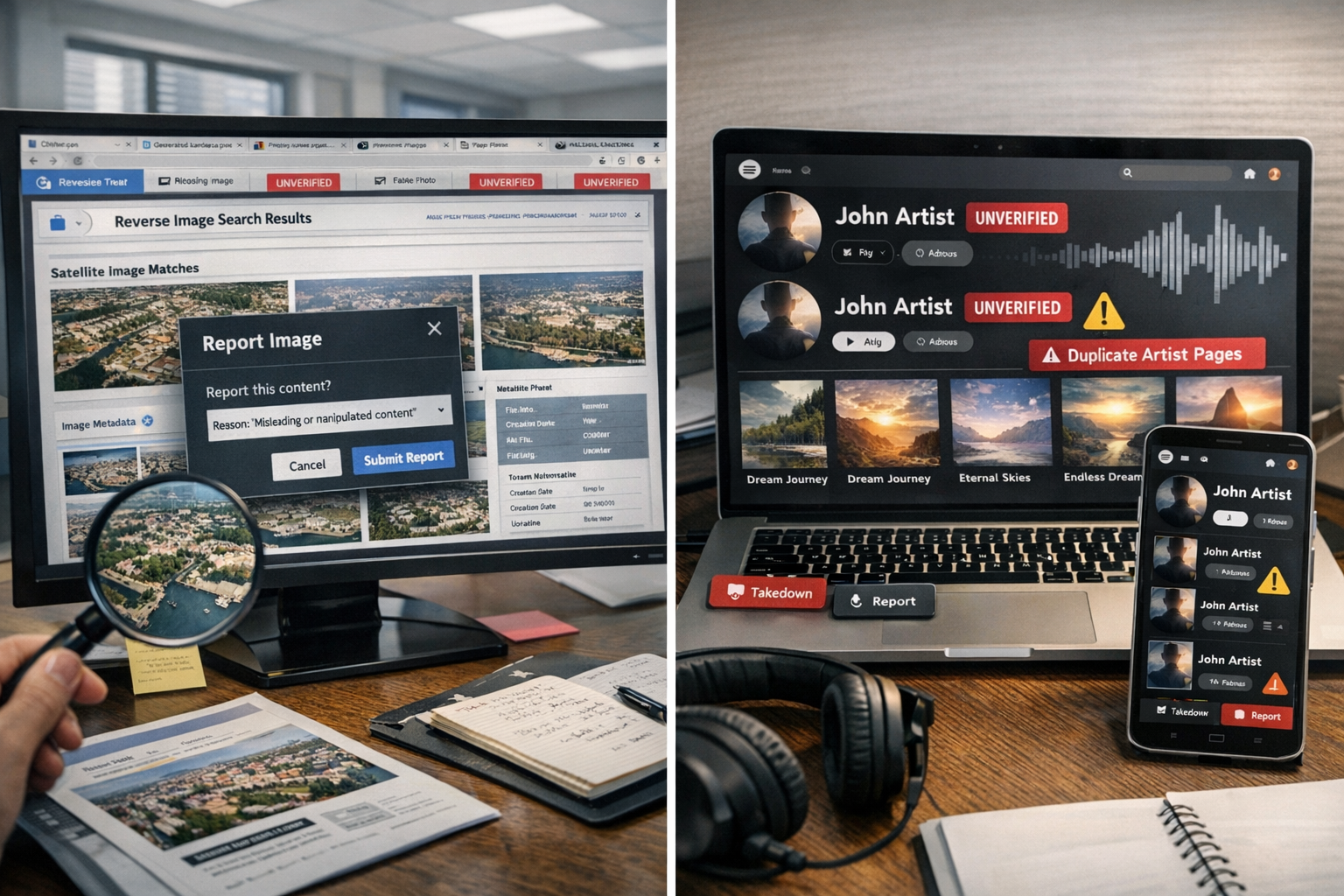
The internet’s trust problem is no longer confined to viral hoaxes
The crisis over what, exactly, can be trusted online is spreading well beyond doctored photos and political deepfakes. It is now reaching the infrastructure people use to verify reality itself — and, in a striking parallel, the music platforms where artists are discovering songs they never made posted under their own names.
New reporting has underscored a widening authenticity gap across the internet. Investigators and fact-checkers say the tools that once helped establish what was real are struggling against a flood of AI-generated and AI-edited material. At the same time, musicians are confronting a surge of impersonation on streaming services, where synthetic tracks can siphon attention, confuse fans and, in some cases, capture royalties meant for real artists.
Taken together, the developments suggest that the next phase of the AI era may be defined less by spectacular deception than by everyday uncertainty: the slow erosion of confidence in images, audio, search results and even artist identities.
Verification is getting harder just as deception gets easier
For years, online verification relied on a patchwork of methods: metadata, reverse-image searches, geolocation, witness accounts and access to primary records like satellite images. But researchers and investigators now say that system is under strain from several directions at once.
One problem is scale. The volume of synthetic media has exploded, making manual verification slower and more expensive. Another is technical sophistication. Rather than producing obviously fake material, newer systems can create “hybrid” manipulations — authentic images altered in subtle ways, or real audio cleaned, spliced and revoiced — that are harder to detect than earlier generations of AI slop.
There is also a growing access problem. As some commercial satellite imagery becomes more restricted, investigators lose one of the most important independent tools for confirming events on the ground. At the same time, bot traffic and low-quality synthetic content are increasingly polluting the web, making search and open-source verification less reliable.
The result is not simply that more fakes exist. It is that the mechanisms for disproving them are weakening.
That shift matters because online trust has long depended on being able to inspect evidence after the fact. If that evidence becomes inaccessible, degraded or overwhelmed by machine-generated noise, verification turns into a slower, more forensic exercise — one that ordinary users, and often even professionals, cannot perform in real time.
In music, artists are finding counterfeit versions of themselves
The same trust breakdown is now playing out on streaming services.
Musicians have begun reporting fake releases uploaded under their names, with AI tools making it easier to generate plausible soundalikes and mass-produce tracks at low cost. Among them is the jazz pianist and composer Jason Moran, who learned from a friend that a supposed new record bearing his name had appeared on Spotify, even though he had not made it.
The problem builds on an older scourge in the industry: streaming fraud. For years, bad actors have used fake accounts, fabricated tracks and bot-driven listening to manipulate payouts. Generative AI has accelerated that model by making it easier to create huge volumes of music-like content, attach recognizable names or styles to it, and flood platforms faster than moderation systems can respond.
The scale is substantial. Deezer said in January that roughly 39 percent of its daily uploads were fully AI-generated. The company also said that up to 85 percent of streams on AI-generated music detected on its service were fraudulent and had been demonetized.
American prosecutors have already described how lucrative the model can become. In a 2024 Justice Department case, authorities said a scheme involving AI-generated songs and bots produced billions of fake streams and more than $10 million in fraudulent royalties.
For working musicians, the consequences are not abstract. A fake release can mislead listeners, damage reputations, crowd search results and divert revenue. And because takedowns often begin only after an artist or fan spots the impersonation, the burden can fall on the people being copied.
Platforms are tightening rules, but cleanup remains reactive
Streaming services have not ignored the threat. Spotify says unauthorized voice cloning is prohibited and that artists must have channels to challenge impersonation claims. In late 2025, the company announced stronger anti-impersonation protections along with filters aimed at spam uploads and mass-produced “slop.”
But enforcement remains difficult at scale. A platform may remove a counterfeit track once it is reported, yet the larger challenge is preventing an endless cycle of new uploads, slight variations and fresh accounts. As with misinformation elsewhere online, moderation often becomes case-by-case cleanup after the fact.
That reactive posture mirrors the broader internet’s difficulty with AI authenticity. By the time a piece of media is flagged, copied, disputed and debunked, it may already have circulated widely. And where the deception is less dramatic — a fake album page, an altered image, a misleading clip — the harm may be cumulative rather than viral, wearing down confidence through repetition.
The hoped-for fix — proving origin at creation — is still incomplete
Some technologists argue that the answer is not better fake-spotting, but stronger proof of provenance from the start.
That idea has coalesced around standards such as C2PA, which is designed to let media carry attached records about where it came from and how it was edited. Adobe’s Content Credentials system, one of the highest-profile efforts in this area, is now in public beta and includes verified identity features intended to help establish authorship and editing history.
In theory, such tools could shift the burden from endlessly detecting manipulated content to confirming authentic content at the moment of creation. In practice, their usefulness depends on broad adoption across cameras, editing software, phones, social platforms and search systems.
That has not yet happened.
Without wide deployment, provenance markers risk becoming a niche signal inside a much larger ecosystem that still strips metadata, recompresses files and rewards frictionless sharing over traceable origins. Even a robust standard would not solve every case: legacy media, anonymous whistleblower material and countless ordinary uploads would still circulate without trusted credentials.
Why this moment matters
The significance of the current wave lies in how many layers of the digital world it touches at once. News verification, platform moderation, music distribution and online search all increasingly depend on systems built for an era when falsification was costlier and easier to spot.
Now synthetic content is cheap, abundant and often good enough to pass initial scrutiny. Meanwhile, the evidentiary tools used to challenge it are fragmented, restricted or overwhelmed.
That leaves a growing mismatch between the speed of creation and the speed of verification. The public encounters content instantly; authenticity is established, if at all, later.
In that gap, trust decays. A photo may be real but doubted. A song may be fake but streamed. An artist may have to prove that a release carrying his own name is not his. And the internet, once built on the promise of limitless access to information, begins to feel less like a record of reality than a contest over who can authenticate it.
The deeper question is whether the online world can still build a reliable trust layer before the burden of proof shifts entirely onto users, artists and investigators. For now, the answer remains unsettled — and the impersonators are moving faster than the systems meant to stop them.
Sources
Further reading and reporting used to add context:
- How the Internet Broke Everyone’s Bullshit Detectors | WIRED
- https://www.reddit.com/r/technology/comments/1sj4i87/how_the_internet_broke_everyones_bullshit/
- https://www.forbes.com/councils/forbesbusinesscouncil/2026/02/19/ai-driven-impersonation-and-the-collapse-of-digital-trust/
- https://www.forbes.com/sites/digital-assets/2026/02/26/ai-is-now-building-itself-yet-the-verification-layer-is-missing/
- https://medium.com/%40veritaschain/eight-things-happened-this-week-that-prove-ai-companies-still-cannot-prove-what-they-refused-to-763f102a225b
- https://www.forbes.com/councils/forbesbusinesscouncil/2025/12/30/the-year-authenticity-breaks-deepfakes-ai-and-the-battle-for-trust-in-2026/
- https://authenticitycrisis.com/signal
- https://www.sdcexec.com/software-technology/ai-ar/news/22962247/hypr-ai-automation-to-combat-rising-impersonation-threats-study
- https://www.reddit.com/r/u_Acuitytec-global/comments/1rz8m7a/the_deepfake_threat_isnt_coming_its_already/
- https://arxiv.org/abs/2602.02100
- https://digidai.github.io/2026/03/21/ai-recruiting-trust-crisis-deepfakes-identity-verification-arms-race/
- https://business.observernewsonline.com/observernewsonline/article/tokenring-2025-12-11-the-unsettling-dawn-of-synthetic-reality-deepfakes-blur-the-lines-challenge-trust-and-reshape-our-digital-world
- https://www.deloitte.com/us/en/insights/topics/talent/human-capital-trends/2026/managing-disinformation-at-scale.html
- https://authenticitycrisis.com/
- https://truthscan.com/blog/cs/generative-ai-the-new-frontier-of-fraud-in-identity-verification-2025/
- https://en.wikipedia.org/wiki/AI_slop
- https://newsroom.spotify.com/2025-09-25/spotify-strengthens-ai-protections/
- ‘It has your name on it, but I don’t think it’s you’: how AI is impersonating musicians on Spotify | AI (artificial intelligence) | The Guardian
- https://www.noypigeeks.com/spotlight/ai-generated-music-streams-deezer-fake/
- Music that impersonates another artist's voice – Spotify
- https://www.musicradar.com/music-industry/slop-of-the-pops-over-30-000-ai-generated-tracks-are-being-uploaded-to-deezer-every-single-day
- https://www.musicradar.com/artists/bands/seriously-wtf-we-are-truly-doomed-king-gizzard-leave-spotify-only-to-be-replaced-by-fake-ai-band-called-king-lizard-wizard
- (EN) Deezer Press Release AI Tool Anniversary – 2026-01-
- https://apnews.com/article/01bb3ef5a344045a64a0a7004e88df5b
- https://www.techradar.com/audio/audio-streaming/any-use-of-ai-tools-to-impersonate-other-artists-or-styles-is-strictly-prohibited-bandcamp-just-showed-spotify-how-easy-it-is-to-ban-ai-slop
- https://www.reddit.com/r/deezer/comments/1leb7z8
- https://www.deezer-investors.com/wp-content/uploads/2025/07/Deezer-H1-25-Results-Presentation-FINAL.pdf
- https://www.datagrom.com/ai-news/ai-bots-impersonate-real-musicians-on-spotify-17430434
- https://en.wikipedia.org/wiki/Deezer
- https://www.datagrom.com/ai-news/deezer-tackles-ai-music-fraud-with-new-labels.html
- https://www.reddit.com/r/BlackboxAI_/comments/1lehof0
- https://www.finanzwire.com/article/deezer-unveils-ai-tagging-to-identify-ai-generated-music-vzvPIc0BVTi
- https://live.euronext.com/sites/default/files/company_press_releases/attachments/2025/04/17/cpr03_lesechos_16165_1328325_EN_Deezer_Press_Release_AI_Tool_18__20250416_1.pdf
- https://ongoingnow.com/deep-dive/ai-generated-music-ignites-streaming-fraud-storm/
- https://www.reddit.com/r/deezer/comments/1jg8cer
- https://popularaitools.ai/blog/can-spotify-detect-ai-music/
- https://www.reddit.com/r/fivethirtyeight/comments/1po5qp5/ipsosdeezer_research_34_of_all_new_music_is_fully/
- https://www.space.com/space-exploration/satellites/it-probably-will-start-a-precedent-why-satellite-companys-withholding-of-iran-imagery-has-this-expert-worried
- https://www.aljazeera.com/news/2026/4/5/us-satellite-firm-planet-labs-announces-blackout-on-war-on-iran-images
- https://www.washingtonpost.com/national-security/2026/03/11/satellite-images-middle-east-iran/
- https://blackwire.world/articles/planet-labs-blackout-iran-internet-war-april-2026.html
- https://blog.adobe.com/en/publish/2025/04/24/adobe-content-authenticity-now-public-beta-helps-creators-secure-attribution
- https://apnews.com/article/0c3fff14d4f2be3cc7931c076d68a0de
- https://helpx.adobe.com/creative-cloud/apps/adobe-content-authenticity/customization.html
- https://c2pa.org/about/
- C2PA | Verifying Media Content Sources
- https://news.adobe.com/news/2024/10/aca-announcement
- https://satnews.com/2026/04/05/planet-labs-imposes-indefinite-blackout-on-iran-satellite-imagery-at-u-s-request/
- https://blog.adobe.com/en/publish/2024/10/08/introducing-adobe-content-authenticity-free-web-app-help-creators-protect-their-work-gain-attribution-build-trust
- https://apnews.com/article/4b5edabf4c8cc89a56150ca4f1b7c06f
- https://apnews.com/article/004f246d084871c4e2460a9baf786506
- https://techcrunch.com/2025/04/24/adobe-wants-to-create-a-robots-txt-styled-indicator-for-images-used-in-ai-training/
- https://www.forbes.com/sites/moorinsights/2024/10/16/adobe-debuts-free-web-app-to-fight-misinformation-and-protect-creators/
- https://www.reddit.com/r/Intelligence/comments/1sd38dd/planet_labs_indefinitely_withholds_iran_war/
- https://www.lemonde.fr/en/international/article/2026/03/06/war-in-iran-verified-images-show-scale-of-tehran-s-response-and-wide-range-of-targets_6751146_4.html
- https://iptc.org/download/events/phmdc2025/IPTC-PHMDC-2025-Brendan_Quinn-C2PA.pdf
- https://www.reddit.com/r/PlanetLabs/comments/1rn97ou/planet_labs_pauses_imagery_after_revealing_irans/
- https://www.reddit.com/r/PlanetLabs/comments/1sco7g5/planet_labs_indefinitely_withholding_imagery_from/
- Southern District of New York | North Carolina Musician Charged With Music Streaming Fraud Aided By Artificial Intelligence | United States Department of Justice
- https://www.yahoo.com/news/articles/first-us-case-ai-driven-155938128.html
- https://www.yahoo.com/news/musician-charged-wire-fraud-using-165455105.html
- https://www.techradar.com/audio/audio-streaming/sony-removes-a-staggering-135-000-deepfake-songs-from-music-streaming-services-but-labelling-ai-material-is-absolutely-the-next-critical-challenge
- https://as.com/actualidad/sociedad/crea-miles-de-canciones-con-ia-las-infla-con-bots-y-acaba-millonario-y-detenido-el-gran-fraude-del-streaming-f202603-n/
- https://techcrunch.com/2026/01/29/deezer-makes-it-easier-for-rival-platforms-to-take-a-stance-against-ai-generated-music/
- https://www.lemonde.fr/en/culture/article/2026/03/29/ai-generated-music-has-the-industry-at-a-loss_6751920_30.html
- https://www.loudersound.com/music/fraudster-earns-million-of-dollars-streaming-ai-songs-no-human-listens-to
- https://news.bloomberglaw.com/litigation/man-charged-with-illegally-boosting-music-streaming-royalties
- https://nationaltoday.com/us/ny/new-york/news/2026/03/21/north-carolina-man-pleads-guilty-to-8-million-streaming-fraud-using-ai-generated-songs-and-bots/
- https://www.yahoo.com/news/man-ai-song-catalog-defrauds-190602855.html
- https://www.digitalmusicnews.com/2024/09/04/music-streaming-fraud-indictment-september-2024/
- https://www.foxbusiness.com/technology/man-charged-using-bots-stream-ai-generated-songs-10m-royalties
- https://www.opindia.com/2024/09/us-man-arrested-for-creating-ai-music-of-fake-bands-minting-over-10m-in-streaming-scam/
- https://www.lewissilkin.com/en/insights/2024/12/17/ai-hits-a-sour-note-in-us-streaming-fraud-lawsuit
- https://en.wikipedia.org/wiki/Music_Fights_Fraud_Alliance
- https://edm.com/news/man-pleads-guilty-ai-music-fraud-8-million-stolen-royalties








Leave a Reply