
From coding helper to workplace agent
Artificial intelligence tools that once lived mainly inside programmers’ editors are beginning to move into a broader role across corporate work, as OpenAI expands Codex beyond code completion and Apple retrains engineers on how to work alongside AI coding systems.
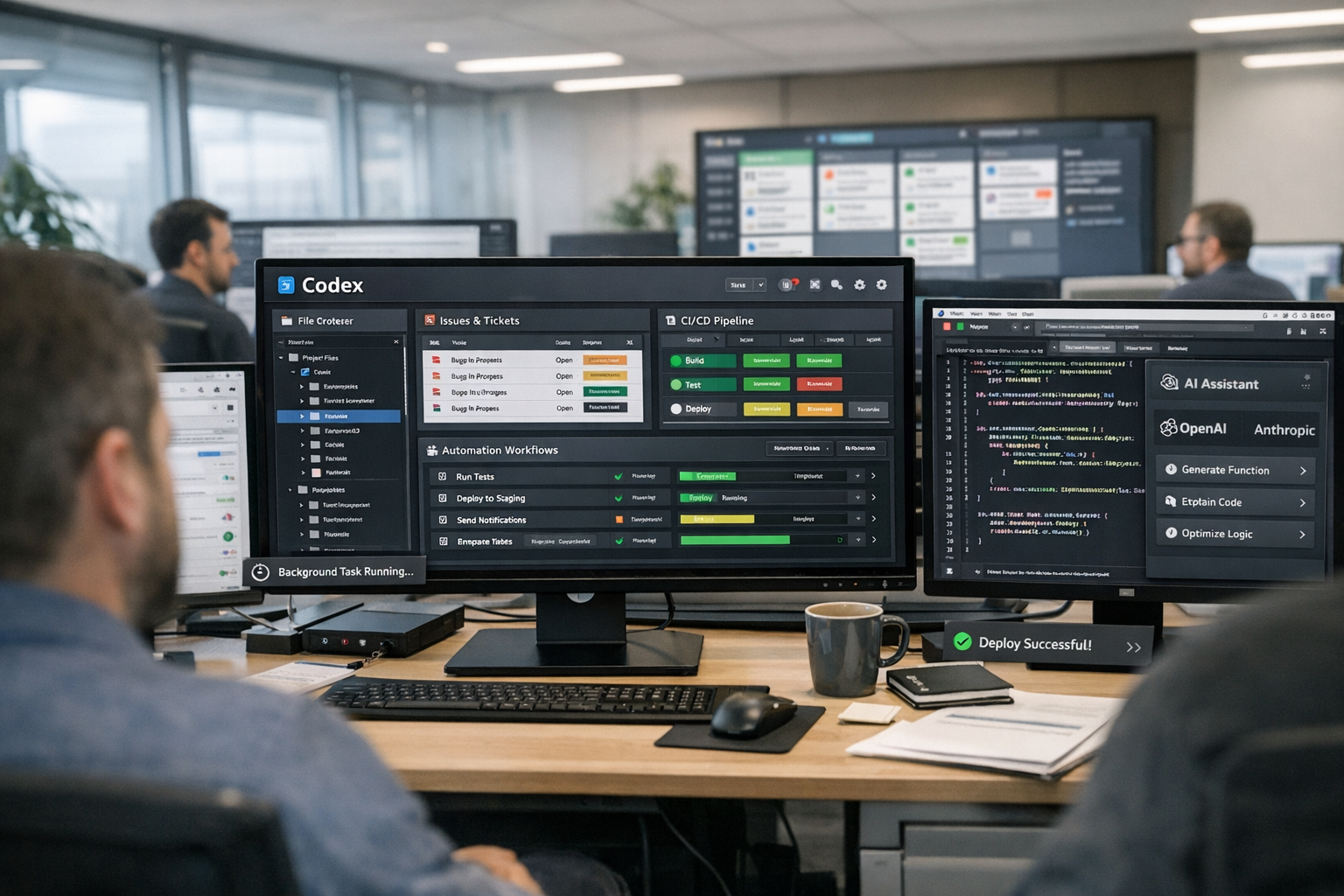
OpenAI said its updated Codex app for macOS and Windows can now use a computer more directly, browse within the app, generate images, remember user preferences and tap plugins — part of a larger push to make the product less of a chatbot for snippets of code and more of an agent that can keep working in the background. Recent product materials describe parallel multi-agent workflows and automations designed for “always-on” background work, suggesting the company wants Codex to handle not just writing software, but also the surrounding chores of modern engineering.
At nearly the same time, Apple has reportedly begun sending some Siri engineers to a multi-week bootcamp focused on AI coding tools, including OpenAI’s Codex and Anthropic’s Claude Code. The move, affecting fewer than 200 engineers, is a notable signal from a company long known for tightly controlled engineering processes and cautious adoption of new tools.
Taken together, the developments point to a broader shift: AI coding agents are being recast from niche developer products into everyday workplace infrastructure.
A wider ambition for OpenAI
OpenAI has been steadily broadening what Codex is supposed to be. In February, when it introduced GPT-5.3-Codex, the company framed the system as useful across much more of the software life cycle, extending beyond code generation into other desktop tasks. The latest changes push that idea further.
The company is now pitching Codex for issue triage, documentation, monitoring, CI/CD workflows and parallel execution of projects — work that touches project management, operations and team coordination as much as software engineering itself. In effect, OpenAI is arguing that the value of AI in programming lies not only in producing code faster, but in absorbing some of the constant background labor that slows teams down.
That matters because software companies have increasingly found that the bottleneck is not always writing the first draft of a function. It is reviewing, testing, debugging, documenting, deploying and keeping projects moving across multiple systems and teams. An AI agent that can persist on tasks, remember context and interact with a desktop environment is aimed squarely at that broader set of frictions.
OpenAI has also been laying the groundwork for enterprise use. Last October, the company said Codex had become integral internally, with nearly all of its engineers using it, and with workspace controls and analytics available for administrators deploying it across organizations. The latest additions extend that enterprise pitch, though they also raise fresh questions about governance, monitoring and security when an “always-on” system is granted wider access to screens, apps and workflows.
Apple’s retraining effort carries its own message
Apple’s reported Siri bootcamp is, in some ways, even more revealing than OpenAI’s product update.
The company has been under mounting pressure over Siri after delaying the more advanced capabilities it previewed at its 2024 developers conference. By WWDC 2025, Apple said those features would slip to 2026 because reliability was not yet good enough. The delays prompted management changes in its A.I. organization and sharpened questions about whether Apple was moving quickly enough in generative A.I.
Against that backdrop, training Siri engineers to use agentic coding tools looks less like a side experiment and more like an operational response. Apple had already moved in this direction earlier this year, adding support in Xcode 26.3 for OpenAI’s Codex and Anthropic’s Claude directly inside its development environment. The reported bootcamp suggests the company is now trying to change not just the tools available to engineers, but the habits and workflows of the teams building one of its most scrutinized products.
For Apple, that is significant. The company has often preferred to build and polish internally rather than reorganize around emerging industry practices. A formal effort to train engineers on outside A.I. coding agents implies that such tools are no longer viewed as optional productivity aids for enthusiasts, but as part of the core method of getting work done.
Why this matters now
The rapid spread of A.I. coding tools over the last year has already changed the daily routines of many developers. What is changing now is the scope of ambition.
Instead of presenting these systems as assistants that answer a question when prompted, companies are increasingly presenting them as semi-autonomous agents that can monitor tasks, coordinate work in parallel and remain active over extended periods. In that model, coding becomes only one use case among many.
That shift has implications far beyond software teams. If A.I. agents can reliably handle repetitive workflow tasks around engineering, other office functions may be next: operations, support, internal documentation, quality assurance and project tracking. The line between “developer tool” and “enterprise software” begins to blur.
It also helps explain the intensity of competition. OpenAI’s expanded Codex arrives as rival systems, particularly Anthropic’s Claude Code, gain traction among programmers. Apple’s embrace of both tools inside Xcode suggests large companies may not want to bet on a single provider, especially for a capability that is fast becoming central to productivity.
Promise, pressure and unanswered questions
For all the momentum, it remains unclear how much of this will translate into sustained gains in real-world settings, especially in large code bases and safety-critical systems. Many engineers say A.I. tools can speed up drafting and routine tasks, but are less reliable when architecture, judgment and long-term maintenance are at stake.
OpenAI’s new “computer use” and always-on capabilities may prove powerful, but they also intensify concerns over security and oversight. Companies will need to decide how much authority to grant these systems, how to audit their actions and how to prevent mistakes from spreading across production environments.
At Apple, the unresolved question is more concrete: whether retraining and new tooling can materially accelerate Siri’s long-delayed overhaul. The company has said its more advanced Siri capabilities are now targeted for 2026. Whether that timetable holds may become an early test of how much these coding agents can truly change output, not just workflow rhetoric.
Still, the direction is increasingly clear. The latest moves from OpenAI and Apple suggest that A.I. coding agents are no longer being treated as clever sidekicks for software developers. They are being positioned as a new layer of workplace infrastructure — one that companies now seem to believe they cannot afford to ignore.
Sources
Further reading and reporting used to add context:
- https://www.techradar.com/pro/security/openai-flags-third-party-data-issue-all-macos-users-should-update-now
- Codex is now generally available | OpenAI
- https://www.tomshardware.com/tech-industry/artificial-intelligence/openai-lauches-gpt-53-codes-spark-on-cerebras-chips
- https://www.techradar.com/pro/github-integrates-claude-and-codex-ai-coding-agents-directly-into-github
- https://en.wikipedia.org/wiki/GPT-5.3-Codex
- https://www.techradar.com/pro/security/openai-releases-codex-security-to-spot-the-next-big-cyber-risks-to-your-company-promises-to-identify-complex-vulnerabilities-that-other-agentic-tools-miss
- https://academy.openai.com/en/home/videos/intro-to-codex-april-09-2026
- https://www.axios.com/2026/03/05/openai-gpt-54-chatgpt-office
- https://en.wikipedia.org/wiki/OpenAI_Codex_%28AI_agent%29
- https://openai.com/index/introducing-upgrades-to-codex/
- https://xaicontrol.com/en/blog/codex-for-almost-everything/
- https://news.aibase.com/news/27154
- https://juggerinsight.com/en/openai-codex-windows-security-gpt54-2026/
- https://www.reddit.com/r/codex/comments/1sgwlub/official_update_on_plans/
- https://www.reddit.com/r/codex/comments/1shkifk/fyi_codex_limits_dropped_by_half_after_the_2x/
- https://en.wikipedia.org/wiki/GPT-5.4
- https://www.theneuron.ai/explainer-articles/-around-the-horn-digest-everything-that-happened-in-ai-this-weekend-saturday-sunday-april-4-5-2026/
- https://fortune.com/2026/03/04/openai-codex-growth-enterprise-ai-agents//
- https://techcrunch.com/2025/06/11/apple-executives-say-new-ai-powered-siri-wasnt-demoware-it-just-wasnt-ready-to-ship/
- https://www.reddit.com/r/OpenaiCodex/comments/1r7mt8h/codex_horrible_ui_performance/
- https://www.reddit.com/r/codex/comments/1sbgxpq/codex_using_100_cpu_when_open/
- https://www.reddit.com/r/codex/comments/1sd3fgz/70_of_my_5hour_limit_vanishes_with_one_prompt/
- Introducing GPT-5.3-Codex | OpenAI
- https://arxiv.org/abs/2603.20847
- https://openai.com/research/index/release/
- https://tech.yahoo.com/ai/apple-intelligence/articles/apple-reportedly-plans-send-siri-235000504.html/
- https://openai.com/ru-RU/index/introducing-gpt-5-4-mini-and-nano/
- https://finance.sina.com.cn/jjxw/2026-04-16/doc-inhusenk7349458.shtml
- https://arxiv.org/abs/2603.17399
- https://arxiv.org/abs/2602.08915
- https://letsdatascience.com/news/apple-reassigns-siri-engineers-to-ai-coding-bootcamp-74532874
- https://platform.openai.com/docs/guides/tools-local-shell
- https://developers.openai.com/api/docs/models/gpt-5.1-codex
- https://medium.com/codex/why-senior-ios-engineers-are-going-indie-in-2026-real-data-be2ba00fef7c
- https://venturebeat.com/technology/apple-integrates-anthropics-claude-and-openais-codex-into-xcode-26-3-in-push
- https://forums.macrumors.com/threads/siri-engineers-sent-to-ai-coding-bootcamp-as-apple-prepares-to-deliver-siri-overhaul.2481045/
- https://arxiv.org/abs/2602.09540
- https://www.reddit.com/r/ClaudeAI/comments/1rlw1yw/i_havent_written_a_line_of_code_in_six_months/
- https://www.reddit.com/r/singularity/comments/1rdqm3s/its_going_to_be_painful_for_a_lot_of_people/
- https://www.reddit.com/r/Xcode/comments/1p3jd5z/there_is_no_way_that_apple_uses_the_ai_coding/
- https://www.reddit.com/r/buildinpublic/comments/1rygl9t/day_60_ios_launches_in_5_days_apple_just_put/
- https://www.reddit.com/r/ClaudeCode/comments/1ro61pg/losing_my_ability_to_code_due_to_ai/
- https://www.reddit.com/r/apple/comments/1smirru/siri_engineers_sent_to_ai_coding_bootcamp_as/
- https://www.reddit.com/r/ClaudeAI/comments/1ra3fiq/coding_for_20_years_here_is_my_honest_take_on_ai/
- https://www.reddit.com/r/ClaudeAI/comments/1qpfzqm/reality_check_on_ai_will_replace_software/
- https://cookbook.openai.com/examples/realtime_eval_guide
- https://openai.com/sv-SE/index/inside-our-in-house-data-agent/
- Codex | AI Coding Partner from OpenAI | OpenAI
- https://openai.com/ta-IN/codex/
- https://openai.com/hy-AM/index/inside-our-in-house-data-agent/
- https://openai.com/ja-JP/index/inside-our-in-house-data-agent/
- https://openai.com/zh-Hant/index/inside-our-in-house-data-agent/
- https://openai.com/id-ID/index/inside-our-in-house-data-agent/
- https://openai.com/bs-BA/index/inside-our-in-house-data-agent/
- https://openai.com/sw-KE/index/inside-our-in-house-data-agent/
- https://openai.com/zh-Hans-CN/index/inside-our-in-house-data-agent/
- https://openai.com/ur-IN/index/inside-our-in-house-data-agent/
- https://openai.com/fil-PH/index/inside-our-in-house-data-agent/
- https://cdn.openai.com/gpt-5-system-card.pdf
- https://deploymentsafety.openai.com/gpt-5-3-codex/gpt-5-3-codex.pdf
- https://cdn.openai.com/pdf/839e66fc-602c-48bf-81d3-b21eacc3459d/chatgpt_agent_system_card.pdf?trk=public_post_comment-text
- https://cdn.openai.com/pdf/23eca107-a9b1-4d2c-b156-7deb4fbc697c/GPT-5-3-Codex-System-Card-02.pdf
- https://www.business-standard.com/technology/tech-news/wwdc25-apple-confirms-delayed-ai-powered-siri-features-coming-in-2026-125061100511_1.html
- https://www.macrumors.com/2025/12/03/apple-removes-giannandrea-executive-page/
- https://www.theguardian.com/technology/2025/dec/01/apple-ai-chief-john-giannandrea-steps-down
- https://www.macworld.com/article/2813651/sorry-siri-fans-dont-expect-those-delayed-apple-intelligence-features-until-2026.html
- https://www.macrumors.com/2025/02/14/apple-intelligence-siri-overhaul-could-get-delayed/
- https://techcrunch.com/2025/12/01/apple-just-named-a-new-ai-chief-with-google-and-microsoft-expertise-as-john-giannandrea-steps-down/
- https://www.engadget.com/ai/apples-ai-infused-siri-may-not-show-up-until-spring-2026-221212681.html
- https://www.techradar.com/pro/microsoft-and-google-ai-veteran-to-replace-outgoing-apple-exec-john-giannandrea
- https://www.macrumors.com/2026/04/13/john-giannandrea-departs-apple-this-week/
- https://arstechnica.com/apple/2025/03/apple-reportedly-planning-executive-shake-up-to-address-siri-delays/
- https://apnews.com/article/865dfa575279c292bc729a2dfa4e1583
- https://www.tomsguide.com/phones/iphones/siri-2-0-release-window-just-tipped-in-new-report-heres-when-it-could-arrive
- https://www.macrumors.com/2025/04/11/apple-delayed-siri-features-this-fall/
- https://elpais.com/economia/2025-12-02/apple-ficha-a-un-ex-de-microsoft-y-google-como-nuevo-responsable-de-ia-para-recuperar-terreno-frente-a-sus-rivales.html
- https://omni.se/a/Pdr1KR
- https://fortune.com/article/apple-secret-robotics-ai-chief-siri-technology-shakeup/
- https://cincodias.elpais.com/smartlife/lifestyle/2025-06-09/las-grandes-ausencias-de-ios-26-wwdc-2025.html
- https://www.macrumors.com/2025/05/19/siri-to-take-a-backseat-at-wwdc/
- https://en.wikipedia.org/wiki/John_Giannandrea
- https://www.reddit.com/r/Applelntelligence/comments/1rxkmaa/removed/
- https://www.mactechnics.org/wp-content/uploads/2025/04/MacTech-NL-April-2025.pdf
- https://borelsigma.com/wp-content/uploads/2025/03/Wall-Street-Journal-.pdf
- https://en.wikipedia.org/wiki/Apple_Intelligence
- https://www.bernlieb.com/wp-content/uploads/2025/06/20250623-47f3fb621eec.pdf
- https://www.macrumors.com/2025/10/03/iphone-car-keys-to-expand/
- https://forums.macrumors.com/threads/siri-engineers-sent-to-ai-coding-bootcamp-as-apple-prepares-to-deliver-siri-overhaul.2481045/page-3
- https://forums.macrumors.com/threads/llm-siri-the-complete-guide-to-apples-ai-assistant-overhaul-coming-in-2026.2463853/
- https://www.macrumors.com/97/
- https://forums.macrumors.com/threads/the-macrumors-show-revamped-siri-delayed-again.2477654/
- https://www.macrumors.com/29/
- https://images.macrumors.com/article-new/2017/04/Qualcomm-Countersues-Apple.pdf
- https://forums.macrumors.com/threads/2458895
- https://www.macrumors.com/16
- https://www.macrumors.com/49/
- https://forums.macrumors.com/threads/apple-confirms-revamped-siri-is-still-coming-in-2026.2477617/
- https://forums.macrumors.com/threads/apple-plans-to-release-delayed-siri-apple-intelligence-features-in-spring-2026.2458895/
- https://images.macrumors.com/article-new/2020/01/PART-2018-548070V1.pdf
- https://www.apple.com/newsroom/2026/02/xcode-26-point-3-unlocks-the-power-of-agentic-coding/
- https://www.apple.com/es/newsroom/2026/02/xcode-26-point-3-unlocks-the-power-of-agentic-coding/
- https://developer.apple.com/documentation/xcode-release-notes/xcode-26_3-release-notes
- https://www.apple.com/fr/newsroom/2026/02/xcode-26-point-3-unlocks-the-power-of-agentic-coding/
- https://www.apple.com/la/newsroom/2026/02/xcode-26-point-3-unlocks-the-power-of-agentic-coding/
- https://www.apple.com/de/newsroom/2026/02/xcode-26-point-3-unlocks-the-power-of-agentic-coding/
- https://www.apple.com/cz/newsroom/2026/02/xcode-26-point-3-unlocks-the-power-of-agentic-coding/
- https://www.apple.com/no/newsroom/2026/02/xcode-26-point-3-unlocks-the-power-of-agentic-coding/
- https://developer.apple.com/documentation/updates/xcode
- https://developer.apple.com/documentation/xcode-release-notes/xcode-26-release-notes
- https://developer.apple.com/xcode/
- https://developer.apple.com/jp/hello/february26
- https://developer.apple.com/support/downloads/terms/apple-developer-agreement/Apple-Developer-Agreement-20250318-Italian.pdf
- https://developer.apple.com/streaming/Diff-draft-18-with-prelim-19.pdf
- https://developer.apple.com/support/downloads/terms/exhibits/Exhibits-to-Schedule-2-and-3-Italian.pdf
- https://developer.apple.com/support/downloads/terms/apple-developer-agreement/Apple-Developer-Agreement-20240610-English.pdf
- https://developer.apple.com/metal/MetalCIKLReference6.pdf
- https://openai.com/it-IT/index/introducing-the-codex-app/
- https://help.openai.com/en/articles/6825453-memory-in-chatgpt
- https://openai.com/index/introducing-the-codex-app/
- https://help.openai.com/zh-hant/articles/6825453-chatgpt-%25E7%2589%2588%25E6%259C%25AC%25E6%259B%25B4%25E6%2596%25B0%25E8%25AA%25AA%25E6%2598%258E
- https://help.openai.com/ru-ru/articles/6825453-chatgpt-%D0%B7%D0%B0%D0%BC%D0%B5%D1%82%D0%BA%D0%B8-%D0%BE-%D0%B2%D1%8B%D0%BF%D1%83%D1%81%D0%BA%D0%B5
- https://developers.openai.com/codex/community/meetups
- https://openai.com/index/introducing-codex/
- https://developers.openai.com/
- https://help.openai.com/zh-hant/articles/6825453-chatgpt-%E7%99%BC%E8%A1%8C%E8%AA%AA%E6%98%8E
- https://developers.openai.com//
- https://platform.openai.com/docs/guides/tools-computer-use
- https://cdn.openai.com/pdf/ac7c37ae-7f4c-4442-b741-2eabdeaf77e0/oai_5_2_Codex.pdf
- https://cdn.openai.com/pdf/2a7d98b1-57e5-4147-8d0e-683894d782ae/5p1_codex_max_card_03.pdf
- https://cdn.openai.com/pdf/97cc5669-7a25-4e63-b15f-5fd5bdc4d149/gpt-5-codex-system-card.pdf
- https://cdn.openai.com/pdf/8df7697b-c1b2-4222-be00-1fd3298f351d/codex_system_card.pdf
- https://platform.openai.com/docs/deprecations/2023-03-20-codex-models.doc
- https://help.openai.com/ja-jp/articles/6825453-chatgpt-%E3%83%AA%E3%83%BC%E3%82%B9%E3%83%8E%E3%83%BC%E3%83%88
- https://help.openai.com/zh-hans-cn/articles/10128477-chatgpt-enterprise-edu-%25E5%258F%2591%25E5%25B8%2583%25E8%25AF%25B4%25E6%2598%258E
- https://help.openai.com/en/articles/6825453-chatgpt-code-interpreter-beta-
- https://help.openai.com/ru-ru/articles/6825453-chatgpt-%D0%BF%D1%80%D0%B8%D0%BC%D0%B5%D1%87%D0%B0%D0%BD%D0%B8%D1%8F-%D0%BA-%D0%B2%D1%8B%D0%BF%D1%83%D1%81%D0%BA%D1%83
- https://help.openai.com/ru-ru/articles/10128477-chatgpt-enterprise-amp-edu-%25D0%25BF%25D1%2580%25D0%25B8%25D0%25BC%25D0%25B5%25D1%2587%25D0%25B0%25D0%25BD%25D0%25B8%25D1%258F-%25D0%25BA-%25D0%25B2%25D1%258B%25D0%25BF%25D1%2583%25D1%2581%25D0%25BA%25D1%2583
- https://openai.com/index/introducing-gpt-5-3-codex/
- https://openai.com/index/introducing-gpt-5-3-codex-spark/
- https://cdn.openai.com/11998be9-5319-4302-bfbf-1167e093f1fb/Native_Image_Generation_System_Card.pdf
- https://9to5mac.com/2026/04/15/report-apple-to-send-siri-engineers-to-multi-week-ai-coding-bootcamp/
- https://omni.se/apple-skickar-siri-teamet-pa-ai-bootcamp/a/43OKX6
- https://www.techradar.com/pro/openai-releases-a-windows-version-of-codex-coding-app
- https://tech.yahoo.com/ai/chatgpt/articles/openai-super-app-takes-shape-204306867.html
- https://openai.com/index/introducing-the-codex-app//
- https://www.apple.com/newsroom/2025/06/apple-supercharges-its-tools-and-technologies-for-developers/
- https://www.cultofmac.com/news/apple-sends-siri-developers-to-ai-coding-bootcamp
- https://openai.com/index/unlocking-the-codex-harness/
- https://techcrunch.com/2025/05/16/openai-launches-codex-an-ai-coding-agent-in-chatgpt/
- https://www.reddit.com/r/codex/comments/1qu3646/introducing_the_codex_app/
- https://en.wikipedia.org/wiki/Worldwide_Developers_Conference
- https://www.reddit.com/r/codex/comments/1sb1b0v/anyone_else_got_this_email_from_openai/



Leave a Reply