
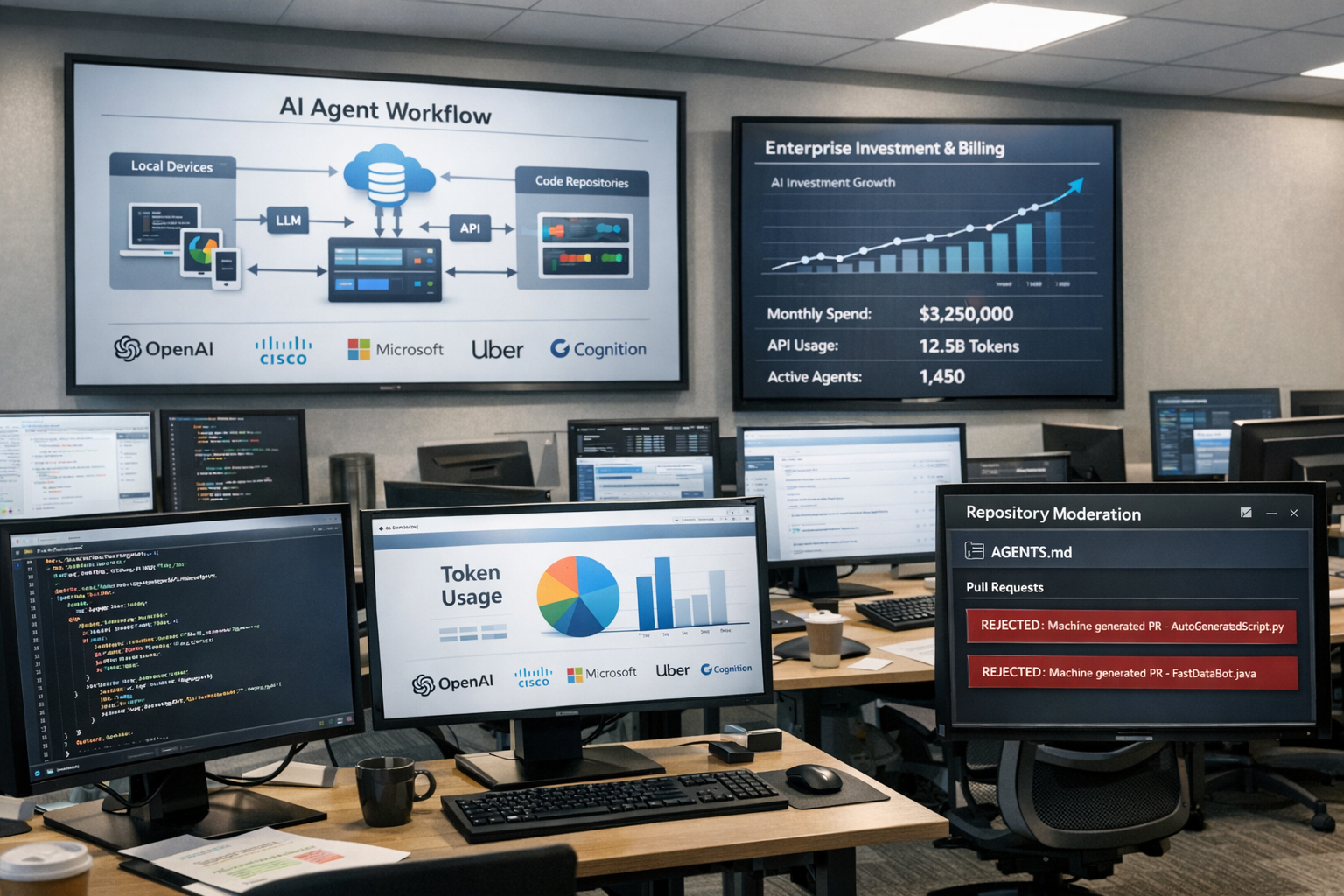
The race to make A.I. agents into enterprise workers is accelerating
The contest to turn artificial intelligence from a coding assistant into a salaried-seeming digital co-worker is entering a more consequential phase.
In recent days, OpenAI has promoted a string of examples meant to show that its Codex product is moving beyond one-off demos and into real business processes: Cisco using it inside enterprise engineering, a tax-preparation system built with partners that improves through repeated use, and Warp deploying OpenAI models to coordinate coding agents across local machines, cloud environments and open-source workflows.
Anthropic, OpenAI’s chief rival in the market for coding agents, has been making a parallel case. The company has highlighted engineering work to make Claude Code more reliable and responsive after users complained this spring that quality had slipped. It has also raised usage limits after securing additional compute capacity, a sign both of demand and of the infrastructure burden these systems still impose.
And investors, for now, are rewarding the category’s momentum. Cognition, the maker of the A.I. coding agent Devin, said this week that it had raised more than $1 billion at a valuation above $26 billion, a striking jump in less than a year and one of the clearest signals yet that Wall Street sees software-writing agents as more than a passing novelty.
But as these tools push deeper into expensive, high-stakes work, so do the tensions surrounding them: rising bills, unsettled questions about reliability, and a growing backlash from developers and open-source maintainers who do not want machine-generated output flooding their projects.
From assistant to workflow
For much of the last two years, generative A.I. in software development was sold as a faster autocomplete — a way to draft functions, explain code or answer technical questions. What the latest wave of announcements suggests is something more ambitious: software agents that can persist across tasks, use tools, retain context and carry out multi-step work that resembles junior engineering labor.
That shift is evident in where vendors are pointing customers. OpenAI’s latest examples are not framed around chat. They are about defect remediation, tax operations and coordination across sprawling codebases. The message is that coding agents are no longer merely helping programmers type faster; they are beginning to absorb chunks of operational work inside companies.
That matters because enterprise software budgets are far larger, and stickier, than consumer subscriptions. It also helps explain why the leading A.I. labs have expanded their enterprise sales efforts so aggressively this year. The business opportunity is no longer just millions of people paying $20 a month. It is companies paying much more for tools that can plausibly cut labor time in some of the most expensive parts of the white-collar economy.
The coding-agent market has matured especially quickly since late 2025, when newer model releases made it easier for systems to operate with less hand-holding. Vendors increasingly package not just models but orchestration layers, memory, tool use and workflow controls — the plumbing required to make an “agent” feel dependable enough for production work.
Reliability becomes the product
That dependability remains fragile.
Anthropic acknowledged as much in an engineering postmortem in April, when it said recent complaints about Claude Code were tied not to the base model itself but to changes in the product layer around it. The distinction was important. It suggested that even if core models improve, the systems wrapped around them — routing, tools, interfaces, context management and other product decisions — can still degrade performance in ways customers immediately feel.
The company has since emphasized fixes and reliability gains, underscoring a broader reality of this market: for enterprise buyers, raw intelligence is not enough. The more these agents are asked to perform actual work, the less tolerance there is for erratic behavior.
OpenAI’s own enterprise case studies appear designed to address the same concern from another angle. By showcasing deployments in large organizations and repetitive professional workflows, it is trying to prove that coding agents can be governed, measured and trusted enough to sit inside core operations.
The industry’s emerging pitch, then, is not simply that A.I. can write code. It is that A.I. can be made reliable enough to join a business process without causing more trouble than it saves.
The economics are getting harder to ignore
At the same moment the tools are becoming more useful, they are also becoming more expensive in ways companies can see.
This spring, OpenAI shifted Codex pricing toward API-token-based billing rather than simpler message-based pricing for many plans, extending those changes to enterprise customers in April. Anthropic, too, has increasingly tied enterprise access to usage, while managing customers through limits and compute allocations.
The result is that the economics of heavy use are becoming more visible. For years, many software tools were purchased on a seat basis that obscured the underlying cost of computation. Coding agents are different. They can consume enormous volumes of tokens as they read repositories, run tools, revise output and iterate on tasks.
For companies experimenting at scale, those costs are no longer theoretical. Reports this month that Uber had burned through its A.I. budget earlier than expected, and that Microsoft had pared back some Claude Code licenses, became flashpoints in a widening debate over whether the productivity gains justify the spending.
The answer is still unsettled. Some developers and investors argue that the budget shock is exactly what one would expect when a genuinely useful product arrives before procurement systems have adjusted. Others say true product-market fit will not be clear until companies renew contracts and can show that more code written by agents translates into better products shipped, fewer defects or lower head count growth.
Still, the pricing changes themselves are revealing. They suggest the major labs believe demand has strengthened enough that they no longer need to hide the true cost of heavy agent use behind flatter subscription plans.
Investors are betting that demand will hold
Cognition’s fund-raising announcement offered the boldest version of that thesis.
The company said enterprise use of Devin had surged this year and described coding agents as moving from a niche tool toward a mainstream way of producing software. Such claims have drawn skepticism in parts of the developer community, where some engineers say they still rarely encounter Devin in day-to-day use. But the size of the financing round and the valuation attached to it indicate that major investors see a large and rapidly expanding market.
That enthusiasm reflects more than hype around one startup. It is a wager that software engineering will be one of the first professions materially reorganized by agentic A.I. — and that the winning companies will capture not just subscription revenue but a new layer of enterprise infrastructure.
The appeal is obvious. Software development is expensive, measurable and already highly digital, making it an unusually natural target for automation. If agents can handle even a modest share of debugging, maintenance, testing or internal tooling, the market could be vast.
The backlash is becoming formal
Yet adoption is not producing universal acceptance. In the open-source world especially, some maintainers are drawing sharper lines.
SQLite, one of the most widely used software libraries in the world, recently added an AGENTS.md file to its repository with blunt instructions: it does not accept “agentic code.” The project said it would consider bug reports produced with the help of agents if they include reproducible test cases, but not machine-written code submissions for direct inclusion. It also split bug discussions into a separate forum after being inundated with A.I.-generated reports of mixed quality.
That response captures a deepening divide in software culture. Enterprises may welcome agents as force multipliers inside controlled environments, where the buyer can tolerate some noise in exchange for speed. Open-source maintainers, by contrast, often bear the unpaid cost of reviewing low-trust submissions and vague bug reports. For them, the flood of machine-generated output can feel less like productivity and more like spam.
The spread of repository instructions aimed at A.I. agents has become one marker of this new era. Some projects are trying to channel agent behavior productively; others are setting boundaries. Either way, the need for such documents reflects how common it has become for developers — or their employers — to point autonomous tools at public codebases.
Why this moment matters
What is changing now is not merely the capability of the models, but the shape of the market around them.
The leading A.I. companies are pushing coding agents into professional workflows. They are charging in ways that expose the true cost of use. Startups are being financed as though a new software platform is taking shape. And customers are beginning to confront a more mature set of questions: not whether the agents are impressive, but whether they are reliable enough, cheap enough and governable enough to keep.
That is a more serious test than the viral chatbot boom that brought generative A.I. into public view in 2023. Consumer fascination made these systems famous. Enterprise agents may determine whether they become enduring businesses.
For now, the signs point in both directions at once. The tools are clearly finding uses that companies will pay for. They are also producing enough expense, friction and resistance to remind the industry that real adoption is messier than a benchmark or a product demo.
In the months ahead, the critical measures may be less about model releases than about renewals, budgets and trust: whether companies keep paying at token-metered prices, whether reliability keeps improving under production pressure, and whether the broader software ecosystem accepts agents as collaborators or walls them off as intruders.
Sources
Further reading and reporting used to add context:
- https://openai.com/index/warp/
- https://openai.com/index/building-self-improving-tax-agents-with-codex/
- https://openai.com/index/cisco
- https://openai.com/index/dell-codex-enterprise-partnership/
- https://openai.com/index/scaling-codex-to-enterprises-worldwide/
- https://www.startuphub.ai/ai-news/artificial-intelligence/2026/warp-bets-on-open-source-with-gpt-5-5
- https://www.theregister.com/security/2026/05/15/openai-caught-in-tanstack-npm-supply-chain-chaos-after-employee-devices-compromised/5241019
- https://help.openai.com/en/articles/10128477-chatgpt-enterprise-edu-release-notes%23.svgz
- https://support.claude.com/en/articles/12138966-release-notes
- https://www.investing.com/news/stock-market-news/openai-leans-on-global-consultancies-to-expand-codex-use-in-large-companies-4626559
- https://www.techradar.com/pro/security/openai-reveals-daybreak-its-attempt-to-topple-anthropic-mythos
- https://techcrunch.com/2026/04/23/openai-chatgpt-gpt-5-5-ai-model-superapp/
- https://techcrunch.com/2026/02/23/openai-calls-in-the-consultants-for-its-enterprise-push/
- https://www.tomshardware.com/tech-industry/artificial-intelligence/openai-lauches-gpt-53-codes-spark-on-cerebras-chips
- https://www.axios.com/2026/05/14/openai-brings-codex-to-your-phone
- https://www.tomshardware.com/tech-industry/artificial-intelligence/anthropics-latest-ai-model-identifies-thousands-of-zero-day-vulnerabilities-in-every-major-operating-system-and-every-major-web-browser-claude-mythos-preview-sparks-race-to-fix-critical-bugs-some-unpatched-for-decades
- https://www.itpro.com/business/business-strategy/openai-ramps-up-enterprise-ai-push-with-new-consultancy-launch
- https://en.wikipedia.org/wiki/GPT-5.5
- https://www.pcgamer.com/software/ai/512-000-lines-of-claude-codes-own-cli-source-code-have-leaked-due-to-human-error-but-the-company-says-no-sensitive-customer-data-or-credentials-were-exposed/
- https://en.wikipedia.org/wiki/Codex_%28AI_agent%29
- https://en.wikipedia.org/wiki/GPT-5.3-Codex
- https://arxiv.org/abs/2605.25438
- https://investor.cisco.com/files/doc_news/Cisco-Announces-its-Second-Annual-AI-Summit-Featuring-the-Builders-of-the-AI-Economy-2026.pdf
- https://en.wikipedia.org/wiki/Claude_%28language_model%29
- https://ru.wikipedia.org/wiki/GPT-5.5
- https://sqlite.org/forum/about
- https://techcrunch.com/2026/05/27/ai-coding-startup-cognition-raises-1b-at-25b-pre-money-valuation/
- https://sqlite.org/forum/forumpost/2e7a8d6ba4b46d8315e80fd4a1e2feb40948dff5b7b11d5ba9cea5cb40aa252b
- https://www.infoq.com/news/2026/05/anthropic-claude-code-postmortem/
- https://www.pymnts.com/news/investment-tracker/2026/cognition-raises-1-billion-to-expand-ai-powered-software-engineer/
- https://venturebeat.com/technology/is-anthropic-nerfing-claude-users-increasingly-report-performance/
- https://www.techradar.com/pro/claude-cannot-be-trusted-to-perform-complex-engineering-tasks-amd-ai-head-slams-anthropics-coding-tool-after-months-of-frustration
- https://sqlite.org/forum/info/79fe718eb24c5ecc7ba52e4ed06dfb2e4cbb899e45153c70bbc4abb62aa0651a
- https://www.anthropic.com/news/claude-opus-4-6?_bhlid=58a575a235ec6eb82c1f4e398c6a8b48fe01ce06
- https://www.anthropic.com/engineering/april-23-postmortem?pubDate=20260425
- https://www.tomshardware.com/tech-industry/artificial-intelligence/anthropics-model-context-protocol-has-critical-security-flaw-exposed
- https://www.itpro.com/software/development/anthropic-claude-code-usage-limits-increase-spacex-compute-deal
- https://aintelligencehub.com/articles/claude-code-quality-postmortem-anthropic-april-2026
- https://www.devpik.com/blog/claude-code-67-percent-dumber-anthropic-degradation
- https://www.axios.com/2026/03/06/anthropic-mozilla-claude-opus-bug-hunting
- https://www.reddit.com/r/ClaudeAI/comments/1tdxwgx/longterm_user_report_claude_code_quality_in_may/
- https://ru.wikipedia.org/wiki/Claude_Code
- https://www.reddit.com/r/ClaudeCode/comments/1tommlc/anthropic_just_published_how_they_contain_claude/
- https://www.reddit.com/r/artificial/comments/1tomozc/anthropic_just_published_how_they_contain_claude/
- https://arxiv.org/abs/2605.24229
- https://red.anthropic.com/2026/cvd/
- https://github.com/openai/agents.md
- https://github.com/agentmd/agent.md
- https://www.anthropic.com/news/higher-limits-spacex?sc_ref=oVuLjXnh32P7Rgry&type=annual
- https://red.anthropic.com/2026/cvd/about/index.html
- https://cognition.ai/blog/series-d
- https://www.anthropic.com/news/claude-sonnet-4-6?guides=understanding-tradeoffs
- https://github.com/supabase/agent-skills/blob/main/AGENTS.md
- https://www.anthropic.com/engineering/claude-code-auto-mode?_bhlid=bb5b0c065a6a8790a89389462f16ab1ea5010c5e
- https://cognition.ai/
- https://github.com/openai/agents.md/issues/39
- https://resources.anthropic.com/hubfs/2026%20Agentic%20Coding%20Trends%20Report.pdf?hsLang=en
- https://resources.anthropic.com/hubfs/The%202026%20State%20of%20AI%20Agents%20Report.pdf
- https://resources.anthropic.com/hubfs/Claude%20Code%20Advanced%20Patterns_%20Subagents%2C%20MCP%2C%20and%20Scaling%20to%20Real%20Codebases.pdf
- https://cognition.ai/Cognition-SLA.pdf
- https://simonwillison.net/2026/May/27/sqlite-agents/
- https://pulseaugur.com/
- https://simonwillison.net/tags/d-richard-hipp/
- https://www.penligent.ai/hackinglabs/hi/ai-agent-deleted-a-production-database-the-real-failure-was-access-control/
- https://github.com/openclaw/openclaw/blob/main/docs/providers/openai.md
- https://webiano.digital/open-source-ai-agents-will-live-or-die-by-trust/
- https://solmaz.io/all/
- https://www.devcompare.io/
- https://sienadesign.co/policies/terms-of-service
- https://www.askamanager.org/2026/03/my-boss-is-getting-rid-of-everyones-favorite-part-of-my-program-fired-for-refusing-to-use-ai-and-more.html
- https://feedgrid.io/?page=3
- https://codenote.net/en/posts/oss-ai-slop-contribution-policy-shift/
- https://help.openai.com/en/articles/20001106
- https://help.openai.com/es-419/articles/20001106-tarifario-de-codex
- https://help.openai.com/id-id/articles/20001106-codex-rate-card
- https://help.openai.com/ja-jp/articles/20001106-codex-rate-card
- https://help.openai.com/fr-fr/articles/20001106-codex-rate-card
- https://help.openai.com/ru-ru/articles/20001106-%D0%BF%D1%80%D0%B0%D0%B9%D1%81-%D0%BB%D0%B8%D1%81%D1%82-codex
- https://help.openai.com/de-de/articles/20001106-codex-rate-card
- https://help.openai.com/zh-hans-cn/articles/20001106-codex-rate-card
- https://help.openai.com/ar/articles/20001106-codex-rate-card
- https://help.openai.com/en/articles/11481834?trk=public_post_comment-text
- https://help.openai.com/pl-pl/articles/20001106-codex-rate-card
- https://help.openai.com/bg-bg/articles/20001106-codex-rate-card
- https://www-cdn.anthropic.com/096d94c1a91c6480806d8f24b2344c7e2a4bc666.pdf?_bhlid=9463cf28948c5bfe6a312e08628f0c0c812c1396
- https://www-cdn.anthropic.com/096d94c1a91c6480806d8f24b2344c7e2a4bc666.pdf
- https://www-cdn.anthropic.com/82fce012122e850bdfb7eecb1feb73800f01c213.pdf
- Cisco and OpenAI redefine enterprise engineering with AI agents | OpenAI
- An update on recent Claude Code quality reports
- More Devins in More Places | Cognition
- sqlite AGENTS.md
- Codex rate card | OpenAI Help Center
- Scaling Codex to enterprises worldwide | OpenAI
- Higher usage limits for Claude and a compute deal with SpaceX
- GitHub – agentsmd/agents.md: AGENTS.md — a simple, open format for guiding coding agents





Leave a Reply