
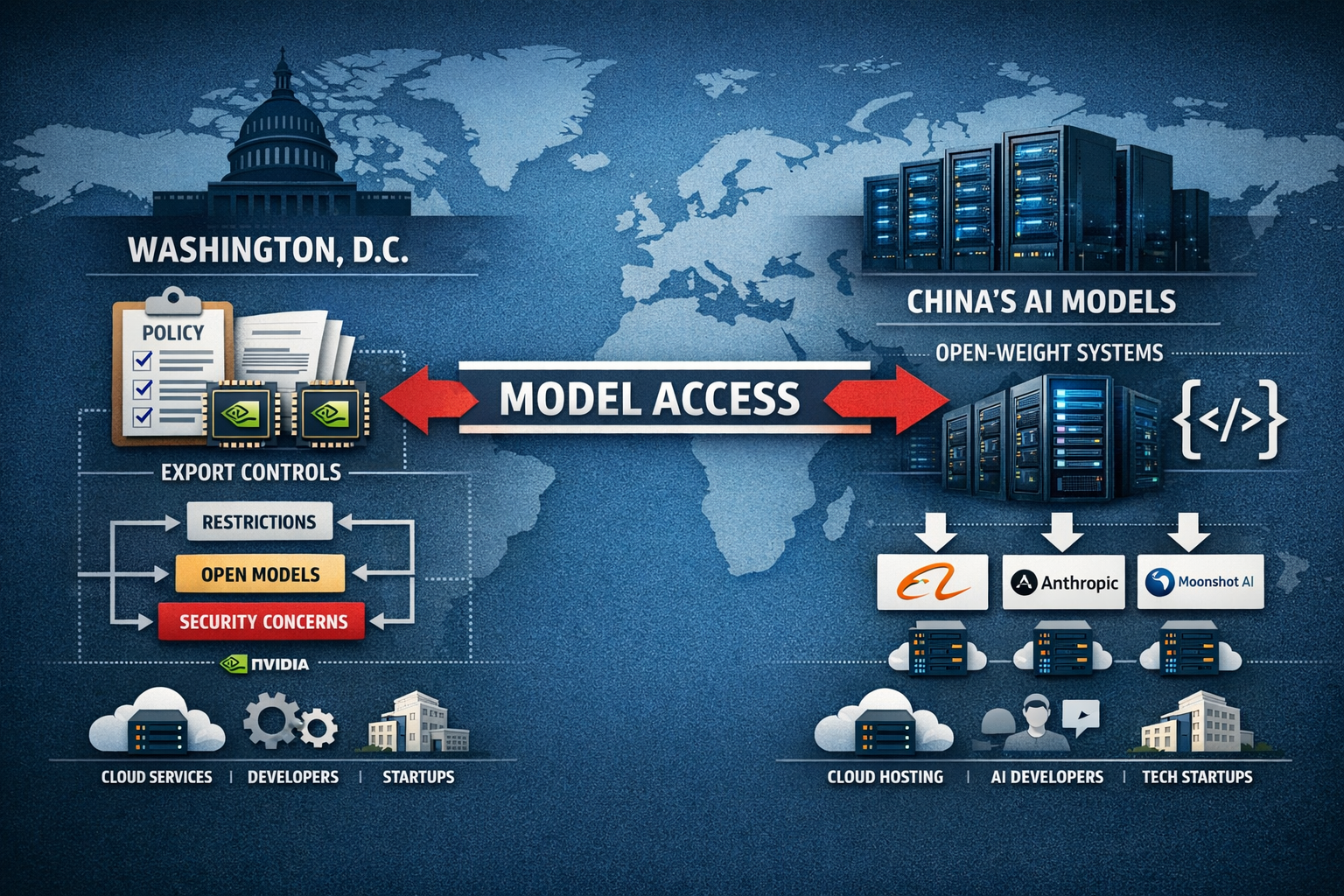
A New Front in the U.S.-China A.I. Rivalry
Washington’s long-running contest with China over artificial intelligence is entering a more complicated phase, one that is no longer defined only by semiconductors and export controls.
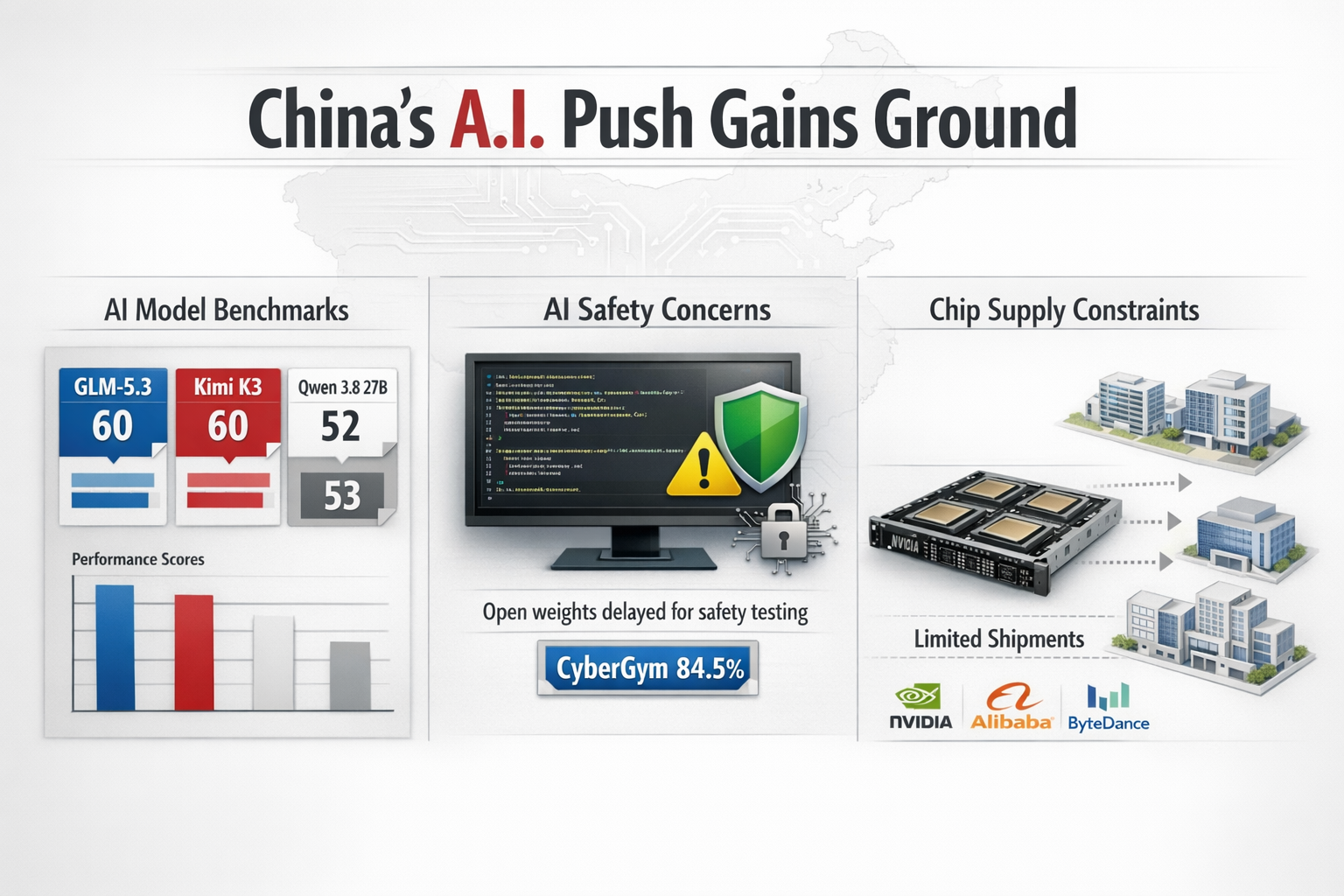
Inside the Trump administration, officials are now debating whether and how to respond to a new generation of Chinese A.I. models that are becoming more capable, more widely available and, in some cases, openly downloadable. The immediate catalyst is Moonshot AI’s Kimi K3, a Chinese model that has been described by people following the industry as approaching the leading edge of performance.
The dispute has exposed a widening divide in Washington: between officials and advisers who want tighter restrictions on Chinese models and those who argue that such measures would be difficult to enforce and could ultimately hurt American companies more than their Chinese rivals.
The argument is also pulling in Silicon Valley, where some leading A.I. companies have tightened access to their most advanced systems even as Chinese competitors promote open-weight models as cheaper, steadier and easier to build on.
The White House Debate
According to recent reporting, some officials in the White House have pushed for a tougher line on Chinese A.I. developers, particularly over concerns that Chinese labs may be using “distillation” — a technique in which a smaller or different model learns from the outputs of a more advanced one — to replicate American breakthroughs.
On July 22, Michael Kratsios, the director of the White House Office of Science and Technology Policy, publicly accused Moonshot of distilling Anthropic’s Fable to create K3. Moonshot had not publicly responded to that allegation in the cited reports, and the government has not laid out detailed public evidence to support the claim.
The Commerce Department, however, has been described as more skeptical of broad restrictions, viewing some proposals as impractical in a world where models can be distributed widely and copied quickly once released.
That practical problem may soon become more pressing. Moonshot has said it plans to release K3’s full weights by July 27, a move that would allow developers to run and adapt the model independently. Once a model is openly released, policing its spread becomes far harder than controlling access to a centralized chatbot or cloud service.
From Chip Controls to Model Controls
That shift helps explain why this moment matters. For several years, Washington’s A.I. strategy toward China has centered on compute: limiting access to advanced chips and the tools used to make them. But the emerging fight is increasingly about model access, licensing and market structure.
Can the United States maintain leadership if its most advanced A.I. systems are available only through tightly controlled interfaces, while Chinese labs distribute strong open alternatives that startups and foreign developers can use with fewer restrictions?
That question has grown more urgent since June 12, when a U.S. export-control directive forced Anthropic to suspend access to Fable 5 and Mythos 5 for all users. Anthropic later said those controls were lifted and that Fable resumed global access on July 1, while Mythos remained limited to a set of approved American organizations.
In the gap created by those restrictions, Chinese companies have moved to make a broader pitch: that their models are not only improving, but are also more dependable to access. Alibaba’s Qwen family and Moonshot’s Kimi line have become central to that argument.
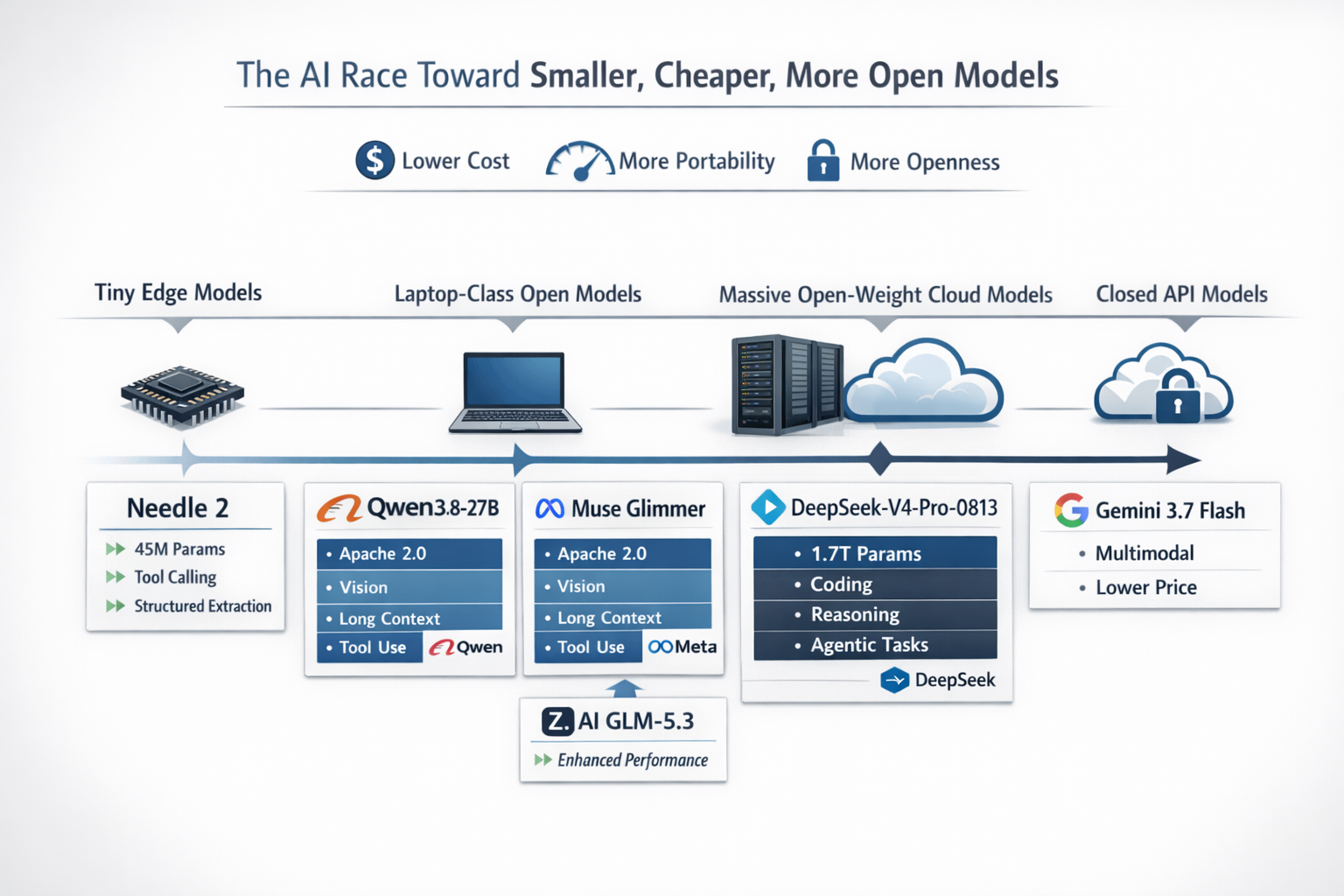
For many developers, especially outside the United States, reliability and openness can matter almost as much as raw capability. A powerful model that can be downloaded, fine-tuned and deployed locally is often more attractive than a slightly better one that may be rate-limited, region-blocked or suddenly withdrawn.
Silicon Valley’s Divide
The administration’s debate has found an echo in the tech industry itself.
Some American A.I. companies and their allies have argued that Chinese open models pose a strategic risk, particularly if they incorporate knowledge gleaned from U.S. frontier systems. Others say trying to wall off developers from Chinese open-weight models would be both ineffective and self-defeating.
That latter camp includes Nvidia’s chief executive, Jensen Huang, who has publicly argued against banning Chinese open models. Huang has praised systems like Kimi and DeepSeek as strong technology and said open models expand the overall A.I. ecosystem. His view is that broader access spurs experimentation, increases demand for computing infrastructure and ultimately benefits the larger market.
His position also reflects Nvidia’s unusual role in the A.I. race. The company sells the chips that power much of the world’s A.I. boom, regardless of which model maker wins. But Huang’s comments have sharpened an uncomfortable divide between infrastructure companies that benefit from wider adoption and model developers that may prefer tighter control over cutting-edge systems.
A separate warning has come from smaller technology companies and startups. Nearly 200 firms, including organizations tied to the startup ecosystem, have urged the administration not to cut off access to Chinese open-weight models, arguing that such a move would make it harder for a new generation of American companies to compete.
For those businesses, the issue is not abstract geopolitics. Open models can dramatically reduce costs, give engineers more control and make it possible to build products without depending entirely on a handful of U.S. A.I. providers.
A Competition Over Openness
The clash points to a broader strategic difference now taking shape between the American and Chinese A.I. sectors.
Leading U.S. labs have increasingly treated their most advanced models as tightly managed products, accessible through terms, pricing and safety restrictions set by the company. Chinese labs, by contrast, have seen an opening in offering high-performing open-weight systems that promise fewer bottlenecks.
That does not mean China is uniformly committed to openness. Chinese officials have reportedly also discussed possible restrictions on overseas access to the country’s strongest models. But for now, China’s firms are exploiting a market opportunity created partly by America’s own caution.
The result is a reversal that would have seemed unlikely only a short time ago: the United States, which long championed open digital ecosystems, is debating new barriers, while Chinese firms are presenting themselves as the more accessible option for global developers.
What Washington Could Do Next
No final U.S. response has been announced, and several options are under discussion. Those include placing Chinese A.I. companies on trade blacklists, limiting federal procurement of Chinese models, issuing security advisories or creating liability risks for American firms that host or distribute such systems.
An outright executive order broadly banning Chinese access to U.S. models is not believed to be under active consideration, according to recent reports. But even narrower measures could have large ripple effects across cloud providers, software companies and startup developers.
The central uncertainty is whether Washington can target genuine security risks without pushing the global developer market toward Chinese alternatives.
That is the dilemma now confronting policymakers. If they move too slowly, critics warn, Chinese firms could narrow America’s lead while benefiting from U.S. research. If they move too aggressively, they may accelerate the adoption of the very models they are trying to contain.
In that sense, the battle over Kimi K3 is about more than one Chinese model or one allegation of distillation. It is a test of whether the United States can compete in an A.I. market where openness itself has become a geopolitical weapon.
Sources
Further reading and reporting used to add context:
- https://www.axios.com/2026/07/22/nvidia-jensen-huang-china-open-source-ai
- https://www.axios.com/newsletters/axios-am-26e0f553-89b7-4cb2-9b3d-74437a5d1fba
- https://apnews.com/article/0d8a5e268deb11a673f4d444fc597cc5
- https://www.tomshardware.com/tech-industry/artificial-intelligence/trump-administration-reportedly-reviving-push-to-ban-chinese-ai-models-following-kimi-k3-launch-citing-cybersecurity-concerns-downloadable-open-weights-could-make-an-outright-u-s-ban-nearly-impossible-to-enforce-amid-growing-adoption
- https://www.theatlantic.com/international/2026/07/china-tech-sector-ai/687938/?utm_source=apple_news
- The White House Is Trying to Figure Out What to Do About Chinese AI | WIRED
- China’s Open AI Models Are Challenging Silicon Valley’s Playbook | WIRED
- https://www.bloomberg.com/opinion/articles/2026-04-16/why-china-can-t-quit-open-ai
- https://www.uscc.gov/research/two-loops-how-chinas-open-ai-strategy-reinforces-its-industrial-dominance
- https://www.csis.org/analysis/what-know-about-chinese-ai-models
- https://thefrontier.press/article/china-s-open-source-gambit
- https://fortune.com/2026/07/22/jensen-huang-chinese-open-source-ai-models-kimi-deepseek-washington-ban-nvidia-chips-data-centers-security/
- https://spidits.com/timeline/china-s-ai-models-have-trump-s-ai-world-at-war-with-itself
- https://arxiv.org/abs/2606.15999
- https://www.brookings.edu/articles/competing-ai-strategies-for-the-us-and-china/
- https://www.ithome.com/0/980/294.htm
- https://arxiv.org/abs/2311.09227
- https://news.sbs.co.kr/english/article.do?news_id=N1008671258
- https://www.anthropic.com/news/redeploying-fable-5
- https://www.anthropic.com/claude/fable
- https://www.anthropic.com/claude/mythos
- Statement on the US government directive to suspend access to Fable 5 and Mythos 5 \ Anthropic
- https://www.anthropic.com/news/fable-safeguards-jailbreak-framework
- https://www.anthropic.com/news/claude-fable-5-mythos-5?via=funfun
- https://www.anthropic.com/news/claude-fable-5-mythos-5?prog_id=5
- https://www.anthropic.com/system-cards
- https://www.anthropic.com/news?939688b5_page=2&e45d281a_page=1
- https://www.commerce.gov/news/press-releases/2024/07/department-commerce-announces-new-guidance-tools-270-days-following
- https://www.anthropic.com/news/hard-questions
- https://www.commerce.gov/hr/ai-work-maximizing-impact-minimizing-risk
- https://www.commerce.gov/sites/default/files/2026-02/DOCFY2025AFR_508.pdf
- https://www.commerce.gov/sites/default/files/2025-01/Investing-in-American-Competitiveness.pdf
- https://www.commerce.gov/sites/default/files/2026-03/Understanding%20AI%20Risks%20and%20Mitigations-TranscriptDocument.pdf
- https://www.commerce.gov/sites/default/files/2025-01/T24%20DOC%20BRIEFING%20MATERIALS%20FOR%20ART_18Dec2024.pdf
- https://www.commerce.gov/sites/default/files/media/files/2023/2023.05.31_bureau_of_industry_and_security_as_kendler_testimony_senate_banking_committee_countering_china_hearing_final.pdf
- https://www.axios.com/2026/07/20/ai-us-china-open-source-kimi
- https://www.tomshardware.com/tech-industry/artificial-intelligence/moonshot-releases-2-8-trillion-parameter-kimi-k3
- https://www.techmeme.com/260722/p32
- https://www.whitehouse.gov/science/
- https://www.whitehouse.gov/releases/2026/07/45470/?query-11-page=3
- https://www.whitehouse.gov/ostp/news/?query-54-page=1
- https://www.moonshot.ai/
- https://www.nature.com/articles/d41586-026-02281-2
- https://www.investing.com/news/stock-market-news/beijing-is-looking-at-curbing-overseas-access-to-chinas-top-ai-models-sources-say-4783159
- https://cyberscoop.com/white-house-accuses-moonshot-ai-anthropic-model-distillation/
- https://kimi-k3.net/
- https://kie.ai/blog/what-is-kimi-k3
- https://www.kimi.com/it-it/blog/kimi-k3
- https://www.reddit.com/r/singularity/comments/1v3lpwv/newsthe_former_director_of_the_white_house_office/
- https://www.reddit.com/r/ArtificialInteligence/comments/1v3son3/we_have_information_that_anthropic_distilled/
- https://www.whitehouse.gov/wp-content/uploads/2026/01/WHOSTP-2025-Wins.pdf
- https://www.reddit.com/r/WhatTrumpHasDone/comments/1utrrti/not_where_they_hoped_itd_be_launch_of_trump_ai/






Leave a Reply