
Apple Tries Again to Reinvent Siri, This Time With Help From Google
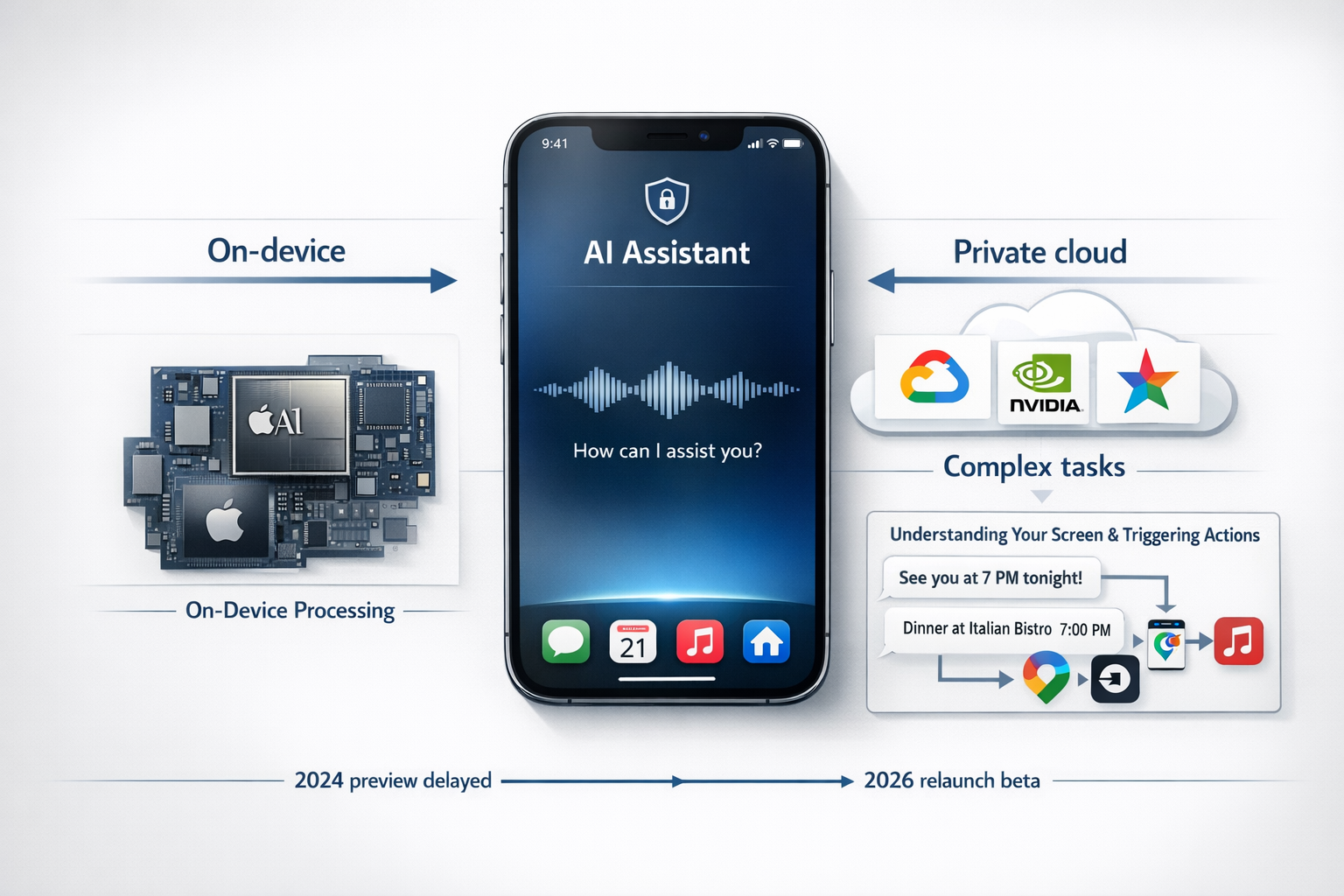
Apple used its developers conference this week to present what may be its most consequential artificial-intelligence reset yet: a rebuilt Siri designed to understand a user’s personal context, read what is on a screen, complete actions across apps and pull in current information from the web.
The system, which Apple is calling “Siri AI,” is also a notable departure for a company that has long emphasized doing as much as possible itself. In unveiling the new assistant at its Worldwide Developers Conference on June 8, Apple said its latest Apple Intelligence platform was rebuilt with help from Google’s Gemini technology, while the most demanding tasks can be handled through Apple’s privacy-focused cloud system, known as Private Cloud Compute.
The announcement amounts to a high-stakes second attempt. Apple first previewed a more personalized Siri at WWDC in 2024, but those features were delayed, leaving the company looking flat-footed as rivals like OpenAI, Google and Anthropic pushed ahead with more conversational and increasingly agentic assistants. Two years later, Apple is trying to show it has found a more practical path: combine its control over devices and apps with outside foundation models and cloud computing, while insisting that user privacy remains central.
Developer testing began immediately after the presentation, and Apple said a public beta would arrive later this year for supported devices set to English.
A More Personal, More Action-Oriented Siri
Apple said the new Siri can draw on information from messages, email, photos and other apps to answer questions tailored to a user’s life and history. It can also understand onscreen content, allowing it to respond to what someone is viewing without requiring every app developer to build custom integrations from scratch.
That capability is significant because modern vision-enabled AI models have improved sharply since Apple’s earlier 2024 plans. In theory, Siri can now infer context directly from the screen — a reservation, a message thread, a document or a webpage — and use that to complete tasks across apps.
Apple is also positioning the assistant as more capable of carrying out multistep requests, the sort of “agentic” behavior that has become a central battleground in artificial intelligence. Instead of answering a single question, Siri is meant to help users get things done.
For Apple, that is an overdue shift. Siri helped popularize voice assistants more than a decade ago, but it has since been eclipsed by newer AI systems that are better at free-form conversation, synthesis and planning.
The Google Alliance Apple Once Might Have Avoided
Perhaps the most striking element of Apple’s presentation was its acknowledgment that it is leaning on Google technology to power part of the overhaul.
Apple has previously integrated outside AI offerings in limited ways, but using Gemini-derived models as a core part of a revamped Siri underscores how difficult and expensive it has become to stay competitive in generative AI using only in-house systems. Rather than waiting for its own models to catch up fully, Apple appears to be betting that users will care more about whether Siri works than whether every layer of the stack originated in Cupertino.
That strategy could make Siri more capable much faster. But it also opens Apple to scrutiny on several fronts: how dependent it becomes on Google, how much control it truly retains over model behavior, and whether a partnership with one of Silicon Valley’s biggest data companies sits comfortably with Apple’s long-running privacy marketing.
Private Cloud Compute Faces a Bigger Test
Apple’s answer is Private Cloud Compute, the system it introduced as a way to send only the most demanding AI requests off-device while preserving tight security controls.
This time, however, Apple disclosed an important expansion: some of those heavy workloads will run not only in Apple-operated infrastructure but also in Google Cloud, using Nvidia graphics processors. Apple has said that for demanding tasks, including complex reasoning and tool use, it worked with Google and Nvidia to extend Private Cloud Compute while preserving the system’s protections.
According to Apple, that setup uses layered safeguards including isolated processing environments, short-lived inference services and attested keys held separately in confidential virtual machines. The company has also said it plans to publish the binaries used in the system for public inspection, an effort to bolster trust among researchers and security experts.
Even so, the arrangement introduces complexity that Apple will have to explain convincingly. One of the central unanswered questions is where, exactly, different kinds of Siri requests will run in practice: on the device itself, in Apple’s own cloud environment or in Private Cloud Compute hosted on Google Cloud. That distinction matters not only for privacy, but also for speed, reliability and cost.
Skepticism After the 2024 Delay
Apple’s executives presented the new Siri as ready for a new chapter, but outside observers are approaching the claims cautiously.
The 2024 Siri promises were ambitious and, ultimately, delayed. That has made developers, analysts and Apple watchers less willing to take polished conference demonstrations at face value. Early developer access has begun through the iOS 27 beta, though some testers have had to wait for access to the new Siri AI features, meaning broader real-world assessments may take time.
The skepticism is not just about whether the technology is possible. Many of the building blocks — large language models, vision systems, app action frameworks and cloud inference — are now mature enough to make Apple’s demos seem plausible. The question is whether Apple can combine them into a dependable assistant that works at the scale of hundreds of millions of devices and lives up to the company’s unusually high promises around privacy.
Limited Rollout, Global Questions
Apple said the new system would first be available later this year in beta for supported devices set to English. As with other Apple Intelligence features, hardware requirements are expected to limit how much of Apple’s installed base can use the system immediately.
Geography will also constrain the launch. Apple has said Siri AI will initially be unavailable on iPhone, iPad and watchOS in the European Union, and that Apple Intelligence and Siri AI are not yet available in China. Those limits highlight the regulatory and market challenges facing Apple as it tries to deploy a deeply integrated AI assistant across jurisdictions with different rules on data, competition and cloud services.
How quickly Apple can expand languages, regions and device support may prove almost as important as the quality of the first release. Rivals are moving quickly, and consumers are increasingly being asked to choose not just between phones, but between AI ecosystems.
Why This Moment Matters
The broader significance of Apple’s announcement is that the company appears to have accepted a new reality in artificial intelligence: control of the user experience may matter more than owning every model underneath it.
For years, Apple’s advantage has been its ability to fuse hardware, software and services into a seamless product. In AI, it is now applying that same logic in a more pragmatic way — using Gemini-derived models, on-device processing, app integration and a privacy architecture it says can be independently examined.
If it works, Apple could turn Siri from an industry punchline into a powerful front end for everyday AI, woven into the iPhone, iPad and Mac in a way rivals may struggle to match. If it stumbles again, the 2026 relaunch will be remembered less as a breakthrough than as confirmation that the assistant era Apple once helped start is now being defined elsewhere.
For now, Apple has offered a new blueprint and a new set of assurances. What comes next will depend less on the polish of a keynote than on whether users, developers and researchers decide that this time, Siri really is better.
Sources
Further reading and reporting used to add context:
- https://www.techradar.com/news/live/apple-wwdc-2026-live
- https://www.tomshardware.com/software/macos/apple-demonstrates-cross-platform-siri-upgrades-in-macos-27-golden-gate-at-wwdc-update-brings-liquid-glass-improvements-and-unifies-ai-strategy
- https://www.creativebloq.com/live/news/tech/apple-wwdc-june-2026
- https://www.androidcentral.com/phones/apple-iphone/apples-new-siri-ai-is-powered-by-gemini
- Expanding Private Cloud Compute – Apple Security Research
- Apple’s New Siri AI Is Ready to Get Personal | WIRED
- https://www.wired.com/video/watch/siri-is-finally-ready-to-get-personal
- https://www.wired.com/story/everything-apple-announced-at-wwdc-2026/
- https://www.gadgets360.com/ai/news/wwdc-2026-apple-intelligence-new-architecture-gemini-ai-models-siri-ai-11610337
- https://techcrunch.com/2026/06/08/apples-long-awaited-ai-siri-overhaul-is-finally-here/
- https://www.apple.com/newsroom/2026/05/apple-kicks-off-worldwide-developers-conference-on-june-8/
- https://www.nasdaq.com/press-release/wwdc26-apple-unveils-next-generation-apple-intelligence-siri-ai-powerful-parental
- https://www.apple.com.cn/newsroom/2026/06/apple-unveils-next-generation-of-apple-intelligence-siri-ai-and-more/
- https://mer.vin/2026/06/apple-private-cloud-compute-on-google-cloud-nvidia-gpus-with-verifiable-privacy/
- https://arstechnica.com/apple/2026/06/say-hi-to-siri-ai-apple-announces-new-more-conversational-voice-assistant/
- https://www.macrumors.com/2026/01/12/google-gemini-next-generation-siri/
- https://elpais.com/tecnologia/2026-06-08/wwdc-2026-tim-cook-presenta-una-siri-renovada-con-ia-generativa-en-su-despedida-al-frente-de-apple.html
- https://www.reddit.com/r/u_vscomparison_media/comments/1u1swt1/apple_wwdc_2026_full_recap_siri_ai_ios_27_watchos/
- https://www.reddit.com/r/stockstobuytoday/comments/1u18n84/apple_rolls_out_geminipowered_siri_ai_aapl_pulled/
- https://en.wikipedia.org/wiki/Apple_Inc.
- https://www.reddit.com/r/Tekkens/comments/1u0mqnc/tekkens_new_siri_ai_and_siri_features_unveiled_at/
- https://www.reddit.com/r/ThatAppleGuide/comments/1u0piu3/wwdc_2026_recap_apple_bet_the_whole_keynote_on/
- https://www.reddit.com/r/apple/comments/1u0pu57/expanding_private_cloud_compute/
- https://www.reddit.com/r/aigossips/comments/1u0fqwh/apple_just_revealed_its_biggest_ai_push_yet_at/
- https://www.apple.com/newsroom/topics/apple-intelligence/
- https://www.apple.com/newsroom/2025/06/apple-elevates-the-iphone-experience-with-ios-26/
- https://www.apple.com/newsroom/
- https://www.apple.com/newsroom/2025/09/new-versions-of-apples-software-platforms-are-available-today
- https://www.apple.com/newsroom/2026/05/apple-unveils-new-accessibility-features-and-updates-with-apple-intelligence
- https://www.apple.com/newsroom/2025/06/apple-supercharges-its-tools-and-technologies-for-developers/
- https://developer.apple.com/videos/play/wwdc2026/122/
- https://www.apple.com/newsroom/2025/09/new-apple-intelligence-features-are-available-today
- https://www.apple.com/newsroom/2025/06/apple-intelligence-gets-even-more-powerful-with-new-capabilities-across-apple-devices/
- https://www.apple.com/newsroom/topics/iphone/
- https://www.apple.com/newsroom/topics/company-news/
- https://devimages-cdn.apple.com/wwdc-services/images/C03E6E6D-A32A-41D0-9E50-C3C6059820AA/guides-76105412-ED4C-4D9D-AAA5-E039F7FE142B/WWDC24-Machine-Learning-and-AI.pdf?dl=1
- https://www.apple.com/os/pdf/All_New_Features_iOS_26_Sept_2025.pdf?pubDate=20250929
- https://devimages-cdn.apple.com/wwdc-services/images/C03E6E6D-A32A-41D0-9E50-C3C6059820AA/guides-76105412-ED4C-4D9D-AAA5-E039F7FE142B/WWDC24-iOS-and-iPadOS.pdf
- https://www.apple.com/os/pdf/All_New_Features_iPadOS_26_Sept_2025.pdf
- https://www.techradar.com/phones/ios/here-we-go-again-apples-new-ios-27-siri-2-0-may-have-a-beta-label-attached-and-a-waitlist-before-you-can-actually-try-it
- https://apnews.com/article/5d18df90b03e4e98ac528c8802e2b531
- https://theweek.com/tech/apple-joins-ai-race-siri
- https://www.investing.com/news/stock-market-news/apples-ai-siri-will-be-held-back-by-aging-devices-morgan-stanley-says-4732879
- https://www.investing.com/news/stock-market-news/apple-settles-lawsuit-over-late-siri-ai-features-for-250-million-4661262
- https://www.investing.com/news/stock-market-news/apple-failed-to-make-its-ai-tool-to-comply-to-eu-regulations-eu-commission-says-4732435
- https://www.investing.com/news/stock-market-news/saving-siri-after-two-years-of-stumbles-is-apples-ai-moment-here-4729736
- https://www.macrumors.com/2026/04/22/google-gemini-powered-siri-2026/
- https://www.idownloadblog.com/2025/03/07/apple-intelligence-siri-delay-confirmed/
- https://www.t3.com/tech/ai/gemini-powered-siri-still-on-track-for-2026-release-apple-tells-major-outlet
- https://www.dailysabah.com/business/economy/apples-ai-siri-will-have-limited-use-morgan-stanley-says
- https://techjournal.org/wwdc-2026-siri-gemini-ios-27
- https://techcrunch.com/2026/02/11/apples-siri-revamp-reportedly-delayed-again/
- https://www.investing.com/news/stock-market-news/apple-bets-on-overdue-siri-fix-to-close-ai-gap-4733770
- https://www.streetinsider.com/Reuters/Apples%2BAI%2BSiri%2Bwill%2Bbe%2Bheld%2Bback%2Bby%2Baging%2Bdevices%2C%2BMorgan%2BStanley%2Bsays/26620793.html
- https://en.wikipedia.org/wiki/Apple_Intelligence
- https://en.wikipedia.org/wiki/Siri
- https://en.wikipedia.org/wiki/Gemini_%28language_model%29
- https://en.wikipedia.org/wiki/Google_Gemini
- Apple unveils next generation of Apple Intelligence, Siri AI, and more – Apple
- Saving Siri: After two years of stumbles, is Apple’s AI moment here? By Reuters



Leave a Reply