
A New Political Front Opens Over A.I.: Power, Climate and the Cost of Growth
The race to build the infrastructure behind artificial intelligence is colliding with a more prosaic reality: electricity grids, climate targets and the politics of local power bills.
In Britain and the United States, governments that have eagerly embraced A.I. as an engine of future growth are now facing mounting resistance over the data centers needed to make that ambition possible. New disclosures in Britain show that officials sharply revised upward their own estimate of the carbon emissions tied to A.I. computing, while a dispute has emerged inside the government over how much electricity the sector will require. In Maine, Gov. Janet Mills vetoed legislation that would have imposed the nation’s first statewide freeze on large new data centers, even as she acknowledged that a pause was, in broad terms, warranted.
Taken together, the developments underscore a widening dilemma for policymakers: how to expand domestic A.I. capacity without overwhelming power systems, undermining emissions goals or provoking a backlash from communities asked to host the facilities.
Britain’s A.I. Ambitions Run Into the Arithmetic of Energy
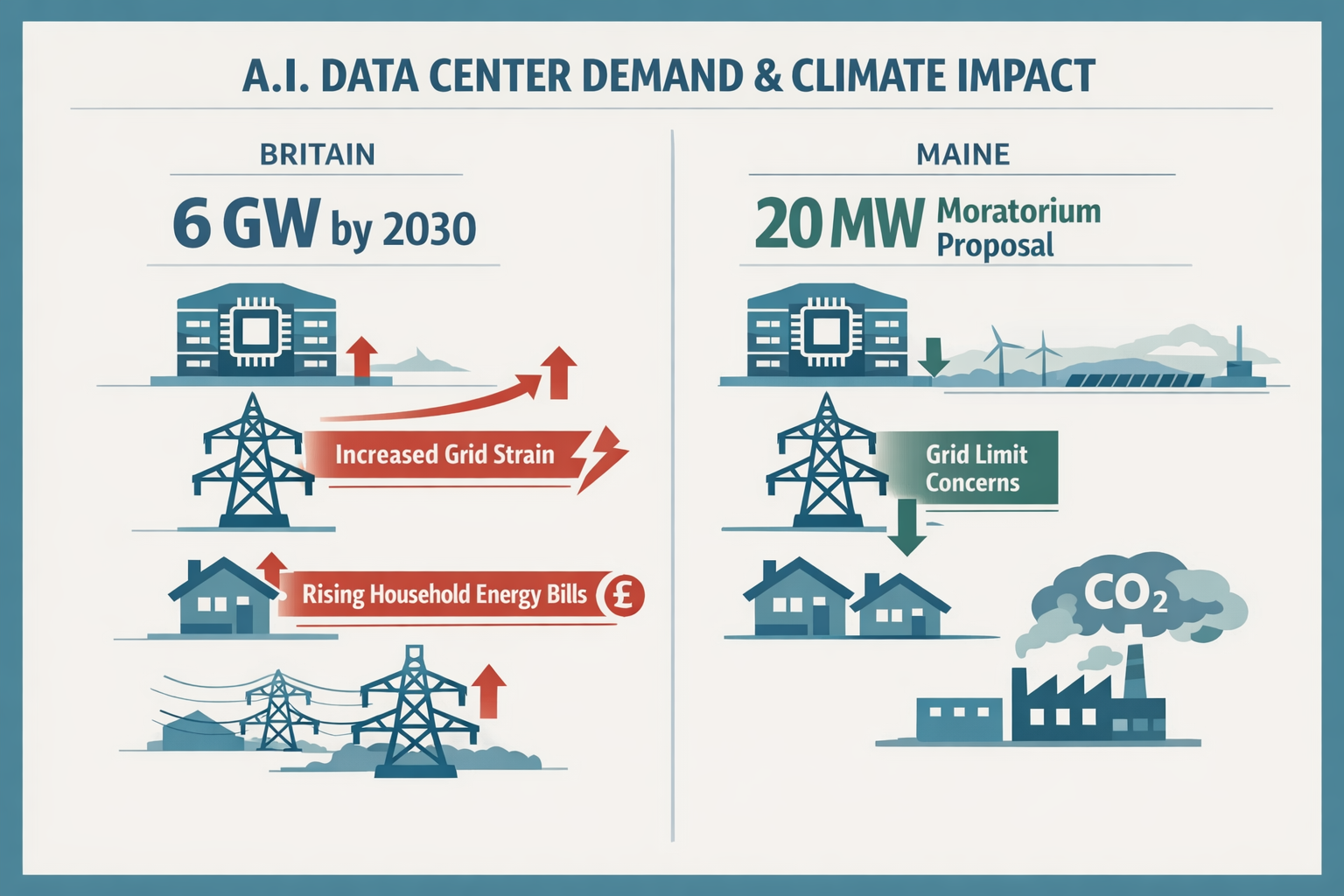
The British government has made no secret of its desire to build more homegrown computing power. Its Compute Roadmap envisions at least 6 gigawatts of A.I.-capable data-center capacity by 2030, including nationally significant sites of more than 500 megawatts and at least one A.I. growth zone above 1 gigawatt.
Those are the kinds of numbers associated not with ordinary office parks, but with industrial-scale electricity demand.
The problem, critics say, is that the government departments charged with delivering Britain’s A.I. push and those responsible for planning the country’s energy future do not appear to be working from the same assumptions. Reporting in recent days has pointed to a gap between the Department for Science, Innovation and Technology’s expansive forecast for A.I. computing and the lower planning assumptions used by the energy ministry.
That discrepancy has raised uncomfortable questions about whether Britain’s push to become an “A.I. superpower” is being mapped onto the same reality as its pledge to decarbonize the electricity system.
The tension is especially acute because data centers are no longer viewed as a niche digital-service issue. A.I.-focused facilities can demand enormous amounts of power continuously, and often at speeds that strain traditional planning processes. If governments underestimate that demand, they risk shortages, transmission bottlenecks and higher costs for other consumers. If they overbuild without clean generation to match, they risk pushing emissions higher just as they are trying to bring them down.
A Carbon Estimate Revised by More Than 100-Fold
The scale of the challenge became clearer after British officials quietly updated their estimate of the emissions associated with A.I. computing. The new projection puts emissions from A.I. data centers at between 34 million and 123 million metric tons of carbon dioxide from 2025 to 2035 — a dramatic increase from earlier estimates and a sign that officials had badly understated the potential climate impact.
That range is broad, reflecting uncertainty over how quickly the grid cleans up, how efficient future hardware becomes and how much A.I. demand accelerates. But even the low end suggests that A.I. infrastructure could become a consequential slice of Britain’s emissions profile. The high end points to a far more serious collision between industrial strategy and climate policy, particularly if renewable deployment and grid upgrades fail to keep pace.
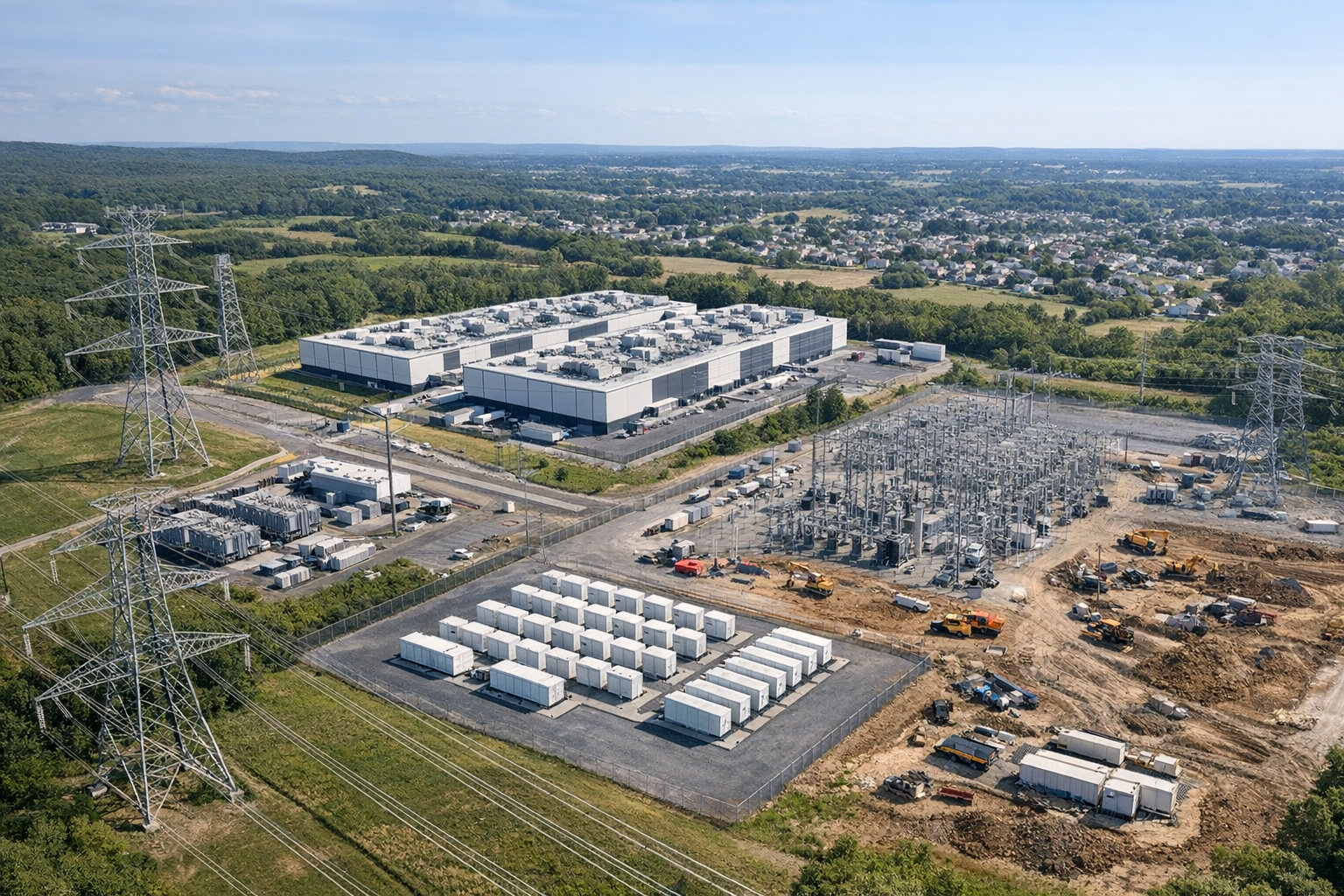
Why this matters now is not simply that A.I. consumes energy, but that governments are making long-lived decisions about land use, permitting and electricity infrastructure today. A 1-gigawatt campus cannot be conjured overnight, nor can the transmission lines and generation needed to serve it. If official forecasts are off by several gigawatts, the consequences will reverberate for years.
In Maine, a Veto That Still Signals Unease
Across the Atlantic, the politics are becoming local.
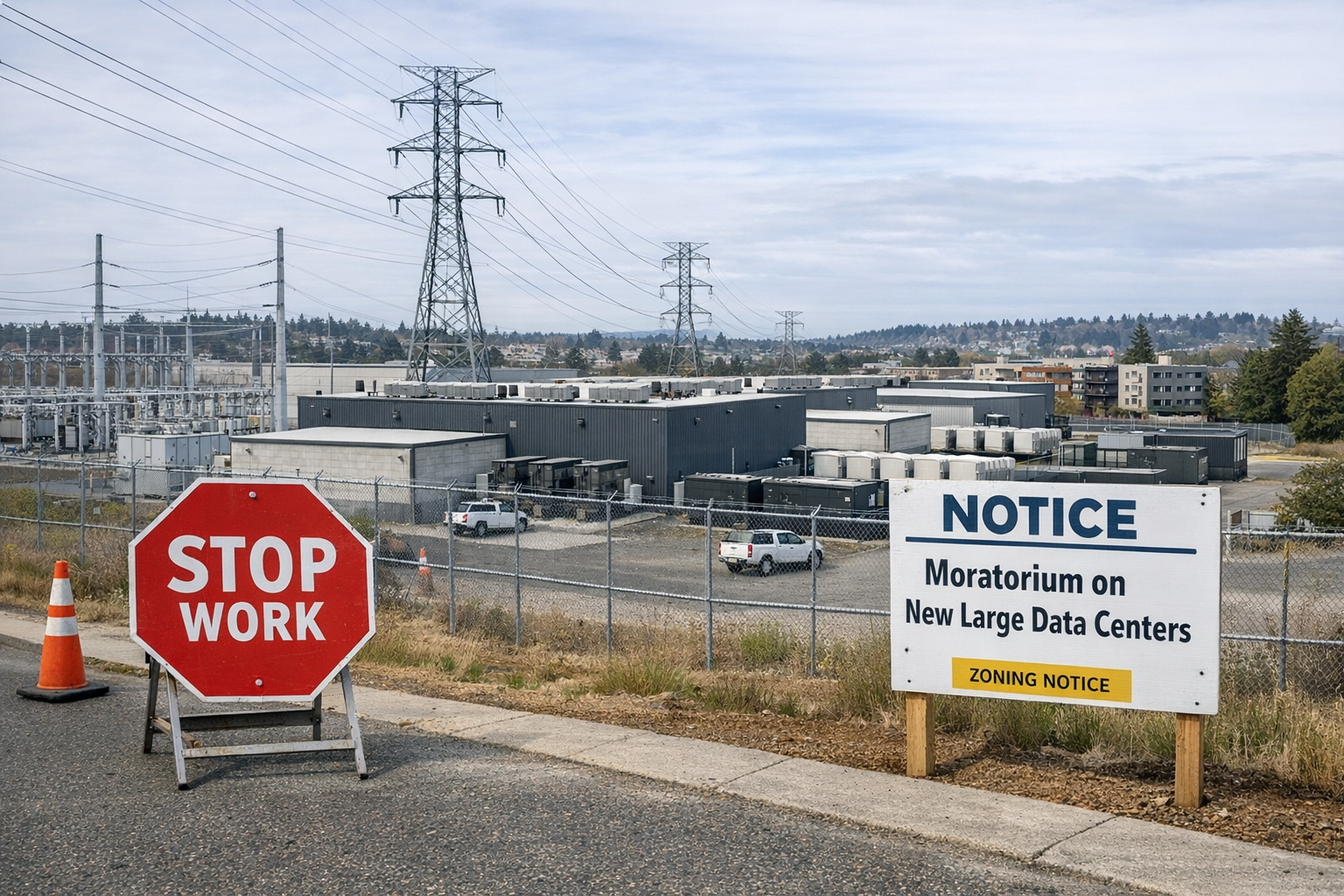
Maine came close to becoming the first state in the country to place a moratorium on large new data centers. The bill would have temporarily paused projects with loads of 20 megawatts or more while establishing a council to study the effects on the grid, communities and the environment.
Ms. Mills, a Democrat, vetoed the measure. But her objection was narrow rather than dismissive. She said a pause would have been “appropriate” in principle, according to reports, but argued that the bill as written would have interfered with an ongoing project in Jay, a town seeking redevelopment and investment.
Her decision reflected the increasingly familiar trade-off confronting governors and lawmakers. On one side are concerns about energy use, environmental strain and the possibility that large industrial customers could put upward pressure on household electricity costs. On the other are promises of jobs, tax revenue and a second life for communities trying to replace lost industry.
The Maine debate is noteworthy not because a moratorium passed — it did not — but because such a proposal got as far as it did. Data centers, long treated as largely benign symbols of the digital economy, are becoming a visible political issue in statehouses and town halls.
The New Geography of A.I. Resistance
Until recently, opposition to data centers tended to flare over zoning disputes, noise or water use in isolated communities. The A.I. boom is changing that. The facilities now being proposed are larger, more power-hungry and more explicitly tied to national industrial strategy.
That has broadened the argument. In Britain, the question is whether the state can honestly promise both rapid A.I. expansion and a clean-power transition if its own departments are not aligned on expected demand. In American states like Maine, the question is whether local communities should absorb the burdens of hyperscale infrastructure without a clearer accounting of grid impacts and public benefits.
The shape of future policy remains uncertain. Britain may yet revise its energy planning to match its A.I. ambitions, or scale those ambitions to fit the realities of the grid. In the United States, other states may look to Maine’s failed effort as a model for narrower pauses, tougher permitting rules or new thresholds that distinguish between especially power-intensive projects and smaller facilities with more obvious local benefits.
For now, one thing is becoming clear: the politics of A.I. are no longer confined to algorithms, safety rules or competition with China and Silicon Valley. They are increasingly about substations, megawatts and whether the infrastructure of the future can be built without deepening the anxieties of the present.
Sources
Further reading and reporting used to add context:
- https://www.tomshardware.com/desktops/servers/maine-governor-vetoes-bill-that-bans-large-new-data-centers-says-legislature-shouldve-exempted-one-particular-well-supported-data-center
- https://apnews.com/article/352ad4fbd531d905b9415258692b318f
- https://www.theguardian.com/technology/2026/apr/26/uk-departments-at-odds-over-energy-demands-of-ai-datacentres
- https://www.maine.gov/housedems/news/sachs-issues-statement-governors-decision-veto-bill-establishing-temporary-pause-data-centers
- https://www.gov.uk/government/publications/uk-compute-roadmap/compute-evidence-annex-changes-corrected-23-april-2026
- https://www.envirolink.org/2026/04/25/uk-government-underestimated-ai-data-center-carbon-emissions-by-more-than-100-fold/
- https://www.bloomberg.com/news/articles/2026-04-24/maine-governor-mills-vetoes-statewide-data-center-moratorium?srnd=phx-us-politics
- https://www.theguardian.com/technology/2026/apr/24/officials-hugely-underestimated-impact-of-ai-datacentres-on-uk-carbon-emissions
- https://www.envirolink.org/2026/04/26/uk-climate-goals-clash-with-ai-energy-demands-as-government-departments-disagree-on-power-projections/
- https://www.independentwomen.com/2026/04/23/maine-passes-first-data-center-moratorium/
- https://letsdatascience.com/news/maine-governor-vetoes-statewide-data-center-moratorium-ed61706c
- https://themainemonitor.org/maine-data-center-moratorium/
- https://www.datacenterdynamics.com/en/news/maine-data-center-moratorium-bill-gets-house-approval-moves-to-senate/
- https://business20channel.tv/maine-data-center-moratorium-2026-governor-mills-vetoes-hist-26-april-2026
- https://www.axios.com/2026/04/05/data-centers-midterms-state-bans-bills-ai
- https://www.techradar.com/pro/if-these-centers-arent-thoughtfully-planned-and-coordinated-they-can-place-extraordinary-demands-on-electric-infrastructure-the-surrounding-environment-and-host-communities-maine-becomes-first-us-state-to-pass-data-centre-construction-ban
- https://www.axios.com/2026/03/25/sanders-aoc-data-center-moratorium-bill
- https://www.reddit.com/r/ArtificialInteligence/comments/1sw5ae1/uk_departments_at_odds_over_energy_demands_of_ai/
- https://www.reddit.com/r/ukpolitics/comments/1swkd7h/uk_departments_at_odds_over_energy_demands_of_ai/
- https://www.reddit.com/r/EnvironmentalNews/comments/1sw13pa/uk_departments_at_odds_over_energy_demands_of_ai/
- https://www.reddit.com/r/Maine/comments/1so0bzk/maine_lawmakers_pass_the_first_statewide_ban_on/
- https://www.reddit.com/r/politics/comments/1smbrx9/maine_lawmakers_pass_firstinnation_data_center/
- https://www.gov.uk/government/publications/uk-compute-roadmap/uk-compute-roadmap
- https://www.maine.gov/governor/mills/news/governor-mills-announces-decision-ld-307-2026-04-24
- https://www.maine.gov/governor/mills/index.php/official_documents/veto_messages
- https://www.gov.uk/government/news/cambridge-supercomputer-set-to-get-6-times-more-powerful-as-government-backs-british-ai-innovation
- https://assets.publishing.service.gov.uk/media/69badd1f9c6ac6540dfd61d7/uk_compute_roadmap_print-version.pdf
- https://www.gov.uk/government/publications/airr-compute-opportunity-ai-for-science/airr-compute-opportunity-ai-for-science
- https://www.maine.gov/governor/mills/news/governor-mills-signs-legislation-extending-maines-affordable-housing-tax-credit-2026-04-21
- https://assets.publishing.service.gov.uk/media/69b7ece3ba47c264e6c8cfba/Request_Document_-_SDC_M40_Campus_-_Section_35_Direction.pdf
- https://www.gov.uk/government/news/engines-of-ai-primed-to-accelerate-new-breakthroughs-economic-growth-and-transform-the-uk-into-an-ai-maker
- https://www.find-tender.service.gov.uk/procurement/ocds-h6vhtk-05a227
- https://www.gov.uk/government/publications/ai-opportunities-action-plan-one-year-on/ai-opportunities-action-plan-one-year-on
- https://www.business.gov.uk/invest-in-uk/investment/sectors/ai-and-data-centres/
- UK Compute Roadmap – GOV.UK
- Compute Evidence Annex: changes corrected (23 April 2026) – GOV.UK










Leave a Reply