
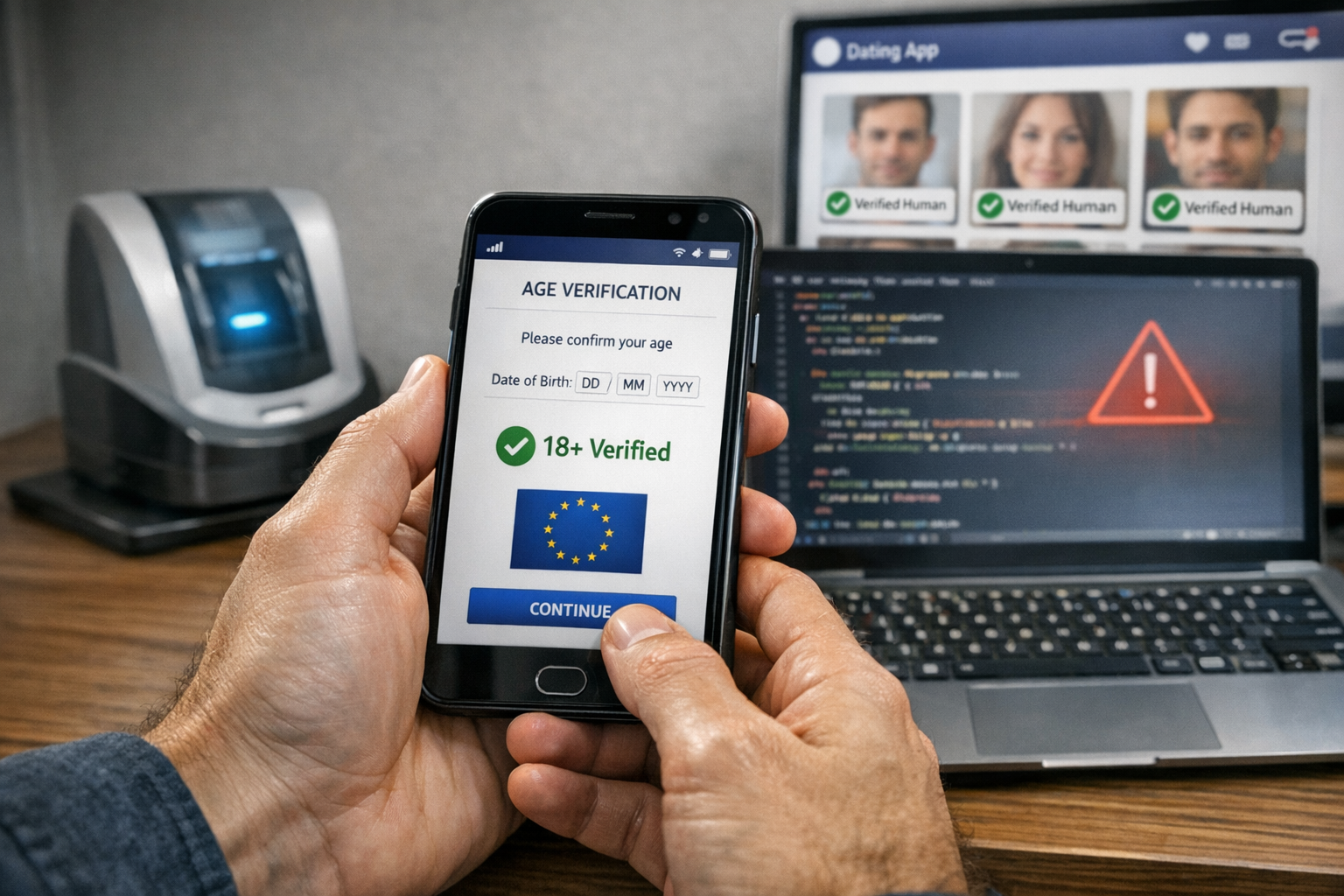
The race to prove that internet users are real people — and, in some cases, old enough to be online at all — is accelerating on two fronts at once: governments are publishing new digital age-checking tools, and consumer apps are beginning to embrace biometric-style “proof of personhood” systems. But the latest developments have also exposed how fragile those systems can be, and how quickly promises of privacy can be tested by real-world attacks.
In Europe, the European Commission said on April 15 that a new age-verification solution was “technically ready,” releasing source code and a beta version as an open-source reference for member states. The idea is politically attractive and technologically ambitious: allow users to prove they are over a required age without disclosing unnecessary personal information, in a design the Commission says is consistent with the bloc’s future digital identity plans and its push to enforce child-safety rules under the Digital Services Act.
Within days, however, independent researchers reported flaws in the Android reference app, saying it could be compromised in minutes. The Commission responded by acknowledging that the code required improvement, saying an updated version was being pushed and emphasizing that what had been published was a demo and reference implementation, not a final mass-market product.
The episode laid bare a familiar problem in digital identity. Systems meant to reduce risk can quickly become sensitive attack surfaces themselves. An app that verifies age without exposing too much personal information may be privacy-preserving in theory, but if weakly implemented it can still create openings for fraud, circumvention or new forms of data exposure.
A Growing Demand for Digital Trust
The pressure to deploy these tools is growing for reasons that are easy to understand. Platforms are under mounting scrutiny over bots, scams, impersonation and underage access. Regulators want tougher safeguards for minors. Companies want cleaner networks and more confidence that users are who they claim to be. And the rise of generative artificial intelligence has intensified anxieties that online spaces are becoming harder to trust.
That has turned “proof of personhood” from a niche concept into a potentially central layer of internet infrastructure.
Nowhere is that shift more visible than in the commercial rollout by World, the identity venture backed by Sam Altman. The company, which has drawn attention for its Orb devices that scan users’ irises, is moving deeper into mainstream consumer products. Tinder now describes World ID-based age verification in some markets and offers a “Humanness Badge” to users who complete Orb verification, signaling that they have been checked as a real person.
The partnership suggests that what began as an experimental identity project tied to crypto-era ideas about digital uniqueness is being repurposed as a broader trust signal for everyday platforms. On a dating app, where fake profiles and scams are a constant concern, the pitch is straightforward: verification could reassure users that they are interacting with an actual human being.
Two Models, Two Sets of Risks
The European Union and World are pursuing different visions of the same underlying goal.
The Commission’s model is framed as public-interest infrastructure: an age check designed to reveal as little as possible, ideally letting a person prove they meet an age threshold without handing over a full identity. Officials have said the system is meant to be open source, privacy-preserving and aligned with the future EU Digital Identity Wallet.
World’s model is more commercially integrated and more closely associated with a proprietary ecosystem. It uses credentials generated within its network, including those connected to Orb verification, to establish that a user is a unique person. That may make it more immediately useful to private platforms seeking a simple trust layer, but it also sharpens concerns about biometric data, centralization and the long-term power that private identity intermediaries could gain.
Both approaches confront the same core dilemma: the stronger the verification, the more consequential the system becomes if it fails — or if it succeeds too well.
A weak age-verification app can be bypassed or exploited. A strong personhood system can drift toward surveillance, exclusion or function creep, especially if platforms begin treating optional badges as practical requirements for participation. What begins as a feature to reassure users could eventually shape who gets access, who remains anonymous and whose identity becomes legible to institutions and corporations.
Security Questions Before Scale
For the European Commission, one immediate question is whether the flaws found in the published code are typical of early-stage software or a warning sign about the architecture itself. Because the release was a reference implementation rather than a final deployment, the vulnerabilities may not reflect what member states ultimately roll out. But the incident underscores how quickly privacy and security claims will be challenged once these systems face adversarial testing.
That scrutiny is likely to intensify as governments look for practical ways to enforce online child-safety rules. Across Europe and elsewhere, policymakers have increasingly embraced age assurance as a solution to concerns about minors accessing pornography, harmful content or adult-oriented services. Yet previous efforts have often run aground on the same tension now haunting the Commission’s app: the more robust the check, the greater the concern about creating new identity databases or normalizing routine credential checks for ordinary internet use.
For World and its platform partners, the uncertainty is different but no less significant. The company has argued that proof-of-personhood systems will be necessary in an internet flooded with bots and AI-generated identities. But whether users will accept iris-linked verification at scale remains unresolved, particularly in products that are intimate, social or safety-sensitive. Dating apps may offer an early test because the harms from fake accounts are so visible; they may also expose the limits of consumer tolerance for biometric verification tied to private companies.
What Comes Next
These parallel developments suggest that verification is entering a new phase. It is no longer confined to regulatory white papers or crypto-adjacent pilots. It is appearing in code released by one of the world’s most powerful regulators and in badges shown to users on mainstream apps.
That shift matters because once verification becomes ordinary, it can quietly reshape the internet’s social contract. For decades, anonymity and pseudonymity were default features of much online life. The emerging model is more conditional: trust, access and visibility may increasingly depend on showing a credential that proves not just age, but personhood itself.
Whether that future is safer or simply more controlled may depend on details that are easy to overlook in launch announcements — how much data is collected, where it is stored, how easily systems can be bypassed, and whether verification remains a choice or becomes an expectation.
For now, the latest week in digital identity has offered a revealing snapshot of the moment: a public-sector age-checking tool that stumbled under scrutiny, and a private-sector biometric system inching closer to everyday use. Together, they show that the internet’s next trust layer may be arriving before its hardest questions are settled.
Sources
Further reading and reporting used to add context:
- https://www.techradar.com/ai-platforms-assistants/the-face-thing-is-probably-going-to-break-sam-altman-backed-firm-warns-ai-will-soon-outgrow-facial-recognition-but-says-its-proof-of-human-system-world-id-could-be-part-of-the-solution
- Gazing Into Sam Altman’s Orb Now Proves You’re Human on Tinder | WIRED
- European age verification app to keep children safe online – European Commission
- https://www.reddit.com/r/privacy/comments/1sn437i/eu_age_verification_app_already_hacked/
- https://www.reddit.com/r/cybersecurity/comments/1sn49qp/eu_age_verification_app_already_hacked/
- https://www.lemonde.fr/en/economy/article/2025/05/28/european-commission-launches-investigation-into-four-pornographic-websites-including-pornhub_6741754_19.html
- The EU approach to age verification | Shaping Europe’s digital future
- https://www.reddit.com/r/eutech/comments/1so33kq/eus_age_verification_app_took_hackers_2_minutes/
- https://www.europarl.europa.eu/doceo/document/E-10-2025-002140-ASW_EN.pdf
- https://qa.time.com/7288387/sam-altman-orb-tools-for-humanity/
- https://www.lemonde.fr/economie/article/2025/07/14/protection-des-mineurs-bruxelles-lance-un-prototype-d-application-de-verification-d-age-des-internautes_6621199_3234.html
- https://better-internet-for-kids.europa.eu/sites/default/files/2025-10/DSA_guidelines_expalined_What_online_platforms_should_do_to_keep_kids_and_teens_safe_online_Booklet_EN.pdf
- https://apnews.com/article/2be62d818a2dccf459a27e147fc4099c
- https://audiovisual.ec.europa.eu/en/stories/M-009975
- https://www.wired.com/story/sam-altman-orb-worldcoin-tools-for-humanity/
- https://www.reddit.com/r/privacy/comments/1sp6jvx/technical_breakdown_of_the_eu_age_verification/
- https://europeannewsroom.com/the-eu-chooses-spain-for-the-age-verification-pilot-to-access-the-internet/
- https://www.reddit.com/r/WayOfTheBern/comments/1spchhh/brussels_new_age_verification_app_hacked_in_two/
- https://www.eunews.it/en/2025/07/14/the-eu-launches-an-online-age-verification-app-pilot-project-in-five-member-states-including-italy/
- https://www.forbes.com/sites/danfitzpatrick/2025/05/19/i-let-sam-altmans-orb-scan-my-eyes-now-im-a-verified-human/
- https://www.reddit.com/r/EU_Economics/comments/1snew9v/eu_age_verification_app_can_be_hacked_in_2/
- World ID for age verification – Tinder
- https://techcrunch.com/2026/04/17/sam-altmans-project-world-looks-to-scale-its-human-verification-empire-first-stop-tinder/
- https://techcrunch.com/2025/04/30/world-partners-with-tinder-visa-to-bring-its-id-verifying-tech-to-more-places/
- European Commission still needs to tinker with age verification app
- https://www.gncrypto.news/news/world-upgrades-world-id-tinder-zoom-docusign/
- https://ir.matchgroup.com/investor-relations/news-events/news-events/news-details/2026/Match-Group-Announces-Fourth-Quarter-and-Full-Year-Results/
- https://www.biometricupdate.com/202604/new-version-of-eu-age-verification-app-follows-biometrics-bypass-exposure-claims/
- https://www.ourworldid.com/
- https://support.world.org/hc/en-us/articles/50699929386643-How-do-I-get-a-Human-Badge-and-Boosts-on-Tinder-using-World-ID
- https://www.reddit.com/r/privacy/comments/1sn1w98/the_eu_age_verification_app_is_not_ok/
- https://www.sofx.com/eu-declared-age-app-ready-while-github-flagged-it-unfit-then-hackers-bypassed-it-in-2-minutes/
- https://www.reddit.com/r/BuyFromEU/comments/1sn6hbi/eu_age_verification_app_hacked_in_less_than_24h/
- https://github.com/eu-digital-identity-wallet/av-app-android-wallet-ui
- https://www.nogentech.org/sam-altman-world-id-us-expansion-tinder-zoom/
- https://www.reddit.com/r/europe/comments/1smh7hp/the_eu_age_verification_app_was_designed_to_be/
- https://www.reddit.com/r/technology/comments/1soi43m/eu_age_verification_app_hacked_with_little_to_no/
- https://www.reddit.com/r/technology/comments/1sqhnyo/eu_declared_age_app_ready_while_github_flagged_it/
- https://www.reddit.com/r/europe/comments/1snfr5t/eu_age_verification_app_can_be_hacked_in_2/
- https://world.org/id-id/blog/announcements/zoom-docusign-world-id-for-business
- https://support.world.org/hc/en-us/articles/46009614590227-How-do-I-verify-my-age-on-Tinder-using-my-World-ID
- https://www.toolsforhumanity.com/legal/privacy-notice-rnd
- https://www.toolsforhumanity.com/fil-ph/legal/privacy-notice
- https://www.toolsforhumanity.com/pl-pl/legal/privacy-notice
- https://support.world.org/hc/ja-jp/articles/46009614590227-World-ID-%E3%82%92%E4%BD%BF%E3%81%A3%E3%81%A6-Tinder-%E3%81%A7%E5%B9%B4%E9%BD%A2%E3%82%92%E8%AA%8D%E8%A8%BC%E3%81%99%E3%82%8B%E3%81%AB%E3%81%AF%E3%81%A9%E3%81%86%E3%81%99%E3%82%8C%E3%81%B0%E3%82%88%E3%81%84%E3%81%A7%E3%81%99%E3%81%8B
- https://world.org/it-it/blog/announcements/world-opens-us-flagship-in-west-hollywood
- https://world.org/it-it/blog/world/introducing-the-world-partner-markets-program
- https://world.org/blog/announcements/introducing-world-chat-connect-send-money-real-humans-world-network
- https://www.toolsforhumanity.com/fr-fr/legal/privacy-notice
- https://www.toolsforhumanity.com/ja-jp/it-it/legal/privacy-notice
- https://www.toolsforhumanity.com/ja-jp/legal/biometric-policy/1.1
- https://whitepaper.world.org/Whitepaper.pdf
- https://world.org/username-policy
- https://foundation.world.org/files/2022-12-07_Register_of_Directors_-_World_Assets.pdf
- https://foundation.world.org/files/2022-12-07_Memorandum_of_Association_-_World_Assets_BVI.pdf
- https://world.org/api/download?uid=private-proof-of-human
- https://ir.matchgroup.com/investor-relations/news-events/news-events/news-details/2025/Tinder-to-Expand-Facial-Verification-Feature-Across-the-U-S–Setting-a-New-Standard-for-Dating-Safety/default.aspx
- https://ir.matchgroup.com/investor-relations/news-events/news-events/news-details/2024/Tinder-Announces-ID-Verification-Is-Expanding-To-Users-In-The-US-UK-Brazil–Mexico/default.aspx
- https://idtechwire.com/tinder-expands-mandatory-face-check-facial-verification-across-u-s/
- https://ir.mtch.com/investor-relations/news-events/news-events/news-details/2026/Match-Group-Announces-Fourth-Quarter-and-Full-Year-Results/
- https://faq.lert.matchgroup.com/
- https://www.theblock.co/amp/post/397857/world-rolls-out-world-id-proof-of-human-upgrade-with-tinder-integration-zoom-feature-and-ticketing-tools
- https://www.wired.com/story/tinder-launches-mandatory-facial-verification-to-weed-out-bots-and-scammers/
- https://www.statista.com/statistics/1612353/us-users-selected-match-group-dating-services-platform/
- https://en.wikipedia.org/wiki/Match_Group
- https://www.reddit.com/r/SwipeHelper/comments/1so8qmx/banned_from_tinder_am_i_banned_match_groupwide/
- https://www.govinfo.gov/content/pkg/FR-2026-04-15/pdf/FR-2026-04-15.pdf
- https://www.reddit.com/r/SwipeHelper/comments/1ozmf7i/tried_to_reach_out_via_match_group_and/
- https://www.reddit.com/r/SwipeHelper/comments/1ri3r0d/has_anyone_figured_out_the_match_group_ban/
- https://www.reddit.com/r/SwipeHelper/comments/1k9cix5/paid_for_tinder_platinum_activity_dropped_to_zero/
- https://www.reddit.com/r/SwipeHelper/comments/1rz6yi0/im_an_attorney_that_was_arbitrarily_match_group/
- https://www.reddit.com/r/SwipeHelper/comments/1k8anru
- https://www.reddit.com/r/stocks/comments/1cb7nax/match_group_mtch_aggressively_removing_paid/
- https://www.reddit.com/r/AnythingGoesNews/comments/1qpfiiv/hackers_say_theyve_hacked_match_group_maker_of/
- https://www.reddit.com/r/afterAWDTSG/comments/1carv6y
- How do I verify my age on Tinder using my World ID? – World Help Center




Leave a Reply