
A New Chinese Model Raises the Stakes in the Global A.I. Price War
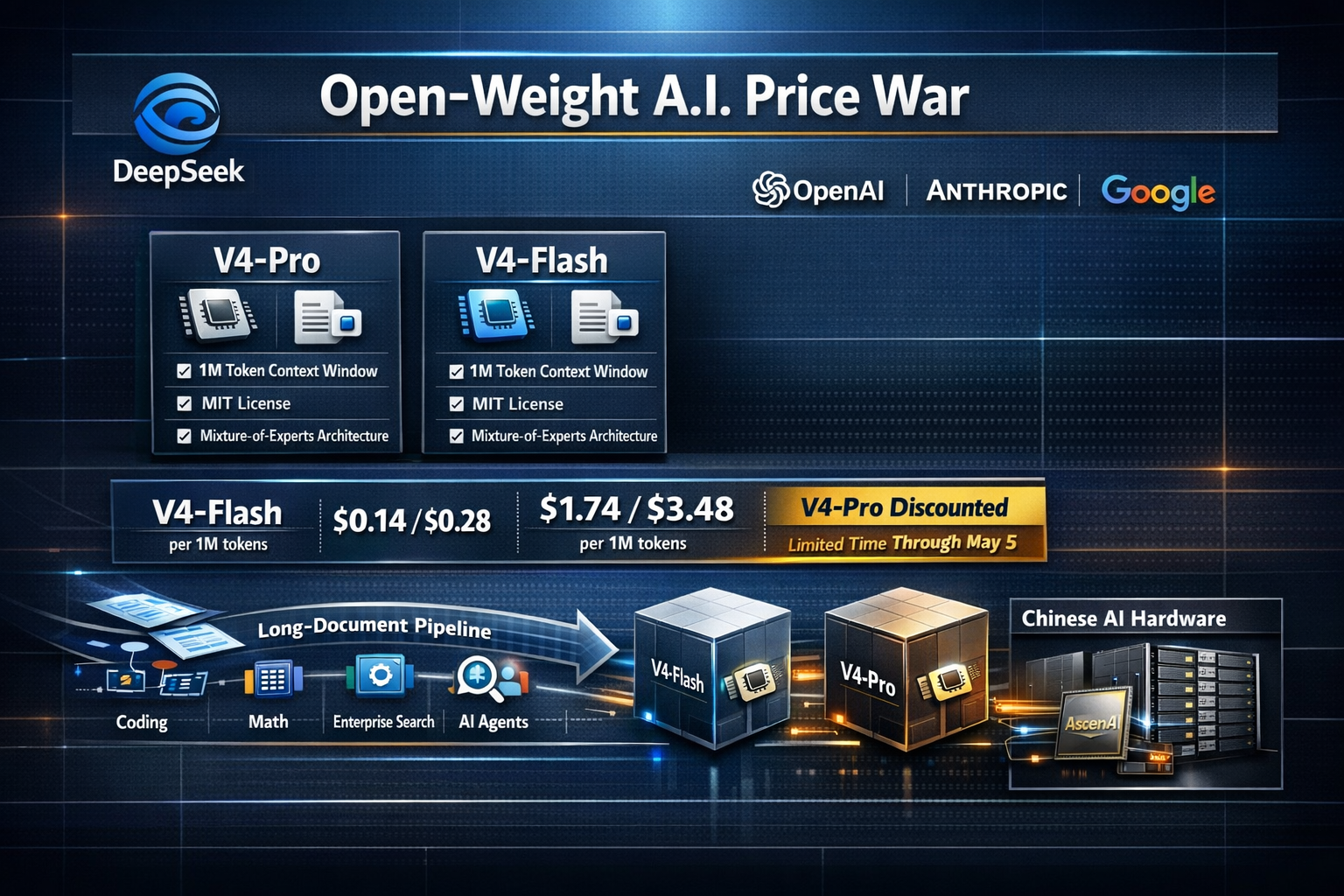
DeepSeek, the Chinese artificial intelligence lab that has become one of the most closely watched challengers to Silicon Valley’s leading model makers, on Thursday released preview versions of two new large language models that sharpen its challenge on an increasingly important front: not just capability, but cost.
The new models, DeepSeek-V4-Pro and DeepSeek-V4-Flash, are open-weight systems published under an MIT license and made available through the company’s API and on Hugging Face. Both support a context window of up to one million tokens — enough to ingest book-length documents, codebases or large archives of records in a single prompt — and both rely on mixture-of-experts architectures designed to activate only a portion of their parameters for each task.
By DeepSeek’s account, V4-Pro has 1.6 trillion total parameters with 49 billion active at a time, while V4-Flash has 284 billion total parameters with 13 billion active. The sheer size of the Pro model makes it one of the biggest openly released weight sets yet. But what has drawn as much attention as the raw scale is the pricing.
DeepSeek lists V4-Flash at 14 cents per million input tokens and 28 cents per million output tokens. V4-Pro’s standard price is $1.74 for input and $3.48 for output, though the company is offering a steep temporary discount through May 5 that cuts those rates to 43.5 cents and 87 cents. Even at the standard rate, the Pro model lands below many comparable flagship offerings from OpenAI, Anthropic and Google; the Flash tier comes in lower still.
That pricing has made the release feel less like a routine model update than a direct economic challenge to Western labs whose businesses have depended in part on premium inference margins.
Performance Close Enough to Matter
DeepSeek is not claiming outright supremacy over the best closed models from the United States. In its own technical paper, the company says the most advanced variant in the family still trails the latest top-tier systems by a modest margin on some reasoning tasks, roughly three to six months behind the frontier. But in the current market, “close” is increasingly enough to disrupt.
Independent benchmarking from Artificial Analysis has placed V4 Pro near the top of the open-weight field, ranking it No. 2 among open-weight reasoning models and putting it ahead of peers on an agent-focused benchmark known as GDPval-AA. Early attention has centered especially on coding, math and long-context tasks, areas where buyers are often willing to trade a slight performance gap for major cost savings.
That equation matters because the market for large language models is no longer driven solely by chatbots impressing consumers. More customers are deploying models inside software agents, coding assistants, customer-service workflows and enterprise search tools, where token costs can balloon quickly. A cheaper model with a very long context window can change the economics of what developers are willing to build.
This is part of why the V4 release has resonated so quickly among developers. A model that is “almost on the frontier,” as one prominent independent researcher described it, can become highly competitive if it is dramatically cheaper to run and permissively licensed to modify.
The Open-Weight Pressure Campaign
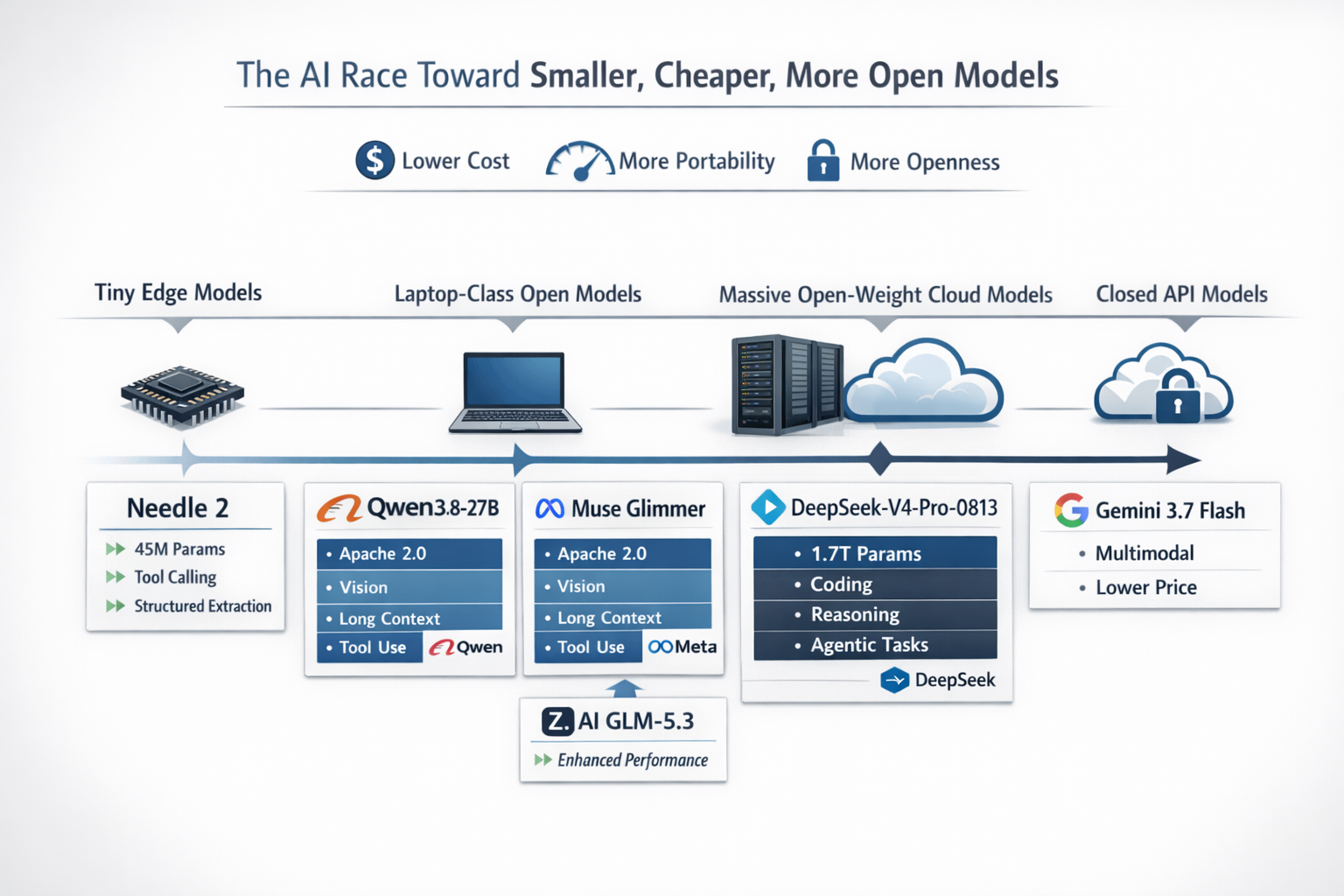
DeepSeek’s strategy also underscores a broader shift in the industry: some of the fiercest competition to closed American models is now coming from Chinese firms distributing open-weight systems.
That matters on several levels. Open-weight releases allow outside developers to inspect, fine-tune and in some cases run models on their own infrastructure, reducing dependence on a single provider. They can also compress prices across the market by giving startups and researchers a credible alternative to subscription or API lock-in from larger American companies.
For months, Western model makers have argued that their closed systems retained clear advantages in safety, reliability and top-end capability. Those arguments still carry weight, especially in high-stakes applications. But DeepSeek and other Chinese labs are testing whether a large enough share of the market will accept some trade-offs in exchange for lower cost, looser licensing and faster diffusion.
The V4 release reinforces that pressure. DeepSeek says it made substantial efficiency gains for long-context use, using a sparse attention design and token-wise compression to cut computational demands relative to its previous generation. In its technical materials, the company says that in a one-million-token setting, V4-Pro requires a fraction of the single-token floating-point operations of its predecessor, while V4-Flash cuts them further. Lower compute requirements, if they hold up in practice, help explain how the company can support aggressive pricing.
A Hardware Story, Too
The release is also being read as part of a broader Chinese push toward a more self-sufficient A.I. stack.
Reuters and other outlets have reported that DeepSeek adapted V4 for Huawei’s Ascend chips, and Huawei has said its Ascend supernode systems support the V4 series. At a moment when U.S. export controls have constrained China’s access to the most advanced Nvidia hardware, that is more than a technical footnote.
It suggests that Chinese labs are trying to prove they can keep advancing frontier-adjacent models on a hardware base that is less reliant on American suppliers. If that effort succeeds at scale, it could weaken one of Washington’s central assumptions: that limiting access to top-end chips will sharply slow China’s progress in advanced A.I.
That does not mean Huawei has solved the economics of frontier deployment, or that Ascend-based systems can yet match Nvidia’s ecosystem in ease, tooling and global developer support. Those remain open questions. But tying a competitive open model to a domestic hardware alternative makes the challenge more strategic.
The Caveats Beneath the Hype
For all the excitement, there are reasons for caution.
As with every major model release, the company’s own benchmarks are only an initial signal. Broader independent testing will determine how V4 performs across messier real-world workloads. Artificial Analysis, while rating the model strongly overall, has also noted a high hallucination rate. For businesses that need reliability over flair, that could limit adoption.
There is also uncertainty around how enduring DeepSeek’s price advantage will be. Promotional rates can help seize attention, but sustaining low prices across heavy usage is harder, especially for companies bearing the cost of serving long-context requests. Rival labs may respond with discounts of their own, narrowing the gap.
And geopolitics still hover over the field. U.S.-China tensions over export controls, model distillation and technology partnerships could shape where these systems are adopted and by whom. Some enterprises, particularly in the United States and Europe, may hesitate to build critical products on Chinese foundation models regardless of benchmark scores.
Why This Moment Matters
Even with those uncertainties, the significance of the release is hard to miss.
For much of the generative A.I. boom, the dominant story was that a handful of American firms were setting the pace at the frontier, while others followed at some distance. DeepSeek’s V4 models point to a more complicated reality. The gap in raw quality may still exist at the very top. But the gap is narrowing enough that pricing, openness and infrastructure flexibility are becoming decisive competitive weapons.
That is especially true in a market moving from demos to deployment. When developers and businesses start choosing models not for bragging rights but for token budgets, licensing terms and the ability to process huge amounts of information cheaply, a company like DeepSeek can exert influence disproportionate to whether it has built the single best model in the world.
In that sense, V4 is not just another release. It is a sign that the next phase of the A.I. race may be defined less by who is first to the frontier than by who makes frontier-level performance cheap enough, open enough and portable enough for everyone else to use.
Sources
Further reading and reporting used to add context:
- https://www.tomshardware.com/tech-industry/artificial-intelligence/deepseek-launches-1-6-trillion-parameter-v4-on-huawei-chips-as-us-escalates-ai-theft-accusations
- DeepSeek is back among the leading open weights models with V4 Pro and V4 Flash
- https://www.huaweicentral.com/deepseek-launches-new-v4-ai-models-running-on-huawei-chips/
- https://news.cgtn.com/news/2026-04-24/DeepSeek-unveils-new-AI-model-adapted-for-Huawei-chips-1MBU0eOEv9S/index.html
- DeepSeek V4 Preview Release | DeepSeek API Docs
- https://chat-deep.ai/news/deepseek-v4-release-tracker/
- https://www.factcheckradar.com/fact-check/deepseek-v4-release-timing-and-huawei-delay-claims
- https://discuss.huggingface.co/t/deepseek-v4-is-live-in-preview-should-your-team-switch/175560
- https://tech.yahoo.com/ai/articles/deepseek-v4-ai-model-launches-112737454.html
- https://neuralstackly.com/blog/deepseek-v4-huawei-chips-2026
- https://www.resultsense.com/news/2026-04-24-deepseek-v4-huawei-ascend-chips/
- https://www.asiafinancial.com/chinas-deepseek-says-new-v4-ai-model-can-run-on-huawei-chips
- https://www.pcgamer.com/software/ai/deepseek-has-reportedly-denied-nvidia-and-amd-early-access-to-its-new-v4-ai-model-giving-huawei-and-other-chinese-chipmakers-a-head-start/
- https://www.tomshardware.com/tech-industry/artificial-intelligence/deepseek-reportedly-urged-by-chinese-authorities-to-train-new-model-on-huawei-hardware-after-multiple-failures-r2-training-to-switch-back-to-nvidia-hardware-while-ascend-gpus-handle-inference
- https://www.tomshardware.com/tech-industry/deepseek-new-model-supports-huawei-cann
- https://en.wikipedia.org/wiki/DeepSeek
- https://www.reddit.com/r/DeepSeek/comments/1shw3uo/the_reason_why_deepseek_updates_are_so_slow/
- https://www.reddit.com/r/DeepSeek/comments/1su7rzr/deepseek_v4_dropped_16t_params_and_1m_context/
- https://www.reddit.com/r/DeepSeek/comments/1sviet2/openai_launched_gpt55_literally_hours_before_v4/
- https://www.reddit.com/r/Sino/comments/1sc4ucx/deepseeks_v4_model_will_run_on_huawei_chips/
- https://www.reddit.com/r/LLMeng/comments/1suawly/deepseek_v4_is_optimized_for_huawei_chips_this/
- https://www.investing.com/news/economy-news/factboxdeepseekv4-the-chinese-ai-model-adapted-for-huawei-chips-4636025
- https://techcrunch.com/2026/04/24/deepseek-previews-new-ai-model-that-closes-the-gap-with-frontier-models/
- https://www.investing.com/news/stock-market-news/deepseek-releases-new-flagship-open-source-ai-model-v4-4634548
- https://www.investing.com/news/stock-market-news/deepseeks-v4-model-will-run-on-huawei-chips-the-information-reports-4597099
- https://www.modemguides.com/blogs/ai-news/deepseek-v4-pro-flash-open-source-release
- https://venturebeat.com/technology/deepseek-v4-arrives-with-near-state-of-the-art-intelligence-at-1-6th-the-cost-of-opus-4-7-gpt-5-5
- https://www.ajupress.com/view/20260427165070270
- https://www.breakingviews.com/columns/breaking-view/deepseek-moment-20-is-more-about-huawei-2026-04-24/
- https://www.martincid.com/technology-sv/deepseek-v4-launches-as-the-largest-open-source-ai-at-a-fifth-of-gpt-5s-cost/
- https://www.kucoin.com/news/flash/deepseek-v4-open-source-model-launches-with-1-6t-parameters-and-mit-license
- https://tech.yahoo.com/ai/articles/deepseek-launches-1-6-trillion-121500709.html
- https://www.reddit.com/r/DeepSeek/comments/1su5w0e/deepseekv4_preview_is_officially_live_opensourced/
- https://zeronoise.ai/posts/gpt-55-arrives-as-deepseek-opens-v4-and-agents-get-more-practical-hdfcxfm46p/download/pdf
- https://www.reddit.com/r/ArtificialInteligence/comments/1su4z4c/deepseek_v4_is_gpt_54_but_open_source_and_a/
- https://www.reddit.com/r/DeepSeek/comments/1su3ogh/deepseek_v4_preview/
- Models & Pricing | DeepSeek API Docs
- Factbox-DeepSeek-V4, the Chinese AI model adapted for Huawei chips By Reuters




Leave a Reply