
A New Phase in OpenAI’s Coding Push
OpenAI is pressing beyond the idea of artificial intelligence as a coding assistant and toward a more ambitious model: software agents that can take ownership of work, manage their own loops and hand results back for human review.
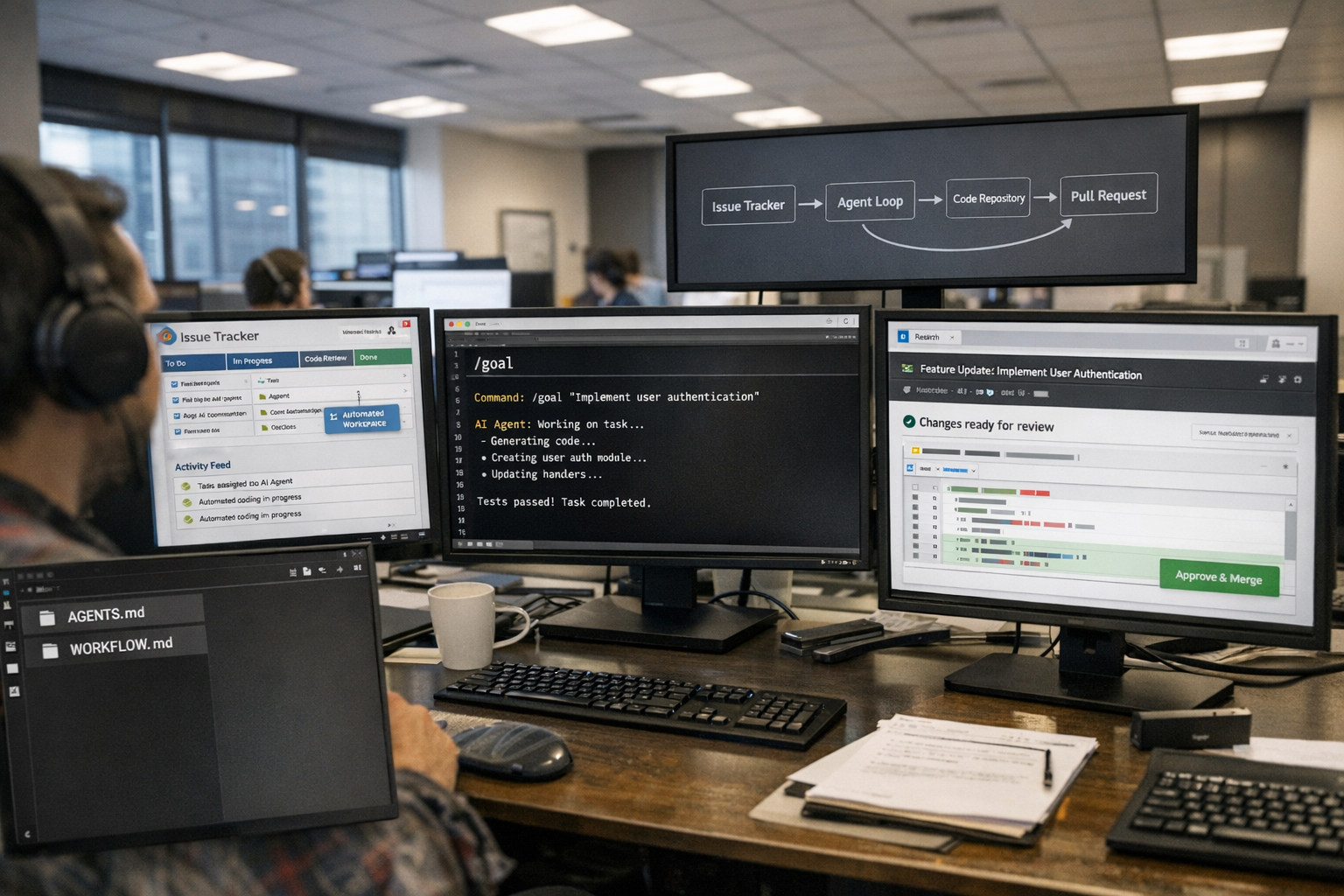
The latest signs of that shift arrived in two linked developments. OpenAI has released Symphony, an open-source specification for orchestrating Codex agents through issue trackers like Linear, and it has updated its Codex command-line tool to support a persistent `/goal` mode that lets an agent continue working until it decides a task is complete or hits a budget limit.
Taken together, the moves point to a broader change in how OpenAI wants AI to fit into engineering work. Rather than waiting for a developer to repeatedly prompt, supervise and redirect a model, the company is increasingly designing tools around delegated tasks that can run over longer periods with less direct oversight.
Turning the Issue Tracker Into the Control Plane
Symphony is framed as a specification and reference implementation, not a polished product. But its underlying idea is notable: the issue tracker becomes the system that coordinates AI work.
In that setup, an open ticket can trigger its own workspace and agent loop. The agent pulls the task, works against repository-specific instructions, and can be restarted if it stalls. Human developers are meant to spend less time “babysitting” multiple active sessions and more time reviewing what the agents produce.
OpenAI has argued that human attention, not raw model capability, is often the bottleneck. Internally, the company found that engineers could comfortably supervise only about three to five parallel Codex sessions before context switching began to erode the benefit. Symphony is an attempt to remove that chokepoint by making the workflow itself more autonomous.
The company has said some teams saw a 500 percent increase in landed pull requests in the first three weeks after adopting the new approach, though such figures are early and come from internal use rather than independent benchmarking.
From Prompting to Delegation
The same philosophy is visible in the new Codex CLI release. Version 0.128.0, released on April 30, adds a `/goal` workflow that allows a coding agent to persist across turns, with pause, resume and continue controls. Instead of handling one request at a time, the tool can keep looping on a broader objective until it judges the work finished or exhausts its configured token budget.
That may sound like a small interface change, but it marks a meaningful transition in product design. Coding tools built around chat have typically assumed a human stays in the loop at every step, nudging the model from subtask to subtask. Goal-based execution shifts the center of gravity: the human defines the destination, and the agent determines how long to keep going.
This approach resembles an emerging class of “agentic” systems in software development, where the challenge is no longer just code generation but persistence, orchestration and recovery from interruptions. The hard part becomes managing long-running work reliably enough that people can trust the system to handle a ticket without constant intervention.
The Broader Codex Strategy
The push fits into OpenAI’s larger effort to remake Codex as a software engineering platform rather than a simple autocomplete engine.
The company has already introduced Codex as a cloud-based agent capable of working on multiple software tasks in parallel. It has also described internal practices intended to make those agents more effective, including lightweight task queues and repository files such as `AGENTS.md` that provide durable context about how a codebase should be handled.
Symphony extends that pattern by pushing more of the workflow into shared infrastructure and repository policy. Files like `WORKFLOW.md` can define how tasks should be run, while Codex App Server provides the programmable runtime underneath. In effect, OpenAI is trying to make AI behavior less dependent on ad hoc prompting and more dependent on codified operating rules.
That matters because one of the main weaknesses of current AI coding systems is inconsistency. A model may perform well in a single session but struggle to maintain state, follow process or recover gracefully over the lifespan of a real engineering task. Formal orchestration specs are an attempt to narrow that gap.
Why the Timing Matters
The release comes as AI companies are competing to show that their tools can do more than answer questions or suggest snippets of code. Investors and enterprise customers increasingly want evidence that AI can absorb larger units of knowledge work — not just assist employees, but complete meaningful chunks of their jobs.
For OpenAI, that means proving Codex can support long-running research, tool use and computer-based work, not merely generate code in response to prompts. A system that can pull a ticket from Linear, execute against a repository’s workflow rules and return a pull request is a much stronger claim about automation than a chatbot that writes a function on demand.
It is also a strategically important follow-on to earlier attention around OpenAI’s partnerships and enterprise distribution. The more consequential question now is not who bundles the tools, but whether the tools can actually change the way technical teams operate.
The Limits of Autonomy
OpenAI’s own materials suggest caution. Symphony is intentionally minimal, and the company says organizations still need to define their own trust and safety posture. In more sensitive environments, that could mean tighter approvals, stronger sandboxing or narrower permissions for what an agent is allowed to access and modify.
There is also the unresolved question of how much human review remains necessary in practice. Some work — especially where requirements are ambiguous or trade-offs are subjective — still depends on interactive judgment. An agent may be able to complete many well-scoped tasks, but software development often involves deciding what should be built, not merely implementing what has already been specified.
And while issue trackers are a natural place to organize work, turning them into always-on agent systems introduces new governance questions. If agents can continuously pick up and act on tasks, companies will have to think more carefully about audit trails, failure recovery and who is accountable when an automated workflow makes a bad change.
A Glimpse of the Next Workplace Interface
Even with those caveats, the direction is becoming clearer. OpenAI is moving from tools that require constant human steering toward systems designed to be assigned work and left to pursue it.
That does not mean programmers are disappearing from the process. But it does suggest that their role may shift further toward setting objectives, defining workflow rules, reviewing outputs and intervening only when something unusual happens.
For now, Symphony is only a reference implementation, and OpenAI is not presenting it as a fully managed platform. But as a signal of intent, it is hard to miss. The company appears to be betting that the next important frontier in AI coding is not better autocomplete, but better delegation.
Sources
Further reading and reporting used to add context:
- An open-source spec for Codex orchestration: Symphony. | OpenAI
- https://help.openai.com/en/articles/11096431-openai-codex-cli-getting-started
- https://help.openai.com/en/articles/11381614
- https://help.openai.com/es-es/articles/11369540-using-codex-with-your-chatgpt-plan
- https://openai.com/cs-CZ/index/introducing-codex/
- https://help.openai.com/id-id/articles/11369540-using-codex-with-your-chatgpt-plan
- https://help.openai.com/ko-kr/articles/11369540-chatgpt-%ED%94%8C%EB%9E%9C%EC%97%90%EC%84%9C-codex-%EC%82%AC%EC%9A%A9%ED%95%98%EA%B8%B0
- https://help.openai.com/pt-br/articles/11369540-como-usar-o-codex-com-seu-plano-do-chatgpt
- https://openai.com/ja-JP/codex//
- https://github.com/openai/codex/releases
- https://openai.com/index/unrolling-the-codex-agent-loop/
- https://openai.com/ja-JP/index/unrolling-the-codex-agent-loop/
- https://cdn.openai.com/pdf/6a2631dc-783e-479b-b1a4-af0cfbd38630/how-openai-uses-codex.pdf
- https://cdn.openai.com/pdf/8df7697b-c1b2-4222-be00-1fd3298f351d/codex_system_card.pdf
- https://newreleases.io/project/github/openai/codex/release/rust-v0.128.0
- https://chilikanal.de/artikel/openais-codex-cli-0-128-0-bringt-goal-der-agent-loopt-bis-zur-zielerreichung-d8464e
- https://www.codexworkshop.com/research/codex-cli-workflows-20260501-0511
- https://pulso.aegismain.com/c/256-codex-cli-0-128-0-agrega-goal
- https://tectontide.com/en/blog/codex-goal-six-hour-run
- https://zenn.dev/suwash/articles/codex_goal_20260502
- https://github.com/openai/codex/actions/runs/17427466615
- https://inference.finepocket.app/en/c/8dccd0a4-0011-4f73-9a92-2fccf557500b
- https://molayo1419.me/insights/codex-cli-0-128-0-%EC%97%90%EC%84%9C-goal-%EC%B6%94%EA%B0%80-macdl2
- https://toolarium.ru/openai-codex-goal/
- https://www.reddit.com/r/CodexAutomation/comments/1t0l4eo/codex_cli_update_01280_persistent_goal_workflows/
- https://en.wikipedia.org/wiki/OpenAI_Codex_%28AI_agent%29
- https://www.reddit.com/r/codex/comments/1qwge41/where_to_find_changelog_of_codex_app/
- https://www.reddit.com/r/CodexAutomation/comments/1svmwe5/codex_cli_update_01250_unix_socket_appserver/
- https://www.reddit.com/r/CodexAutomation/comments/1srmug7/codex_cli_update_01220_selfcontained_installs/
- https://www.reddit.com/r/CodexAutomation/comments/1stxxph/codex_cli_update_01240_quick_reasoning_controls/
- https://www.reddit.com/r/CodexAutomation/comments/1rfrqtq/codex_cli_update_01060_direct_install_script_v2/
- https://www.reddit.com/r/ChatGPTCoding/comments/1lihahq
- https://www.reddit.com/r/CodexAutomation/comments/1std7uu/codex_cli_update_01230_bedrock_provider_mcp/
- https://www.reddit.com/r/CodexAutomation/comments/1s8ysxk/codex_cli_update_01180_proxyonly_windows_sandbox/
- https://www.reddit.com/r/CodexAutomation/comments/1sicqz2/codex_cli_update_01190_realtime_voice_v2_by/
- https://www.reddit.com/r/CodexAutomation/comments/1s4ygp0/codex_cli_update_01170_debugging_with_threadstate/
- https://www.reddit.com/r/codex/comments/1oix4as
- https://openai.com/index/introducing-codex/
- https://openai.com/business/guides-and-resources/how-openai-uses-codex/
- https://openai.com/index/introducing-gpt-5-3-codex/
- https://openai.com/academy/codex/
- https://openai.com/ms-BN/index/introducing-gpt-5-3-codex-spark/
- https://openai.com/ru-RU/index/introducing-codex/
- https://openai.com/ar/index/introducing-codex/
- https://openai.com/ro-RO/index/introducing-codex/
- https://openai.com/index/scaling-codex-to-enterprises-worldwide
- https://openai.com/et-EE/index/introducing-codex/
- https://the-decoder.com/openai-says-human-attention-is-the-bottleneck-so-it-built-a-system-to-let-agents-manage-themselves/
- https://the-decoder.com/
- https://the-decoder.com/former-openai-researcher-says-current-ai-models-cant-learn-from-mistakes-calling-it-a-barrier-to-agi/
- https://the-decoder.com/ai-industry-finds-its-2026-narrative-as-openai-and-microsoft-argue-users-are-the-bottleneck-not-models/
- https://the-decoder.com/openai-officially-confirms-mega-funding-round-and-chatgpt-super-app/
- https://the-decoder.com/ai-models-can-barely-control-their-own-reasoning-and-openai-says-thats-a-good-sign/
- https://the-decoder.com/andrej-karpathy-says-humans-are-now-the-bottleneck-in-ai-research-with-easy-to-measure-results/
- https://the-decoder.com/openai-unveils-gpt-5-5-claims-a-new-class-of-intelligence-at-double-the-api-price/
- https://the-decoder.com/openai-ceo-altman-admits-he-broke-his-own-ai-security-rule-after-just-two-hours-says-were-all-going-yolo/
- https://the-decoder.com/andrej-karpathy-says-programming-is-unrecognizable-now-that-ai-agents-actually-work/
- https://the-decoder.com/openai-develops-six-layer-context-system-to-help-employees-navigate-600-petabytes-of-data/
- https://the-decoder.com/openais-leaked-memo-says-new-spud-model-will-make-all-its-products-significantly-better/
- https://the-decoder.com/wp-content/uploads/2024/08/whistleblower-sb1047-letter.pdf
- https://the-decoder.com/wp-content/uploads/2024/08/anthropic-sb1047-letter.pdf
- https://the-decoder.com/wp-content/uploads/2024/08/openai_sb1047-letter.pdf
- https://the-decoder.com/wp-content/uploads/2025/12/The-Legend-of-Zelda_shrine_puzzle_gemini.pdf
- An open-source spec for Codex orchestration: Symphony. | OpenAI
- Introducing Codex | OpenAI







Leave a Reply