
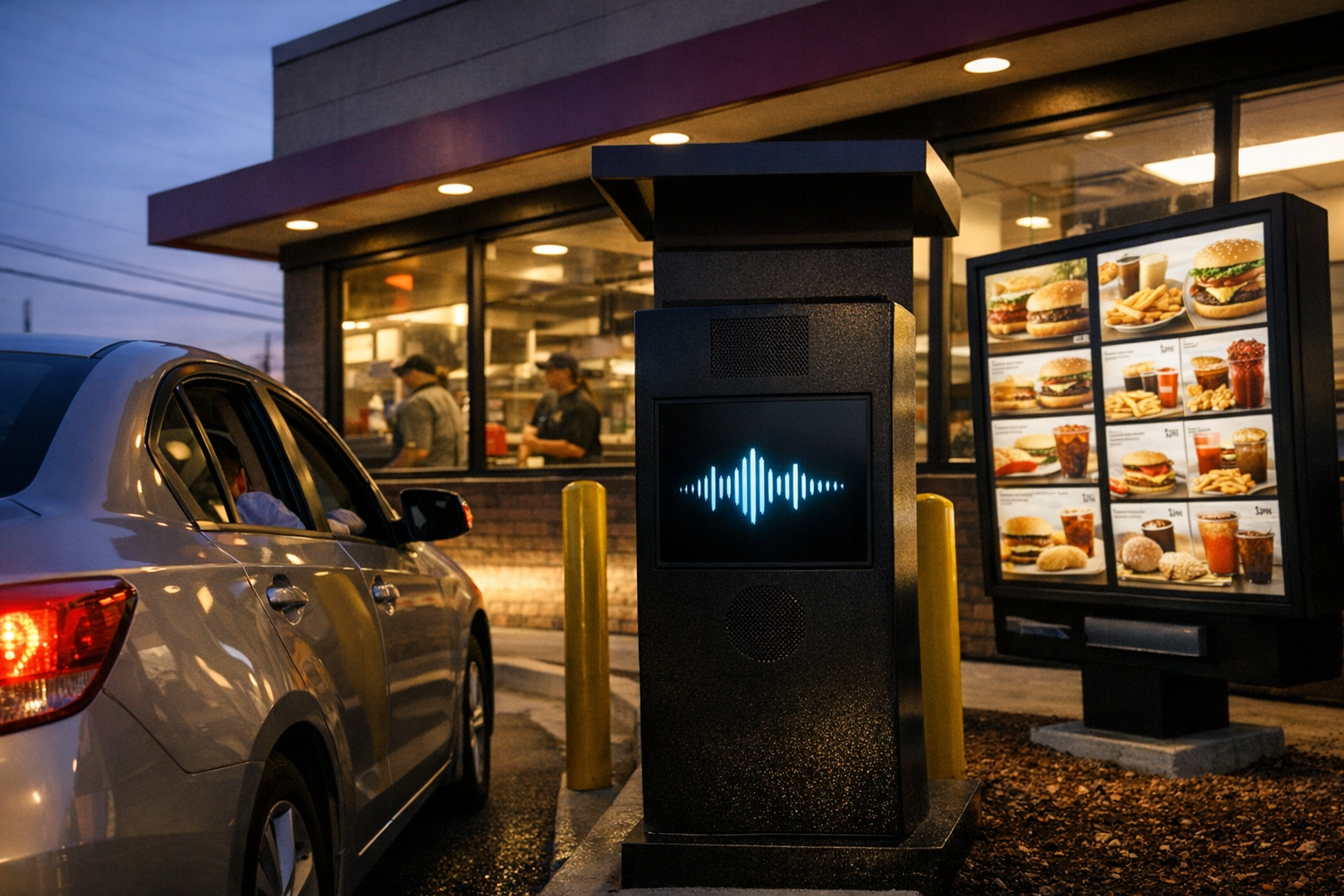
The Bot at the Speaker Box
The next person taking a fast-food order may not be a person at all.
As artificial intelligence has spread through software coding, office productivity and search, companies are now pressing it into a more public role: speaking directly with customers, answering product questions, resolving service requests and, increasingly, handling transactions that once required a worker on the other end.
That shift became clearer this summer as McDonald’s began testing a Google-powered A.I. drive-thru ordering system at five U.S. restaurants, while OpenAI introduced a new enterprise platform, OpenAI Presence, aimed at helping businesses put voice and chat agents into live customer-service and internal workflows. In Japan, Yamada Denki, working with the robotics and A.I. company avatarin, rolled out a 24-hour multilingual retail support agent for shoppers.
Taken together, the moves point to a new phase for commercial A.I.: less about impressive demonstrations, more about whether bots can reliably do frontline service work at scale.
From Assistants to Frontline Workers
For several years, companies used generative A.I. largely behind the scenes — drafting emails, summarizing meetings, helping programmers write code, or answering internal employee questions. What is changing now is where the technology shows up.
Instead of assisting workers in the background, these systems are being positioned as the first point of contact with consumers in revenue-generating and support-heavy settings: drive-thrus, call centers, retail advice desks and online service channels.
OpenAI’s new Presence offering reflects that change in ambition. Announced on July 22, it is not a self-serve software product but a managed platform for deploying voice and chat agents in what the company describes as high-volume, high-stakes workflows. The system is designed for customer-service operations as well as internal business tasks, with built-in monitoring, testing, guardrails, integrations and pathways for human escalation.
The fact that OpenAI is offering engineering support rather than simply handing customers a tool underscores what many businesses have discovered: the main challenge is no longer just whether a model can generate plausible language. It is whether an A.I. agent can perform consistently in messy, real-world conditions, without making enough errors to hurt a brand.
Fast Food Tries Again
That is especially true in fast food, where speed, accuracy and customer patience are all in short supply.
McDonald’s said in June that it was testing an English- and Spanish-language A.I. drive-thru system known as ArchIQ at five U.S. locations. The company has said early orders showed a high degree of automation, though the pilot remains limited.
The experiment comes after a previous generation of A.I. ordering systems in fast food ran into public setbacks. McDonald’s had shelved an earlier test in 2024 after conspicuous errors, reinforcing a broader lesson in service automation: customers may tolerate some friction from a human worker during a rush, but they are often less forgiving when a machine gets the order wrong in a way that feels avoidable or absurd.
Even so, restaurant chains have kept pushing ahead. Taco Bell and Wendy’s have also continued investing in automated ordering, betting that improvements in speech recognition, language models and multilingual support could make the economics more attractive than earlier systems allowed.
For restaurants, the appeal is obvious. Drive-thru lanes are a major source of sales, but staffing them is expensive and difficult, particularly during late-night or peak-hour shifts. A system that can take orders accurately, upsell consistently and switch between languages without fatigue offers a tantalizing promise — if it works.
Retail’s New Sales Floor
Retailers, too, are experimenting with a more customer-facing form of A.I.
avatarin said it had built a 24/7 retail agent using OpenAI’s GPT-Realtime for Yamada Denki shoppers, offering multilingual support and helping guide customers through product selection and purchase. The companies said that 30,000 people used the service in its first two weeks and that 92 percent of survey responses were positive.
The significance of such tools is not merely that they can answer questions after hours. Retailers increasingly want agents that can operate across chat, voice and multiple languages, while staying connected to inventory systems, product catalogs and checkout flows. In that sense, the new generation of retail bots is being marketed less as an FAQ layer and more as a digital sales associate.
That ambition depends heavily on improvements in live speech technology. OpenAI and other vendors have recently promoted realtime products for transcription, translation and voice interaction, including systems meant to reduce delays and improve turn-taking in conversation. Those advances lower the practical barrier to putting A.I. in direct contact with customers who expect a smooth exchange, not a stilted sequence of prompts.
The Real Product Is Reliability
If there is a central theme in this new wave of deployments, it is that reliability and governance have become as important as raw model capability.
OpenAI’s Presence platform is notable in part because it emphasizes production support: testing, oversight, integrations and human backup. It is being offered in limited general availability, not as a mass-market tool anyone can switch on in minutes. The company says deployments are supported by its own engineers and systems integrators, a sign that enterprise customers still need significant hand-holding before entrusting A.I. with sensitive or high-volume interactions.
That approach echoes a wider industry understanding. Plenty of companies can now produce a chatbot demo. Far fewer can put one into a customer-service queue, connect it to business systems, manage legal and brand risks, and ensure that a failed conversation is handed off smoothly to a person.
Some vendors say they are already reaching scale. OpenAI partner Parloa has said its agents handle millions of conversations in sectors like retail, travel and insurance. But broad adoption may depend less on excitement around the technology than on whether businesses can prove stable performance over time.
The Stakes Beyond Efficiency
The appeal of service automation is often framed in terms of labor costs and around-the-clock availability. But the stakes are broader.
For companies, reducing routine interactions handled by people could improve margins and address hiring challenges. For customers, better language translation and nonstop access could make service easier, especially in multilingual or global settings.
Yet the risks are equally clear. If fewer human touchpoints remain, the ones that do become more important. A botched order, a misunderstood request or a dead-end support conversation can quickly shape how a brand is perceived. And while automation may absorb repetitive tasks, it also raises unresolved questions about staffing, job quality and what kind of human oversight must remain in place.
For now, the momentum is unmistakable. The latest A.I. push in service industries is no longer centered on whether a chatbot can hold a conversation. It is centered on whether companies can trust these systems to represent them in public — at the speaker box, on the sales floor and in the support queue — when the conversation actually matters.
Sources
Further reading and reporting used to add context:
- https://openai.com/index/introducing-openai-presence/
- OpenAI Presence | OpenAI Help Center
- https://openai.com/news/company-announcements/
- https://openai.com/hy-AM/index/introducing-openai-presence/
- McDonald's testing new AI ordering technology at some drive-thrus – ABC News
- https://openai.com/ar/index/introducing-openai-presence/
- https://openai.com/index/advancing-the-next-era-of-national-science/
- https://openai.com/uk-UA/index/introducing-openai-presence/
- https://openai.com/id-ID/index/introducing-openai-presence/
- https://openai.com/fa-IR/index/introducing-openai-presence/
- https://openai.com/hr-HR/index/introducing-openai-presence/
- https://fortune.com/2026/05/26/ai-drive-thru-a16z-arc-taco-bell-mcdonalds-fast-food/
- https://www.reddit.com/r/wendys/comments/1v9lwsb/ai_ordering_at_drivethru/
- https://www.reddit.com/r/GenAI4all/comments/1u3obbb/mcdonalds_is_replacing_drivethru_workers_with_an/
- https://www.reddit.com/r/RetailNews/comments/1vb6fnv/fastfood_execs_keep_pushing_for_more_ai_systems/
- https://www.reddit.com/r/McDonalds/comments/1txzv22/mcdonalds_just_announced_a_big_change_to_its/
- https://www.reddit.com/r/NoStupidQuestions/comments/1tm77fj/is_ai_ever_going_to_take_over_fast_food_and/
- https://www.reddit.com/r/WorkReform/comments/1urdi09/ah_hell_no_i_have_problems_with_fast_food_but/
- https://www.reddit.com/r/InterstellarKinetics/comments/1typ9yf/backlash_mcdonalds_has_announced_it_is_rolling/
- https://www.reddit.com/r/antiai/comments/1v6pqng/just_a_little_story_of_something_that_happened/
- https://www.reddit.com/r/mildlyinfuriating/comments/1rpo5js/popeyes_ai_took_my_drive_thru_order_and_its_ass/
- https://www.reddit.com/r/antiai/comments/1tcctd9/ai_at_the_drivethrough/
- https://www.reddit.com/r/fuck_ai_slop/comments/1uwoijh/restaurants_using_ai_for_drivethru/
- https://www.reddit.com/r/McDonalds/comments/1tz3vtq/mcdonalds_introduces_ai_drivethru_system_sparking/
- https://deploymentsafety.openai.com/gpt-live/gpt-live.pdf
- https://cdn.openai.com/pdf/21b88bb5-10a3-4566-919d-f9a6b9c3e632/openai-ostp-rfi-oct-27-2025.pdf
- https://developers.openai.com/api/docs/models/gpt-realtime
- https://developers.openai.com/api/docs/models/gpt-realtime-1.5
- https://developers.openai.com/api/docs/models/gpt-realtime-2
- https://developers.openai.com/api/docs/models/gpt-realtime-2.1
- https://developers.openai.com/api/docs/models/gpt-realtime-mini
- https://openai.com/index/advancing-voice-intelligence-with-new-models-in-the-api/
- https://openai.com/index/introducing-gpt-realtime/?_bhlid=c917f7290320f580f989219a969f3e1737ea3a76
- https://developers.openai.com/api/docs/models/gpt-realtime-2.1-mini
- https://community.openai.com/t/introducing-gpt-realtime-and-realtime-api-updates-for-production-voice-agents/1355039
- https://developers.openai.com/api/docs/models/all
- https://openai.com/index/introducing-gpt-realtime/?_bhlid=764e81dd0e3539f9cb12f6e04734dd29582e2954
- https://openai.com/tr-TR/index/introducing-gpt-realtime/
- https://cdn.openai.com/11998be9-5319-4302-bfbf-1167e093f1fb/Native_Image_Generation_System_Card.pdf
- https://prtimes.jp/main/html/rd/p/000000040.000057072.html
- https://about.avatarin.com/wp-content/uploads/2026/02/%E3%80%90%E5%85%B1%E5%90%8C%E3%83%AA%E3%83%AA%E3%83%BC%E3%82%B9fnl_web%E3%80%91%E3%80%8C%E3%81%8F%E3%82%89%E3%81%97%E3%81%BE%E3%82%8B%E3%81%93%E3%82%99%E3%81%A8AI%E3%82%A8%E3%83%BC%E3%82%B7%E3%82%99%E3%82%A7%E3%83%B3%E3%83%88%E3%80%8D%E3%81%AE%E9%96%8B%E7%99%BA%E3%82%92%E9%96%8B%E5%A7%8B.pdf
- https://www.itmedia.co.jp/news/spv/2405/21/news146.html
- https://note.com/yasuhitoo/n/ne7832ec9818b?hl=en
- https://openai.github.io/openai-agents-python/realtime/guide/
- https://www.247.ai/insight/247-ai-universal-agent-model-elevates-chat-operations-for-us-home-improvement-leader/
- https://www.leadlock.ai/blog/deploy-an-openai-gpt-realtime-ai-receptionist-for-an-auto-dealership/
- https://www.fidelity.com/news/article/technology/202605261800BIZWIRE_USPR_____20260526_BW635751
- https://community.openai.com/t/gpt-realtime-1-5-is-live-in-realtime-api/1374919/16
- https://www.agentpmt.com/articles/field-sales-ai-hits-hardware-aisles-and-dealer-floors
- https://www.sprinklr.com/blog/voice-bot-gpt-realtime/
- https://www.chaterimo.com/articles/state-of-ai-customer-support-2026/
- https://arxiv.org/abs/2302.13795
- https://arxiv.org/abs/2303.08774
- https://arxiv.org/abs/2303.18027
- https://openai.com/index/uber/
- https://openai.com/index/podium/
- https://openai.com/index/parloa/
- https://openai.com/index/1-million-businesses-putting-ai-to-work/
- https://openai.com/index/lowes/
- https://openai.com/index/buy-it-in-chatgpt/
- https://openai.com/index/target-partnership/
- https://openai.com/index/openai-support-model/
- https://openai.com/index/ada/
- https://openai.com/index/instacart-partnership/
- https://openai.com/index/inside-our-in-house-data-agent/
- https://cdn.openai.com/business-guides-and-resources/a-practical-guide-to-building-agents.pdf
- https://cdn.openai.com/pdf/7ef17d82-96bf-4dd1-9df2-228f7f377a29/the-state-of-enterprise-ai_2025-report.pdf
- https://www.lcpdfr.com/downloads/gta5mods/scripts/46108-lspdfr-expanded/page/15/
- https://manualzz.com/doc/35609732/
- https://appsrankings.com/app/297606951/amazon-shopping
- https://podscripts.co/podcasts/the-joe-rogan-experience/1944-ryan-long
- https://podscripts.co/podcasts/painkiller-already/pka-760-w-santizap-interviewing-hulk-hogan-and-insulting-him
- https://cwe.mitre.org/data/slices/1450.html
- https://altathiemen.wordpress.com/
- https://patents.justia.com/patent/7987491
- https://www.scribd.com/document/730767614/wallstreetjournal-20240409-TheWallStreetJournal
- https://www.packagedesign.app/onlyfans/best/natural-tits-onlyfans
- https://www.podcasts-online.org/es/the-perfect-show-1579838291
- https://bcajonline.org/mail_category/from-the-president/
- https://oregonnews.uoregon.edu/lccn/sn97071090/1945-04-10/ed-1/seq-7.pdf
- https://openai.com/my-MM/index/strengthening-chatgpt-responses-in-sensitive-conversations/
- https://cdn.openai.com/pdf/small-business-jam-report-dec-2025.pdf
- https://community.openai.com/t/chatgpt-4o-very-positive-feedback/1218866
- https://community.openai.com/t/back-to-the-worse-shorter-responses-already/742239
- https://cdn.openai.com/papers/15987609-5f71-433c-9972-e91131f399a1/openai-affective-use-study.pdf?_bhlid=2aefa488396d3be81f9abb3935e45478e4855b46
- https://community.openai.com/t/please-stop-reducing-the-character-limit-for-gpt-4/244833
- https://forum.openai.com/public/videos/whose-opinions-do-language-models-reflect-2023-09-13
- https://cdn.openai.com/pdf/a794887b-5a77-4207-bb62-e52c900463f1/penda_paper.pdf?_bhlid=b24e5a34222dc25fdf60cdb275019625dbadcb48
- https://community.openai.com/t/integration-of-emotional-intelligence-in-ai-development-of-rational-emotion-pattern-concepts-and-metrics/830018?page=4
- https://cdn.openai.com/pdf/a794887b-5a77-4207-bb62-e52c900463f1/penda_paper.pdf
- https://community.openai.com/tag/feedback/51
- https://community.openai.com/t/emotional-intelligence-in-ai-rational-emotional-patterns-rem-and-ai-specific-perception-engine-as-a-balance-and-control-system/994060
- https://cdn.openai.com/papers/gpt-4-system-card.pdf?trk=public_post_comment-text
- https://community.openai.com/t/the-official-imagegen-4o-and-dall-e-megathread/1230134?page=92
- https://community.openai.com/t/games-inc-by-mitchell-creator-of-gpt-hub-ai-tools-and-ogl-rpg-systems/927343
- https://community.openai.com/tag/gpt/364
- https://community.openai.com/t/beyond-chatbots-building-an-ai-persona-that-users-treat-like-a-real-person/1160191
- https://huggingface.co/spaces/GotThatData/semantic-scalpel/blob/main/README.md
- https://www.coupang.com/vp/products/9438470697
- https://www.globalpokerindex.com/tournaments/2023/south-korea/grand-poker-tour-gpt-no-limit-hold-em-8-max-high-roller-1223364/
- https://aktienkurs-orderbuch.finanznachrichten.de/vvv3.htm
- https://www.linkedin.com/pulse/weekly-updates-jun-29nd-2026-gustavo-garc%C3%ADa-sgaue
- https://www.speakrj.com/audit/report/UCWp2Kj8aD9XlCGiIZzwHciw/youtube/live/
- https://www.linkedin.com/posts/etienne-coursimault-16242775_at-a-time-when-token-pricing-is-likely-to-activity-7455812876969291776-JbGz
- https://www.linkedin.com/pulse/how-choose-llm-2026-rajnish-dasari-cisa-cpew-ccio-ivoef
- https://adamkarvonen.github.io/machine_learning/2024/03/20/chess-gpt-interventions.html
- https://agentwiki.org/how_to_handle_rate_limits
- https://huggingface.co/papers?q=in-car+voice+assistant
- https://epoch.ai/publications/can-ai-scaling-continue-through-2030
- https://www.alapan.org/fckimages/file/xolewijudo_dojozaguk.pdf
- https://www.reddit.com/r/singularity/comments/1gqn099
- https://www.jo-hubert.fr/upload/files/9c33b3fe-38f0-452f-a944-6cb945234649.pdf
- https://dimensioninteractive.com/WYSIWYGImage/file/8693819461.pdf
- https://tengokusoku1919.com/js/ckfinder/userfiles/files/e6c74249-8e47-4662-840f-d04bde47070b.pdf
- https://www.reddit.com/r/Sino/comments/1v2jdlj/removed/







Leave a Reply