
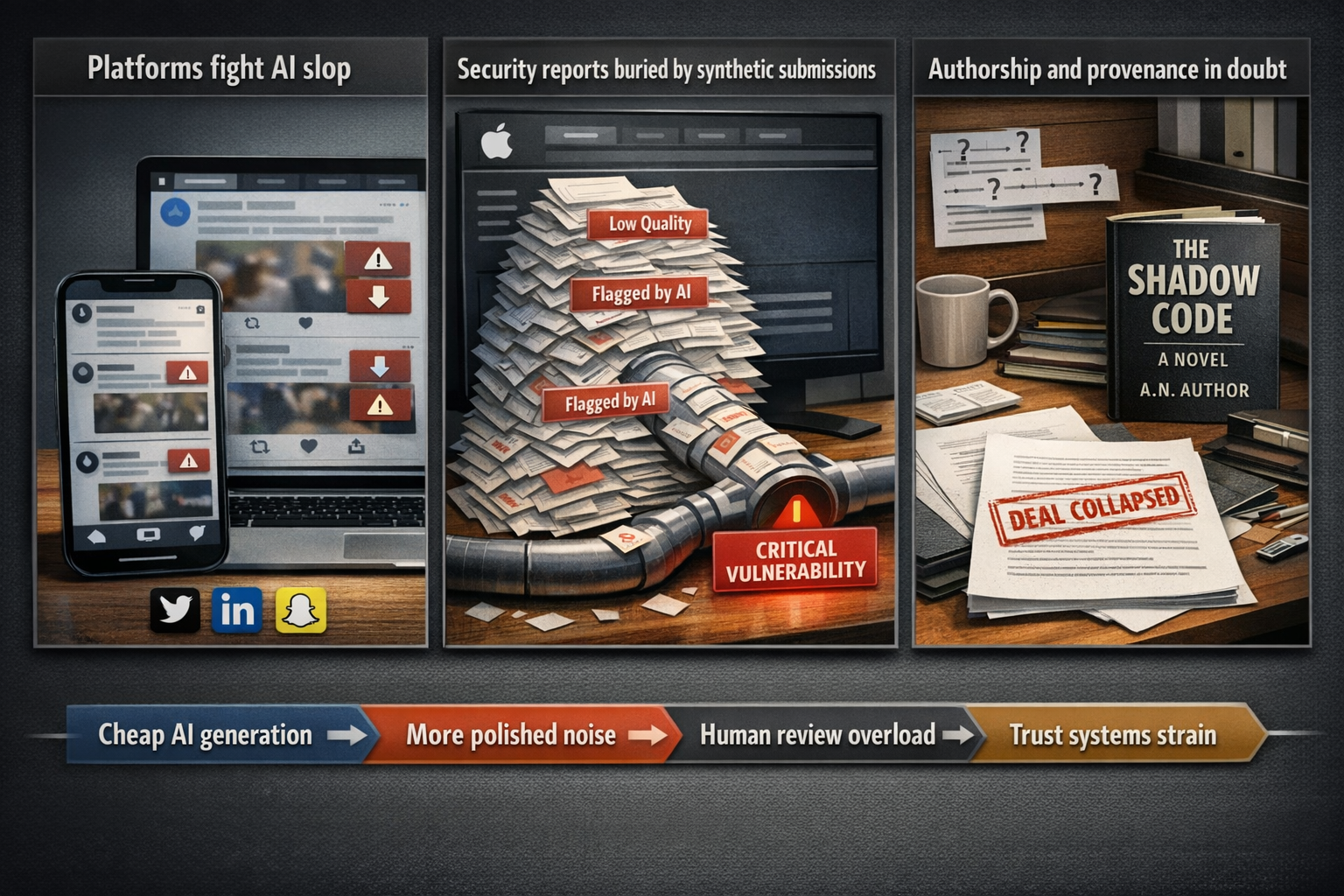
A flood of machine-made material once dismissed as mere internet clutter is becoming something more consequential: a strain on the systems that platforms, companies and creative industries rely on to separate what is real, useful and original from what is not.
In recent days, that pressure has surfaced in sharply different corners of the digital economy. Social media companies are adding new controls to curb low-quality AI-generated posts. Apple’s bug-reporting pipeline has been so burdened by fabricated or weak AI-assisted submissions that a legitimate macOS vulnerability was delayed from reaching the company. And in publishing, a much-watched crime novel deal reportedly worth more than $2 million fell apart after questions arose over whether the manuscript’s development could be authenticated.
Taken together, the episodes point to a broader quality crisis: as generative AI makes it cheap to produce polished text, video and images at industrial scale, institutions built around trust and review are struggling to keep up.
Platforms Move Against “AI Slop”
On social platforms, the problem is visible most plainly in feeds increasingly crowded with repetitive, emotionally manipulative or generic synthetic content designed to harvest attention.
On X, viral AI-generated melodramas — morality-play posts in which innocence, cruelty and justice are arranged for maximum outrage and uplift — have been drawing millions of views and generating revenue for their creators. The posts often present themselves with the pace and emotional force of human storytelling, even when they are largely assembled by AI systems and optimized for clicks.
Other platforms are beginning to treat that as more than an annoyance. LinkedIn said earlier this year that it was demoting generic AI-heavy posts and comments, describing “AI slop” as polished-sounding content that adds little genuine insight. The company has also introduced a dedicated reporting option for users to flag such material. In June, LinkedIn said early testing of its detection systems showed 94 percent accuracy, though that figure is company-reported and the longer-term effectiveness remains unclear.
Snap, meanwhile, has signaled a harder line in Spotlight, its short-form video feed. The company is barring fully AI-generated videos there, while still allowing content edited with Snapchat’s own AI tools. The distinction underscores the balancing act many platforms now face: they want to promote AI as a creative aid while preventing feeds from being overrun by synthetic, repetitive uploads that can be produced in vast quantities.
The economic logic behind the flood is straightforward. AI tools have dramatically lowered the cost of making content that looks finished enough to satisfy ranking systems and curious users. As researchers and journalists have documented for months, the incentive structures of social media still reward volume, novelty and emotional intensity, even when the underlying material is formulaic or misleading. That has made low-effort AI output not just easy to create, but profitable.
A Security Bottleneck
The same economics are now affecting systems far removed from consumer feeds.
Apple has tightened the rules of its bug bounty program as AI-generated submissions proliferate. The company now explicitly warns against AI-written reports and against issues surfaced by AI without proper validation, emphasizing that submissions must be complete, reproducible and actionable. Repeated ineligible, AI-heavy submissions can lead to a researcher being suspended from the program for 180 days.
The policy shift reflects an increasingly practical concern: overload. According to recent reporting, fabricated or low-quality AI-assisted bug reports have clogged Apple’s review pipeline badly enough that Bynario, an Italian startup, initially struggled to report a serious macOS flaw. The vulnerability was said to be potentially worth up to $200,000 on the black market.
Whether that particular case proves exceptional or emblematic, it has sharpened concern about what happens when cheap synthetic output collides with high-stakes triage systems. Bug bounty programs depend on human reviewers sorting genuine security findings from noise. If AI tools allow bad actors, opportunists or careless submitters to manufacture plausible-looking technical reports at scale, the cost is not only wasted reviewer time. Real vulnerabilities may sit longer without attention, and the overall trustworthiness of the channel can degrade.
Apple has not publicly detailed the full size of its backlog, and the extent to which valid reports have been delayed remains opaque. But the company’s tougher language suggests that the problem has moved beyond theory.
Publishing’s Authentication Problem
In publishing, the questions are less about feed ranking or cybersecurity than authorship itself.
A major deal for Jerry Falade’s debut crime novel, *Call Me, I’ll Hide the Body*, collapsed after agents said they could no longer authenticate how the manuscript evolved. The book had reportedly attracted an offer of more than $2 million from Minotaur, part of Macmillan U.S., after a 14-way auction, and was planned for publication in 2028. Falade has denied improper AI use.
The breakdown comes at a sensitive moment for an industry already unsettled by AI-assisted writing, disclosure disputes and uncertainty over where editing ends and machine authorship begins. Publishers have long relied on a mix of trust, contracts and editorial judgment to establish provenance. But generative AI has complicated those assumptions. A manuscript may be partly drafted, expanded, polished or reworked using tools whose contribution is difficult to reconstruct after the fact.
That ambiguity matters especially in high-stakes acquisitions, where a book is being sold not just as a text but as an author’s original voice and future career. In the Falade case, the public record remains incomplete, and the evidence behind the collapse has not been fully aired. Even so, the episode suggests that in some parts of publishing, the inability to verify a manuscript’s development may now be enough to imperil a major deal.
Why It Matters Now
What links these episodes is not simply the presence of AI, but the mismatch between the speed of generation and the slower work of verification.
Platforms can suppress generic posts, but only by refining moderation and ranking systems that were not built for endless volumes of competent-looking synthetic content. Security teams can tighten eligibility rules, but that still leaves humans to sort through growing piles of submissions. Publishers can ask for attestations and drafts, but proving how a creative work came into being is often difficult, especially after the fact.
In each case, the core institutions are confronting the same problem: trust systems can be overwhelmed faster than they can adapt.
For years, debates about generative AI often focused on aesthetics, ethics or labor. The latest wave of incidents points to a more operational concern. Low-value machine output is not only diluting quality; it is beginning to jam the channels through which attention is allocated, vulnerabilities are disclosed and cultural products are validated.
The challenge for companies and industries now is not whether AI-generated material will keep spreading. It is whether they can build filters, incentives and standards strong enough to keep useful systems from being buried under the synthetic noise.
Sources
Further reading and reporting used to add context:
- https://www.techradar.com/pro/i-cant-believe-its-taken-linkedin-so-long-to-push-back-against-ai-slop-but-will-its-changes-really-stop-all-the-cringey-updates
- https://www.macrumors.com/2026/07/21/apple-patches-hide-my-email-flaw/
- Keeping conversations real on LinkedIn
- https://www.washingtonpost.com/technology/2025/08/17/ai-video-slop-creators/
- https://www.linkedin.com/posts/snap-inc-co_we-had-some-april-fools-fun-yesterday-renaming-activity-7445546820145172480-kAVX
- https://www.theguardian.com/technology/2025/aug/11/cat-soap-operas-and-babies-trapped-in-space-the-ai-slop-taking-over-youtube
- https://support.apple.com/en-us/126348
- https://www.reddit.com/r/technology/comments/1vavfs8/linkedin_introduces_a_seems_like_ai_slop_button/
- https://www.reddit.com/r/antiai/comments/1vcbdg4/snapchat_bans_ai_videos_from_spotlight_platform/
- https://help.snapchat.com/hc/en-gb/articles/25494876770580-Generative-AI-on-Snapchat?lang=en-GB
- https://help.snapchat.com/hc/en-us/articles/49491042592532-What-is-an-AI-Sponsored-Snap
- https://values.snap.com/policy/creator-monetization-policy?lang=en-US
- https://www.reddit.com/r/InterstellarKinetics/comments/1vb6eac/exclusive_linkedin_has_smoothly_introduced_a_new/
- https://values.snap.com/privacy/transparency/community-guidelines/moderation
- https://www.reddit.com/r/technology/comments/1vc9bpa/snapchat_banning_entirely_aigenerated_videos_from/
- https://www.engadget.com/2191075/snap-will-no-longer-allow-younger-teens-spotlight-videos-to-be-publicly-viewable/
- https://9to5mac.com/2026/07/27/claude-codex-and-other-ai-tools-credited-in-todays-apple-security-releases/
- https://www.reddit.com/r/BetterOffline/comments/1vavzs2/linkedin_introduces_a_seems_like_ai_slop_button/
- https://www.reddit.com/r/linkedin/comments/1val00d/linkedin_just_rolled_out_an_ai_killer/
- https://www.reddit.com/r/macbook/comments/1usisml/removed/
- https://www.reddit.com/r/aiwars/comments/1vbx8rj/new_linkedin_feature/
- https://www.linkedin.com/posts/thedigitalthinker_digitalthinker-artificialintelligence-linkedin-activity-7472637862375727104-9anc
- https://www.linkedin.com/posts/sumonad_linkedin-is-now-using-ai-to-read-your-posts-activity-7470091793284546560-pxDJ
- https://news.linkedin.com/2026/authentic-content-and-conversations
- https://www.linkedin.com/help/linkedin/answer/a10346037
- https://www.linkedin.com/posts/ai-in-business-official_linkedins-war-on-ai-slop-is-not-just-a-policy-activity-7463317705618669568-EjXM
- https://www.linkedin.com/posts/davidkeenex_linkedin-doesnt-want-your-ai-slop-anymore-activity-7467895032340119552-ebde
- https://news.linkedin.com/2026/ImprovingTheFeed
- https://www.linkedin.com/pulse/linkedin-just-changed-rules-ai-content-heres-what-means-polotniana-t6o5e
- https://www.wired.com/story/theres-something-very-dark-about-a-lot-of-those-viral-ai-fruit-videos/
- https://www.linkedin.com/posts/melplaza_authenticity-leadership-aislop-activity-7469887606542057473-S96u
- https://www.linkedin.com/posts/fast-company_linkedin-declares-war-on-ai-slop-activity-7462873916588457985-_-Ad
- https://business.linkedin.com/content/dam/lem/business/en/advertise/agencies/pdfs/LLMs___the_Future_of_AI_Discovery_The_Agency_Opportunity.pdf
- https://business.linkedin.com/content/dam/lem/business/en/advertise/agencies/pdfs/Powering_AI_Visibility_with_LinkedIn.pdf
- https://business.linkedin.com/content/dam/business/marketing-solutions/global/en_US/site/pdf/wp/2025/the-art-and-science-of-video.pdf
- https://business.linkedin.com/content/dam/lem/business/en/hire/talent-connect/1110-1-how-are-you-using-ai-to-personalize-talent-engagement-v2%20%281%29.pdf
- https://learning.linkedin.com/content/dam/me/business/en-us/talent-solutions/resources/pdfs/li-ai-powered-coaching.pdf
- https://business.linkedin.com/content/dam/lem/business/en/hire/talent-connect/1361-what-becomes-possible-when-your-ai-has-real-talent-intelligence-v2.pdf
- https://www.macrumors.com/guide/vulnerabiltiies/
- https://support.apple.com/en-us/128073
- https://security.apple.com/bounty/
- https://www.macrumors.com/2026/07/20/clicklock-malware-mac-users-giving-up-passwords/
- https://blog.calif.io/p/apple-mie-exploitation-challenge
- https://security.apple.com/bounty/guidelines/
- https://www.reddit.com/r/apple/comments/1ukilw1/apple_hide_my_email_vulnerability_reveals_peoples/
- https://podcasts.apple.com/us/podcast/inside-the-ai-slop-propaganda-wars/id1703615331?i=1000758628732
- https://www.reddit.com/r/macbook/comments/1ummacx/removed/
- https://www.reddit.com/r/bugbounty/comments/1um855m/has_anyone_recently_reported_a_security/
- https://www.reddit.com/r/NoShitSherlock/comments/1uki1k1/apple_hide_my_email_vulnerability_reveals_peoples/
- https://security.apple.com/bounty/categories/
- https://www.reddit.com/r/bugbounty/comments/1v1n98m/removed/
- https://appleinsider.com/articles/26/07/20/clicklock-malware-makes-macs-unusable-until-victims-surrender-their-passwords
- https://www.reddit.com/r/bugbounty/comments/1upv5fa/removed/
- https://www.reddit.com/r/bugbounty/comments/1uzq86v/removed/
- https://www.reddit.com/r/bugbounty/comments/1va66h6/removed/
- https://www.reddit.com/r/bugbounty/comments/1usv6s5/removed/
- https://www.reddit.com/r/privacy/comments/1ukug0h/apple_hide_my_email_vulnerability_reveals_peoples/
- https://www.reddit.com/r/bugbounty/comments/1utt49n/removed/
- https://arxiv.org/abs/2604.15637
- https://thehackernews.com/2026/06/apple-patches-30-ios-macos-safari-flaws.html
- https://www.cyberkendra.com/2026/07/apple-mie-bypassed-by-two-macos-kernel.html
- https://arxiv.org/abs/2605.21378
- https://cdn.nca.gov.sa/api/files/public/upload/32c22bb8-71c4-4b4e-92fa-3c9ac0cbb806_Weekly_Vulnerabilities_Summary_10_May_to_16_May-.pdf
- https://cdn.nca.gov.sa/api/files/public/upload/a3828327-b32f-418b-bb6f-21c22f0c4e09_Weekly_Vulnerabilities_Summary_22_Mar_to_28_Mar—-.pdf
- https://cdn.nca.gov.sa/api/files/public/upload/8d480d91-bddb-45b9-8f85-877c75b56d70_Weekly_Vulnerabilities_Summary_27_Jul_to_02_Aug—Copy.pdf
- https://www.wired.com/story/made-in-china-the-chinese-creator-who-imitates-ai-slop/
- https://www.wired.com/story/shes-never-going-to-age-porn-stars-are-embracing-ai-clones-to-stay-forever-young/
- https://www.wired.com/story/pinterst-ai-slop-content/
- https://www.wired.com/story/from-sensual-butt-songs-to-santas-alleged-coke-habit-ai-slop-music-is-getting-harder-to-avoid/
- https://www.wired.com/story/cheapfake-ai-celeb-videos-are-rage-baiting-people-on-youtube/
- https://www.wired.com/story/anime-porn-projekt-melody/
- https://www.wired.com/story/dozens-of-youtube-channels-are-showing-ai-generated-cartoon-gore-and-fetish-content/
- https://www.wired.com/story/ai-bots-streaming-music/
- https://www.wired.com/story/the-future-of-ai-media-parody-of-the-apocalypse-guy-named-josh/?sourceCode=VisualStory
- https://www.wired.com/story/i-work-in-hollywood-everyone-who-used-to-make-tv-now-training-ai/
- https://www.wired.com/story/x-didnt-fix-groks-undressing-problem-it-just-makes-people-pay-for-it/
- https://health.wired.com/terms-conditions.pdf
- https://energy-tech-summit.wired.com/terms-conditions.pdf
- https://www.theguardian.com/books/crime
- https://www.theguardian.com/books/fiction
- https://www.theguardian.com/books/true-crime
- https://www.theguardian.com/books/publishing
- https://www.theguardian.com/books/all
- https://www.theguardian.com/books/2026/jul/01/all
- https://www.theguardian.com/books/crime%2Btone/news
- https://www.theguardian.com/books/2026/mar/20/hachette-horror-novel-shy-girl-suspected-ai-use-mia-ballard
- https://www.theguardian.com/books/2026/apr/12/is-ai-the-greatest-art-heist-in-history
- https://www.theguardian.com/books/2026/jul/12/all
- https://www.theguardian.com/books/young-adult
- https://www.theguardian.com/books/2026/jun/27/all
- https://usadvertising.theguardian.com/assets/files/the-guardian-us–corporate-sustainability_-consumer-sentiments-research-x-script.pdf
- https://ausadvertising.theguardian.com/assets/files/guardianadvertising_shift_happens_au_2025.pdf
- https://usadvertising.theguardian.com/assets/files/the-guardian-us-brand-safety-white-paper-%281%29-%281%29-%281%29.pdf
- https://recruiters.theguardian.com/assets/files/hr_tech/HRTechGuide_GuardianJobs.pdf
- https://advertising.theguardian.com/assets/files/media-kit-2026-1772022840.pdf
- https://advertising.theguardian.com/assets/files/rate-card-2026-%281%29.pdf
- https://thestoryriver.com/category/interviews-2/
- https://rhyskeller.com/picture-books-shine-editors-sign-teams-tell-all-part-3/
- https://www.royalroad.com/forums/thread/167878
- https://upload.wikimedia.org/wikipedia/commons/d/d8/Attraction_-_Secrets_of_Gravity.pdf
- https://www.marybakereddylibrary.org/research/a-copyist-for-mary-baker-eddy/
- https://journals.ub.uni-giessen.de/onculture/article/download/1261/1491/
- https://www.bcmuseum.or.kr/comm/file/down?id=515
- https://journals.sagepub.com/doi/pdf/10.1177/13563890261444326
- https://touchthedonkey.blogspot.com/2019/08/?m=0
- https://link.springer.com/article/10.1007/s13278-026-01593-5
- https://www.dyesinhistoryandarchaeology.com/resources/Past_Meetings/DHA%2043%20Leeds%202024.pdf
- https://scalar.usc.edu/works/the-space-between-literature-and-culture-1914-1945/vol20_2024_vanoverveld-1.20
- https://www.artsatl.org/qa-poet-julie-bloemeke-explores-digital-connection-in-slide-to-unlock/
- https://awriterofhistory.com/2024/04/25/what-makes-a-thriller/
- https://www.lasmusasbooks.com/blog/las-musas-book-birthday-mercedes-sosa-voice-of-the-people
- https://lmu-munich.academia.edu/VevianZaki
- https://graphicmemoir.co.uk/f/alex-frith
- https://usclivar.org/sites/default/files/meetings/2019/posters/Littleetal_poster_CLIVAR_upload.pdf
- https://arxiv.org/abs/2607.20349
- https://www.reddit.com/r/popculturechat/comments/1vc5dnw/2_million_crime_novel_deal_collapses_amid/
- https://www.reddit.com/r/PubTips/comments/1vbxwzd/discussion_2m_crime_novel_deal_collapses_amid/
- https://www.reddit.com/r/Fauxmoi/comments/1vc582d/2m_crime_novel_deal_collapses_amid_questions_over/
- https://www.reddit.com/r/books/comments/1vc1be2/2m_crime_novel_deal_collapses_amid_questions_over/
- https://qz.com/meta-manus-acquisition-unwind-china-beijing-061226
- https://techcrunch.com/2026/07/14/google-faces-another-ai-training-lawsuit-from-major-publishers/
- https://www.reddit.com/r/WritingWithAI/comments/1vc1q3i/book_deals_and_ai/
- https://techcrunch.com/2026/06/13/meta-reportedly-moves-to-unwind-2b-manus-deal-after-beijings-demand/
- https://fortune.com/2026/07/23/anthropic-fable-moonshot-k3-and-ais-growing-industrial-distillation-problem/
- https://www.washingtonpost.com/business/2026/07/11/meta-artificial-intelligence-instagram-images-privacy/697671f2-7d46-11f1-b194-f872dd4ec5aa_story.html
- https://www.aljazeera.com/amp/economy/2026/7/15/authors-publishers-sue-google-over-alleged-ai-copyright-infringement
- https://www.reddit.com/r/COPYRIGHT/comments/1vb0nid/ai_questions_spoil_book_movie_heat_on_call_me_ill/
- https://www.poynter.org/business-work/2026/nota-news-companies-cut-contracts-after-plagiarism/
- https://news.bloomberglaw.com/artificial-intelligence/anthropic-authors-1-5-billion-deal-receives-final-approval
- https://arstechnica.com/tech-policy/2026/07/judge-approves-anthropics-1-5-billion-copyright-settlement-with-authors/
- https://bernoff.com/blog/bogus-book-credentials-laureates-ai-lament-google-scrapes-bottom-newsletter-15-july-2026
- https://www.niemanlab.org/2026/07/search-traffic-has-declined-so-much-that-some-publishers-are-considering-opting-out-of-google-entirely/
- https://www.thewritsignal.com/
- https://arxiv.org/abs/2604.02500
- https://www.thebookseller.com/
- https://www.thebookseller.com/Home
- https://www.thebookseller.com/news/copy-of-copy-of-news2
- https://www.thebookseller.com/editors-letter
- https://www.thebookseller.com/home
- https://www.linkedin.com/posts/the-bookseller-magazine_a-number-of-literary-agencies-are-adding-activity-7431675519064068096-m0M1
- https://www.thebookseller.com/?pid=42
- https://arstechnica.com/ai/2026/05/ai-put-synthetic-quotes-in-his-book-but-this-author-wants-to-keep-using-it/
- https://www.wired.com/story/future-of-truth-ai-interview/
- https://www.publishersweekly.com/pw/by-topic/digital/copyright/article/100211-authors-guild-speaks-out-on-publisher-ai-use.html
- https://www.thebookseller.com/news/news-top-stories/take-a-breaks-fiction-feast-to-use-ai-tools-on-stories-created-in-house
- https://arstechnica.com/ai/2026/03/hachette-pulls-shy-girl-horror-novel-after-concerns-about-ai-use/
- https://readersquillagency.com/wp-content/uploads/2026/02/booklifePW-December-1.pdf
- https://cmn-cdn-001.sagepub.com/books/titles/288106/att_sb1_146198.pdf
- https://ufdcimages.uflib.ufl.edu/UF/00/02/83/15/08473/03-19-2024.pdf
- https://www.wsj.com/public/resources/documents/S5UteTsWmC69jXlbogvi-WSJNewsPaper-11-9-2023.pdf
- https://tnpress.com/wp-content/uploads/2025/10/TTP_Sept_2025web.pdf
- https://www.historians.org/wp-content/uploads/2026/03/248-6.pdf








Leave a Reply