
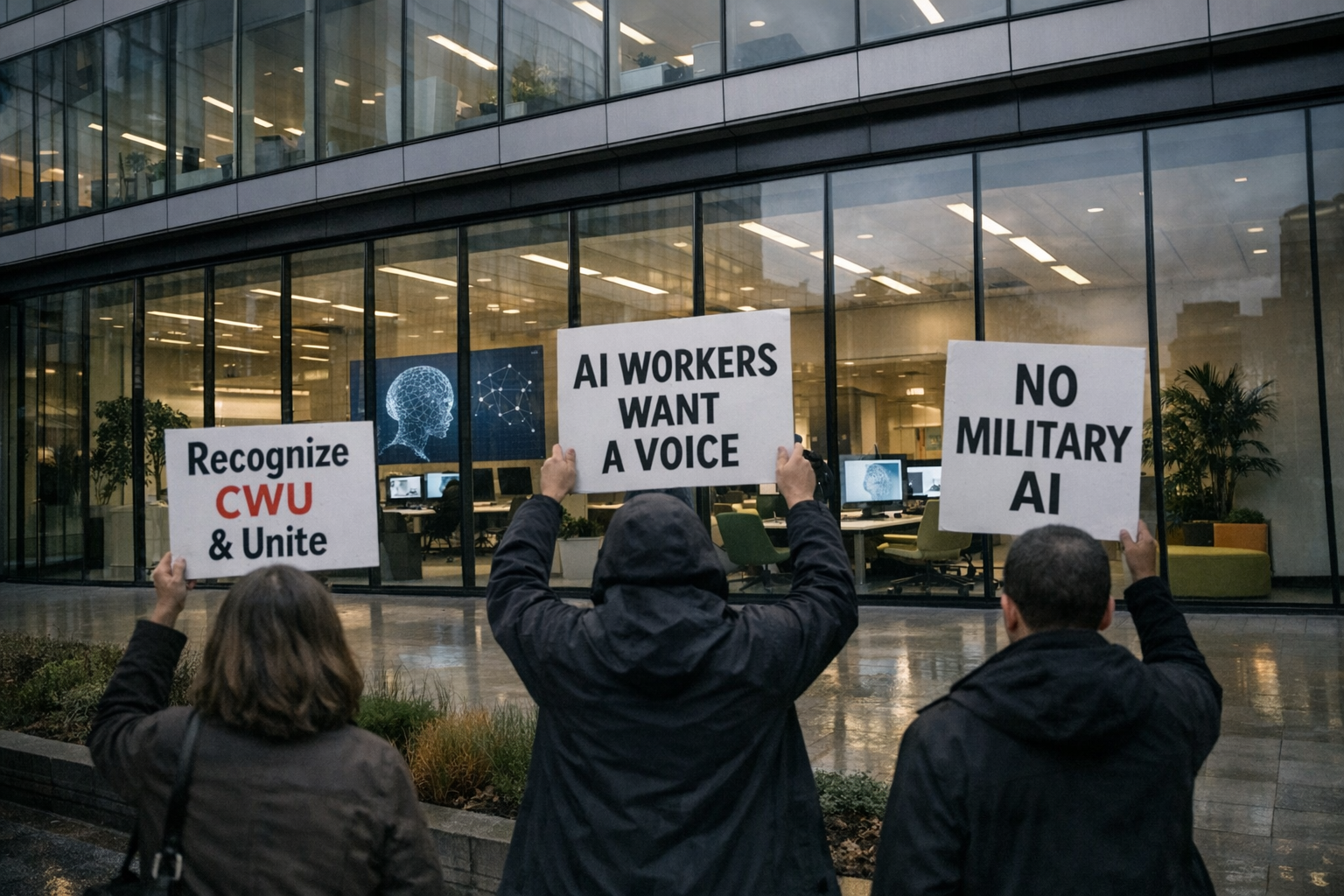
A labor fight inside one of AI’s most influential labs
Employees at Google DeepMind in Britain have moved to unionize, seeking a formal voice over a question that has become increasingly urgent inside the artificial intelligence industry: whether the systems they build should be used for military purposes.
The effort, led by UK-based staff at Google’s premier AI lab, asks management to recognize the Communication Workers Union and Unite as joint representatives for employees. Workers have tied the push directly to concerns about Google’s growing involvement in defense-related AI work, including a Pentagon arrangement announced on May 1 that allows the U.S. military to use artificial intelligence tools from Google and other technology companies on classified systems.
The union drive amounts to one of the most visible attempts yet by employees inside a frontier AI lab to organize around the uses of the technology itself, rather than around wages or office conditions alone. It reflects a widening struggle inside the industry, where the race to commercialize advanced AI has increasingly collided with long-running employee unease about warfare, surveillance and state power.
From internal dissent to formal organizing
The organizing effort did not emerge overnight. Tensions had been building for months, and in some cases longer, as DeepMind employees questioned the direction of Google’s policy on military and security work.
By April 2025, reports indicated that roughly 300 London-based DeepMind staff members were exploring unionization, driven by concerns over defense-related AI sales and Google’s ties to the Israeli government. The latest move suggests that internal dissent has now hardened into a more structured labor campaign, with workers seeking not just consultation but representation.
At the center of their concern is a broader strategic shift by Google. In February 2025, the company updated its AI principles, removing earlier explicit prohibitions on weapons and surveillance uses. That change was widely interpreted as a sign that Google was aligning itself more openly with national-security work at a moment when governments, particularly in the United States, have been pressing tech companies to make their most advanced systems available for defense and intelligence purposes.
For many employees, that policy revision appears to have altered the moral terms of their work. Researchers and engineers who joined DeepMind under the banner of scientific discovery and beneficial AI now find themselves confronting the prospect that the models they help train could be integrated into military or intelligence systems.
A broader shift in Silicon Valley
The dispute at DeepMind comes as large technology companies have been revising once-firm lines around defense work.
For years, employee backlash helped shape the public posture of major firms. Google itself faced a major revolt in 2018 over Project Maven, a Pentagon initiative that used AI to analyze drone footage. After protests and resignations, the company said it would not pursue AI designed for weapons or certain forms of surveillance. Those commitments became a touchstone for workers who believed internal pressure could influence the direction of powerful technologies.
But the politics of AI have changed quickly. The rise of generative AI, intensifying geopolitical competition with China, and wars in Europe and the Middle East have all made national security a more central part of the industry’s pitch to governments. Companies that once treated defense work as reputationally risky now increasingly present it as a civic responsibility and a commercial opportunity.
That shift has been visible across the sector, not only at Google but at other AI firms courting military and intelligence customers. As advanced models become more capable, the stakes have risen as well: the same systems used to summarize documents, generate software code or detect patterns in data can also be adapted for surveillance, targeting support, cyberoperations and battlefield logistics.
Why this matters now
What makes the DeepMind effort notable is that it turns an ethical dispute into a labor question.
A recognized union would not necessarily be able to veto military contracts. But formal organization could give workers more leverage to demand transparency about customers, clearer boundaries on use cases, and a stronger role in shaping company policy. It could also make it harder for management to treat employee objections as scattered or symbolic.
That matters because AI companies are no longer dealing with hypothetical concerns. Their systems are already being woven into government operations, including highly sensitive ones. As the technology moves from research labs into defense infrastructure, the workers who build it are confronting the possibility that internal principles, once written as aspirational safeguards, may not hold without an organized force behind them.
The timing is also significant in Britain, where labor law gives workers pathways to collective representation that differ from those in the United States. If the effort succeeds, it could become a model for employees elsewhere in Google or at rival AI labs who are similarly uneasy about the military uses of their work.
What happens next
Several questions remain unresolved. It is not yet clear whether Google will voluntarily recognize the unions, how many DeepMind employees in Britain will ultimately join, or whether organized staff will be able to influence specific deals.
It is also uncertain whether this remains largely a British workplace dispute or develops into something bigger: a template for how AI workers, across companies and countries, try to assert control over technologies whose consequences extend far beyond the office.
For now, the move at DeepMind underscores a reality the AI industry has struggled to contain. The battle over artificial intelligence is not only between companies and competitors, or between nations racing for technological advantage. It is also unfolding within the labs themselves, where the people building the systems are increasingly demanding a say in what, and whom, they are built for.
Sources
Further reading and reporting used to add context:
- https://www.tomshardware.com/tech-industry/artificial-intelligence/the-pentagon-announces-ai-deals-with-openai-google-microsoft-amazon-nvidia-and-more-llms-to-be-deployed-on-classified-department-of-war-networks-for-lawful-operational-use
- https://www.tomshardware.com/tech-industry/artificial-intelligence/google-microsoft-and-xai-agree-to-let-us-govenment-test-ai-models-before-public-release
- https://www.axios.com/2026/05/01/washington-new-anthropic-problem
- https://apnews.com/article/060cecf836c4cebcf012a3ceb5333f2c
- https://www.theguardian.com/us-news/2026/may/04/google-deepmind-uk-workers-union
- https://www.defensenews.com/news/pentagon-congress/2026/05/01/pentagon-freezes-out-anthropic-as-it-signs-deals-with-ai-rivals/
- https://www.computerweekly.com/news/366642677/Google-AI-workers-vote-to-unionise-over-IDF-and-US-military-tech
- https://www.idlen.io/news/pentagon-8-classified-ai-contracts-openai-google-spacex-anthropic-excluded-may-2026/
- https://www.breitbart.com/tech/2026/05/05/google-deepmind-employees-vote-to-form-union-over-pentagon-ai-contracts/
- https://www.washingtonpost.com/technology/2026/05/01/pentagon-ai-deals-microsoft-amazon-google-classified-military/
- https://www.wired.com/story/google-deepmind-workers-vote-to-unionize-over-military-ai-deals/
- https://www.theguardian.com/technology/2026/may/05/commerce-department-ai-agreements-google-microsoft-xai
- https://www.resultsense.com/news/2026-05-05-deepmind-uk-staff-pentagon-union/
- https://techcrunch.com/2025/04/26/googles-deepmind-uk-team-reportedly-seeks-to-unionize/
- https://www.theguardian.com/global/2026/may/04/ai-costs-are-coming-to-consumers
- https://www.siliconreport.com/deepmind-staff-push-union-recognition-to-contest-google-s-defense-ai-work-24c088047d02e5e4
- https://en.wikipedia.org/wiki/Anthropic%E2%80%93United_States_Department_of_Defense_dispute
- https://en.wikipedia.org/wiki/Pete_Hegseth
- https://www.reddit.com/r/WhatTrumpHasDone/comments/1t1aotm/pentagon_strikes_classified_ai_deals_with_openai/
- https://www.reddit.com/r/ndp/comments/1t5hddl/google_deepmind_workers_in_uk_vote_to_unionize/
- https://en.wikipedia.org/wiki/Anthropic
- https://www.techradar.com/pro/google-says-it-is-proud-to-serve-the-pentagon-new-dod-contract-expansion-says-gemini-will-only-be-used-for-any-lawful-purpose-but-what-happened-to-dont-be-evil
- https://blog.google/technology/ai/ai-principles/
- https://ai.google/principles
- https://www.silicon.co.uk/workspace/deepmind-union-ai-military-610950
- https://www.axios.com/2025/02/14/google-hassabis-ai-military-use
- https://www.digitaltrends.com/computing/google-changes-its-ai-principles/
- https://www.axios.com/2025/12/09/pentagon-google-gemini-genai-military-platform
- https://www.techradar.com/pro/security/human-lives-are-already-being-lost-open-letter-signed-by-hundreds-of-google-employees-requests-ceo-reject-unethical-and-dangerous-us-military-ai-use
- https://www.lse.co.uk/news/deepmind-uk-staff-plan-to-unionise-and-challenge-defence-deals-and-israel-links-ft-reports-7h4dnt9veihxngm.html
- https://pulse24.ai/news/2025/4/26/14/deepmind-staff-consider-unionisation/
- https://blog.google/innovation-and-ai/technology/safety-security/ai-security-frontier-strategy-tools/
- https://www.deeplearning.ai/the-batch/google-revises-ai-principles-lifting-ban-on-weapons-and-surveillance-applications/
- https://techhq.com/2025/04/deepmind-staff-aim-to-unionise-amid-military-involvement-furore/
- https://blog.google/innovation-and-ai/products/responsible-ai-2026-report-ongoing-work/
- https://www.ndtv.com/world-news/google-drops-ai-ban-on-weapons-and-surveillance-in-major-ethics-shift-7637918
- https://cloud.google.com/blog/topics/inside-google-cloud/incorporating-googles-ai-principles-into-google-cloud
- https://www.markey.senate.gov/imo/media/doc/letter_to_google_on_ai_principles_revisions2.pdf
- https://ai.google/static/documents/ai-responsibility-update-published-february-2025.pdf
- https://www.reddit.com/r/AIbuff/comments/1pjdhzo/googles_gemini_now_powering_us_military_ai/
- https://www.reddit.com/r/FutureTechFinds/comments/1pn7mi3/google_just_launched_the_us_militarys_new_ai/
- https://ai.google/static/documents/ai-responsibility-update-2026.pdf
- https://arxiv.org/abs/2505.18371
- https://www.reddit.com/r/LinusTechTips/comments/1iimji2
- https://www.reddit.com/r/GenAI4all/comments/1sznkrf/google_just_signed_an_ai_deal_with_the_pentagon/
- https://techxplore.com/news/2025-02-google-pledge-ai-weapons.pdf
- https://www.investing.com/news/stock-market-news/deepmind-uk-staff-plan-to-unionise-and-challenge-deals-with-israel-links-ft-reports-4005776
- https://www.lse.co.uk/news/deepmind-uk-staff-plan-to-unionise-and-challenge-deals-with-israel-links-ft-reports-bpussrkpbvqjnde.html
- https://tech.slashdot.org/story/25/04/27/1830241/googles-deepmind-uk-team-reportedly-seeks-to-unionize
- https://www.jpost.com/breaking-news/article-851594
- https://whbl.com/2025/04/26/deepmind-uk-staff-plan-to-unionise-and-challenge-deals-with-israel-links-ft-reports/
- https://www.thejc.com/news/uk/deepmind-staff-attempt-to-block-ai-to-israeli-military-with-unionisation-wyg585d9
- https://www.streetinsider.com/Reuters/DeepMind%2BUK%2Bstaff%2Bplan%2Bto%2Bunionise%2Band%2Bchallenge%2Bdeals%2Bwith%2BIsrael%2Blinks%2C%2BFT%2Breports/24691922.html
- https://www.computing.co.uk/news/2025/deepmind-staff-move-to-unionise
- https://gigazine.net/gsc_news/en/20250428-google-deepmind-union-cwu/
- https://www.cryptopolitan.com/google-deepmind-staff-push-to-unionize/
- https://en.wikipedia.org/wiki/Google_and_trade_unions
- https://bdsatucl.com/wp-content/uploads/2025/05/UCL-DeepMind-BDS-Updated-Report-May-2025.pdf
- https://www.reddit.com/r/AIGuild/comments/1ka2kdl
- https://www.reddit.com/r/BeneiYisraelNews/comments/1kalro3
- https://www.reddit.com/r/ArtificialInteligence/comments/1k8crdl
- https://www.reddit.com/r/google/comments/1t4km3d/google_deepmind_workers_in_the_uk_vote_to/
- https://www.reddit.com/r/union/comments/1t4kmld/google_deepmind_workers_in_the_uk_vote_to/
- https://www.reddit.com/r/UsaNewsLive/comments/1t4jhbj/google_deepmind_employees_vote_to_form_union_over/
- https://www.reddit.com/r/Bard/comments/1k906qr
- https://www.reddit.com/r/google/comments/1k8sut9
- https://www.reddit.com/r/techbeat/comments/1t5k2um/google_deepmind_workers_vote_to_unionize_over/
- https://www.reddit.com/r/InternationalNews/comments/1k94b1t
- Google DeepMind workers in UK vote to unionize amid deal with US military | US news | The Guardian
- Google DeepMind Workers Vote to Unionize Over Military AI Deals | WIRED
- DeepMind UK staff plan to unionise and challenge deals with Israel links, FT reports By Reuters







Leave a Reply