

A Chinese Open Model Enters the Coding Elite
A sprawling new artificial intelligence model from the Chinese lab Zhipu AI is rapidly gaining notice among developers and benchmark watchers, not simply because it is open, but because it appears to be competitive with some of the industry’s most capable closed systems on demanding coding tasks.
The model, GLM-5.2, was released this week as open weights under an MIT license, a permissive arrangement that allows developers and companies to use and adapt it with relatively few restrictions. Zhipu says the model supports a context window of 1,048,576 tokens — enough, in theory, to ingest very large codebases, lengthy technical documents or extended agentic workflows in a single session. The release has already been added to platforms including Hugging Face and Cloudflare’s Workers AI, a sign of how quickly infrastructure providers are moving to make it available.
That combination — frontier-scale performance, permissive licensing and immediate platform support — helps explain why GLM-5.2 is drawing attention well beyond China’s fast-moving A.I. sector.
Strong Showing on Coding Benchmarks
Early results suggest the model is especially strong in software engineering and long-horizon coding tasks, an increasingly important category as A.I. companies try to build systems that can do more than autocomplete snippets of code.
Artificial Analysis, an independent benchmarking group closely watched in the industry, said GLM-5.2 had become the top open-weights model on its Intelligence Index, with a score of 51. That put it ahead of prominent open rivals including MiniMax-M3, DeepSeek V4 Pro and Kimi K2.6.
On FrontierSWE, a benchmark designed to test sustained software-engineering performance over hours-long tasks, GLM-5.2 ranked third overall, according to the research and public discussion surrounding the release. It trailed Anthropic’s Claude Fable 5 and Claude Opus 4.8, but by a relatively narrow margin, and appeared to outperform GPT-5.5 on that measure. For open models, which have often lagged behind the best proprietary systems on exactly these more complex, multi-step workflows, that is a notable milestone.
The model has also risen near the top of coding-specific leaderboards for web development and agentic programming tasks, reinforcing the view that its strengths lie less in chatbot polish than in practical technical work.
Why This Release Matters
The release lands at a moment when the contest between open and closed A.I. systems is sharpening. For much of the last two years, the strongest coding and reasoning models have largely remained proprietary, accessible only through paid application programming interfaces and cloud platforms controlled by a handful of companies. Open models, while improving quickly, were often framed as cheaper or more customizable alternatives rather than genuine peers.
GLM-5.2 complicates that distinction.
If its benchmark performance holds up in real-world use, developers may now have an open model that is not merely “good for an open model,” but one that can contend seriously on frontier coding workloads. That matters for startups seeking to reduce inference costs, enterprises wary of depending too heavily on a single vendor and researchers who want to inspect or adapt model behavior more directly than closed systems permit.
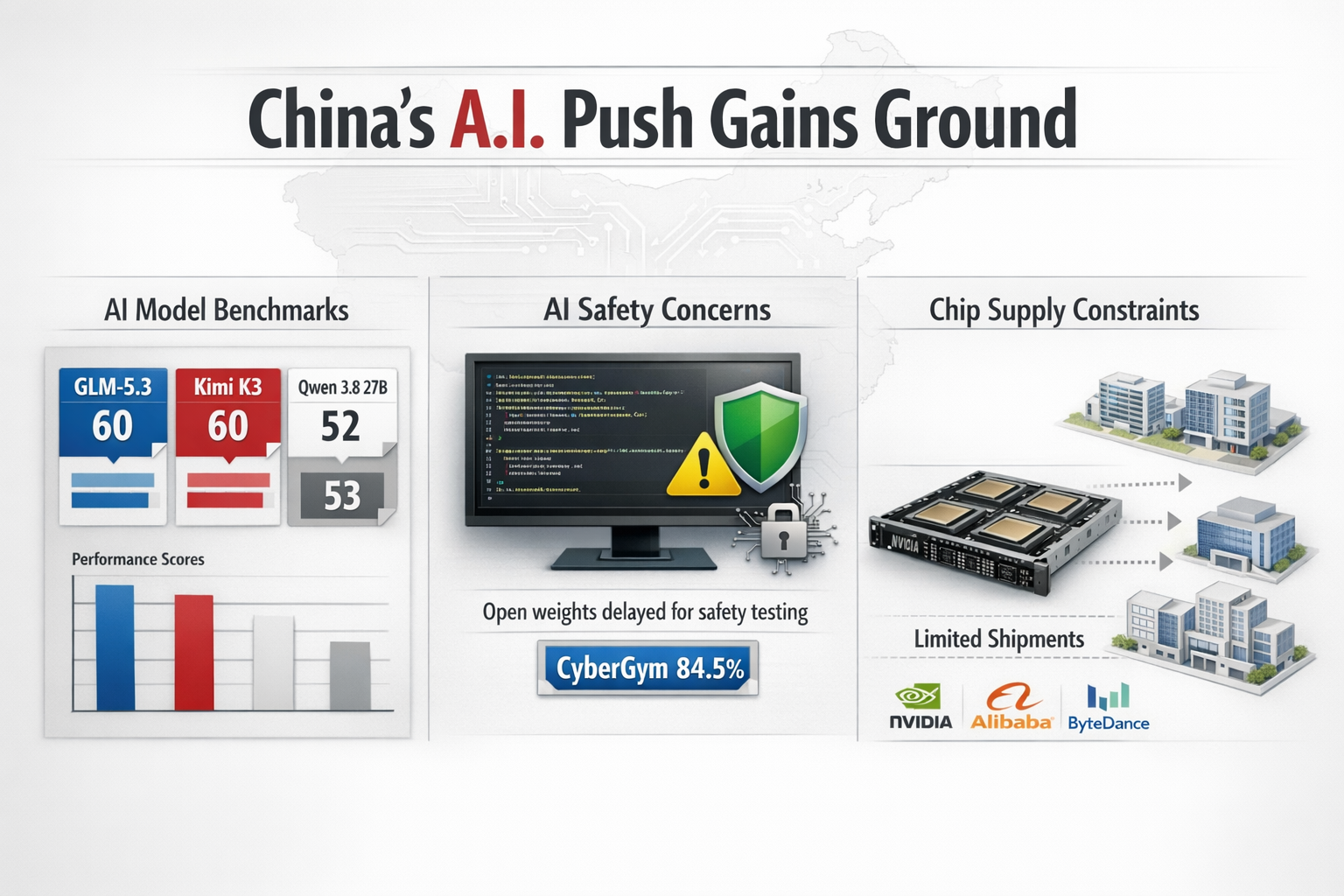
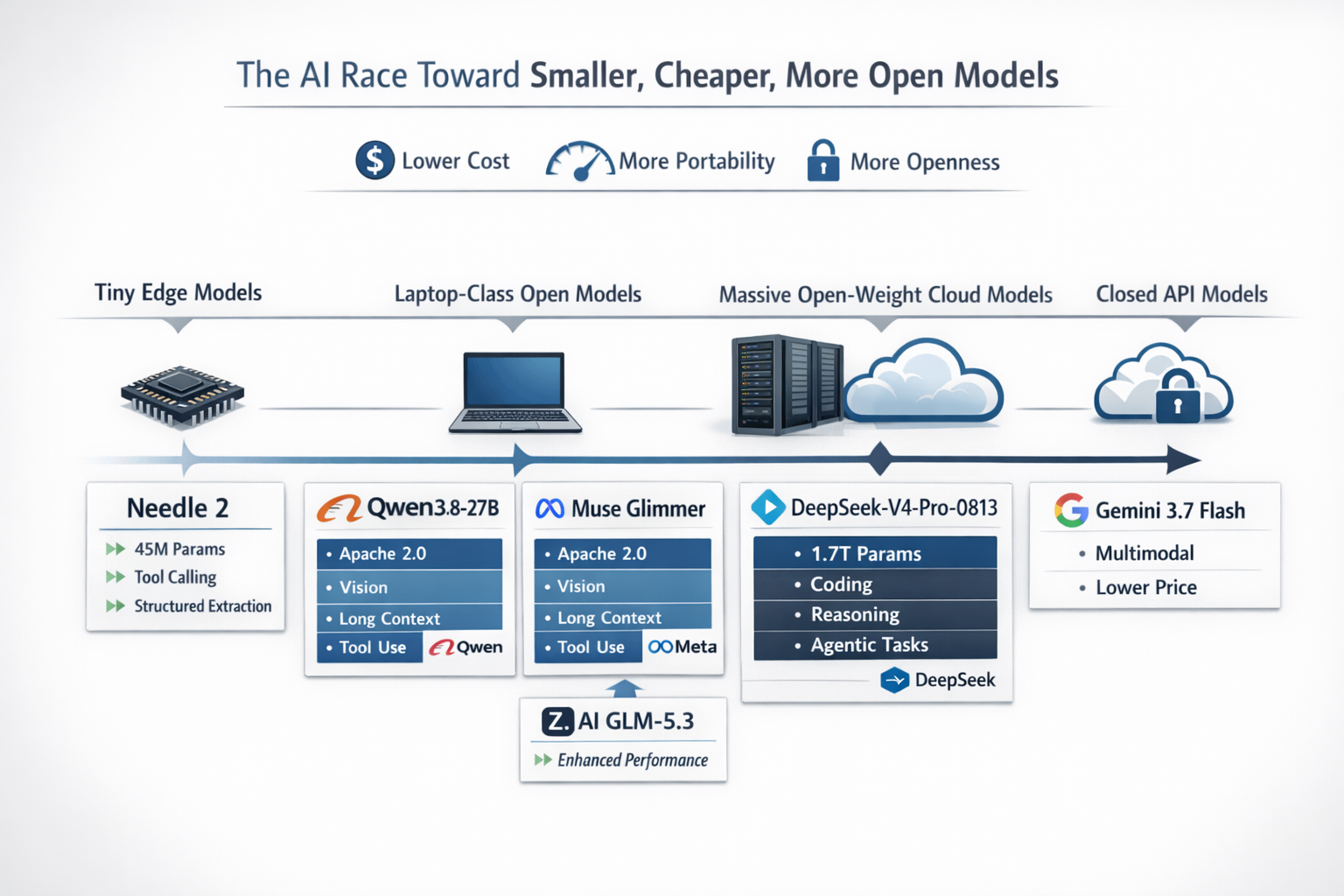
It also underscores the growing influence of Chinese A.I. labs in the open-model race. Over the past year, companies including DeepSeek, MiniMax, Moonshot and Zhipu have helped shift expectations about where leading open systems will come from. Zhipu’s latest release adds to that pressure on American rivals, especially those betting that proprietary advantages in coding and reasoning will remain durable.
Vast Scale, and Real Limits
GLM-5.2 is enormous. The Hugging Face listing describes it as a 753-billion-parameter mixture-of-experts model with 40 active parameters, weighing in at roughly 1.5 terabytes in BF16 precision. In practical terms, that places it far beyond consumer-grade local use without aggressive quantization, offloading or multi-GPU setups. Developers have pointed to support from serving frameworks such as vLLM and SGLang, and some have begun discussing deployment on high-end Nvidia Blackwell infrastructure, but “open” does not necessarily mean lightweight or easy to run.
The model is also text-only. Zhipu has separate vision models, but the newly released weights do not include multimodal input. That may limit some use cases, particularly in areas like visual interface generation or image-grounded reasoning, where top closed systems have increasingly converged on multimodal capabilities.
And while the million-token context window is one of the release’s headline features, it remains an open question how consistently that maximum will be available in production. Some platforms exposing the model are initially offering smaller limits than the headline number, and long-context performance in real deployments often depends as much on serving infrastructure and cost tolerance as on model architecture.
Cost, Speed and Token Hunger
Developers testing GLM-5.2 have praised its coding ability, especially on larger repositories, debugging and implementation work. But they have also identified trade-offs.
Artificial Analysis found that the model tends to generate more output tokens per task than leading open competitors, making it relatively “token-hungry.” That can translate into higher real-world costs and slower turnaround times, even when per-token pricing looks attractive. Reports from early users similarly suggest that the model can feel slow on complex jobs, particularly compared with some faster proprietary options.
That distinction matters. In the current A.I. market, capability alone is no longer enough; the winning models are often the ones that balance quality with responsiveness and operating cost. A model that performs near the top but requires significantly more tokens and time may still be appealing for difficult coding work, while being less attractive for everyday interactive use.
Zhipu appears aware of that tension. The company has emphasized different reasoning modes, including options intended to trade off deeper deliberation against efficiency.
Independent Validation Still Matters
As with many model launches, some of the strongest claims have come from the company itself, and outside validation is still accumulating. Benchmark rankings from independent groups have helped bolster the release, but reproducibility in live use remains crucial, especially for a model being positioned as a serious alternative to the best closed systems.
That caution is familiar by now in A.I.: benchmark scores can be informative, but they do not always map neatly onto day-to-day utility. Even enthusiastic early testers have noted quirks and unevenness. In one widely shared set of informal creative coding tests, for example, the model produced an impressive animated SVG of a pelican riding a bicycle, yet underperformed on a more whimsical request for an opossum on an e-scooter, suggesting that gains in engineering performance do not eliminate the idiosyncrasies users have come to expect from large language models.
Still, the broader pattern is difficult to miss. GLM-5.2 is being treated not as a curiosity, but as a plausible member of the top tier in open coding models.
A New Phase in the Open-Weights Race
The significance of GLM-5.2 is not that it has definitively surpassed the best proprietary systems. On many reasoning measures, it still appears to trail the strongest closed models. Nor is it likely to be the last open release to post striking benchmark numbers this year.
What makes it important is that it pushes the frontier of what an openly available coding model can be: very large, long-context, commercially permissive and close enough to the leaders to change procurement and development decisions.
For developers, that means more leverage and more choice. For cloud platforms, it means another high-demand model to serve. And for the major closed-model companies, it is a reminder that the competitive pressure is no longer coming only from each other, but increasingly from open releases that are arriving faster, cheaper and with fewer strings attached.
Sources
Further reading and reporting used to add context:
- https://artificialanalysis.ai/models/glm-5-2/
- https://www.llmreference.com/compare/claude-opus-4-8/glm-5.2
- https://www.frontierswe.com/
- https://awesomeagents.ai/news/zhipu-glm-5-2-open-source/
- https://www.frontierswe.com/optimizer-design
- https://pandaily.com/zhipu-ai-glm-5-dot-2-open-source-mit-jun2026
- https://www.techtimes.com/articles/318543/20260617/glm-52-open-weights-live-top-coding-benchmark-api-use-carries-china-data-risk.htm
- https://digg.com/ai/ii9xibgn
- https://developers.cloudflare.com/changelog/post/2026-06-16-glm-52-workers-ai/
- https://www.kucoin.com/news/flash/z-ai-launches-glm-5-2-with-1m-token-context-window-on-hugging-face
- https://abit.ee/en/artificial-intelligence/glm-52-zai-ai-language-model-coding-en
- https://digg.com/ai/cav4xlj8
- https://www.reddit.com/r/AIGuild/comments/1u7vmrx/zai_releases_glm52_with_a_1_milliontoken_context/
- https://www.reddit.com/r/chutesAI/comments/1u4lnn8/glm52_drops_zais_new_flagship_with_1m_usable/
- https://www.reddit.com/r/AtlasCloudAI/comments/1u7y2hk/glm_52_zai_zhipu_is_live_on_atlas_openweights/
- https://www.reddit.com/r/AISEOInsider/comments/1u815mr/glm_52_benchmark_shocked_me_against_claude_opus_48/
- https://arxiv.org/abs/2606.18193
- https://arxiv.org/abs/2606.13715
- https://www.reddit.com/r/LocalLLaMA/comments/1u7kcwf/zaiorgglm52_is_here/
- https://www.reddit.com/r/opencodeCLI/comments/1u4z06y/glm52_by_zai_is_now_on_opencode/
- https://www-cdn.anthropic.com/0b4915911bb0d19eca5b5ee635c80fef830a37ea.pdf
- https://www.reddit.com/r/AIDeveloperNews/comments/1u7lxr3/zhipu_ai_zai_launches_glm52_a_753b_opensource_moe/
- https://en.wikipedia.org/wiki/Z.ai
- https://www.reddit.com/r/LocalLLaMA/comments/1u7o9vp/glm_52_api_is_live_weights_are_on_hf_and_ollama/
- https://www.reddit.com/r/singularity/comments/1u7l9yu/zai_releases_glm_52_model_long_horizon_tasks_and/
- https://www.reddit.com/r/LocalLLaMA/comments/1u7p25o/glm52_just_dropped_open_weights_and_it_already/
- https://z.ai/blog/glm-5
- https://huggingface.co/zai-org/GLM-5
- https://docs.z.ai/guides/llm
- https://ollama.com/library/glm-5
- https://huggingface.co/zai-org/models
- https://huggingface.co/collections/zai-org/glm-5
- https://z.ai/blog/scaling-pain
- https://huggingface.co/zai-org/GLM-5/tree/64eea7dbc0a271a9fe2c2881495efa8511c0cc1b
- https://docs.z.ai/guides/llm/glm-5-turbo
- https://docs.z.ai/guides/vlm/glm-5v-turbo
- https://docs.z.ai/guides/overview/pricing
- https://z.ai/blog/zcube
- https://huggingface.co/api/resolve-cache/datasets/UMxYTLAILabs/MalayMMLU/786e753e6874460ab65b18767a4142cd5c7ebfe0/MalayMMLU_Poster.pdf?download=true&etag=%226deb6b6cc822a3093b63912e90fcb8f8cff6e7fd%22
- https://huggingface.co/datasets/theatticusproject/cuad/resolve/main/CUAD_v1/full_contract_pdf/Part_I/Co_Branding/PaperexchangeComInc_20000322_S-1A_EX-10.4_5202103_EX-10.4_Co-Branding%20Agreement.pdf?download=true
- https://huggingface.co/datasets/PromptSystematicReview/ThePromptReport/resolve/f61264e30cab2f5d28e02922e43cd72d20875102/papers/a%20new%20dataset%20and%20empirical%20study%20for%20sentence%20simplification%20in%20chinese.pdf?download=true
- https://huggingface.co/api/resolve-cache/datasets/math-ai/TemplateGSM/0c8ed6b60fea0a84f25ddb1b8b761db695df2e19/TemplateMath_Part_I.pdf?download=true&etag=%2221ab60798f00384aa9dc86636c07bca9bbbabad7%22
- https://huggingface.co/api/resolve-cache/models/typealias/llm-compiler-7b-ftd/4c520533f86dd60ebd3f4394962c70e6098bdfd5/LICENSE.pdf?download=true&etag=%226708c62f164559ecc76e83bcf5351318788f25cb%22
- https://huggingface.co/api/resolve-cache/datasets/KashiwaByte/DISC-Assignment/4f8ffdbd645da6cfd1f77e4a5babca02ec3a3e75/DISC_2024_Assignment.pdf?download=true&etag=%2213af977703b94c1dbe203186c40501455f9f7911%22
- https://artificialanalysis.ai/articles/glm-5-2-is-the-new-leading-open-weights-model-on-the-artificial-analysis-intelligence-index
- https://artificialanalysis.ai/articles/glm-5-everything-you-need-to-know
- https://artificialanalysis.ai/articles
- https://www.kucoin.com/news/flash/zhipu-ai-s-glm-5-2-tops-open-source-models-in-aa-intelligence-index
- https://artificialanalysis.ai/changelog
- https://artificialanalysis.ai/models/comparisons/glm-5-2-vs-glm-5
- https://artificialanalysis.ai/articles/kimi-k2-5-everything-you-need-to-know
- https://huggingface.co/blog/mlabonne/glm-5
- https://artificialanalysis.ai/articles/gemini-3-1-pro-preview-new-leader-in-ai
- https://www.ai-stat.ru/news/2026-02-16-open-source-vs-proprietary-gap
- https://artificialanalysis.ai/downloads/state-of-ai/2025/2025-Year-End-Artificial-Analysis-State-of-AI-Highlights-Report.pdf
- https://artificialanalysis.ai/downloads/ai-review/2024/Artificial-Analysis-AI-Review-2024-Highlights.pdf
- https://artificialanalysis.ai/downloads/state-of-ai/2025/Q2-2025-Artificial-Analysis-State-of-AI-Highlights-Report.pdf
- https://artificialanalysis.ai/downloads/state-of-ai/2025/Q3-2025-Artificial-Analysis-State-of-AI-Highlights-Report.pdf
- https://www.reddit.com/r/ZaiGLM/comments/1r28vd7/artificial_analysis_glm5_leading_openweight/
- https://www.reddit.com/r/singularity/comments/1r27dqs/artificial_analysis_glm_5_performance_profile/
- https://www.reddit.com/r/LocalLLaMA/comments/1n6myps/artificial_analysis_intelligence_index_now/
- https://ollama.com/library/glm-5%3Acloud
- https://ollama.com/library
- https://ollama.com/library/
- https://ollama.com/models
- https://docs.ollama.com/
- https://docs.ollama.com/index
- https://ollama.com/library?sort=popular%3A%3A
- https://docs.ollama.com/api
- https://ollama.com/library/glm4
- https://ollama.com/library?sort=newest
- https://ollama.com/library/glm-5.1
- https://codersera.com/blog/glm-5-2-release-1m-context-coding-2026/
- https://jls42.org/en/news/ia-actualites-16-jun-2026
- https://www.llmreference.com/model/glm-5.2/openrouter
- https://chatforest.com/builders-log/glm-5-2-z-ai-1m-context-mit-open-weights-agentic-coding-builder-guide/
- https://awesomeagents.ai/models/glm-5-2/
- https://www.cometapi.com/what-is-glm-5-2/
- https://chatforest.com/builders-log/zhipu-glm-5-2-1m-context-open-weights-agentic-coding-builder-guide/
- https://www.gmicloud.ai/en/blog/why-glm-52-might-be-the-most-practical-coding-model-available-right-now
- https://www.supercareer.co/blog/glm-5-2-review-2026
- https://jls42.org/en/news/ia-actualites-14-jun-2026
- https://gearbriefly.com/2026/06/16/glm-5-2-coding-plan-switch/
- https://www.reddit.com/r/LocalLLaMA/comments/1u4je3d/glm52_next_week_open_weight_mit/
- https://research.nvidia.com/labs/nemotron/files/NVIDIA-Nemotron-3-Ultra-Technical-Report.pdf
- https://s3.us-east-1.amazonaws.com/files.cnas.org/documents/Red-Lines_TECH_Final.pdf
- https://theory-of-space.github.io/paper/Theory_of_Space.pdf
- https://pubs.rsc.org/en/content/articlepdf/2026/an/d5an01377a
- https://signal65.com/wp-content/uploads/2026/01/Signal65-Insights_Evaluating-Proprietary-Models.pdf
- https://payshopp.net/?_=%2Fpdf%2F2602.15763%23oiIsiUa7YGXxkxUiKzZPY60%3D
- zai-org/GLM-5.2 · Hugging Face
- GLM-5.2 is the new leading open weights model on the Artificial Analysis Intelligence Index








Leave a Reply