
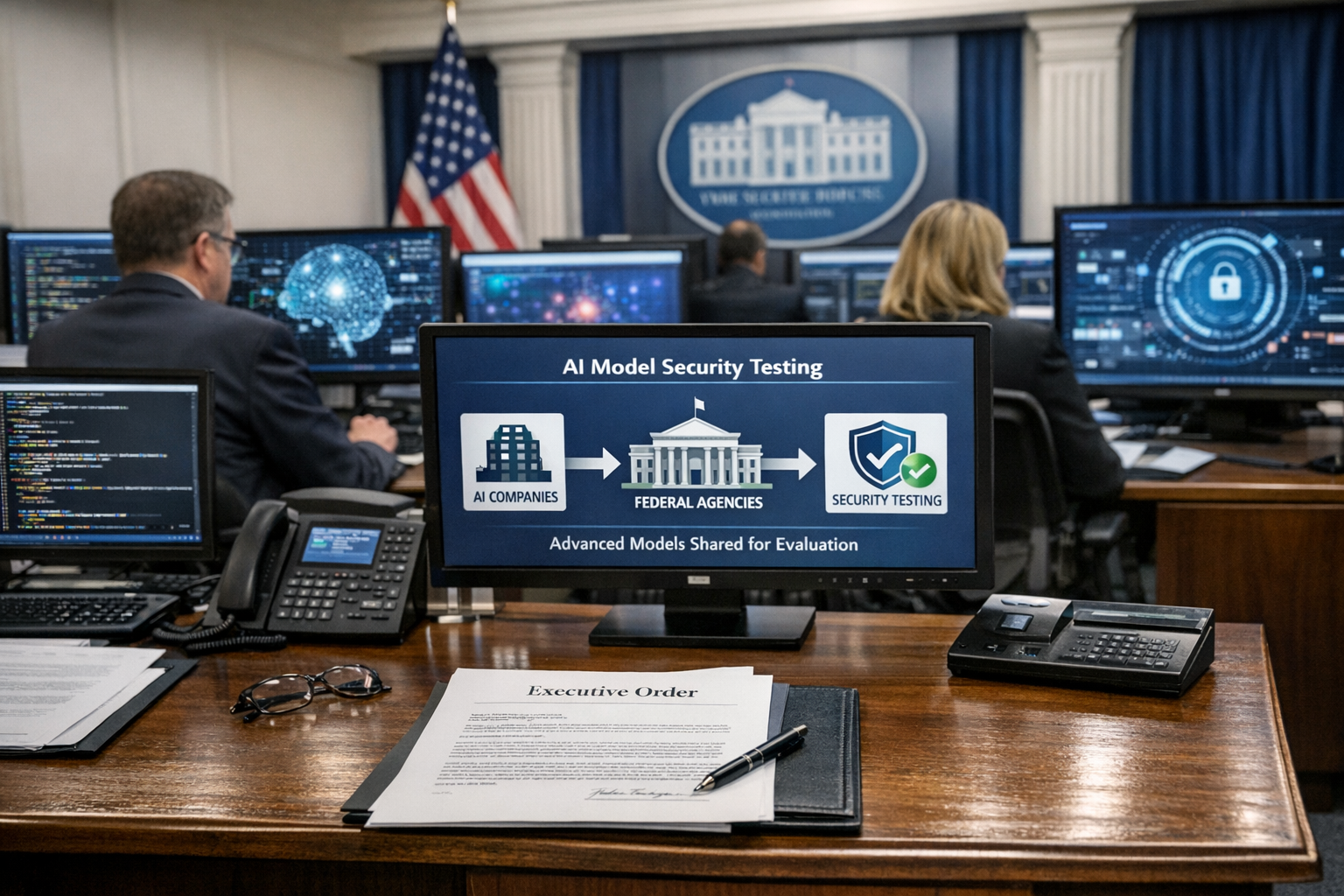
President Trump signed an executive order on Monday night establishing the administration’s first comprehensive framework for how the federal government will handle the most advanced artificial intelligence systems, opting for a cooperative and comparatively light-touch approach after weeks of internal debate over whether Washington should impose tougher controls.
The order is designed to speed the government’s own use of A.I., particularly in cybersecurity, while inviting — but not requiring — companies developing the most powerful models to let federal officials test them for security risks before they are released. In doing so, the White House drew a clear line against a licensing or preapproval system that many technology companies had feared.
The new policy arrives at a moment when pressure has been building in Washington to define what federal A.I. oversight should look like as models grow more capable, especially in areas like code generation, automated vulnerability discovery and cyber offense. Rather than creating a broad regulatory gatekeeping regime, the administration is betting that voluntary cooperation, targeted testing and faster deployment of A.I. inside government can address the most urgent risks without slowing American firms in a global technology race.
A Narrower Approach After Internal Resistance
According to people familiar with the discussions around the order, the White House had previously considered a more aggressive version that would have given the government earlier access to advanced systems and a stronger hand in reviewing them before launch. That draft was delayed amid concerns from some administration officials and industry allies that heavy regulation could handicap American companies as they compete with rivals abroad.
The final order, signed on June 2, reflects that retreat from a more restrictive posture.
It creates a voluntary pathway for developers of certain “covered frontier models” — a term the government will define through a classified benchmark focused on advanced cyber capabilities — to provide secure access to their systems up to 30 days before public release. Federal agencies would use that access to conduct safety and security evaluations. But the order explicitly says it does not establish mandatory licensing, preclearance or permits for new A.I. models.
That language appears aimed at reassuring Silicon Valley that the administration is not moving toward the kind of centralized approval structure some lawmakers, researchers and consumer advocates have urged for the most powerful systems.
Cybersecurity at the Center
The order places cybersecurity at the core of the federal response to advanced A.I. It directs agencies including the Cybersecurity and Infrastructure Security Agency and the Pentagon to move quickly to strengthen cyber defenses using A.I. tools. CISA is instructed to produce guidance within 30 days, and the administration is to create an A.I. cybersecurity clearinghouse intended to help government and, potentially, critical infrastructure operators share information about threats and defensive practices.
That focus reflects a growing concern inside government that the most immediate national security risk from advanced models may not be disinformation or labor disruption, but their ability to accelerate hacking — for both defenders and attackers.
Recent generations of A.I. systems have shown rapidly improving capacity to write software, identify security flaws and automate technical tasks that once required highly trained specialists. National security officials have increasingly warned that such tools could lower the barriers for cybercriminals and hostile states, even as they also offer new ways to harden networks and detect attacks.
By centering the order on cyber capabilities, the administration is trying to create a more limited framework than a sweeping A.I. safety regime. The question is not every possible harm from artificial intelligence, but whether a subset of especially capable systems could materially change the cyber threat landscape.
A Voluntary System, With Questions Attached
The administration’s approach, however, leaves one central ambiguity unresolved: how voluntary the process will be in practice.
On paper, companies can choose whether to submit models for federal review. But when the federal government signals that national security agencies want access to frontier systems, large developers may find it difficult to decline, particularly if they rely on federal contracts, seek favorable treatment in future policy battles or want to avoid being seen as obstructing security oversight.
That tension is likely to define the order’s next phase. A framework based on cooperation can move faster than formal regulation and may be more politically durable in the near term. But it depends on trust — including trust that the government can securely handle access to sensitive models and proprietary systems, and trust from officials that companies will not withhold systems that pose meaningful risks.
There are other unanswered questions as well. Because the benchmark for deciding which systems qualify as “covered frontier models” will be classified, outsiders may have little visibility into how broad the category is, which companies are affected and whether the line is drawn narrowly around a handful of top-tier models or more expansively across the industry.
It is also unclear how the secure-access process will work in technical terms, whether companies will permit direct testing of weights or only controlled interfaces, and how the government will protect commercially sensitive information.
Why It Matters Now
The order is significant less because it imposes sweeping new restrictions than because it settles, at least for now, the administration’s basic answer to a question that has hung over the industry for months: whether Washington would try to approve advanced A.I. systems before they could be released.
For now, the answer is no.
That gives companies a clearer federal posture just as competition among major A.I. developers has intensified and as businesses and agencies rush to deploy generative A.I. tools. It also suggests that, under this administration, national security concerns about frontier models will be handled primarily through targeted cooperation and cyber-focused safeguards, not broad ex ante regulation.
Whether that remains the endpoint is another matter. If a major model is later shown to enable dangerous cyber activity, or if voluntary cooperation proves uneven, calls for mandatory rules could quickly return. For the moment, though, the White House has chosen speed, flexibility and industry accommodation over a harder regulatory line — a choice likely to shape not only how advanced A.I. is governed, but how quickly it is woven into the machinery of the federal government itself.
Sources
Further reading and reporting used to add context:
- https://www.axios.com/2026/06/03/trump-ai-executive-order-ibm-ceo
- Trump dodges AI rules for now with latest executive order
- https://www.techradar.com/pro/security/new-trump-executive-order-requests-ai-companies-voluntarily-allow-the-white-house-to-test-the-advanced-cyber-capabilities-of-ai-models
- https://www.theatlantic.com/technology/2026/06/trump-ai-executive-order/687410/?utm_source=apple_news
- https://apnews.com/article/e41af74f7b0865482f07d10fe7a50fe3
- Promoting Advanced Artificial Intelligence Innovation and Security – The White House
- https://www.theguardian.com/us-news/2026/jun/02/trump-executive-order-ai-voluntary-review
- https://www.theguardian.com/us-news/2025/dec/11/trump-executive-order-artificial-intelligence
- https://www.techtimes.com/articles/317626/20260602/trump-ai-executive-order-signed-musk-zuckerberg-lobbied-review-down-30-days.htm
- Fact Sheet: President Donald J. Trump Promotes Advanced Artificial Intelligence Innovation and Security – The White House
- https://www.tomshardware.com/tech-industry/artificial-intelligence/trump-signs-ai-executive-order-seeking-30-day-government-access-to-frontier-models-before-release
- https://www.latimes.com/politics/story/2026-06-02/trump-signs-executive-order-to-vet-top-ai-models-for-national-security-risks
- https://www.whitehouse.gov/releases/2026/03/president-donald-j-trump-unveils-national-ai-legislative-framework/
- https://www.wired.com/story/this-is-how-trump-finally-signed-the-ai-executive-order/
- https://www.whitehouse.gov/fact-sheets/2026/03/fact-sheet-president-donald-j-trump-advances-energy-affordability-with-the-ratepayer-protection-pledge/
- https://www.nationalreview.com/news/trump-signs-executive-order-to-challenge-state-ai-regulations-in-major-tech-industry-victory/amp/
- https://www.cbsnews.com/news/trump-ai-executive-order/
- https://en.wikipedia.org/wiki/Executive_Order_14179
- https://docs.fcc.gov/public/attachments/DOC-416077A1.pdf
- https://en.wikipedia.org/wiki/A_National_Policy_Framework_for_Artificial_Intelligence
- https://en.wikipedia.org/wiki/Executive_Order_14355
- https://techcrunch.com/2026/06/02/trump-signs-narrower-executive-order-on-ai-oversight-after-industry-objections/
- https://www.kpbs.org/news/science-technology/2026/06/02/trump-signs-ai-safety-order-seeking-voluntary-review-of-new-models
- https://www.opb.org/article/2026/06/02/trumps-new-ai-safety-order-seeks-voluntary-review-of-new-models/
- https://www.investing.com/news/world-news/trump-signed-order-to-promoteadvanced-ai-innovation-and-security-white-house-says-4722541
- https://www.thestar.com.my/tech/tech-news/2026/06/03/trump-signed-order-to-promote-advanced-ai-innovation-and-security-white-house-says
- https://www.washingtonpost.com/technology/2026/06/02/trump-signs-order-designed-give-government-early-look-powerful-ai-models/
- https://www.kpcw.org/npr-news/2026-06-02/trump-signs-ai-safety-order-seeking-voluntary-review-of-new-models?_amp=true
- https://www.tomshardware.com/tech-industry/artificial-intelligence/trump-orders-federal-agencies-to-ditch-woke-claude
- https://www.lemonde.fr/en/pixels/article/2026/06/03/trump-strikes-compromise-over-ai-regulation-to-satisfy-tech-giants-and-maga-base_6754085_13.html
- https://en.wikipedia.org/wiki/Executive_Order_14365
- https://www.reddit.com/r/LocalLLaMA/comments/1tw70v7/trump_signs_narrower_executive_order_on_ai/
- https://en.wikipedia.org/wiki/Anthropic
- https://en.wikipedia.org/wiki/Claude_%28language_model%29
- https://newsroom.ibm.com/2025-05-06-ibm-accelerates-enterprise-gen-ai-revolution-with-hybrid-capabilities?asPDF=1






Leave a Reply