
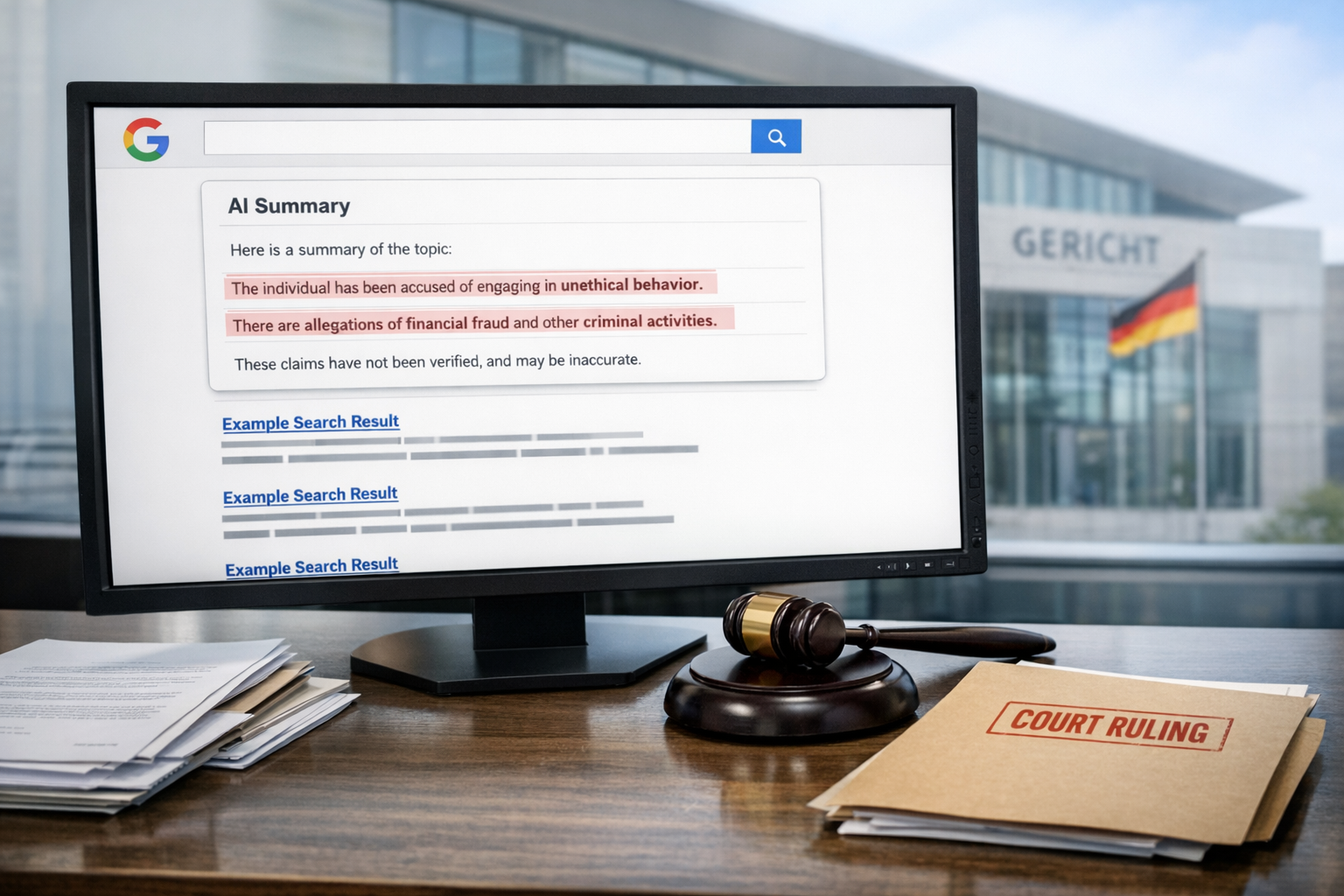
A German court has ruled that Google can be held liable for defamatory errors generated by its A.I.-powered search summaries, a decision that could sharpen the legal risks facing one of Silicon Valley’s most aggressively deployed generative A.I. products.
The ruling, issued on May 28 by the Munich Regional Court I, arose from a complaint by two Munich-based publishers who said Google’s “A.I. Overviews” falsely portrayed them as connected to scams, subscription traps and other dubious business practices. The court ordered Google to stop disseminating the statements and assigned the company 80 percent of the legal costs.
Google said on June 12 that it would appeal.
A different standard for A.I. answers
What makes the decision significant is not simply that a court found falsehood in an A.I.-generated response. It is the court’s reasoning: that Google’s summaries should be treated as Google’s own speech, rather than as a neutral presentation of material from elsewhere on the web.
That distinction goes to the heart of how generative A.I. systems are being understood by courts and regulators. Traditional search engines have generally been able to argue that they merely index and point users to third-party content. But the Munich court concluded that A.I. Overviews do something different. By synthesizing information into self-contained answers, the feature produces “new” and independently formulated statements, the court said, making Google responsible for the damage those statements may cause.
The court also rejected the idea that users can reasonably be expected to click through and verify every underlying source. In the case of conventional links, that expectation has often helped shield platforms from liability. But with A.I. summaries, the court said, users are presented with an answer that appears complete on its own.
That reasoning could have consequences well beyond this dispute in Germany. If upheld on appeal, it may offer a blueprint for plaintiffs seeking to hold A.I. companies responsible for false, harmful or defamatory output generated by chatbots, answer engines and other systems that repackage source material into fresh prose.
Pressure on a fast-growing Google feature
The case lands at an awkward moment for Google, which has made A.I. Overviews central to its effort to remake search around generative A.I. The feature was rolled out broadly in U.S. Search in May 2024, and Google later said it had been used by more than one billion people.
That scale has amplified both its promise and its hazards. Google and its rivals have argued that A.I.-generated summaries can save users time by distilling information from across the web. But critics have warned that the same systems can produce polished-sounding falsehoods, sometimes with an air of authority that makes them more persuasive than a list of ordinary search links.
The Munich ruling underscores a growing legal question: when an A.I. system assembles information into a concise answer, who bears responsibility when the answer is wrong?
For years, that question has hovered over generative A.I. products in the abstract. The German decision gives one of the clearest judicial answers yet: the company that designs, trains, operates and manages the system may be liable.
Why the case matters beyond Germany
The decision is not final, and its reach remains uncertain. Appeals courts may narrow or overturn the ruling, and other jurisdictions may apply different legal standards to defamation, platform responsibility and publisher liability.
Still, legal experts are likely to study the case closely because it captures a problem confronting courts around the world. Generative A.I. systems do not simply store or display information; they transform it, combining fragments from multiple sources into language that may not have appeared anywhere before. That makes it harder for companies to claim they are merely intermediaries.
If higher courts endorse the Munich court’s distinction between A.I. summaries and conventional search results, the implications could be broad. A.I. providers may face stronger incentives to slow product rollouts, add friction to sensitive answers, expand human review or build stricter moderation systems for content involving reputation, health, finance and other high-risk subjects.
For publishers, businesses and individuals who say they have been maligned by automated systems, the ruling may signal that courts are increasingly willing to treat those systems not as black boxes beyond ordinary legal accountability, but as products whose makers can be held to account.
For Google, the appeal will be about more than one disputed search summary. It may become an early test of whether the legal protections that helped define the internet era can be carried intact into the age of generative A.I.
Sources
Further reading and reporting used to add context:
- https://www.pcgamer.com/software/ai/google-claims-most-users-know-information-generated-with-ai-should-not-be-blindly-trusted-but-a-court-ruled-its-still-liable-for-false-claims-made-in-ai-overview/
- https://www.wired.com/story/a-court-has-ruled-that-google-is-liable-for-false-statements-generated-by-ai-overviews/
- https://www.techtimes.com/articles/318298/20260612/google-will-appeal-german-ruling-that-makes-it-legally-liable-when-its-ai-overviews-lie.htm
- https://arstechnica.com/tech-policy/2026/06/nobody-needs-ai-to-search-the-internet-court-says-in-ruling-against-google/
- https://www.computerworld.com/article/4184220/google-is-held-liable-for-false-information-from-its-ai.html
- https://www.business-standard.com/technology/tech-news/who-s-liable-when-ai-gets-it-wrong-german-court-ruling-stirs-global-debate-126061100709_1.html
- https://amp.dw.com/en/german-court-holds-google-liable-for-fake-ai-answers/a-77527661
- https://www.tbsnews.net/worldbiz/europe/nobody-needs-ai-search-internet-german-court-rules-google-case-1459766
- https://www.lawnews.co.uk/legal-news/munich-court-ruling-establishes-google-ai-overviews-liability/
- Google to challenge German ruling saying it is liable for AI-generated false claims By Reuters
- https://www.gadgets360.com/ai/news/google-responds-after-german-court-rules-on-ai-overviews-errors-11621796/amp
- https://www.financialexpress.com/life/technology-google-held-liable-for-ai-modes-incorrect-will-it-set-a-precedent-for-chatgpt-and-claude-4264861/
- https://meteoraweb.com/en/news/google-held-liable-for-false-statements-generated-by-ai-overviews-a-landmark-ruling-for-algorithmic-accountability
- https://en.wikipedia.org/wiki/AI_Overviews
- https://www.axios.com/2025/09/14/penske-media-sues-google-ai
- https://en.wikipedia.org/wiki/Google_litigation
- https://www.theatlantic.com/technology/archive/2024/06/google-ai-overview-libel/678751/?utm_source=apple_news
- https://www.techradar.com/computing/artificial-intelligence/googles-ai-overviews-are-often-so-confidently-wrong-that-ive-lost-all-trust-in-them
- https://blog.google/products/search/ai-mode-search/
- https://blog.google/products/search/new-ways-to-connect-to-the-web-with-ai-overviews/
- https://blog.google/products-and-platforms/products/search/ai-overviews-update-may-2024/
- https://blog.google/products/search/generative-ai-google-search-may-2024/
- https://blog.google/products-and-platforms/products/search/ai-mode-ai-overviews-updates
- https://blog.google/company-news/inside-google/2024-at-google/
- https://blog.google/products-and-platforms/products/search/ai-mode-development/
- https://blog.google/products-and-platforms/products/search/google-search-ai-january-2024-update/
- https://blog.google/products-and-platforms/products/search/google-search-generative-ai-learning-features/
- https://blog.google/technology/ai/2024-ai-extraordinary-progress-advancement/
- https://blog.google/products/search/google-circle-to-search-android/
- https://blog.google/products-and-platforms/products/search/google-search-update-march-2024/
- https://blog.google/documents/213/AI_Sprinters_Report.pdf
- https://www.kuhlen-berlin.de/news/2026/urheberrecht-und-ki-vor-gericht-gema-gegen-openai-lg-m%C3%BCnchen-i-urteil-vom-11-11-2025-az-42-o-14139-24
- https://www.moneycontrol.com/technology/german-court-ruling-holds-google-liable-for-false-ai-overviews-results-article-13947472.html
- https://www.justiz.bayern.de/gerichte-und-behoerden/landgericht/muenchen-1/presse/2026/3.php
- https://www.handelsblatt.com/technik/ki/landgericht-muenchen-google-haftet-fuer-ki-uebersichten/100232565.html
- https://cybernews.com/ai-news/german-court-google-liable-false-ai-overview/
- https://www.connect.de/news/google-ai-overviews-gerichtsurteil-falschaussagen-untersagt-3212685.html
- https://www.wettbewerbszentrale.de/lg-muenchen-i-google-haftet-fuer-falsche-aussagen-in-ki-uebersicht/
- https://unn.ua/en/amp/google-is-responsible-for-ai-generated-overviews-german-court
- https://reptile.haus/journal/munich-ai-liability-ruling-google-ai-overviews-business-2026/
- https://www.reddit.com/r/mediasres/comments/1u1w3mm/geramond_verlag_gewinnt_gegen_google_google/
- https://www.reddit.com/r/actutech/comments/1u22cmg/un_tribunal_allemand_d%C3%A9clare_google_responsable/
- https://www.grur.org/fileadmin/daten_bilder/veranstaltungen/bezirksgruppen/nord/2026-01-19-GRUR-Vortrag-Dornis-PPP.pdf
- 26_O_869_26_begl_Abschrift_Urteil_v_28_05_2026
- https://www.justiz.bayern.de/media/images/behoerden-und-gerichte/amtsgerichte/muenchen/pressemitteilungen/pm09_-_250324.pdf
- https://www.reddit.com/r/europes/comments/1u2y7tb/german_court_holds_google_liable_for_false_ai/
- New ways to connect to the web with AI Overviews









Leave a Reply