
Britain Forces a New Choice on Google’s AI Search
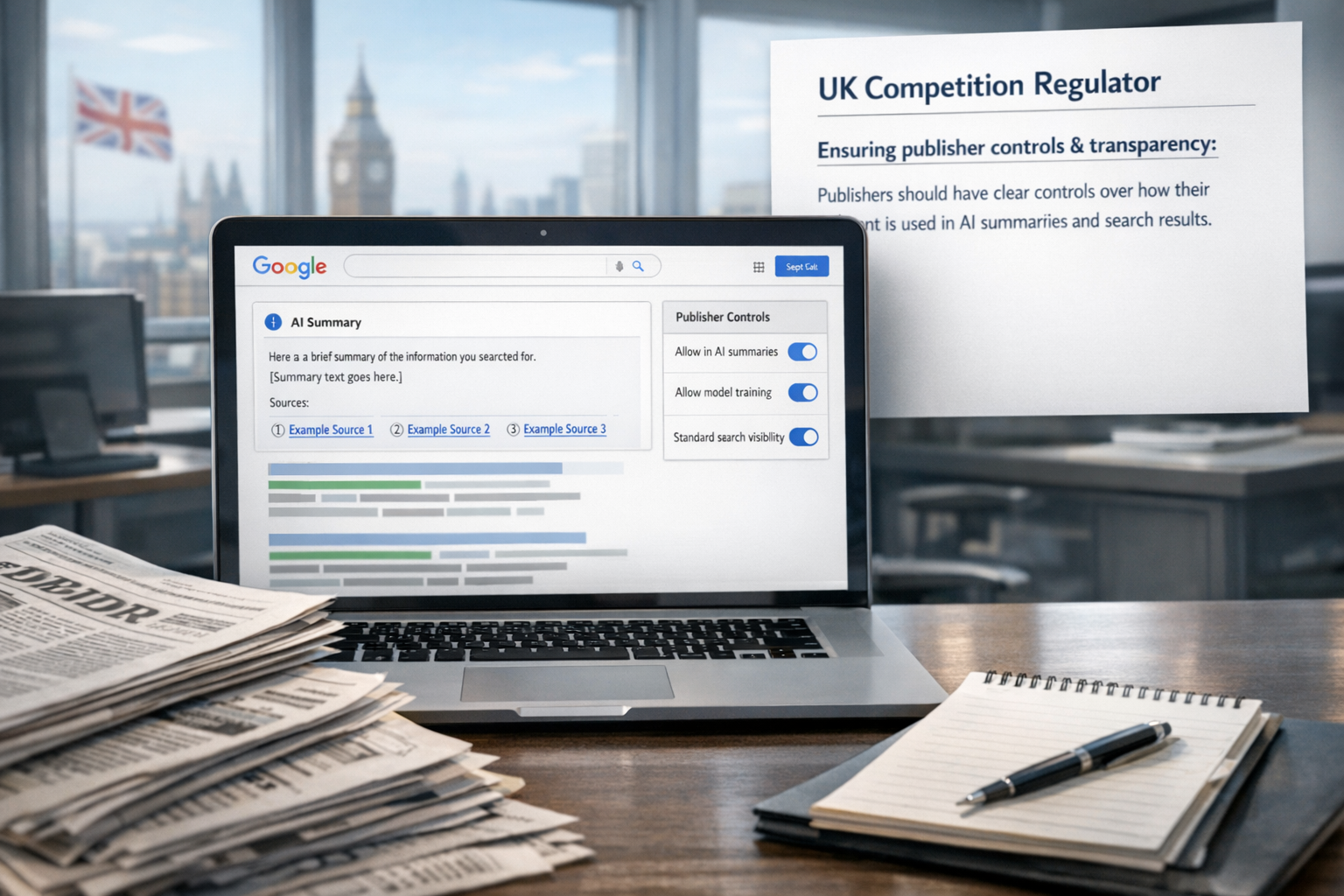
Britain’s competition watchdog has ordered Google to give publishers the ability to keep their journalism out of the company’s A.I.-generated search summaries, a decision that could reshape a growing global conflict over who benefits when search engines answer questions directly instead of sending users to the original source.
The ruling, announced Tuesday by the Competition and Markets Authority, requires Google Search to provide publishers with meaningful controls over whether their material can be used in generative A.I. features such as AI Overviews. The regulator also said Google must offer clearer attribution and links in A.I. results, explain more fully how publisher content is used, provide more detailed engagement data and allow publishers to opt out of having their content used to fine-tune Google’s A.I. models.
The authority called the move a “world first,” and for publishers that have watched referral traffic weaken as A.I.-driven answers become more prominent, it amounts to something they have long sought: leverage.
Until now, many publishers argued that they faced an impossible choice — either allow Google to use their reporting in new A.I. products or risk disappearing from the search ecosystem on which they still depend for readers and revenue. The British order is intended to break that link, at least in principle, by allowing publishers to refuse inclusion in A.I. summaries without necessarily giving up ordinary search visibility.
That distinction could prove crucial as news organizations, magazine publishers and other websites try to negotiate licensing deals and defend the value of their work in an era when search engines increasingly aim to keep users on their own pages.
A Test of Britain’s New Digital Rulebook
The decision is one of the clearest demonstrations yet of how Britain plans to use its new digital markets regime to govern the behavior of the largest technology companies.
Under the Digital Markets, Competition and Consumers Act 2024, the C.M.A. can designate powerful platforms as having “strategic market status” and then impose tailored conduct requirements on them. Google received that designation in general search in October 2025. The regulator opened consultation on new search rules in January, then moved to finalize the publisher-specific measures after Google accelerated its push to weave generative A.I. more deeply into search this spring.
That timing mattered. As Google expanded A.I. answers in May, publishers warned that the shift could further reduce the clicks that historically brought readers to their sites. For news organizations already under pressure from falling advertising revenue and changing audience habits, even small declines in search traffic can carry large financial consequences.
The C.M.A.’s intervention suggests regulators are no longer treating A.I. search solely as a matter of future competition risk. Instead, they are beginning to dictate operational rules now — how content is used, how credit is given and what information platforms must share with the businesses whose material helps power A.I. responses.
Why Publishers See More Than a Technical Change
For publishers, the issue is not merely whether an A.I. summary contains their reporting. It is whether those summaries substitute for the visit itself.
When a search engine produces a synthesized answer at the top of a results page, users may get enough information without clicking through to the underlying article. That threatens page views, subscriptions, ad impressions and the broader relationship between a publication and its audience. Publishers have also argued that weak attribution in A.I. summaries can obscure the original reporting and reduce the incentive to invest in it.
By ordering clearer attribution and links, the British regulator is acknowledging that source visibility is part of the economic dispute. So is data. More detailed engagement metrics could help publishers measure whether inclusion in A.I. search features helps or harms them, evidence that may become central in future negotiations over licensing and compensation.
The ruling also reaches beyond what users see on the search page. By requiring an option to opt out of content use for model fine-tuning, the C.M.A. is addressing a separate but related concern: that publishers’ work is not only being summarized for answers today but also used to improve the systems that may compete with them tomorrow.
Google’s Broader Calculus
Google’s search business remains the dominant gateway to information for much of the web, which is why publishers have struggled to push back. Even with a new opt-out mechanism, many sites may conclude that they cannot afford to disappear from emerging A.I. search features if users increasingly rely on them.
That imbalance is part of the reason the British regulator intervened. A formal right to say no has little value if exercising it quietly damages rankings, discoverability or referral traffic. Whether the new tools are effective in practice may depend on implementation details that have not yet been fully tested: how the controls work, how transparent Google is about their consequences and whether publishers can verify that opting out does not carry hidden penalties.
Google is also expected to provide more granular reporting in Search Console, including separate performance information tied to A.I. search features. That could offer publishers a clearer picture of how often their content appears in A.I. answers and whether those appearances generate meaningful traffic. But the utility of those reports — and whether they are sufficient to prove commercial harm or value — remains uncertain.
A Signal Beyond Britain
The immediate impact of the order is in the United Kingdom, but its significance is likely to spread far beyond it.
News publishers around the world have been pressing governments and courts for stronger rights over how technology platforms use their content, first in social media and search, and now in generative A.I. The arguments vary by country, but the themes are increasingly familiar: lost traffic, weakened attribution, uncompensated use of journalism and the fear that A.I. products will intermediate publishers out of their own audiences.
Britain’s move offers a possible template. Rather than waiting for broad antitrust cases or copyright litigation to unfold over years, a regulator has imposed concrete conduct rules on a dominant search engine: more control, more transparency, more attribution. Other jurisdictions weighing how to police A.I.-powered search may see that approach as faster and more practical.
Whether it becomes a model will depend on what happens next. If publishers can use the opt-out right to secure better licensing terms or preserve search traffic while limiting A.I. use, the British rule could become a reference point in regulatory debates elsewhere. If, on the other hand, the controls prove too cumbersome or too costly to use, the decision may be remembered as a symbolic first step rather than a substantive shift in power.
For now, the order underscores a broader reality of the A.I. era: the fight over generative search is no longer just about innovation. It is about who gets credit, who gets paid and whether the economic foundations of online publishing can survive a world in which the answer increasingly arrives before the click.
Sources
Further reading and reporting used to add context:
- https://apnews.com/article/ce2016a4519fbe234799e009bac8f120
- https://www.techspot.com/news/112638-google-ordered-publishers-uk-opt-out-ai-search.html
- CMA secures fairer deal for publishers and improves Google search services in UK – GOV.UK
- Google search publisher conduct requirement – GOV.UK
- https://techcrunch.com/2026/06/03/publishers-will-be-able-to-opt-out-of-ai-search-thanks-to-new-regulation/
- https://www.resultsense.com/news/2026-06-04-cma-google-ai-overviews-publisher-opt-out/
- https://thetechportal.com/2026/06/03/uk-orders-google-to-change-ai-search-rules-allowing-publishers-to-opt-out-of-ai-summaries/
- https://www.theguardian.com/business/2026/jun/03/what-does-uk-watchdog-new-google-ai-results-rule-means-publishers
- Google's general search and search advertising services – GOV.UK
- https://thenextweb.com/news/uk-cma-google-search-conduct-requirements
- https://dig.watch/updates/uk-cma-targets-ai-search-content-use-in-new-google-conduct-requirements
- https://blog.google/products-and-platforms/products/search/ai-mode-ai-overviews-updates/
- https://news.webindia123.com/news/articles/business/20260603/4457969.html
- https://apnews.com/article/f2bf8545f3b987aa1900a829c0d01390
- https://www.reddit.com/r/BetterOffline/comments/1twfoo8/uk_government_announces_publisheropt_out_for/
- https://arxiv.org/abs/2605.14021
- https://www.reddit.com/r/u_DesignerMinute2708/comments/1twitxk/verity_uk_regulator_mandates_google_ai_optout_for/
- https://www.reddit.com/r/techbeat/comments/1tw14ej/google_to_offer_publishers_ai_search_optout_after/
- https://www.reddit.com/r/degoogle/comments/1tvlihk/uk_media_websites_given_power_to_block_google/
- https://assets.publishing.service.gov.uk/media/69b970dba564b64fbe35ab5e/Google.pdf
- https://www.reddit.com/r/SEO_for_AI/comments/1tvji46/google_is_introducing_ai_search_performance/
- https://www.reddit.com/r/AIDangers/comments/1tvlk4m/uk_media_websites_given_power_to_block_google/
- https://www.reddit.com/r/Journalism/comments/1tvl4q8/uk_orders_google_to_allow_publishers_to_opt_out/
- https://developers.google.com/search/docs/appearance/ai-overviews?kgs=aa0bcc3d152ed142
- https://developers.google.com/search/docs/appearance/ai-overviews?hl=ja
- https://developers.google.com/search/updates
- https://developers.google.com/search/blog/2025/12/ai-powered-configuration
- https://developers.google.com/search/docs/appearance/ai-overviews?hl=it
- https://developers.google.com/search/blog/2025/05/succeeding-in-ai-search
- https://developers.google.com/search
- https://developers.google.com/search/docs/appearance/ai-overviews?hl=zh-cn
- https://developers.google.com/search/docs/appearance/ai-overviews?hl=zh-tw
- https://developers.google.com/search/docs/appearance/ai-features?hl=pl
- https://developers.google.com/search/docs/appearance/ai-features?hl=es
- https://developers.google.com/search/blog/2025/12/ai-powered-configuration?hl=pt-BR
- https://developers.google.com/static/business-communications/business-messages/files/how-smart-communication-tools-drive-business-results.pdf
- https://developers.google.com/cast/downloads/just-dance-now.pdf
- https://developers.google.com/assistant/downloads/get-started.pdf
- https://developers.google.com/speed/protocols/tcp_initcwnd_paper_ccr_final.pdf
- https://developers.google.com/identity/casestudies/skyscanner-smartlock-casestudy.pdf













Leave a Reply