
A Florida wrongful-arrest lawsuit is putting police facial-recognition practices under fresh scrutiny
A Florida man who was arrested and prosecuted after police used facial-recognition software to identify him as a suspect in an attempted child-luring case has sued several law-enforcement agencies, arguing that officers treated a flawed algorithmic lead as if it were proof.
The federal suit, filed Tuesday by the American Civil Liberties Union and the ACLU of Florida on behalf of Robert Dillon of Fort Myers, names the Jacksonville Beach Police Department, the Jacksonville Sheriff’s Office, the Pinellas County Sheriff’s Office and officers involved in the investigation. The complaint contends that investigators relied too heavily on a statewide facial-recognition system and then built a case around that initial match, despite evidence that should have cast serious doubt on whether Mr. Dillon was the man seen in surveillance footage.
The case, stemming from an August 2024 arrest, is the latest in a growing line of challenges to police use of facial-recognition technology and raises a question courts around the country are increasingly being asked to confront: when does an algorithmic suggestion become so influential that it distorts the rest of an investigation?
An arrest after a surveillance search
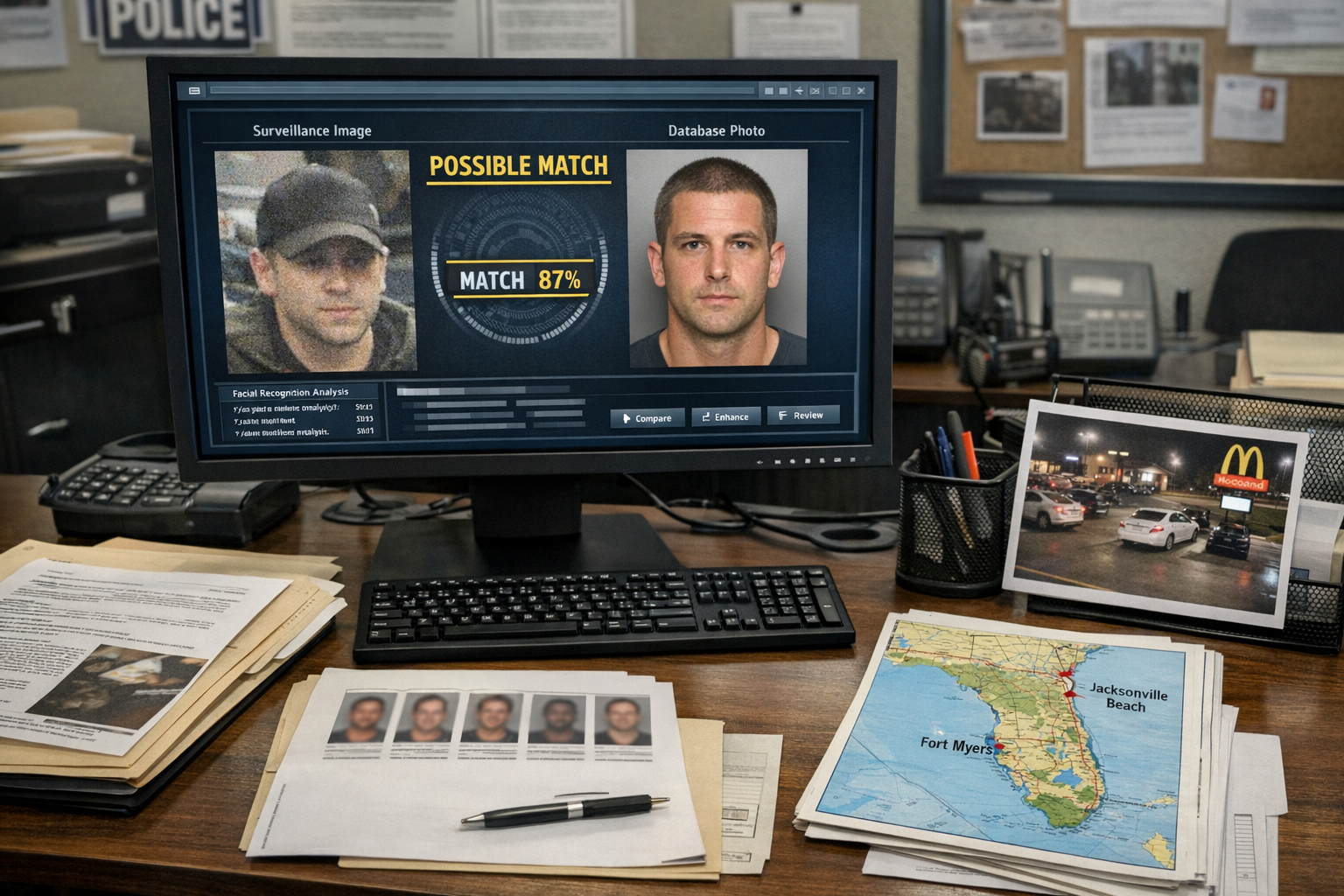
According to the lawsuit, police were investigating an incident at a McDonald’s in Jacksonville Beach in which a man was accused of trying to persuade a young girl to leave with him. Investigators ran grainy surveillance images through Florida’s statewide facial-recognition system, known as FACES or FACESNXT, and the software returned Mr. Dillon as a possible match.
Mr. Dillon, who lived in Fort Myers, more than 300 miles away, was later arrested at his home. The charges were eventually dropped.
The lawsuit argues that officers overlooked or failed to fully account for facts that cut against the identification. Among them, the complaint says, were Mr. Dillon’s assertion that he had never been to Jacksonville Beach and license-plate-reader searches that found no indication his vehicle had been near the McDonald’s where the episode occurred.
At issue is not only the computer-generated lead, but what happened after it. The complaint says police used the facial-recognition result to shape a photo lineup shown to witnesses, a process civil-liberties lawyers say can turn a tentative technological suggestion into a self-reinforcing identification.
That concern has become central to criticism of facial-recognition use in criminal cases: once investigators are told software has found a likely match, they may consciously or unconsciously interpret other evidence through that lens.
One of the nation’s oldest police systems
The lawsuit also casts a spotlight on Florida’s face-recognition network itself. Operated by the Pinellas County Sheriff’s Office since 2001, FACES is regarded as one of the oldest law-enforcement facial-recognition systems in the United States. Civil-liberties advocates say its age, reach and relative opacity make it especially important to understand how the system is used and what safeguards exist when it produces an error.
Florida’s system allows agencies to compare surveillance or other images against a database of booking photos and other records. Like other facial-recognition tools, it does not produce certainty; it generates candidate matches that are supposed to be reviewed by human investigators. But critics have long warned that in practice, officers may give such results far more weight than policy language suggests.
The complaint says that is what happened here: that a possible match was treated less as a lead to investigate than as the backbone of probable cause.
A broader pattern of concern
The suit arrives as scrutiny of police facial-recognition practices has intensified nationally, and in Florida in particular. Civil-rights groups have argued for years that facial-recognition systems can misidentify people, especially when the source images are blurry, poorly lit or captured at difficult angles — precisely the kinds of images often pulled from convenience stores, fast-food restaurants and street cameras.
What makes the Florida case particularly significant is that it is not being presented as an isolated mistake. The ACLU has pointed to another wrongful-arrest case in the state tied to the same system earlier this year, and local reporting in the Jacksonville area recently identified at least one more mistaken facial-recognition case. Together, those episodes are fueling new questions about oversight, training and disclosure: how often officers are told the limits of a match, what judges are told when warrants are sought, and whether defendants are given enough information to challenge the technology used against them.
The legal stakes could be substantial. Courts have historically allowed police considerable leeway in building probable cause from multiple pieces of evidence that, taken together, appear persuasive. But attorneys challenging facial recognition argue that when an initial software match is flawed, later steps — including witness identifications — may be contaminated rather than independent.
In Mr. Dillon’s case, the lawsuit alleges that exculpatory information was omitted or minimized when officers sought a warrant. If that claim gains traction in court, it could sharpen standards for what police must disclose when facial-recognition tools are part of an investigation.
Why the case matters now
For years, the debate over facial recognition in policing has centered on abstract warnings about bias, accuracy and surveillance. Cases like this one are changing that argument by giving it a human face: an arrest at home, prosecution in a city hundreds of miles away, and the burden of proving that a machine-assisted accusation was wrong.
The suit is likely to test not just the reliability of one identification, but the procedures surrounding facial-recognition use in Florida more broadly. Discovery could reveal how often the FACES system has been used, what instructions officers receive about interpreting results, and whether agencies have tracked mistaken identifications or reviewed past arrests.
It may also force a more basic reckoning. Police departments have often described facial recognition as an investigative aid, not a decisive tool. But lawsuits like this one ask whether, in practice, that distinction holds — or whether once a name emerges from the software, the rest of the system begins moving toward that person.
For now, it remains unclear how a federal court will assess the conduct of the officers involved or whether the case will lead to policy changes. But as more defendants and civil-rights lawyers challenge arrests linked to facial-recognition searches, the burden on police agencies to show that these systems are being used cautiously — and not as shortcuts to certainty — is growing.
Sources
Further reading and reporting used to add context:
- Dillon v. City of Jacksonville Beach | American Civil Liberties Union
- https://www.aclu.org/cases?issue=immigrationdetainers
- https://www.aclu.org/news/privacy-technology/more-than-a-dozen-wrongful-arrests-due-to-police-reliance-on-facial-recognition-technology
- https://www.cbsnews.com/news/lawsuit-wrongful-arrest-ai-facial-recognition/
- https://www.aclufl.org/press-releases/
- https://techcrunch.com/2026/06/01/florida-sues-openai-sam-altman-in-first-of-its-kind-lawsuit-over-violent-incidents/
- https://www.aclu.org/press-releases?issue=privacy-technology
- https://www.acludc.org/press-releases/aclu-sues-federal-officers-for-violent-abduction/
- https://www.acluva.org/press-releases/aclu-va-sends-joint-letter-opposing-facial-recognition-technology/
- https://www.laaclu.org/press-releases/aclu-louisiana-sues-louisiana-state-police-facial-recognition-documents/
- https://www.aclufl.org/news/police-say-simple-warning-will-prevent-face-recognition-wrongful-arrests-thats-just-not-true/
- https://www.aclumich.org/en/cases/facial-recognition
- https://www.reddit.com/r/techbeat/comments/1u2pwh0/man_sues_florida_police_over_erroneous_faces/
- https://www.reddit.com/r/technology/comments/1u2fxbt/man_sues_florida_cops_over_arrest_spurred_by_93/
- https://www.reddit.com/r/ArtificialInteligence/comments/1u2upfe/florida_police_wrongfully_arrested_a_commercial/
- https://www.reddit.com/r/TrueAnon/comments/1u2jolc/man_sues_florida_cops_over_arrest_spurred_by_93/
- https://www.reddit.com/r/ItaliaBox/comments/1u2nki2/man_sues_florida_cops_over_arrest_spurred_by_93/
- https://assets.aclu.org/live/uploads/2025/07/2025.07.16-ACLU-Written-Statement-Artificial-Intelligence-and-Criminal-Exploitation-FINAL.pdf
- https://data.aclum.org/storage/2025/01/US_Commission_on_Civil_Rights_www_usccr_gov_files_2024-09_civil-rights-implications-of-frt_0.pdf
- https://www.reddit.com/r/TrueReddit/comments/1u24n98/wrongful_arrest_exposes_failures_in_one_of_the/
- https://en.wikipedia.org/wiki/Deportation_in_the_second_Trump_administration
- https://www.reddit.com/r/AnythingGoesNews/comments/1u24klb/wrongful_arrest_exposes_failures_in_one_of_the/
- Florida Man Sues Police Over Wrongful Arrest Due to False Facial Recognition Match | American Civil Liberties Union
- https://www.theguardian.com/us-news/2026/jun/10/florida-lawsuit-ai-facial-recognition
- https://www.commondreams.org/news/police-facial-recognition
- https://statescoop.com/florida-man-aclu-sue-police-after-wrongful-arrest-using-facial-recognition-tech/
- https://dockets.justia.com/docket/florida/flmdce/3%3A2026cv00353/454266
- https://docs.justia.com/cases/federal/district-courts/florida/flmdce/3%3A2025cv01494/450940/28
- https://law.justia.com/cases/federal/district-courts/florida/flmdce/3%3A2012cv00451/270638/487/
- https://www.asatunews.co.id/en/florida-man-sues-police-facial-recognition
- https://dockets.justia.com/docket/florida/flmdce/3%3A2026cv00415/454807
- https://cases.justia.com/federal/district-courts/florida/flsdce/1%3A2025cv22558/691050/141/0.pdf
- https://www.justice.gov/crt/case-document/file/920171/dl?inline=
- https://ecf.flmd.uscourts.gov/cgi-bin/show_public_doc?2025-00668-9-3-cv=
- https://www.justice.gov/crt/case-document/file/977846/dl
- https://ecf.flmd.uscourts.gov/cgi-bin/show_public_doc?2026-00370-12-3-cv=
- https://www.wesh.com/article/florida-man-wrongly-arrested-police-facial-recognition/70409653
- https://www.wired.com/story/wrongful-arrest-tests-one-of-the-oldest-police-face-recognition-tools-in-the-us/
- https://www.nist.gov/news-events/news/2015/09/study-reveals-forensic-facial-examiners-can-be-near-perfect
- https://police.stpete.org/generalOrders/section-2/ii-47FacialRecognitionSoftware.pdf
- https://pinellas.gov/
- https://www.fox13news.com/news/pinellas-county-sheriffs-office-ai-language-translation-body-cameras
- https://baynews9.com/fl/tampa/news/2016/10/19/study_face_recogniti
- https://www.wesh.com/article/volusia-man-arrested-fraud-theft-he-did-not-commit/70237799
- https://www.sheriff.org/Transparency/Documents/FY_22-23_OIG_Annual_Report.pdf
- https://www.fox13news.com/news/pinellas-county-uses-ai-facial-recognition-reunite-lost-pets-families-via-petco-love-lost/
- https://www.wesh.com/article/how-is-facial-recognition-technology-being-used-across-central-florida/31116255
- https://sls.eff.org/technologies/face-recognition
- https://www.cltampa.com/news/pinellas-county-sheriffs-office-wants-to-use-realtime-facial-recognition-surveillance-12257275/
- https://cityofnsb.com/DocumentCenter/View/19674/32-6-Facial-Recognition-Technologypdf
- https://en.wikipedia.org/wiki/Pasco_County_Sheriff%27s_Office
- https://www.reddit.com/r/florida/comments/1u2ozem/pinellas_county_sheriffs_office_rolls_out/
- https://en.wikipedia.org/wiki/Bob_Gualtieri
- https://pinellassheriff.gov/media/NeoGov/2025-26-PCSO-EBH-Booklet-Active-FINAL-Revised.pdf
- https://pinellassheriff.gov/WebFormsEntry/UploadedFiles/570/RFI%2024-02%20%284%29.pdf
- https://www.reddit.com/r/StallmanWasRight/comments/odkda8
- https://newsite.pinellassheriff.gov/media/mediafields/ClosedCasesPost/4nhf2qj23zvaz65a1jf2egtycw/5e126426483a02329cf00812981c831a.pdf
- https://justice.ky.gov/Boards-Commissions/facialrec/Documents/JPSC%20Model%20Facial%20Recognition%20Policy%20FINAL.pdf
- https://www.jacksonvillebeach.org/faq.aspx?TID=41
- https://www.orlando.gov/files/sharedassets/public/documents/opd/policies-and-procedures/police-operations/1147.0-facial-recognition.pdf
- https://www.jacksonvillebeach.org/269/Police-Forms-Publications
- https://jacksonvillebeach.org/644/How-Are-We-Doing
- https://www.biometricupdate.com/202507/florida-mans-facial-recognition-match-not-probable-cause-for-wrongful-arrest
- https://www.govtech.com/public-safety/five-things-to-know-about-police-facial-recognition-tech
- https://assets.aclu.org/live/uploads/2026/04/2026-04-13-kimberlee_williams_aa_letter_final_Redacted-1.pdf
- https://www.jacksonvillear.gov/DocumentCenter/View/6684/10-9-Stop-Arrest-and-Search-of-Persons?bidId=
- https://public.powerdms.com/HDOP/documents/3807599
- https://www.flawedfacedata.com/
- https://www.documentcloud.org/documents/20945283-board-of-police-commissioners-2021-06-17-dpd-report-on-facial-recognition-usage-060721-061321pdf/
- https://www-staging.washingtonpost.com/business/2024/10/06/police-facial-recognition-secret-false-arrest/
- https://www.jacksonvillebeach.org/FAQ.aspx?QID=258
- https://library.municode.com/fl/jacksonville/codes/code_of_ordinances/286353?nodeId=TITXVIJUCO_CH634FICO
- https://www.reddit.com/r/realtech/comments/hf2ig4
- https://www.reddit.com/r/legaladvice/comments/s82fsa
- https://www.reddit.com/r/technology/comments/1fxxmju
- https://www.reddit.com/r/AmIFreeToGo/comments/1j0b7h8
- https://www.reddit.com/r/norfolk/comments/m1fkal
- https://www.actionnewsjax.com/news/local/man-wrongfully-jailed-prosecutors-cite-facial-recognition-match-before-dropping-case/CJBWGL47CVEFJDFBJWQ3XHBNZU/
- https://www.actionnewsjax.com/news/investigates/jso-ai-not-only-tool-that-identified-charlotte-man-suspect-crime-he-didnt-commit/DUH2UB6ILJFK3LHHVFCWPMYG7E/
- https://www.actionnewsjax.com/news/local/twin-lakes-academy-middle-school-security-guard-arrested-accused-lewd-conduct-with-student/FSVYKU4SQZBBTBCVK7PBWCQNPI/
- https://www.news4jax.com/news/local/2026/06/04/confessed-jacksonville-serial-rapist-now-charged-with-package-theft-police-say/
- https://www.actionnewsjax.com/news/local/charlotte-father-10-says-jacksonville-police-ai-misidentification-cost-him-his-freedom-home-job/ZHHJGP3NOZETJCPMSCBQGES6SY/
- https://gigazine.net/gsc_news/en/20260610-ai-misidentification-wrongful-arrest/
- https://afrotech.com/automated-facial-recognition-tech-jacksonville-sheriffs-office-wrongfully-leads-father-jailed
- https://www.actionnewsjax.com/news/local/jacksonville-man-accused-shooting-2-year-old-boy-pleads-not-guilty/VIJFUPNHGNEXBMM35P2CSF6VXY/
- https://www.tomshardware.com/tech-industry/artificial-intelligence/facial-recognition-is-jailing-the-wrong-people-police-keep-using-it-anyway
- https://www.reddit.com/r/ArtificialInteligence/comments/1u2uq48/north_carolina_man_spent_50_days_in_jail_after/
- https://en.wikipedia.org/wiki/Jacksonville_Sheriff%27s_Office
- https://www.reddit.com/r/jacksonville/comments/1rbym2u/headline_jax_beach_police_claim_14_arrests_in_45/
- https://www.njcourts.gov/system/files/cases/briefs/a_41_24_amicus_curiae_brief_of_dr_michael_c_king_ph_d.pdf




Leave a Reply