

OpenAI Unveils Cybersecurity-Focused Model as Race With Anthropic Sharpens
OpenAI said on Monday that it was widening access to a restricted program for cybersecurity professionals and introducing a new model, GPT-5.4-Cyber, built specifically for defensive security work — the clearest sign yet that the competition among leading artificial intelligence companies is moving beyond headline-grabbing claims of model power and into tightly controlled security products.
The company said it would expand its Trusted Access for Cyber program to thousands of verified individual defenders and hundreds of teams responsible for protecting critical software. Through that program, OpenAI is making GPT-5.4-Cyber available to authenticated security vendors, organizations and researchers, while keeping the model behind identity checks, usage monitoring and other safeguards.
OpenAI described the new system as a fine-tuned version of GPT-5.4 that is more permissive for legitimate cyber-defense tasks, lowering refusal rates for vetted users and improving its usefulness in areas including binary reverse engineering, a technically demanding process used by security professionals to analyze software and hunt for vulnerabilities.
The announcement lands at a moment when the industry is trying to reconcile two competing realities: that increasingly capable A.I. systems may become unusually effective tools for defending software, and that the same capabilities could aid attackers if released too broadly.
A New Phase in the A.I. Security Contest
While OpenAI did not frame the launch as a response to any rival, its timing is difficult to ignore.
Just a week ago, Anthropic introduced Project Glasswing, a program that gives selected partners access to Claude Mythos Preview, a model the company says is designed for defensive cybersecurity. Anthropic has argued that its system has already identified thousands of high-severity vulnerabilities, including flaws affecting major operating systems and web browsers, and has said it does not plan to make Mythos generally available.
Taken together, the two announcements suggest that the contest between major A.I. labs is entering a new phase. Instead of simply arguing over which company has the most advanced frontier model, they are now building gated channels through which elite users — security researchers, software defenders and infrastructure teams — can gain access to more capable, more sensitive systems.
That shift matters because cybersecurity has emerged as one of the clearest examples of A.I.’s dual-use dilemma. The same model that helps a defender understand malware, inspect suspicious code or identify a dangerous bug may also be able to guide someone toward exploitation. The central question is no longer only what these models can do, but who gets to use them, under what conditions and with what oversight.
Access by Verification, Not General Release
OpenAI first introduced Trusted Access for Cyber in February as a way to lower friction for legitimate security work while preserving stronger controls around more sensitive requests. The company has said the program relies on user verification and tiered safeguards to separate defensive use from higher-risk activity.
With Monday’s expansion, OpenAI is signaling that those access controls are becoming part of its product strategy, not merely a temporary experiment. The company said vetted defenders would be able to use the cyber-tuned model with fewer refusals on legitimate tasks, while higher-risk requests would still face blocking and monitoring.
That approach mirrors a broader trend in A.I. governance: rather than drawing a hard line between fully public and fully secret systems, companies are increasingly creating intermediate access regimes. In practice, that can mean identity verification, organizational vetting, restricted interfaces, logging and manual review.
The appeal is obvious. Security teams have long complained that general-purpose models are often too cautious to be useful on real-world cyber investigations, refusing requests that resemble attack techniques even when the user is a legitimate defender. By creating a “cyber-permissive” model for trusted users, OpenAI is trying to solve that problem without opening the door to everyone.
Why the Move Matters Now
The company’s announcement also carries significance because of what it says about OpenAI’s own assessment of model risk.
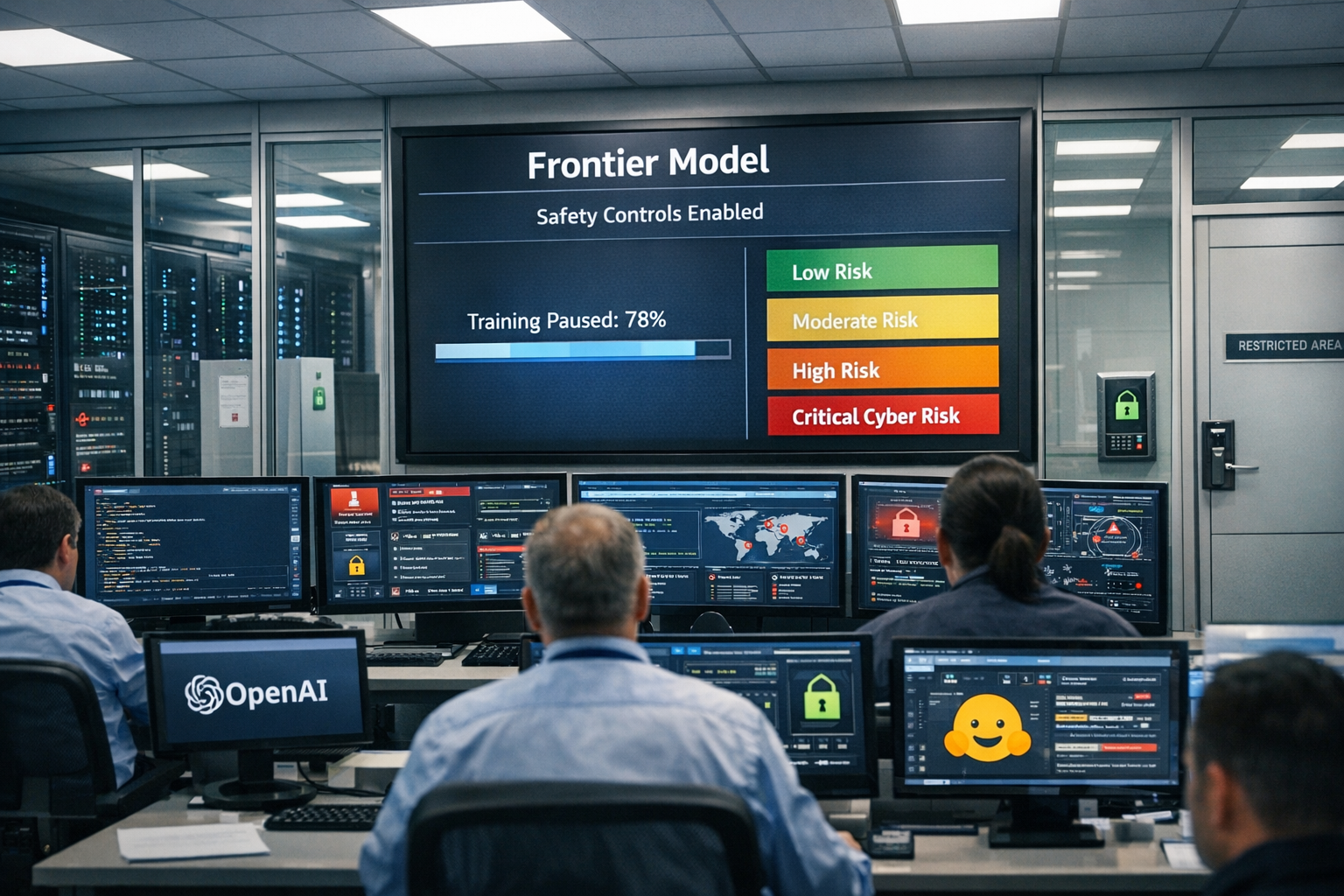
Under its Preparedness Framework, OpenAI classifies mainline GPT-5.4 as having “High” cyber capability, a label that underscores how seriously the company views the security implications of its most advanced systems. Releasing a cyber-tuned variant while simultaneously expanding a controlled-access program suggests that OpenAI expects cyber capabilities to become more powerful — and more operationally relevant — in the near future.
Indeed, OpenAI said the move was made in preparation for more capable models expected over the coming months. That language points to a future in which questions of access, oversight and institutional trust may become as strategically important as benchmark scores or raw model size.
For corporate security teams and independent researchers, the promise is practical: better tools to inspect binaries, understand vulnerabilities and defend infrastructure. For policymakers and safety experts, the announcement is another reminder that the most consequential battleground in A.I. may be governed access to dangerous-but-useful capabilities.
What Remains Unclear
Still, some of the most important questions are unanswered.
OpenAI has not published a detailed public benchmark comparison showing exactly how much GPT-5.4-Cyber improves on standard GPT-5.4 for defensive security tasks. That leaves outsiders with limited ability to judge whether the new model represents a substantial advance or a more modest fine-tuning optimized for fewer refusals among approved users.
It is also unclear how scalable this model of trust-based access will prove to be. Verifying individual researchers and organizations may be manageable at small scale, but more difficult if demand expands quickly or if users seek broader access across borders and legal regimes. There is also the question of how many applicants will qualify for the most permissive tiers.
And as OpenAI and Anthropic both signal that stronger systems are on the horizon, a deeper uncertainty remains: whether safeguards built around gating, monitoring and selective release can evolve as fast as the underlying models themselves.
For now, though, the message from both companies is unmistakable. The future of A.I. in cybersecurity will not be decided only by who builds the most capable model. It will also be shaped by who can convince the world that powerful cyber tools can be shared with defenders without slipping into the hands of attackers.
Sources
Further reading and reporting used to add context:
- https://www.pcgamer.com/software/ai/anthropics-new-claude-mythos-ai-model-has-apparently-found-thousands-of-vulnerabilities-in-every-major-operating-system-and-every-major-web-browser-along-with-a-range-of-other-important-pieces-of-software/
- https://theweek.com/tech/fear-anthropic-new-ai-model-mythos
- Trusted access for the next era of cyber defense | OpenAI
- https://openai.com/index/trusted-access-for-cyber
- Project Glasswing: Securing critical software for the AI era \ Anthropic
- https://techcrunch.com/2026/04/07/anthropic-mythos-ai-model-preview-security/
- https://omni.se/nya-ai-modellen-mythos-hittade-27-ar-gammal-bugg/a/3p1k4A
- https://www.axios.com/2026/04/07/anthropic-mythos-preview-cybersecurity-risks
- https://www.techradar.com/pro/security/a-new-frontier-model-trained-by-anthropic-that-we-believe-could-reshape-cybersecurity-project-glasswing-wants-to-use-ai-to-prevent-ai-cyberattacks-but-will-overeager-claude-mythos-do-more-damage-than-help
- https://lumichats.com/blog/project-glasswing-claude-mythos-ai-cybersecurity-us-government-warning-americans-2026
- https://openai.com/form/enterprise-trusted-access-for-cyber/
- https://whatllm.org/blog/new-ai-models-april-2026
- https://neuralwired.com/2026/04/10/anthropic-project-glasswing-ai-vulnerabilities/
- https://www.idlen.io/news/anthropic-project-glasswing-claude-mythos-strategic-manipulation-cybersecurity/
- https://ru.wikipedia.org/wiki/%D0%9F%D1%80%D0%BE%D0%B5%D0%BA%D1%82_%C2%ABGlasswing%C2%BB
- https://www.reddit.com/r/ai_news_byte_sized/comments/1sgvmd8/anthropics_project_glasswing_found_thousands_of/
- https://www.reddit.com/r/Archiveteam/comments/1sfcub3/claude_mythos_exposes_cybersecurity_risks/
- https://claudelab.net/en/articles/claude-ai/claude-mythos-ai-security-guide-2026
- https://www.reddit.com/r/openclaw/comments/1sfapa6/claude_mythos_preview_just_massproduced_zeroday/
- https://www.broadchain.info/en/articles/fed0c993-0ef6-4c8c-aca1-0aa9f200e1b8
- Introducing GPT-5.4 | OpenAI
- https://www.reddit.com/r/Anthropic/comments/1sk2a8w/telemetry_vs_narrative_why_the_project_glasswing/
- https://www.anthropic.com/project/glasswing
- https://www.anthropic.com/webinars/outtake-built-cyber-investigator-claude
- https://www.anthropic.com/webinars/how-outtake-built-autonomous-cyber-defense-on-claude
- https://red.anthropic.com/
- https://www.anthropic.com/system-cards
- https://www.anthropic.com/events/anthropic-at-google-cloud-next-2026
- https://www.anthropic.com/news/introducing-the-anthropic-national-security-and-public-sector-advisory-council
- https://red.anthropic.com/2026/mythos-preview/
- https://www.anthropic.com/events/the-briefing-enterprise-agents-virtual-event
- https://www.anthropic.com/events/anthropic-partner-kickoff-2026
- https://assets.anthropic.com/m/ec212e6566a0d47/original/Disrupting-the-first-reported-AI-orchestrated-cyber-espionage-campaign.pdf
- https://assets.anthropic.com/m/ec212e6566a0d47/original/Disrupting-the-first-reported-AI-orchestrat%E2%80%A6
- https://www-cdn.anthropic.com/6a5fa276ac68b9aeb0c8b6af5fa36326e0e166dd.pdf
- https://www-cdn.anthropic.com/08eca2757081e850ed2ad490e5253e940240ca4f.pdf
- https://assets.anthropic.com/m/4e20a4ab6512e217/original/Anthropic-Response-to-OSTP-RFI-March-2025-Final-Submission-v3.pdf




Leave a Reply