
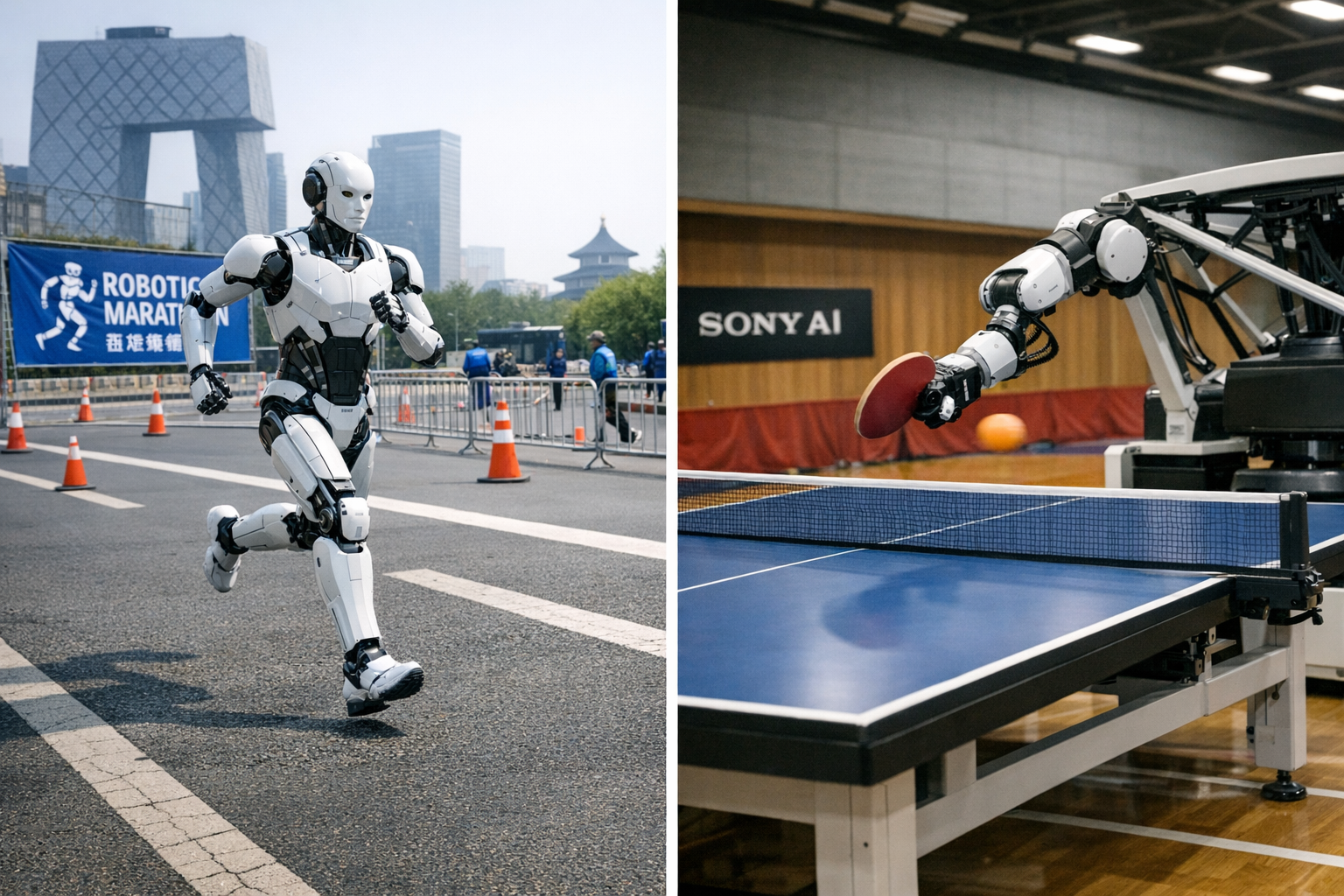
Two New Robot Feats Push Embodied AI Into the Sporting Arena
Two striking demonstrations of robotic performance this week — one on a road course in Beijing, the other across a table tennis court — are sharpening a question that has hovered over artificial intelligence for years: how well can machines handle the physical world when speed, uncertainty and endurance matter?
In China, a humanoid robot named Lightning was declared the winner of a half-marathon after finishing the 21.1-kilometer course in 50 minutes 26 seconds, according to event organizers. The official time, recorded at the Beijing E-Town Humanoid Robot Half-Marathon on April 19, was faster than the current men’s human half-marathon world record of 57:20, set by Jacob Kiplimo in Lisbon last month.
And in research reported this week, Sony AI said its table-tennis robot, Ace, defeated three of five elite human players under official-style match conditions, a result that researchers described as a milestone in a sport long seen as a punishing test of perception, reaction and motor control. In the main evaluation, Ace lost the two matches it played against professional players, though Sony said later follow-up matches showed further gains, including wins over some professionals.
Taken together, the results suggest that robotics is advancing on two of the hardest fronts in embodied artificial intelligence: sustained locomotion in the open world and split-second action in adversarial, highly dynamic environments.
A Record, With Caveats
The Beijing race was staged as a public test of humanoid mobility, with robots navigating a course that organizers said included flat stretches, slopes, curves and narrow segments. Human runners were on the broader route as well, though separated for safety.
The headline result came with important qualifications. Organizers said the competition included both autonomous and remotely controlled robots, and that remotely operated entries were assessed a 1.2 time-coefficient penalty. Under those rules, Lightning, from Honor’s Qitian Dasheng, or “Monkey King,” team, took the official win in 50:26. Another Honor robot reportedly crossed the line faster, in 48:19, but was penalized because of the event’s autonomy rules.
That means the “record” was real within the structure of the competition, though not simply a matter of which machine physically crossed first. It also underscores a broader issue in robotics contests: what exactly is being measured. In this case, organizers were not just rewarding speed, but a degree of independence from human control.
Even so, the result was difficult to dismiss. For years, videos of humanoid robots stumbling, overheating or struggling with basic terrain have served as reminders of how demanding bipedal movement is. Covering more than 13 miles at sustained pace outdoors is a markedly different challenge from short lab demonstrations or carefully staged warehouse routines.
Ping-Pong as a Robotics Test
If road racing probes balance and efficiency, table tennis examines another frontier altogether: the ability to sense, predict and act in fractions of a second.
Ace is not a humanoid athlete in the conventional sense. It is a specialized table-tennis system built around high-speed sensors, reinforcement learning and custom robotic hardware. In the research, Ace played on an Olympic-size court under rules based on those of the International Table Tennis Federation, facing five elite and two professional players. Researchers said the system had not been trained on opponent-specific data beforehand.
That matters because table tennis is not just about hitting a ball back. It requires reading spin, angle, speed and placement almost instantly, then selecting and executing a response while the opponent is adapting in real time. In robotics, that combination of vision, prediction and precise control has made racket sports a coveted benchmark.
Ace’s record against elite players, while short of dominance against professionals in the study’s central tests, points to a system operating near human competitive pace in a physical contest where delays of milliseconds can decide a point. Sony has framed the project not simply as a sporting novelty, but as evidence that robots can improve at dynamic physical interaction — a capability with implications well beyond recreation.
Why These Feats Matter Now
The pairing of the two achievements is what makes this moment notable. They illuminate different dimensions of the same technological push: getting AI systems out of purely digital domains and into bodies that can move, react and persist in the real world.
In recent years, advances in large language models have transformed tasks involving text, code and image generation. But many researchers and investors have increasingly turned their attention to “embodied AI,” the effort to give machines the ability to perceive and act physically in changing environments. The hope is that robots that can run a route, return a serve or recover from small disturbances may eventually become more useful in factories, hospitals, logistics hubs and homes.
The skills on display in Beijing and at the table tennis table are more broadly relevant than they may first appear. Long-distance running demands energy efficiency, balance, gait stability and robustness over time. Competitive ping-pong requires high-speed perception, rapid planning, dexterity and adaptation to uncertainty. These are core ingredients for any machine expected to work safely and effectively around people.
That does not mean a half-marathon robot is ready to navigate a cluttered building, or that a table-tennis specialist can fold laundry. But both demonstrations show progress on the underlying mechanics and control systems that have often limited robots in less scripted settings.
The Limits of the Milestones
As with many high-profile robotics breakthroughs, the achievements also raise questions about how far the results generalize.
The Beijing race, for all its real-world features, was still a structured event. Commentators have noted that the robots followed a premapped route and were supported by crews, conditions far removed from the unpredictability of crowded sidewalks, construction zones or unfamiliar indoor spaces. The event’s rules also favored autonomy by design, making the official outcome partly a reflection of format.
Ace, meanwhile, excels at a narrow but exceptionally difficult task. Whether that translates into broader manipulation skills — or into a commercially useful system outside sport — remains uncertain. Beating selected elite players in controlled conditions is not the same as proving sustained superiority over a wide field, and table tennis allows for a highly optimized machine built for one purpose.
Still, in robotics, narrow competence at a hard task often comes before broader capability. Machines first master one slice of the world, then another, and only gradually begin to combine those skills.
From Spectacle to Signal
For now, both performances are likely to be received partly as spectacle: a robot outrunning the best human half-marathoner, another trading shots with top table-tennis players. But beneath the headline appeal is a more consequential signal.
Robotics progress is often uneven, arriving not as one grand leap toward general-purpose humanoids, but as a series of highly specific breakthroughs in mobility, control and adaptation. This week’s feats suggest those pieces are continuing to improve.
The challenge ahead is not simply to make robots faster or more athletic. It is to turn these isolated demonstrations into systems that can operate reliably outside curated tests, without special infrastructure, and in environments no engineer has fully scripted in advance.
That remains a distant goal. But the distance, at least in some corners of robotics, appears to be shrinking.
Sources
Further reading and reporting used to add context:
- https://apnews.com/article/995b239945e0dc8d7bea918a850969dc
- https://theweek.com/tech/chinese-robot-sets-new-half-marathon-record
- https://www.techradar.com/ai-platforms-assistants/humanoid-robot-beats-human-world-record-for-the-first-time-at-the-beijing-half-marathon-but-some-are-still-stumbling-at-the-starting-line
- https://www.theguardian.com/p/x4q25k
- https://www.wired.com/story/a-humanoid-robot-set-a-half-marathon-record-in-china/
- https://techcrunch.com/2026/04/19/robots-beat-human-records-at-beijing-half-marathon/
- https://fortune.com/2026/04/19/humanoid-robot-world-record-half-marathon-race-china-honor/
- https://news.cgtn.com/news/2026-04-19/China-s-humanoid-robots-close-in-on-human-half-marathon-pace-1MsBRtKA4NO/index.html
- https://www.globaltimes.cn/page/202604/1359229.shtml
- Sony AI Announces Breakthrough Research in Real-World Artificial Intelligence and Robotics
- https://www.smithsonianmag.com/smart-news/a-humanoid-robot-just-beat-the-human-world-record-for-the-fastest-half-marathon-during-a-race-in-china-180988599/
- https://www.livescience.com/technology/robotics/watch-an-ai-based-table-tennis-robot-beat-elite-players
- https://www.kpbs.org/news/international/2026/04/19/a-humanoid-robot-sprints-past-the-human-half-marathon-world-record-in-beijing-race
- https://technode.com/2026/04/20/honors-humanoid-robot-breaks-human-half-marathon-record-in-50min-26sec/
- https://news.sky.com/story/the-robot-that-can-outplay-elite-table-tennis-players-13535070
- https://en.wikipedia.org/wiki/Beijing_E-Town_Half-Marathon
- https://www.reddit.com/r/robotics/comments/1ssyhq3/the_guardian_aipowered_robot_beats_elite_table/
- https://www.reddit.com/r/ArtificialInteligence/comments/1ssygm9/the_guardian_aipowered_robot_beats_elite_table/
- https://cadenaser.com/nacional/2026/04/19/se-hace-realidad-lo-imposible-los-robots-vencen-a-los-humanos-en-la-media-maraton-de-pekin-por-primera-vez-en-la-historia-cadena-ser/
- https://www.huffingtonpost.es/tecnologia/los-robots-humanoides-corren-vuelan-pulverizan-todos-registros-media-maraton-pekin-f202604.html
- https://en.wikipedia.org/wiki/Humanoid_robot
- https://www.reddit.com/r/InterstellarKinetics/comments/1sptv4u/breaking_chinese_humanoid_robot_just_ran_a/
- https://english.beijing.gov.cn/latest/news/202604/t20260419_4593508.html
- https://english.beijing.gov.cn/whatson/events/sports/202512/t20251230_4378487.html
- https://english.beijing.gov.cn/latest/news/202603/t20260306_4550687.html
- https://www.nature.com/articles/d41586-026-01045-2
- https://www.nature.com/articles/s41586-026-10338-5
- https://english.beijing.gov.cn/latest/news/202504/t20250421_4070140.html
- https://french.beijing.gov.cn/latest/news/202604/t20260420_4595674.html
- https://english.beijing.gov.cn/consuminginbeijing/onedayinbeijing/sportshealth/newsofsportshealth/202604/t20260413_4580603.html
- https://german.beijing.gov.cn/latest/news/202603/t20260327_4567819.html
- https://www.nature.com/articles/s41598-025-31222-8
- https://www.nature.com/articles/s41598-023-37746-1
- https://www.nature.com/articles/s41598-026-40324-w_reference.pdf
- https://www.nature.com/articles/s41598-025-21076-5.pdf
- https://www.nature.com/articles/s41598-025-14426-w.pdf
- https://www.nature.com/articles/s41598-025-31222-8_reference.pdf
- https://apnews.com/article/302d0c4781bab20100d6a0bb4e77b629
- https://www.t3.com/tech/honor-used-phone-tech-to-build-a-record-breaking-robot-that-runs-faster-than-a-human
- https://www.irunfar.com/2026-beijing-e-town-half-marathon-humanoid-robot-beats-human-world-record
- A humanoid robot beat the human half-marathon record at a Beijing race. But what did it actually prove? | Scientific American
- https://www.latimes.com/sports/story/2026-04-20/humanoid-robot-lightning-sets-half-marathon-record-in-beijing
- https://www.cbsnews.com/news/humanoid-robot-half-marathon-beijing-human-world-record/
- https://www.euronews.com/next/2026/04/20/humanoid-robot-smashes-human-half-marathon-world-record-in-beijing-race
- https://www.lumsas.com/blog/beijing-humanoid-robot-half-marathon-2026-honor-lightning-record
- https://english.cctv.com/2026/04/20/ARTIHM6S3mByhGVtsliKZ8qK260420.shtml
- https://www.washingtonpost.com/business/2026/04/19/humanoid-robots-half-marathon-beijing/db716dcc-3ba4-11f1-90c4-9772c7fabc03_story.html
- https://elpais.com/tecnologia/2026-04-19/los-robots-chinos-pulverizan-registros-y-arrasan-a-los-humanos-en-el-medio-maraton-de-pekin.html
- https://www.reddit.com/r/humanoidrobotics/comments/1sql28v/on_april_19_2026_the_2nd_beijing_etown_humanoid/
- https://worldathletics.org/records/toplists/road-running/half-marathon/outdoor/men/senior/2026
- https://worldathletics.org/news/report/jacob-kiplimo-half-marathon-world-record-lisbon
- https://en.wikipedia.org/wiki/Lisbon_Half_Marathon
- https://en.wikipedia.org/wiki/Half_marathon_world_record_progression
- https://world-track.org/2026/03/jacob-kiplimo-half-marathon-world-record-edp-lisbon-half-marathon-5720/
- https://www.aljazeera.com/sports/2026/3/8/ugandas-jacob-kiplimo-regains-half-marathon-world-record-in-lisbon
- https://aboutrun.com/kiplimo-half-marathon-world-record-lisbon-2026/
- https://aims-worldrunning.org/articles/2963-kiplimo-breaks-world-record-at-edp-lisbon-half.html
- https://mylaps.com/news/world-record-performance-at-lisbon-half-marathon/
- https://en.wikipedia.org/wiki/Jacob_Kiplimo
- https://www.monitor.co.ug/uganda/sports/athletics/kiplimo-breaks-world-half-marathon-record-with-57-20-on-lisbon-return-5384006
- https://en.wikipedia.org/wiki/Half_marathon
- https://www.theguardian.com/sport/2026/mar/08/ugandas-jacob-kiplimo-storms-to-half-marathon-world-record-in-lisbon
- https://www.bbc.co.uk/sport/athletics/articles/c7vj9g4mp55o
- https://helm.news/2026-03-08/ugandan-runner-jacob-kiplimo-set-new-mens-half-marathon-world-record.html
- https://www.watchathletics.com/article/13631/jakob-kiplimo-smashes-half-marathon-world-record-with-57-20-at-lisbon-half-marathon
- https://en.wikipedia.org/wiki/World_Athletics_Half_Marathon_Championships
- https://es.wikipedia.org/wiki/Jacob_Kiplimo
- https://www.vg.no/sport/i/3pELVq/ny-verdensrekord-jacob-kiplimo-loep-halvmaraton-paa-57-20-i-lisboa
- https://as.com/masdeporte/atletismo/kiplimo-pierde-el-record-mundial-de-media-maraton-por-ir-a-rebufo-de-un-coche-f202602-n/
- https://as.com/masdeporte/atletismo/kiplimo-vuelve-a-ser-el-mas-rapido-de-la-historia-en-media-maraton-f202603-n/
- https://aims-worldrunning.org/downloads/2026.e1.DistanceRunning.web.pdf
- https://athleticsweekly.com/wp-content/uploads/securepdfs/2026/04/AWKY-03-04-26-006-AWKY.pdf
- Who is Winner? Champion Crowned for Humanoid Robot Half Marathon
- Outplaying elite table tennis players with an autonomous robot | Nature







Leave a Reply