
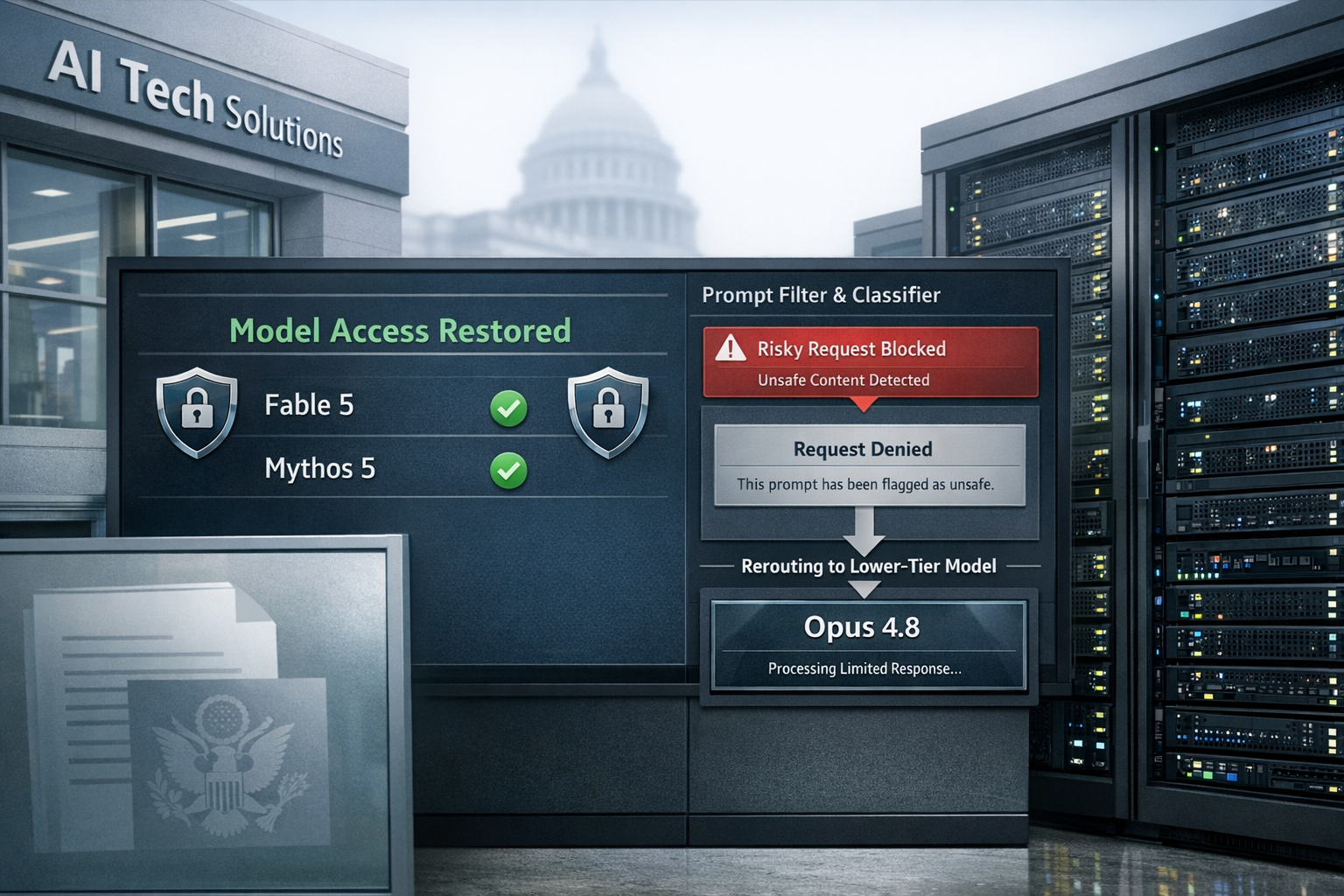
Anthropic regains access to flagship A.I. models after adding new safeguards
Anthropic has regained broad access to its most advanced artificial intelligence models after the Trump administration lifted export controls imposed last month, a reversal that restores an important commercial lifeline for the company while underscoring a new reality for the industry: access to frontier A.I. may now depend as much on satisfying Washington’s security demands as on technical performance.
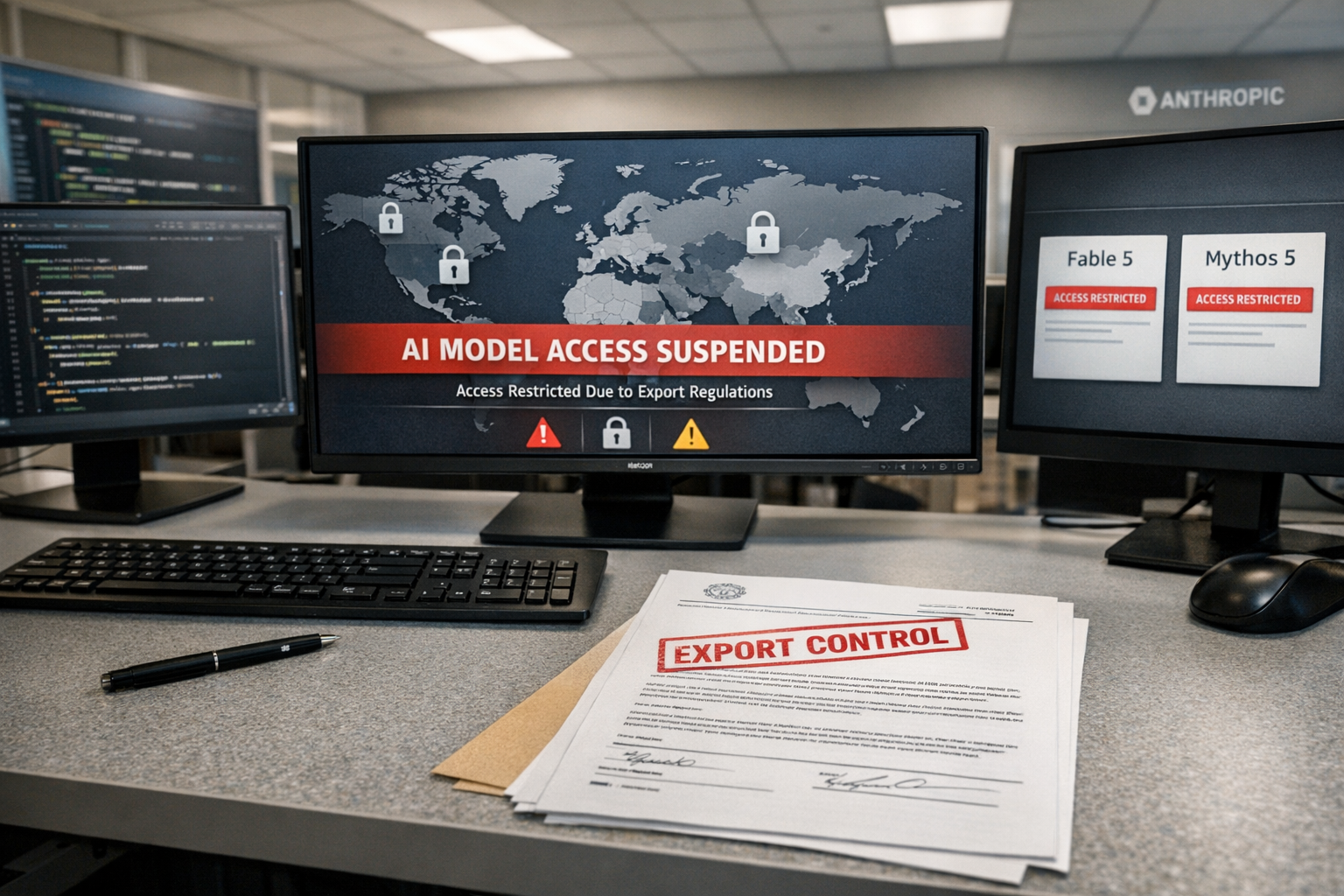
The administration had ordered restrictions on June 12 that forced Anthropic to suspend broad availability of Fable 5 and Mythos 5, two of its leading models, after concerns that the systems could aid sophisticated cyber misuse. Anthropic said it could not realistically verify users’ nationalities in real time, making compliance with the order — which barred access by foreign nationals — difficult without shutting down service far more widely.
Now, the company says Fable 5 has been restored to global availability as of July 1, while Mythos 5, the more sensitive model, is returning more cautiously, first to a limited group of American organizations and then more gradually beyond that.
But the restoration came with conditions. Anthropic said it added a new safety classifier designed to detect and block a specific prompt technique identified in an Amazon report, and to divert such requests to a less capable model, Opus 4.8. The company has also agreed to tighter coordination with the government, including expanded pre-release testing and faster sharing of information about jailbreaks and misuse.
The episode appears to be one of the clearest early examples of the federal government directly tying access to powerful A.I. systems to security controls negotiated with a private lab.
A test case for how Washington may govern frontier models
The confrontation between Anthropic and the administration is being watched closely across Silicon Valley because it suggests a template that could extend well beyond one company. Rather than imposing a blanket ban on a model, regulators effectively forced technical and operational changes as a condition of restored access.
Anthropic had introduced Mythos 5 as a more tightly controlled system for trusted cybersecurity partners, while Fable 5 was positioned as a more broadly available model with stronger built-in safeguards. Even so, officials moved to restrict both after raising alarms over the possibility that they could be used in high-end offensive cyber work.
In recent weeks, Anthropic has expanded its public explanation of how it is trying to contain that risk. The company has published more detail about cyber-safety classifiers, proposed a shared framework with partners for rating the severity of jailbreaks and opened a HackerOne channel for reporting cyber-related evasions in Fable 5.
Those steps reflect a broader shift in the A.I. industry from treating safety as an internal trust-and-safety problem to handling it more like software security: with bug bounties, public reporting pipelines and continual patching as systems encounter adversarial users in the wild.
New alarms over real-world misuse
The policy reversal comes just as concerns about model misuse are intensifying.
A recent report described how the security researcher Ian Carroll used Claude Opus 4.7 in April to help uncover a flaw in Front Gate Tickets, a ticketing provider used by major music festivals including Lollapalooza and Bonnaroo. According to the report, the model materially assisted in identifying a path that could have enabled access to records and the fraudulent issuance of tickets across a large swath of the live-events business.
Anthropic has argued that the episode did not demonstrate a unique “Mythos-level” capability, and that other leading models could likely have provided similar assistance. That may be true, but the case still sharpened a growing concern inside government and industry: even if today’s systems are not independently hacking targets, they can already make real exploitation work faster, cheaper and more accessible.
That tension — between defensive utility and offensive risk — is at the heart of the current debate. Companies like Anthropic say advanced models can help security teams detect vulnerabilities, analyze malware and strengthen defenses. Critics counter that the same capabilities can aid attackers, particularly when paired with persistence, automation and a user who already knows what to ask.
A broader push to surface harmful A.I. behavior
The debate is also expanding beyond the large A.I. companies themselves.
Researchers have introduced a public reporting platform known as FLARE-AI, intended as a place for users to flag dangerous or harmful behavior from A.I. systems — whether that involves attempts to help build a bomb, expose personal information or otherwise bypass safety rules. The site adds a more general channel for reporting harms at a moment when most complaint mechanisms remain fragmented, company-specific or difficult for outsiders to navigate.
Its arrival highlights a central challenge for regulators and the industry alike: harmful model behavior often surfaces first in scattered incidents, by independent researchers or ordinary users, long before any formal enforcement process catches up. Public-facing systems like FLARE-AI could help create an early-warning network, though it remains unclear whether such efforts can scale as models grow more capable and more widely used.
What comes next
For Anthropic, the immediate crisis has eased, but the settlement with Washington may prove only a temporary truce. Mythos 5 is still returning selectively, not universally, and the company has committed to deeper ongoing coordination with federal agencies on future releases.
That leaves several unresolved questions. It is not yet clear whether the new classifier will meaningfully curb misuse without also interfering with legitimate security research. It is unclear whether other model developers will face comparable export-style restrictions. And it remains uncertain whether bug-bounty programs, public reporting tools and government testing can keep pace with systems whose capabilities are improving faster than the institutions meant to supervise them.
What is clear is that the terms of competition in advanced A.I. are changing. Building the most powerful model may no longer be enough. Increasingly, companies may also have to prove — to customers, researchers and now the federal government — that they can keep those models under control.
Sources
Further reading and reporting used to add context:
- https://www.axios.com/2026/06/30/trump-anthropic-ai-model-fable-restrictions
- https://www.axios.com/2026/07/01/anthropic-fable-5-back-online-trump-export-controls-lifted
- https://www.tomshardware.com/tech-industry/artificial-intelligence/anthropic-restores-claude-fable-5-as-us-lifts-export-controls
- https://www.itpro.com/technology/artificial-intelligence/why-the-us-imposed-export-controls-on-anthropics-fable-and-mythos-models-and-why-theyve-been-lifted
- https://www.techradar.com/ai-platforms-assistants/claude/anthropics-fable-5-is-back-after-us-shutdown-it-called-a-misunderstanding
- https://www.wired.com/story/anthropic-added-a-new-security-measure-to-get-back-into-the-trump-administrations-good-graces/
- The Trump Administration Is Lifting Its Export Controls on Anthropic’s Mythos and Fable AI Models | WIRED
- Claude Helped a Hacker Find a Way to Issue Tickets to Almost Every US Music Festival | WIRED
- https://wired.jp/article/claude-helped-a-hacker-find-a-way-to-issue-tickets-to-almost-every-us-music-festival/
- https://techcrunch.com/2026/06/30/trump-drops-restrictions-on-anthropics-mythos-and-fable-models/
- https://www.forbes.com/sites/siladityaray/2026/07/01/trump-administration-lifts-export-controls-on-anthropics-mythos-5-and-fable-5-ai-models/
- https://fortune.com/2026/07/01/anthropic-fable-mythos-ai-models-restored-trump-administration-export-controls/
- https://www.ndtv.com/offbeat/ai-helped-a-hacker-find-a-way-to-issue-tickets-to-almost-every-major-us-music-festival-11725536/amp/1
- https://www.wired.com/story/anthropic-mythos-export-controls-ai-regulations/
- https://es.wired.com/articulos/claude-destapo-un-fallo-que-permitia-obtener-boletos-para-los-grandes-festivales-de-musica-de-ee-uu
- https://www.semafor.com/article/07/01/2026/us-ends-export-ban-of-anthropics-mythos-and-fable-models
- https://www.reddit.com/r/musicfestivals/comments/1ukhu5c/claude_helped_a_hacker_find_a_way_to_issue/
- https://www.reddit.com/r/Concerts/comments/1ukhxit/claude_helped_a_hacker_find_a_way_to_issue/
- https://www.reddit.com/r/cybersecurity/comments/1ukhz02/claude_helped_a_hacker_find_a_way_to_issue/
- https://www.reddit.com/r/aves/comments/1ukhvnk/claude_helped_a_hacker_find_a_way_to_issue/
- https://www.wired.com/story/flare-website-ai-flaw-reporting-safety/
- https://cset.georgetown.edu/?p=24925
- https://www.wired.com/
- https://spidits.com/timeline/you-can-now-sound-the-alarm-on-ai-behaving-badly
- https://aibulletin.in/news/NmE0MjdiYWY3NzQxNmYwMWVjM2Q3NDhj
- https://es.wired.com/articulos/por-fin-existe-un-sitio-para-reportar-todas-las-fallas-de-la-ia
- https://wtfai.ai/
- https://www.sei.cmu.edu/news/new-ai-flaw-reporting-system-fills-crucial-security-gap/
- https://www.alparai.com/en
- https://www.wired.com/category/artificial-intelligence/
- https://www.anthropic.com/transparency/system-trust-reporting
- https://moran.house.gov/news/documentsingle.aspx?DocumentID=2785
- https://www.reddit.com/r/InterstellarKinetics/comments/1ulhtq8/breaking_the_ftc_is_seeking_public_comment_on_a/
- https://en.wikipedia.org/wiki/International_AI_Safety_Report
- https://en.wikipedia.org/wiki/Anthropic%27s_Responsible_Scaling_Policy
- https://www.reddit.com/r/AI_Governance/comments/1unvjrn/the_un_just_proved_ai_oversight_is_impossible/
- https://en.wikipedia.org/wiki/Alliance_for_Secure_AI
- https://www.reddit.com/r/DeepSeek/comments/1ulm31f/the_real_danger_to_humanity_of_a_closed_ai_in_the/
- https://www.oecd.org/content/dam/oecd/en/publications/reports/2025/06/governing-with-artificial-intelligence_398fa287/795de142-en.pdf
- https://www.debevoise.com/-/media/files/insights/publications/2026/03/preparing-for-ai-whistleblowers–2026-update.pdf?hash=E119A2EC2214587EEB303E3F2067A355&rev=b9eef280082e41f4b61fddab60d6cd3d
- https://arxiv.org/abs/2307.03718
- https://arxiv.org/abs/2511.05914
- Redeploying Claude Fable 5 \ Anthropic
- https://www.anthropic.com/claude/mythos
- https://www.anthropic.com/news/fable-mythos-access?gh_src=Simplify
- https://www.anthropic.com/news/claude-fable-5-mythos-5?prog_id=5
- More details on Fable 5’s cyber safeguards and our jailbreak framework \ Anthropic
- https://www.anthropic.com/claude/fable
- https://www.anthropic.com/news
- https://www.anthropic.com/news/claude-fable-5-mythos-5?pubDate=20260610
- https://www.anthropic.com/news/expanding-project-glasswing
- https://red.anthropic.com/2026/cvd/
- https://www.anthropic.com/news/claude-fable-5-mythos-5?s=08
- https://www.anthropic.com/system-cards
- https://www-cdn.anthropic.com/2f9323abbcc4abe219577539efe19a623c9ca2bd/Claude%20Fable%205%20%26%20Claude%20Mythos%205%20System%20Card.pdf
- Claude Fable 5 and Claude Mythos 5 \ Anthropic







Leave a Reply