
Cities and governments push back as AI data-center growth collides with local limits
The race to build the physical backbone of artificial intelligence is running into a new obstacle: politics.
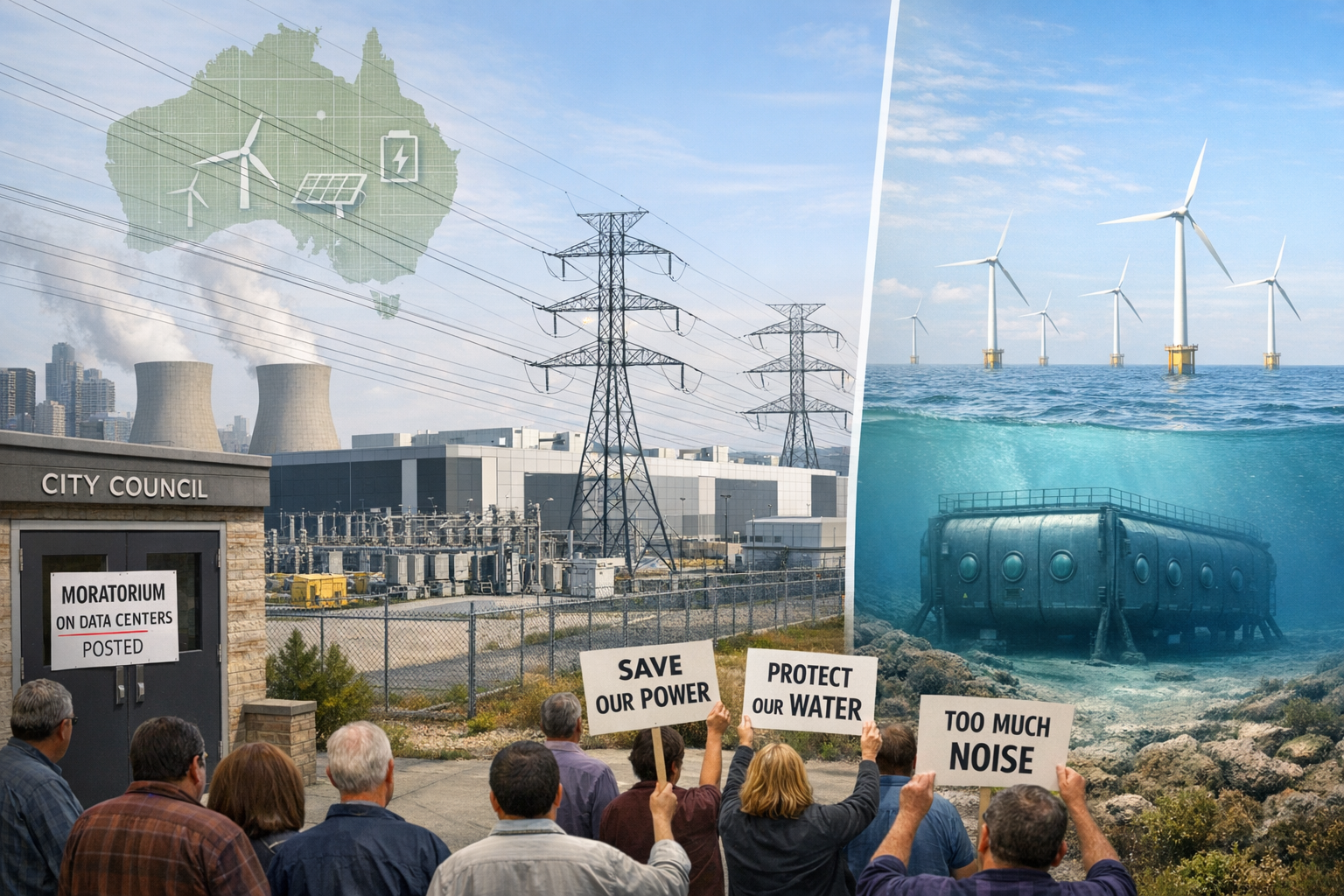
In Seattle, one of America’s most important technology hubs, city leaders have hit pause. In Australia, the federal government is warning that a new data-center boom will not be allowed to unfold on industry’s terms alone. And in China, developers are advancing an entirely different answer to the same problem, promoting an underwater, wind-powered data center as a way to reduce the enormous power, water and land demands that have fueled opposition elsewhere.
Taken together, the moves signal a turning point in the battle over AI infrastructure. What was until recently a largely abstract debate about the costs of the AI boom is hardening into concrete policy fights, regulatory tests and engineering experiments.
At stake is a question now confronting local governments and national planners alike: how to accommodate soaring demand for computing power without overloading electric grids, driving up utility costs, consuming scarce water or further fraying relations with communities asked to host the facilities.
Seattle imposes a moratorium
Seattle’s City Council voted unanimously this week to enact an emergency moratorium on new large data centers, immediately freezing new siting for a year while the city studies how such projects would affect electricity supply, water use, utility rates, land use, employment and public health. The ordinance can be extended by six months.
The decision made Seattle the largest U.S. city to adopt such a pause, an especially pointed development given the region’s role as home turf for Amazon and Microsoft, two companies central to the AI boom.
The immediate trigger was not hypothetical. According to city officials, four companies had approached Seattle City Light about five large-scale projects with a combined maximum demand of 369 megawatts — roughly enough electricity to power 300,000 homes. That figure sharpened concerns that data-center expansion, particularly for AI workloads, could reshape the city’s energy system faster than local planning rules and utilities were prepared to handle.
The moratorium does not settle the matter. It opens a study and public-hearing process that could produce a more durable framework — or simply delay projects before they proceed in some modified form. But the message from Seattle was unmistakable: cities that once competed to attract digital infrastructure are increasingly questioning whether the benefits justify the burden.
Australia moves to “set the terms”
A similar recalibration is underway in Australia, where the federal government is signaling that the AI and data-center buildout will face tougher conditions.
Andrew Charlton, the assistant minister for the digital economy, said Australia should not repeat the mistakes of the country’s resources boom, when the economic upside of rapid development often outpaced public safeguards and broader planning. He argued that government must “set the terms” for what he described as a consequential economic shift.
The urgency is clear in the numbers. Charlton said there are 44 projects in the pipeline in New South Wales alone seeking 11 gigawatts of grid capacity, a striking amount in a country where data centers already account for about 2 percent of electricity use across the national market.
The government has been building toward a stricter approach since releasing “Data Centre Expectations” in March. It is now pointing to what officials describe as a tougher “triple lock”: requiring new renewable energy supply, making developers responsible for the network costs they impose, and ensuring flexibility in electricity demand.
That approach reflects a growing fear among policymakers that the benefits of AI-related investment could be accompanied by socialized costs — pricier grid upgrades, tighter electricity supply and greater strain on public infrastructure. Whether those expectations become binding rules remains uncertain. Critics note that the tougher posture has not yet been fully legislated, leaving open the question of how far the government is prepared to go when major investment and political pressure intensify.
A widening backlash over community costs
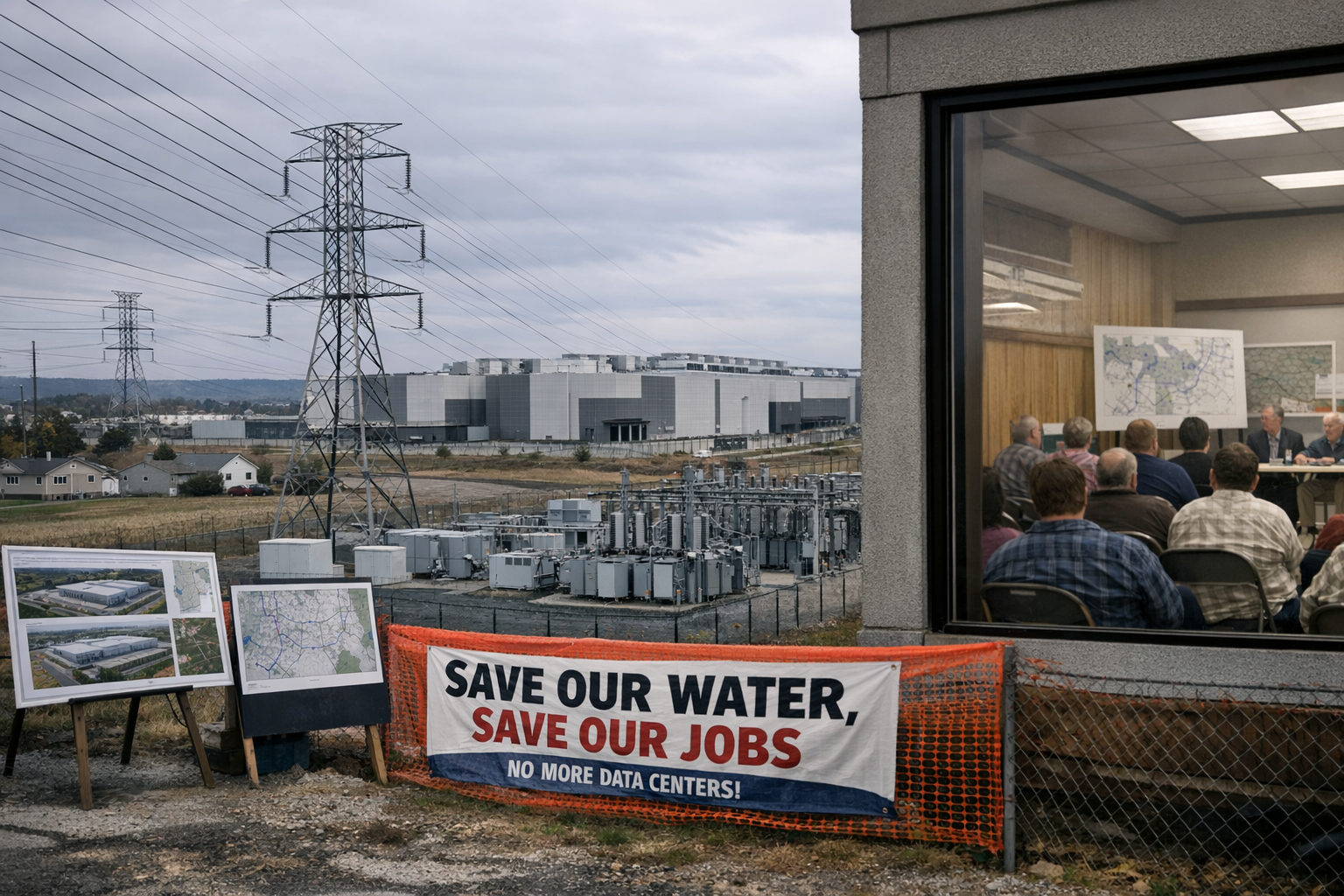
The policy shifts are emerging against a backdrop of widening public unease over what modern data centers demand from the places around them.
Facilities built for AI are typically more power-hungry than earlier generations of server farms, and many also require substantial cooling, prompting scrutiny of both electricity and water use. Residents and activists in multiple countries have raised concerns about noise, industrialization of neighborhoods, pollution from backup power systems, pressure on water supplies and the broader climate consequences of building ever-larger complexes to support energy-intensive AI services.
That skepticism has moved rapidly from the margins toward the center of the discussion. For years, data centers were often framed as relatively clean, low-profile engines of the digital economy. The AI boom has made that framing harder to sustain. The scale of proposed projects, and the speed with which they are arriving, has forced local officials to ask whether the infrastructure behind AI is simply too resource-intensive to be treated like any other commercial development.
Why the issue matters now is not just the rise of AI itself, but the concentration of demand. Utilities and governments are being asked to accommodate clusters of massive, fast-moving projects whose energy needs can resemble those of entire towns. The question is no longer merely whether there is enough power in the abstract, but who pays for new capacity, who gets priority and what communities must absorb.
China offers a technological counterargument
While regulators elsewhere tighten scrutiny, China is presenting a more technologically optimistic answer.
Off the coast of Shanghai, the Shanghai Lingang undersea data-center project entered operation in May as a 24-megawatt facility powered by offshore wind and cooled by seawater. Developers say the arrangement reduces electricity needed for cooling, eliminates freshwater use and sharply cuts the land footprint compared with conventional land-based data centers.
Those features are central to its appeal. One of the most contentious aspects of the global data-center boom has been the resource overhead required just to keep high-performance computing equipment from overheating. Seawater cooling, if it works reliably at scale, could address one of the industry’s most criticized weak points. A direct link to offshore wind is also meant to answer concerns that data-center growth is outrunning clean-energy supply.
The project is being billed as the world’s first wind-powered underwater data center, and for China it serves a dual purpose: a practical experiment in infrastructure design and a statement that the country intends to keep expanding AI capacity while searching for ways to blunt the environmental and political costs.
But the model remains unproven in one important respect — scale. Lingang is still best understood as a demonstration or early commercial project. Its economics, long-term reliability and potential for replication are not yet clear. Even if underwater facilities prove technically feasible, they may not be suitable for every coastline, market or grid.
A new phase in the AI buildout
What links Seattle’s moratorium, Australia’s tougher rhetoric and China’s offshore experiment is a growing recognition that AI’s future depends not only on chips and models, but on the acceptability of the industrial systems that support them.
For much of the past two years, the dominant question surrounding AI infrastructure was how quickly companies could build enough capacity. Now a second question is rising alongside it: under what conditions they will be allowed to do so.
That shift matters because data centers are no longer being debated as invisible components of the internet. They are becoming contested pieces of civic and national infrastructure, with implications for power markets, climate targets, water resources and local quality of life.
The next phase of the AI boom may therefore be defined less by raw expansion than by negotiation — between developers and regulators, between national ambition and local resistance, and between conventional construction and novel designs that promise to make the industry less demanding.
Whether those experiments and guardrails will be enough remains uncertain. But the era when data-center growth could be treated as an unalloyed good is plainly ending.
Sources
Further reading and reporting used to add context:
- https://www.techradar.com/pro/it-doesnt-benefit-us-seattle-votes-for-year-long-ban-on-new-ai-data-centers
- https://www.tomshardware.com/tech-industry/artificial-intelligence/seattle-to-pass-one-year-ai-data-center-moratorium-next-week-will-use-window-to-study-community-impact-of-ai-buildouts
- https://www.axios.com/local/charlotte/2026/06/09/charlotte-data-center-moratorium-150-days
- https://www.theguardian.com/australia-news/2026/jun/11/datacentre-ai-growth-economy-resources-australia-labor-government
- https://www.tomshardware.com/tech-industry/china-says-worlds-first-offshore-wind-powered-underwater-data-center-has-entered-full-operation-houses-2-000-servers-24-megawatt-subsea-ai-facility-uses-ocean-water-for-passive-cooling-and-offshore-wind-for-power
- https://www.datacenterdynamics.com/en/news/hiclouds-offshore-wind-powered-underwater-data-center-up-and-running-off-coast-of-shanghai-china/
- https://english.shanghai.gov.cn/en-Latest-WhatsNew/20260601/89a94ac072f842eeacf82fcf0cce8261.html
- https://council.seattle.gov/2026/04/30/councilmembers-introducing-moratorium-on-data-centers-in-seattle/
- https://seattlemetronews.com/2026/06/10/city-council-approves-emergency-moratorium-on-large-data-centers/
- https://www.theguardian.com/world/2026/jun/09/worlds-first-wind-powered-underwater-datacentre-starts-operating-in-china
- https://www.seetaoe.com/details/266914.html
- https://www.lingang.gov.cn/html/website/lg/English/CityofInnovation/InnovationProjects/2021462605065908225.html
- https://www.techradar.com/pro/china-unveils-worlds-first-underwater-data-center-2-000-server-facility-is-powered-by-offshore-wind-and-cooled-by-the-sea-making-it-one-of-the-most-efficient-around
- https://www.axios.com/local/seattle/2026/05/15/seattle-data-center-moratorium-ai-energy
- https://english.shanghai.gov.cn/en-Strength-Scitechcenter/20250611/c60460fe62e440d08b62be991cade0c9.html
- https://www.foodandwaterwatch.org/wp-content/uploads/2026/05/No-Data-Centers-in-Seattle.pdf
- https://www.reddit.com/r/UsaNewsLive/comments/1u24xwj/seattle_enacts_oneyear_ban_on_data_centers/
- https://www.reddit.com/r/technology/comments/1u1rons/seattle_enacts_yearlong_ban_on_new_ai_datacenters/
- https://www.chinadailyasia.com/upload/main/pdf/2026/06/01/edc99f38cf59050a3e370c97312660e5.pdf
- https://www.meridian.mi.us/media/33tdfm4q/051926-board-packet.pdf
- https://www.reddit.com/r/SeattleWA/comments/1tw8pxo/seattle_advances_ai_data_center_moratorium_bill/
- https://www.minister.industry.gov.au/ministers/charlton/speeches
- https://www.gov.uk/government/news/a-decisive-shift-to-power-british-ai-new-11-billion-plan-to-back-chip-firms-boost-computing-power-and-skills-for-the-ai-revolution
- https://thewitness.com.au/labor-to-impose-triple-lock-energy-rules-to-prevent-grid-strain-and-blackouts/
- https://www.theguardian.com/australia-news/live/2026/jun/11/australia-news-live-labor-coalition-one-nation-anthony-albanese-pauline-hanson-capital-gains-housing-peptides-arthritis-ntwnfb?page=with%3Ablock-6a29e4dd8f08b7f4c072725a
- https://www.theguardian.com/australia-news/live/2026/jun/11/australia-news-live-labor-coalition-one-nation-anthony-albanese-pauline-hanson-capital-gains-housing-peptides-arthritis-ntwnfb?page=with%3Ablock-6a29f1808f08b7f4c07272d1
- https://www.rba.gov.au/fin-stability/resources/speeches.html
- https://www.minister.industry.gov.au/ministers/charlton/transcripts/press-conference-announcing-data-centre-expectations
- https://www.federalreserve.gov/recentpostings.htm
- https://www.capitalbrief.com/briefing/permanent-renter-andrew-charlton-issues-call-to-buy-australian-ai-d441d564-5982-43e3-ae0a-78b02e87e03d/
- https://www.federalreserve.gov/newsevents.htm
- https://www.gov.uk/government/speeches/the-kings-speech-2026
- https://assets.carnegieendowment.org/files/Phillips-Robins%20et%20al._Compute_final.pdf
- https://hansard.parliament.uk/pdf/commons/2026-06-01
- https://www.cliffordchance.com/content/dam/cliffordchance/briefings/2026/03/data-centres-and-ai-compute-infrastructure-insights-2026.pdf
- https://commonsbusiness.parliament.uk/Document/105575/Pdf?subType=Standard
- City Council passes emergency data center moratorium and policy framework – Seattle City Council Blog






Leave a Reply