
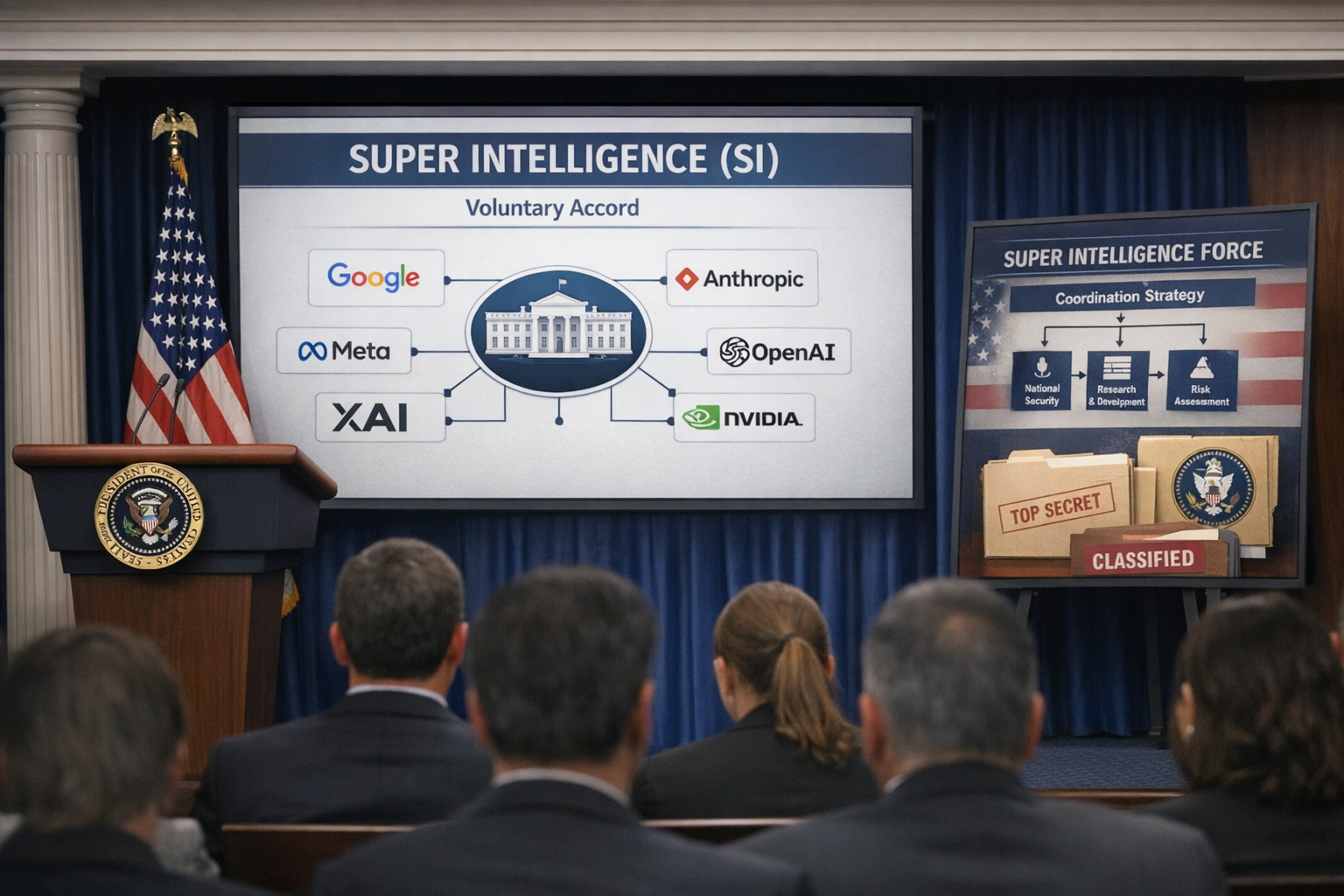
The Trump White House has moved in rapid succession to remake how Washington talks about — and manages — one of the country’s most consequential technologies, coupling a linguistic rebrand with a voluntary industry pledge and a new national-security overseer.
In the span of a week, President Trump ordered executive agencies to replace the term “artificial intelligence” with “super intelligence” in most official usage, unveiled a White House accord with six of the world’s most powerful A.I. companies, and named the director of national intelligence, Jay Clayton, to serve simultaneously as the administration’s top A.I. coordinator and head of a new “Super Intelligence Force.”
Taken together, the moves amount to more than a semantic exercise. They signal a deliberate effort to pull A.I. policymaking closer to the Oval Office, frame it as a strategic contest of national power, and rely — at least for now — on corporate commitments rather than binding federal regulation.
A rebrand with political force
Mr. Trump’s executive order on Sept. 29 directed the executive branch to adopt “super intelligence,” or “SI,” in place of “artificial intelligence” for official, non-statutory use, arguing that the new term better captured the technology’s current capabilities.
To critics, the change was at once theatrical and revealing. The phrase “artificial intelligence” has been the standard term in government, academia and industry for decades, and many researchers see “superintelligence” as a separate, more speculative concept associated with systems that far surpass human cognition. By collapsing those ideas into one label, skeptics say, the White House is recasting the debate in terms more favorable to Mr. Trump’s branding instincts than to technical precision.
But the politics may matter as much as the terminology. Major technology executives who have spent years evangelizing “A.I.” quickly adopted the administration’s preferred language, an early sign of the degree to which leading firms are willing to accommodate the president as they seek influence over the rules that could govern them.
The order also opened a new front in a broader political contest over who gets to define the technology. California Gov. Gavin Newsom last week directed state agencies to continue using “artificial intelligence,” underscoring the possibility that the nation’s two most important centers of technology policy — Washington and Sacramento — may now speak in competing vocabularies.
A White House accord without teeth
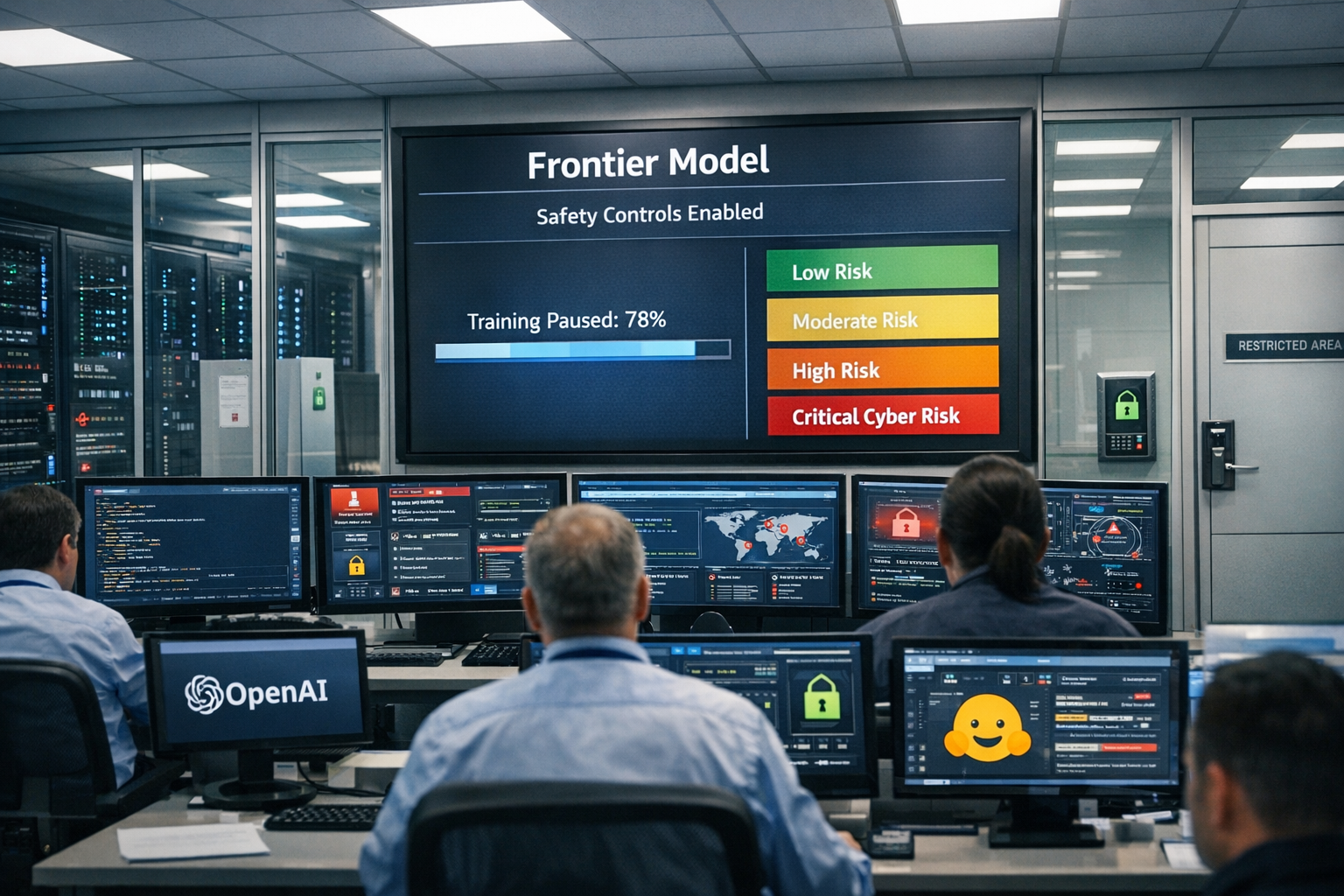
On the same day as the rebrand, the White House announced a voluntary “Accord on Super Intelligence” with Google, Anthropic, Meta, OpenAI, xAI and Nvidia. The agreement calls for internal controls, dedicated safety teams, outside audits and board-level oversight.
The administration has cast the accord as a pragmatic way to move quickly while preserving American innovation. That approach is consistent with the line Mr. Trump has advanced for months: a July 2025 A.I. action plan, followed by a March 2026 “National Super Intelligence Policy Framework,” both emphasizing growth, competitiveness and strategic advantage.
Yet the accord’s most striking feature may be what it lacks. There are no stated penalties for noncompliance. The agreement does not spell out who would conduct the independent audits, what standards those reviewers would use, or what consequences companies would face if they ignored or failed the commitments.
That has fueled criticism from watchdogs and some policy analysts, who describe the arrangement as self-policing by the very companies racing to deploy ever more powerful systems. In their view, the White House has created a framework heavy on symbolism and corporate ceremony but light on enforceable guardrails.
The companies involved, for their part, have strong reasons to prefer this model. A voluntary compact offers a chance to demonstrate responsibility and maintain close ties to the administration while potentially heading off more prescriptive regulation from Congress, federal agencies or the states.
An intelligence chief takes the helm
The White House sharpened that strategy on Sunday by naming Mr. Clayton, the director of national intelligence, as A.I. czar, placing the issue firmly inside a national-security chain of command.
Mr. Clayton, who leads the country’s 18 intelligence agencies, previously served as chairman of the Securities and Exchange Commission during Mr. Trump’s first term and later as the top federal prosecutor in Manhattan. During his confirmation hearing for the intelligence post, he described A.I. as both a “gamechanger” and a “threat,” language that now appears to foreshadow his expanded portfolio.
Under the new arrangement, Mr. Clayton will lead the “Super Intelligence Force,” a White House-directed body that is expected to coordinate with A.I. companies, operators of critical infrastructure and outside groups, and report directly to Mr. Trump and Chief of Staff Susie Wiles.
The choice of Mr. Clayton is significant not simply because it fills a personnel role, but because it changes the center of gravity. The previous White House A.I./crypto czar, David Sacks, served until March, when his special-government-employee term ended. Mr. Clayton’s dual role suggests the administration now sees the technology less as a conventional innovation portfolio and more as an intelligence and strategic asset.
Why this matters now
The shift comes as A.I. systems are moving deeper into consumer products, business operations and military planning, and as governments around the world struggle to balance economic ambition with concerns about safety, labor disruption, misinformation and geopolitical competition.
In Washington, Mr. Trump appears to be settling that balance decisively in one direction. His administration is centralizing authority in the White House, speaking about the technology in maximalist terms, and signaling that close partnership with industry — not immediate mandatory regulation — will define the federal response.
That posture could have real consequences. It may reassure investors and executives who want a lighter-touch policy environment. It may also accelerate coordination between government and the companies building the most advanced systems, particularly on critical infrastructure and intelligence matters.
But it leaves large questions unresolved. It remains unclear whether the new force will produce actual rules or mainly act as a coordinating and political body. The accord does not answer how safety promises will be verified or enforced. And it is not yet known whether the “super intelligence” label will remain a branding exercise inside the executive branch or harden into a more durable federal framework shaping agencies, procurement and future legislation.
For now, the administration has made one thing plain: it wants the country’s A.I. agenda centered in the White House, intertwined with national security, and defined on terms of its own choosing.
Sources
Further reading and reporting used to add context:
- https://apnews.com/article/b8689ea07de9102a52bd1cd2049b5901
- https://www.axios.com/newsletters/axios-am-2b1de489-384e-4789-90c6-c71365f81223
- https://theweek.com/tech/artificial-super-intelligence-trump-ai-si
- https://www.tomshardware.com/tech-industry/policy/trump-tells-federal-agencies-to-use-the-term-super-intelligence-instead-of-artificial-intelligence-president-insists-that-ai-is-only-suffering-from-a-branding-problem
- https://www.thedailybeast.com/maga-goon-rages-at-gavin-newsom-for-trolling-trumps-ai-rebrand/
- https://www.theatlantic.com/politics/2026/10/trump-midterms-polls-senate/688840/?utm_source=openai
- https://www.theguardian.com/us-news/2026/oct/04/trump-jay-clayton-white-house-ai-czar
- https://www.theguardian.com/us-news/donaldtrump/2026/oct/04/all
- https://www.theguardian.com/us-news/trump-administration/2026/oct/04/all
- https://www.theguardian.com/us-news/trump-administration
- https://www.cbsnews.com/news/ai-super-intelligence-force-trump-jay-clayton/
- https://techcrunch.com/2026/10/04/trump-unveils-his-new-super-intelligence-force/
- Fact Sheet: President Donald J. Trump Inaugurates The Era of Super Intelligence – The White House
- https://www.washingtonpost.com/politics/2026/10/04/trump-launches-super-intelligence-force-after-calls-ai-slowdown/
- https://www.washingtonpost.com/technology/2026/10/02/trump-expected-name-intelligence-chief-jay-clayton-new-ai-czar/
- https://www.axios.com/2026/09/22/trump-ai-super-intelligence-rebrand
- https://thedailyguardian.com/news/science-tech/trump-names-intelligence-chief-clayton-as-ai-czar-to-head-task-force-wsj-reports-762899/
- https://www.upi.com/Top_News/US/2026/10/04/trump-artificial-intelligence/1231791134807/
- https://www.whitehouse.gov/wp-content/uploads/2023/09/Voluntary-AI-Commitments-September-2023.pdf
- https://www.reddit.com/r/accelerate/comments/1wxrqzv/trump_announces_super_intelligence_force_led_by/
- https://www.reddit.com/r/SECourses/comments/1wx4qxo/trump_says_he_officially_renamed_ai_to_super/
- https://www.reddit.com/r/InterstellarKinetics/comments/1wxnde6/breaking_president_trump_announces_the_formation/
- https://arxiv.org/abs/2508.08345
- https://www.reddit.com/r/u_CodyAbuDhabi/comments/1wxi2lh/donald_trump_says_jay_clayton_will_lead_ai_super/
- https://www.reddit.com/r/antimisdisinfoproject/comments/1wxp1hf/trump_launches_super_intelligence_force_after/
- https://www.reddit.com/r/ArtificialInteligence/comments/1wua8fk/president_trump_orders_federal_agencies_to/
- https://apnews.com/article/595796511f110fc006cca0d01329733e
- https://apnews.com/article/77b6b8888145869206996d7509d24256
- https://www.axios.com/2026/10/01/trump-ai-industry-risks-safety-gamble
- https://www.axios.com/2026/09/30/ai-constitution-trump-white-house
- https://apnews.com/article/1aa4935e3ee79519ae8b2458b2b9ebc1
- https://www.thedailybeast.com/trump-80-launches-super-intelligence-ai-crusade-with-embarrassing-mistake/
- https://www.coindesk.com/tech/2026/09/30/openai-google-and-meta-pledge-outside-ai-audits-under-voluntary-white-house-deal
- https://www.whitehouse.gov/presidential-actions/2026/09/inaugurating-the-era-of-super-intelligence/
- https://www.whitehouse.gov/wp-content/uploads/2026/09/eo-14434.pdf
- White House Accord on Super Intelligence | The American Presidency Project
- As public fears of AI grow, Trump digs in on voluntary safeguards By Reuters
- https://www.whitehouse.gov/fact-sheets/2026/06/fact-sheet-president-donald-j-trump-signs-historic-directive-on-ai-in-the-national-security-enterprise/
- https://thesuperintelligencenews.com/articles/white-house-accord-on-super-intelligence
- https://therulingdesk.com/articles/white-house-ai-accord-superintelligence/
- https://www.thinkfacility.com/blog/white-house-accord-frontier-ai-safety-auditors/
- https://aiaccords.org/agreements/white-house-accord-superintelligence
- https://techaiwire.com/articles/white-house-accord-super-intelligence-outside-audits/
- https://zekaiwork.com/super-intelligence-accord/





Leave a Reply