
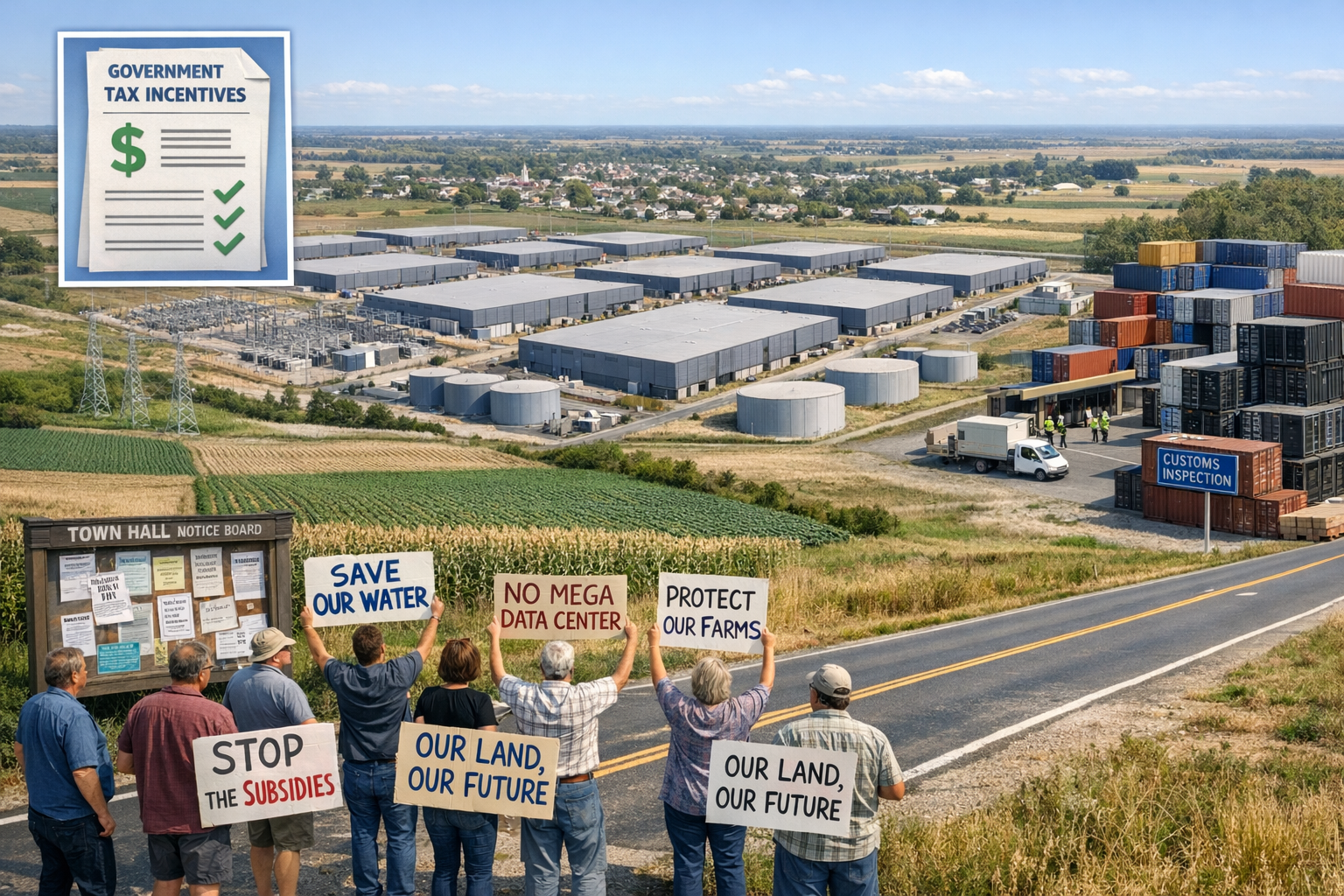
The AI Data Center Buildout Meets Politics
The race to build the physical backbone of artificial intelligence is colliding with a widening set of political and social constraints, as governments dangle tax breaks, rural communities push back against giant proposed campuses, and U.S. prosecutors treat the underlying hardware as a matter of national security.
Taken together, recent developments in the United States and Australia suggest that data centers — once seen largely as an obscure corner of industrial real estate — are becoming a more visible flashpoint in debates over public subsidies, land and water use, investor exuberance and the strategic control of advanced computing.
In Washington, a revamped federal tax regime is poised to offer especially generous benefits for investment in rural areas starting on Jan. 1, 2027, potentially opening a new lane of public support for data center developers. But even before the incentives take effect, lawmakers have begun to question whether sprawling server farms should qualify.
In Australia, meanwhile, some of the world’s biggest AI-linked projects are encountering a more grounded reality: skepticism from residents asked to live beside them and from investors being asked to finance them.
And in California, federal authorities have arrested a businessman accused of helping move more than $300 million worth of export-controlled computer servers to China through third countries, underscoring how sensitive the equipment inside these facilities has become.
A New Subsidy Fight in Rural America
The U.S. tax dispute centers on the redesign of Opportunity Zones under the sprawling domestic policy package known as the One Big Beautiful Bill Act. Treasury and the Internal Revenue Service have said states are now nominating eligible census tracts for the next round of designations, which will begin in 2027. Under the new rules, investments in zones that are entirely rural can receive enhanced treatment.
Federal guidance identified 25,332 eligible low-income tracts, including 8,334 that are fully rural, creating a potentially significant map for developers seeking cheaper land, access to power and tax advantages.
For data center companies, the incentives could arrive at a moment of intense demand for AI computing capacity. Hyperscale operators and their suppliers have been scouring the country for sites with enough electricity, fiber connectivity and political support to host ever larger clusters of servers. Rural counties, eager for investment, often appear to offer all three.
But the politics are becoming more complicated. A Senate bill has already been introduced that would exclude data centers from the new benefits, a sign that what once might have been framed as a straightforward economic development program is becoming part of a larger argument over whether communities should subsidize facilities that consume vast amounts of electricity and create relatively few permanent jobs.
That tension helps explain why some major technology companies have not rushed to embrace the incentives, despite the promise of “free cash,” as critics describe it. For the largest operators, the tax benefits may be attractive but not decisive compared with other constraints, especially power availability and transmission access. And taking public subsidies for projects associated with AI can carry political risk of its own.
Rural Australia Pushes Back
If the American debate is still largely about incentives, the Australian one is increasingly about consent.
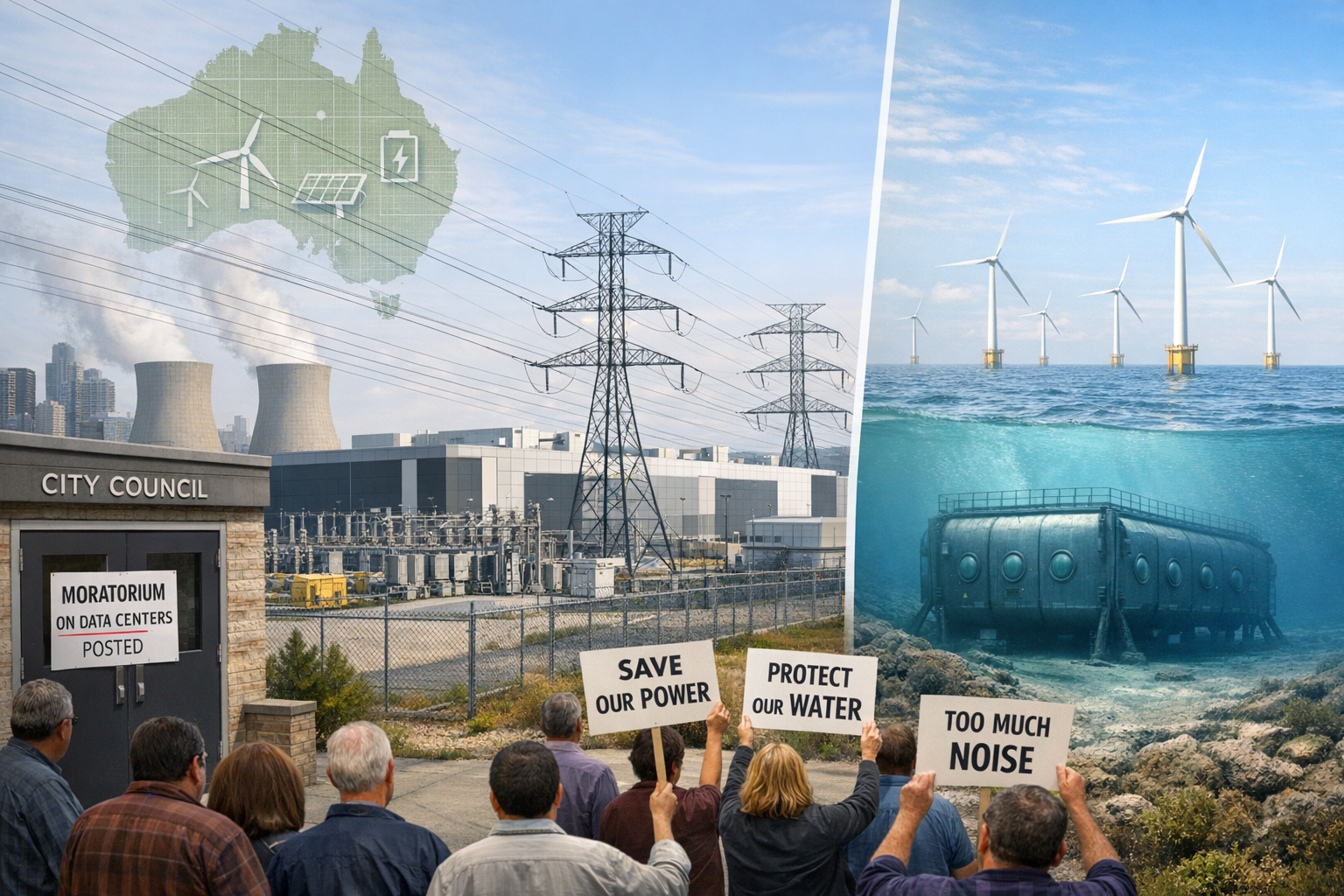
Near Dalby, in Queensland’s Western Downs region, residents are objecting to a proposed hyperscale data center development valued at roughly A$31 billion to A$32 billion. The project, tied to Anthropic, would cover about 725 hectares, making it less a conventional industrial site than a major territorial presence in a rural landscape already marked by years of extractive development.
For some locals, the promise of economic opportunity has been overshadowed by fears about water use, power demand, limited local job creation and what they see as inadequate consultation. The backlash comes from communities that have long experience with resource booms and busts and are now being told that the next wave of development — this time in service of global AI demand — should be welcomed as progress.
Queensland officials have promoted the sector as an opportunity for the state and are developing a dedicated planning framework for data centers. But the Dalby dispute illustrates a broader challenge for governments trying to attract AI infrastructure: these projects may be digital in purpose, yet their local footprint is intensely physical. They require land, transmission, cooling and water, and they can reshape communities long before any promised economic gains become visible.
Investor Doubts in Tasmania
In Tasmania, that same mismatch between grand ambition and local reality has surfaced in the market’s response to Firmus Technologies, the “AI factories” developer seeking a roughly A$7.1 billion initial public offering at a valuation of about A$30.6 billion.
The float, if completed as envisioned, would rank among the largest in Australian history. But prospective investors have raised doubts about the company’s execution risk, balance sheet strain and forecasts, with some describing its assumptions as implausibly optimistic. At the same time, local opposition has continued around its projects, including complaints over consultation, utilities and the pace of expansion.
That combination — community resistance on the ground and skepticism in the capital markets — points to a central vulnerability in the AI infrastructure story. Demand for computing power may be growing rapidly, but translating that demand into profitable, buildable, politically durable projects is proving harder than headline spending figures suggest.
For developers, the challenge is no longer simply raising money for the next campus. It is persuading both residents and investors that these facilities can be integrated into local economies without overwhelming them, and that expected returns justify the enormous capital commitments.
Servers as Strategic Assets
The strategic stakes were made clearer last week when the Justice Department announced the arrest of Greg Lui, a 38-year-old California businessman accused of smuggling export-controlled computer servers to China using false paperwork and transshipment routes through Malaysia and Singapore.
Prosecutors said the alleged scheme involved more than $300 million worth of servers, a scale that suggests not an isolated rules violation but the possibility of an organized effort to circumvent U.S. export restrictions on advanced computing equipment.
The case fits a broader pattern of increasingly aggressive American enforcement around AI hardware bound for China. As Washington has tightened restrictions on advanced chips and systems that could support cutting-edge AI development, the servers used in data centers have taken on new geopolitical significance. They are not being treated as ordinary commercial goods, but as strategic assets whose destination matters.
That, in turn, changes the meaning of the data center boom itself. The issue is no longer only where AI will be trained and served, or who will profit from hosting the facilities. It is also who controls access to the computational machinery that makes advanced AI possible.
Why This Matters Now
The recent clashes over tax breaks, siting and export controls show how quickly the AI buildout has outgrown the usual bounds of a private-sector construction story.
In the United States, the coming rural tax benefits could influence where projects are proposed, but they may also provoke a sharper backlash if communities see subsidized data centers as heavy users of land and power with limited public payoff. In Australia, disputes in Queensland and Tasmania suggest that regional resistance can become a serious constraint on timelines, approvals and valuations. And in national security terms, the U.S. smuggling case is a reminder that the infrastructure of AI sits squarely inside the broader contest over technological power.
The unresolved questions are substantial. Congress could still narrow U.S. eligibility before the 2027 tax regime fully takes effect. Australian projects may yet win approval, but perhaps on more restrictive terms or slower schedules. Firmus may find investors willing to back its ambitions, or the market may force a reassessment. And prosecutors may show that the alleged server-smuggling operation was part of a wider network still under investigation.
What is already clear is that data centers are no longer quiet back-end facilities. They have become one of the most contested front lines in the AI economy.
Sources
Further reading and reporting used to add context:
- https://www.tomshardware.com/tech-industry/artificial-intelligence/california-tech-ceo-arrested-faces-up-to-20-years-in-prison-for-smuggling-usd300-million-in-nvidia-ai-servers-to-china-federal-prosecutors-say-chips-were-routed-through-malaysia-and-singapore-using-false-paperwork
- https://www.theguardian.com/australia-news/2026/oct/03/ai-datacentre-backlash-firmus-asx-float-tasmania-australia
- https://www.theguardian.com/australia-news/2026/oct/05/queensland-data-centre-anthropic-western-downs-dalby
- https://www.theguardian.com/technology/2026/sep/16/anthropic-lands-31bn-datacentre-deal-in-western-queensland
- Office of Public Affairs | California Man Arrested for Smuggling More Than $300 Million in Export-Controlled Computer Servers to China | United States Department of Justice
- https://www.irs.gov/newsroom/enhanced-tax-incentives-for-qualified-opportunity-zone-investments-in-rural-areas
- https://www.govinfo.gov/content/pkg/CREC-2026-09-01/pdf/CREC-2026-09-01-house.pdf
- Western Downs residents fear being steamrolled as council assesses $32b data centre – ABC News
- https://www.govinfo.gov/content/pkg/BILLS-119s5418is/xhtml/BILLS-119s5418is.html
- https://www.theguardian.com/australia-news/2026/aug/27/tasmania-datacentre-ai-standards-national-cabinet-albanese-government
- https://lawfilesext.leg.wa.gov/biennium/2025-26/Pdf/Bill%20Reports/House/6231-S.E%20HBR%20APH%2026.pdf
- https://lawfilesext.leg.wa.gov/Biennium/2025-26/Htm/Bill%20Reports/Senate/6231%20SBR%20WM%20OC%2026.htm
- https://www.govinfo.gov/content/pkg/CRPT-119hrpt106/html/CRPT-119hrpt106-pt2.htm
- https://home.treasury.gov/policy-issues/tax-policy/data-transparency/qualified-opportunity-zones
- https://www.justice.gov/opa/pr/chinese-national-and-two-us-citizens-charged-conspiring-smuggle-artificial-intelligence
- https://mylrc.sdlegislature.gov/api/Documents/Bill/291571.pdf?Year=2026
- https://www.scstatehouse.gov/sess126_2025-2026/fiscalimpactstatements/S0867%202026-01-29%20introduced.pdf
- https://leg.wa.gov/jlarc/taxReports/2026/data/1/printExec.pdf
- https://nebraskalegislature.gov/FloorDocs/109/PDF/Slip/LB1165.pdf
- https://www.hud.gov/opportunity-zones/investors
- https://www.hud.gov/opportunity-zones/updates
- https://www.irs.gov/credits-deductions/businesses/invest-in-a-qualified-opportunity-fund
- Treasury, IRS provide guidance to States for nominating census tracts as qualified opportunity zones under the One, Big, Beautiful Bill | Internal Revenue Service
- https://www.irs.gov/irb/2026-20_IRB
- https://www.govinfo.gov/content/pkg/CREC-2026-09-01/pdf/CREC-2026-09-01-pt1-PgH5368.pdf
- https://www.irs.gov/pub/irs-drop/rp-26-14.pdf
- https://news.bloomberglaw.com/health-law-and-business/data-centers-won-billions-in-tax-breaks-some-states-are-balking
- https://www.cdfifund.gov/opportunity-zones
- https://news.bloomberglaw.com/in-house-counsel/data-center-spenders-save-billions-from-depreciation-tax-break
- https://www.finance.senate.gov/imo/media/doc/finance_committee_section-by-section_title_vii5.pdf
- https://www.congress.gov/crs_external_products/R/PDF/R48550/R48550.1.pdf
- https://opportunityzones.com/wp-content/uploads/2025/06/2025-Opportunity-Zones-Legislation-Report-June-2025-Update.pdf
- https://www.reddit.com/r/neoliberal/comments/1wxhl1x/rural_data_centers_are_in_for_a_big_federal_tax/
- https://www.reddit.com/r/WhatTrumpHasDone/comments/1wxhttd/rural_data_centers_are_in_for_a_big_federal_tax/
- https://www.kiplinger.com/taxes/tax-planning/rural-opportunity-zones-expert-guide-execution-calendar
- https://www.abc.net.au/news/2026-09-28/questions-over-benefits-of-data-centres-after-construct-ends/107201000
- https://www.abc.net.au/news/2026-07-23/firmus-urged-to-be-good-corporate-citizen/106870000
- $5 billion Firmus IPO divides investors after valuation triples in two months | MarketScreener
- https://www.abc.net.au/news/2026-09-09/six-new-confidential-data-centre-proposals-tasmania-revealed/107131974
- https://www.datacenterdynamics.com/en/news/firmus-seeks-5bn-raise-in-australian-ipo-report/
- https://www.abc.net.au/listen/programs/hobart-mornings/firmus-oliver-curtis-tim-rosenfield-tasmania-data-centres/106868690
- https://www.abc.net.au/news/2026-07-02/firmus-response-public-backlash-artificial-intelligence-tasmania/106864804
- https://www.minotaurcapital.com/news/2026-10-02-buy-hold-short-firmus-shapes-up-to-be-the-most-divisive-ipo-yet
- https://www.marketscreener.com/news/australia-s-firmus-prices-shares-to-raise-5-billion-term-sheet-shows-ce785ad3d088f026
- https://www.abc.net.au/news/2026-09-16/data-centre-firmus-courting-investors-ahead-of-share-float/107154842
- https://www.businesstimes.com.sg/companies-markets/us5-billion-firmus-ipo-divides-investors-after-valuation-trebles-two-months
- https://www.reddit.com/r/tasmania/comments/1wil5e5/ai_data_centre_provider_firmus_courting_investors/
- https://www.reddit.com/r/AusFinance/comments/1wvmn8v/vas_a200_virtually_the_same_upcoming_firmus_mega/
- https://www.reddit.com/r/AustralianDataCentres/comments/1wgthit/firmus_is_pitching_a_float_reported_near_a50bn/
- https://www.reddit.com/r/tasmania/comments/1wqat1x/firmus_starts_development_work_in_wesley_vale/
- https://www.reddit.com/r/AustralianDataCentres/comments/1wn4czj/three_of_the_six_names_on_the_afrs_2026_tech/
- https://www.reddit.com/r/AustralianDataCentres/comments/1wjk0xy/firmus_job_ad_points_to_2_million_gpus_by_2028/
- https://www.reddit.com/r/AustralianDataCentres/comments/1wvlk29/firmus_prices_its_ipo_at_a11_a_share_to_raise/





Leave a Reply