
OpenAI Moves Deeper Into Hardware With a Custom Chip for Running AI Models
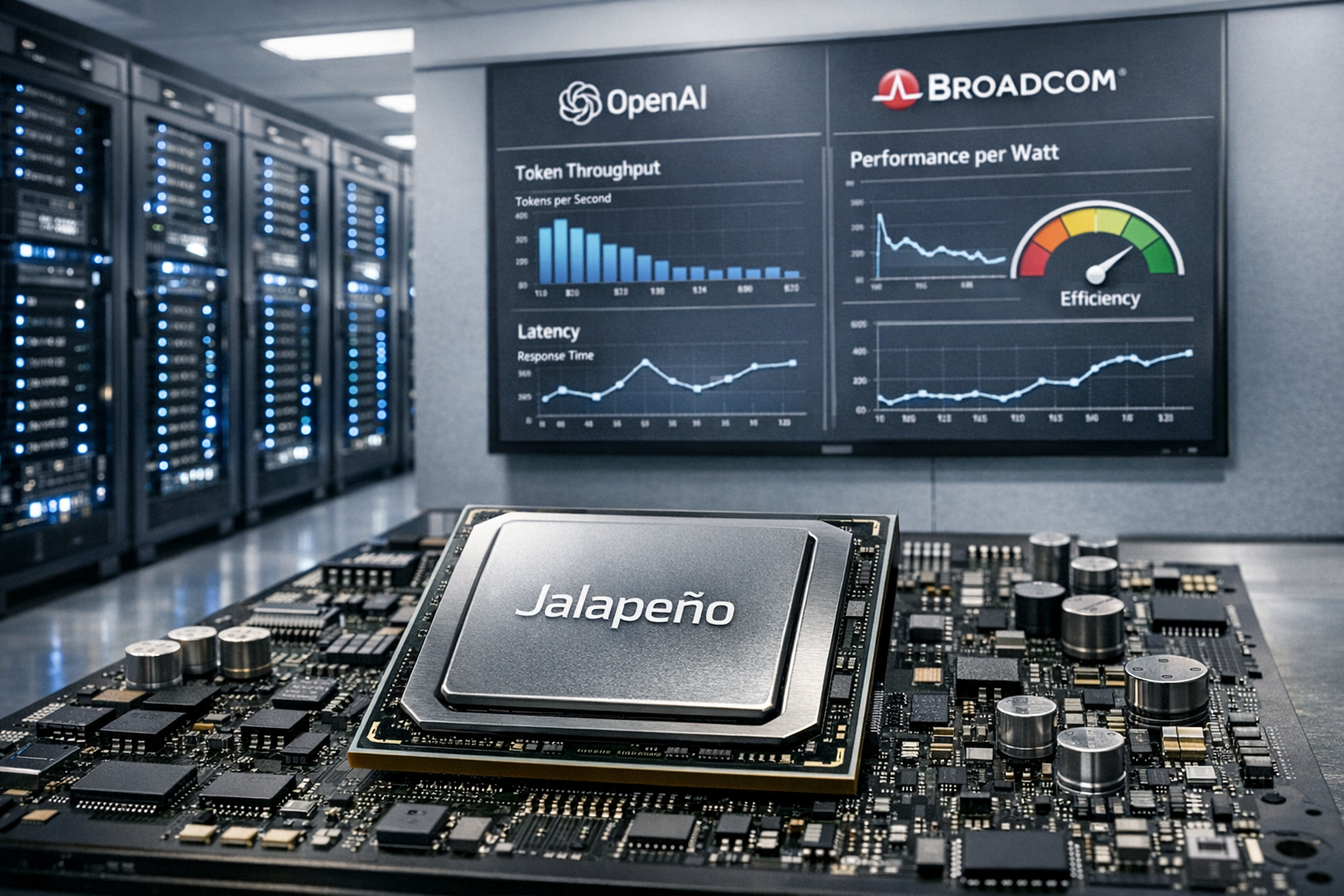
OpenAI on Tuesday formally unveiled Jalapeño, its first custom-designed chip for artificial intelligence, marking a significant step in the company’s effort to build more of the machinery behind its fast-growing products rather than relying so heavily on outside suppliers.
Developed with Broadcom, the chip is designed specifically for inference — the process of serving responses from trained models — which has become one of the most expensive and strategically important parts of the AI business. OpenAI said engineering samples are already running lab workloads and that an initial deployment is planned by the end of 2026, with broader expansion to follow.
The company says the chip is tailored to the demands of large language models powering ChatGPT, Codex, its application programming interface and future AI agents. Early internal testing, OpenAI said, shows better performance per watt than current leading options, though the company has not yet released full benchmark data or detailed cost figures.
The announcement gives a concrete form to a strategy OpenAI had previously described in broader terms: extending its reach beyond models and consumer products into the physical infrastructure required to run them at scale.
A Shift From Buying Compute to Designing It
For years, the AI boom has been defined in part by dependence on Nvidia’s graphics processing units, which have become the industry standard for both training and serving large models. But as AI companies race to cut costs, reduce latency and secure enough computing capacity, many have begun searching for alternatives.
Inference has emerged as a particularly attractive target. Training frontier models remains enormously expensive and technically demanding, but once those models are deployed, the cost of answering billions of prompts, generating code, handling enterprise workloads and powering agents can also become vast. A chip optimized narrowly for that task can, in theory, improve economics in ways general-purpose GPUs cannot.
That is the logic behind Jalapeño. Rather than replacing OpenAI’s entire hardware footprint, the chip appears aimed at one of the biggest recurring burdens in the company’s business: delivering AI output quickly, reliably and cheaply enough to support mass-market use.
If OpenAI can materially lower per-query costs, the implications could extend well beyond its own balance sheet. Cheaper inference can support more capable products, lower prices for developers, and make always-on AI assistants and software agents more viable at scale.
Part of a Broader Full-Stack Ambition
The new chip is also the latest sign that frontier AI companies are no longer content to compete only on model quality. Increasingly, they are trying to control the full stack: chips, networking, data centers, cloud partnerships and end-user applications.
OpenAI has been moving in that direction for some time. In October 2025, it and Broadcom disclosed a multiyear plan involving OpenAI-designed AI accelerators and deployments stretching from the second half of 2026 through 2029, with an ambition measured in 10 gigawatts of compute. Jalapeño is the first named product to emerge publicly from that plan.
It also fits into OpenAI’s wider Stargate effort, the company’s long-term push to secure large-scale American compute capacity with partners including Oracle, SoftBank and Microsoft, among others. Taken together, those efforts suggest that OpenAI sees infrastructure not as a back-office necessity, but as a central competitive weapon.
That matters because the economics of artificial intelligence are increasingly shaped by whoever can secure enough power, servers, networking and chips — and then use them efficiently. In that contest, better models alone may not be enough.
What OpenAI Gains — and What Remains Unclear
OpenAI’s pitch for Jalapeño is straightforward: greater efficiency, lower inference costs, less reliance on third-party GPUs and more control over how its systems are tuned and scaled. Broadcom, which has become a key partner for hyperscalers and large tech companies pursuing custom silicon, gives OpenAI an experienced manufacturing and design ally.
Still, major questions remain unanswered.
OpenAI has not disclosed final technical specifications, comprehensive benchmark comparisons, pricing effects or production volumes. It is not yet clear how large a share of OpenAI’s inference fleet the chip is expected to take over, how quickly manufacturing can ramp, or whether the company’s chip ambitions will remain focused on inference or broaden into a larger family of AI accelerators over time.
There is also the question of software and ecosystem lock-in. Nvidia’s position is not based solely on chip performance; it also rests on a mature software stack, developer familiarity and years of integration across the industry. A custom inference chip can be valuable without displacing that broader ecosystem, but it still must prove itself in real deployments.
Why This Matters Now
The timing reflects the industry’s changing center of gravity. The first phase of the generative AI race was about who could build the most impressive models. The next phase is increasingly about who can afford to run them at scale.
That shift is pushing leading labs toward vertical integration, blurring the lines between AI developer, cloud customer, chip designer and infrastructure operator. For OpenAI, Jalapeño is not just a hardware announcement. It is a statement that the company intends to shape more of the supply chain beneath its products.
For the broader market, that could bring both efficiency and concentration. If only a small number of well-capitalized firms can design custom silicon, secure power and build dedicated AI data centers, competitive advantages may accrue even more strongly to the biggest players.
Jalapeño does not settle that contest. But it shows how it is likely to be fought: not only with new models and flashy demos, but with quieter battles over watts, latency, networking and cost per token. In the AI industry’s next chapter, those may prove just as decisive.
Sources
Further reading and reporting used to add context:
- https://www.axios.com/2026/06/24/openai-jalapeno-ai-chip-broadcom-nvidia
- https://techcrunch.com/2026/06/24/openai-unveils-its-first-custom-chip-built-by-broadcom/
- https://investors.broadcom.com/news-releases/news-release-details/openai-and-broadcom-unveil-llm-optimized-intelligence-processor
- https://www.techtimes.com/articles/319012/20260624/openais-first-custom-ai-chip-targets-50-cheaper-inference-jalapeno-unveiled.htm
- https://www.europapress.es/portaltic/sector/noticia-openai-presenta-jalapeno-primer-procesador-inferencia-ia-20260624155841.html
- https://www.digitimes.com/news/a20260625VL200/openai-silicon-broadcom-design-accelerator.html
- https://en.softonic.com/articles/openai-unveils-jalapeno-its-first-custom-chip-with-broadcom
- https://www.resultsense.com/news/2026-06-25-openai-broadcom-jalapeno-chip/
- https://news.mynavi.jp/article/20260625-4625278/
- https://voice.lapaas.com/openai-broadcom-unveil-jalapeno-custom-chip-built/
- https://www.uol.com.br/tilt/noticias/reuters/2026/06/24/openai-revela-chip-personalizado-desenvolvido-com-broadcom-para-impulsionar-infraestrutura-de-ia.amp.htm
- https://clankercloud.ai/news/openai-broadcom-jalapeno-inference-chip-agentic-cloud
- https://www.topcpu.net/en/news/openai-broadcom-jalapeno-ai-chip-2026-deployment
- https://omni.se/open-ai-lanserar-sitt-forsta-ai-chip-byggs-av-broadcom/a/aJ3KaO
- https://www.tomshardware.com/openai-broadcom-to-co-develop-10gw-of-custom-ai-chips
- https://www.tomshardware.com/tech-industry/artificial-intelligence/broadcom-to-supply-meta-with-custom-silicon-through-2029-broadom-ceo-hock-tan-departs-metas-board
- https://www.techradar.com/pro/the-next-evolution-of-the-arm-compute-platform-agi-cpu-is-its-first-in-house-ai-chip-signs-up-meta-and-openai-as-early-clients
- https://www.reddit.com/r/AIGuild/comments/1uev4j9/openai_unveils_jalape%C3%B1o_its_first_custom_ai_chip/
- https://www.pcgamer.com/software/ai/openai-has-teamed-up-with-broadcom-to-make-its-own-ai-processors-according-to-a-report-possibly-as-part-of-a-long-term-plan-to-move-away-from-nvidias-gpus/
- https://www.reddit.com/r/BayAreaHomes/comments/1uehme3/openai_unveils_first_custom_ai_inference_chip/
- https://en.wikipedia.org/wiki/OpenAI
- https://www.reddit.com/r/u_RealPotential4086/comments/1uef29t/openai_and_broadcom_unveil_jalape%C3%B1o_a_custom_ai/
- https://www.reddit.com/r/MarketFluxHub/comments/1uemf2a/openai_and_broadcom_launch_jalape%C3%B1o_first_custom/
- https://www.reddit.com/r/BroadcomStock/comments/1uee7g5/openai_and_broadcom_unveil_llmoptimized_inference/
- https://openai.com/index/openai-and-broadcom-announce-strategic-collaboration//
- https://openai.com/index/stargate-sb-energy-partnership/
- https://openai.com/index/stargate-advances-with-partnership-with-oracle/
- https://openai.com/index/building-the-compute-infrastructure-for-the-intelligence-age/
- https://openai.com/es-ES/index/openai-and-broadcom-announce-strategic-collaboration/
- https://openai.com/ca-ES/index/openai-and-broadcom-announce-strategic-collaboration/
- https://openai.com/index/openai-nvidia-systems-partnership/
- https://openai.com/index/announcing-the-stargate-project/
- https://openai.com/index/five-new-stargate-sites
- https://openai.com/id-ID/index/openai-and-broadcom-announce-strategic-collaboration/
- https://openai.com/it-IT/index/stargate-sb-energy-partnership/
- https://openai.com/index/stargate-community/
- https://cdn.openai.com/pdf/21b88bb5-10a3-4566-919d-f9a6b9c3e632/openai-ostp-rfi-oct-27-2025.pdf
- https://cdn.openai.com/global-affairs/openai-us-infrastructure-blueprint-sep-2025.pdf
- https://cdn.openai.com/global-affairs/9c98a71f-7d2f-4566-9da7-4a7628c60bea/oai-ideas-to-power-democratic-ai-june-2025.pdf.
- OpenAI and Broadcom unveil LLM-optimized inference chip | OpenAI
- OpenAI and Broadcom announce strategic collaboration to deploy 10 gigawatts of OpenAI-designed AI accelerators | OpenAI








Leave a Reply