
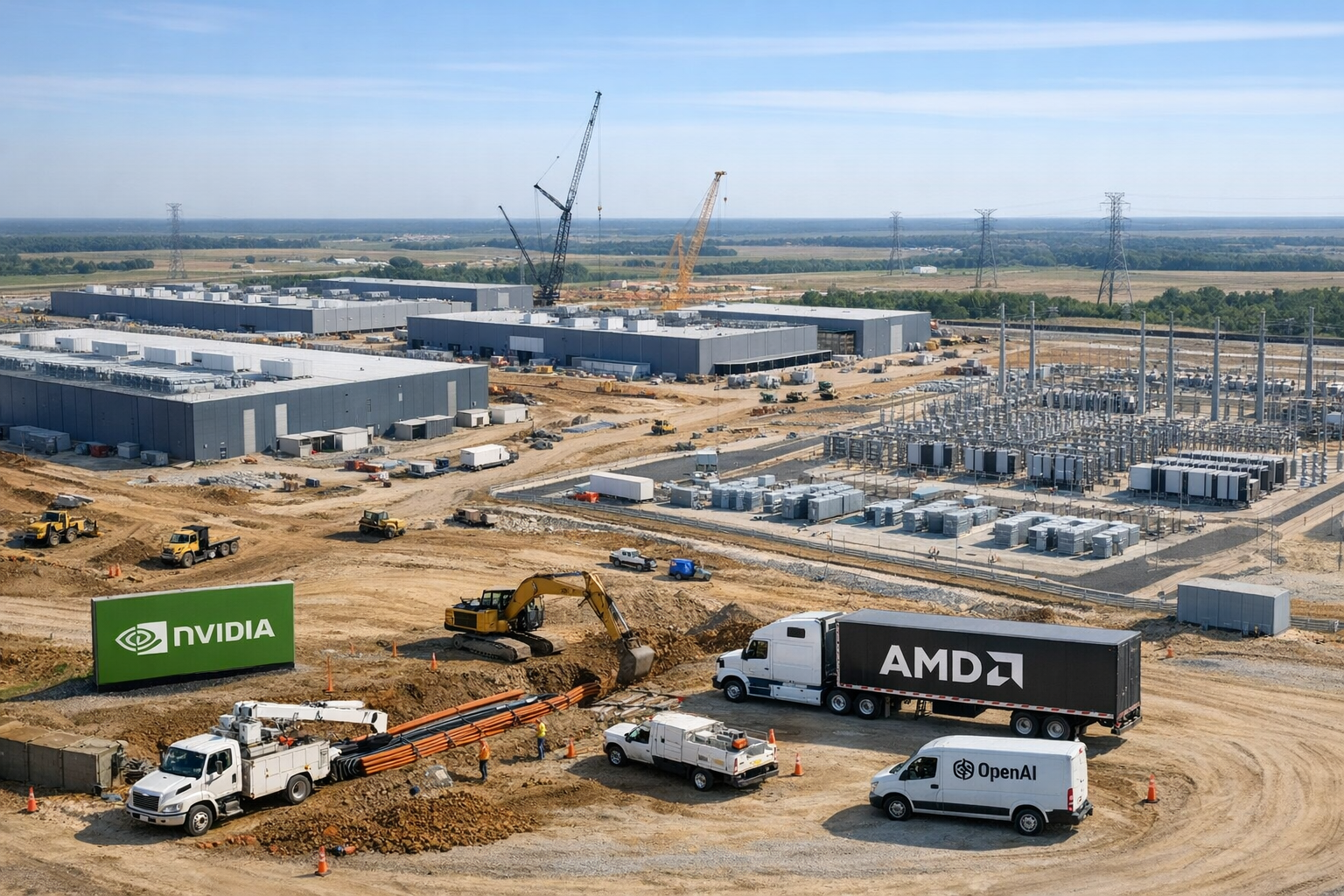
The contest to build artificial intelligence is becoming a contest to build everything around it
The race to dominate artificial intelligence has entered a new phase, one measured less by model announcements than by power contracts, chip supply and the politics of building vast new industrial campuses.
Over the last two days, Nvidia, Anthropic and OpenAI each unveiled moves that, taken together, show how the center of gravity in AI competition is shifting. Nvidia said its Vera Rubin platform is moving into production with an architecture meant to span the entire data-center stack. Anthropic struck a major pact with AMD to deploy up to 2 gigawatts of MI450-series GPU capacity for its Claude models. And OpenAI disclosed plans for a giant campus in Effingham County, Ga., backed by a 3.2-gigawatt electricity agreement and an unusually large package of local benefits.
The message across all three developments is the same: in the frontier-AI business, the scarce resource is no longer only research talent or novel algorithms. It is the ability to secure chips, electricity, networking, cooling and enough political support to get enormous facilities built.
Nvidia pushes from chips to the full “AI factory”
For years, Nvidia’s dominance in AI has rested on its graphics processors, which became the industry’s essential engines for training and running large language models. But the company’s latest pitch is broader. With Vera Rubin, Nvidia is arguing that the relevant unit of computing is no longer the individual server or even the single chip, but the data center itself.
The company says the platform is designed “from chip to grid,” combining central processors, graphics processors, networking and cooling into a rack-scale system. That approach reflects a growing ambition: not just to sell the most coveted accelerators in AI, but to shape every critical layer of the modern AI data center.
That matters because the economics of AI are increasingly determined by how efficiently giant clusters work as a whole. As models grow larger and inference workloads surge, bottlenecks in memory, interconnects, power delivery and heat removal can become as important as the chips themselves. By packaging more of the stack into an integrated system, Nvidia is trying to make itself harder to displace.
AMD courts frontier labs with a multigigawatt deal
AMD, long cast as Nvidia’s most plausible rival in AI chips, is trying to answer with scale.
The company and Anthropic said Anthropic would deploy up to 2 gigawatts of AMD MI450 GPU capacity to train and serve Claude, with the first 1 gigawatt expected to begin coming online in the first half of 2027. AMD also said it planned to invest up to $5 billion in Anthropic.
The agreement is one of the clearest signs yet that leading AI labs are willing to diversify beyond Nvidia if sufficient performance and supply can be guaranteed. For AMD, it follows other large customer arrangements as it tries to establish itself as a genuine second platform for frontier AI workloads.
The sheer size of the commitment is striking. AI infrastructure is increasingly described in utility-scale terms — megawatts and gigawatts, the language of power plants rather than software start-ups. A 2-gigawatt deployment, if realized, would rank among the largest compute commitments in the industry.
Still, the arrangement also highlights the unanswered questions hanging over the sector. The timetable is forward-looking, and the practical challenge of delivering that much hardware, networking and cooling on schedule will be immense. Critics have also pointed to the circular nature of some chipmaker-AI lab financial partnerships, in which investments and purchasing commitments can reinforce one another in ways that make the underlying economics harder to parse.
OpenAI’s Georgia project underscores the new politics of power
If Nvidia’s announcement was about architecture and AMD’s about supply, OpenAI’s was about the other emerging constraint: access to electricity and local consent.
OpenAI said it was developing Project Camellia, a planned data-center campus in Effingham County, near Savannah, supported by a 3.2-gigawatt contract with Georgia Power to be delivered in phases between 2028 and 2032. Local officials have described the project as a $20 billion investment, potentially one of the largest private capital commitments in coastal Georgia.
OpenAI paired the announcement with promises aimed squarely at a growing public backlash against hyperscale data centers. The company pledged $80 million in community benefits and said it would provide up to $71 million in Codex credits for students in Georgia, while emphasizing jobs, workforce development and responsible energy practices.
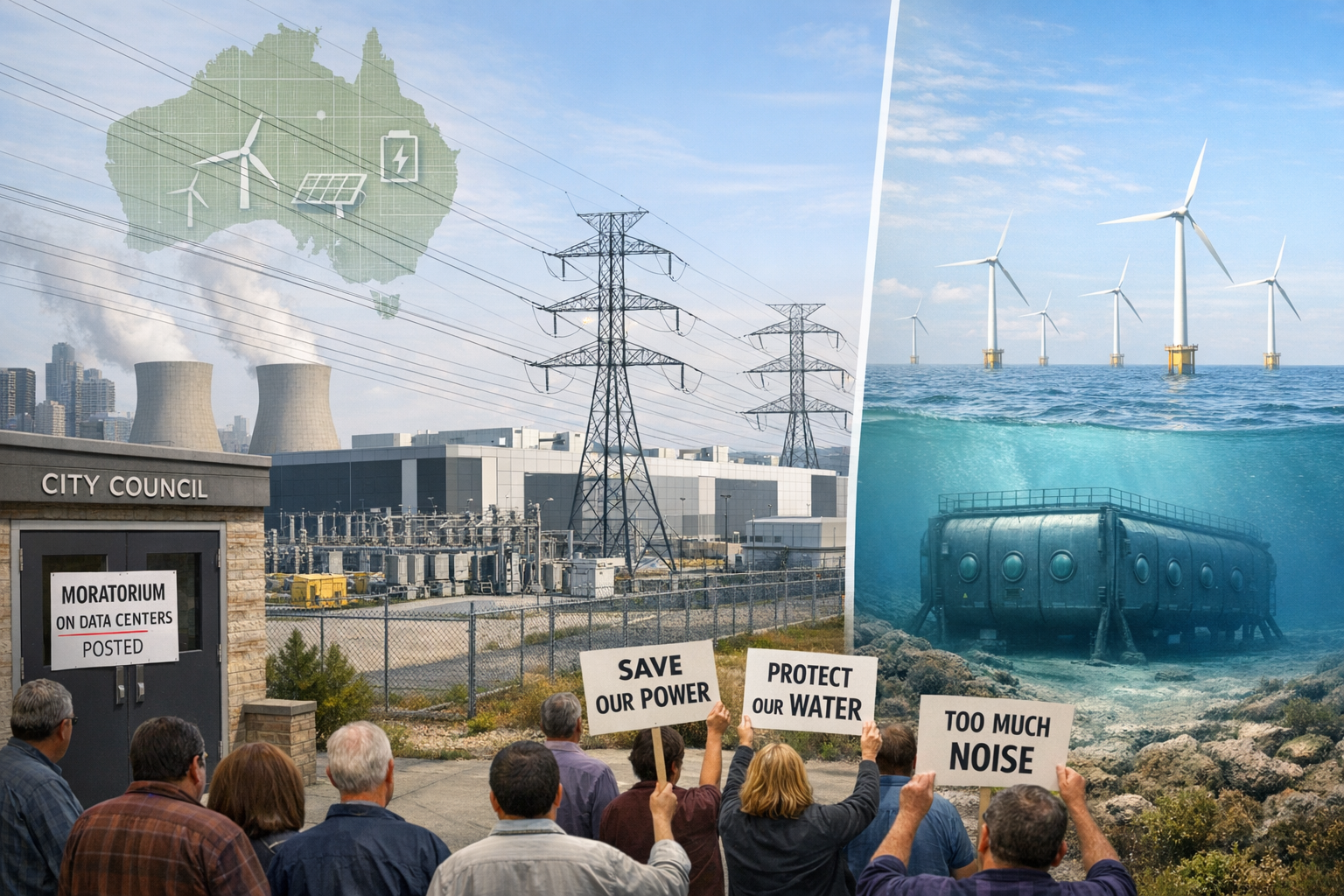
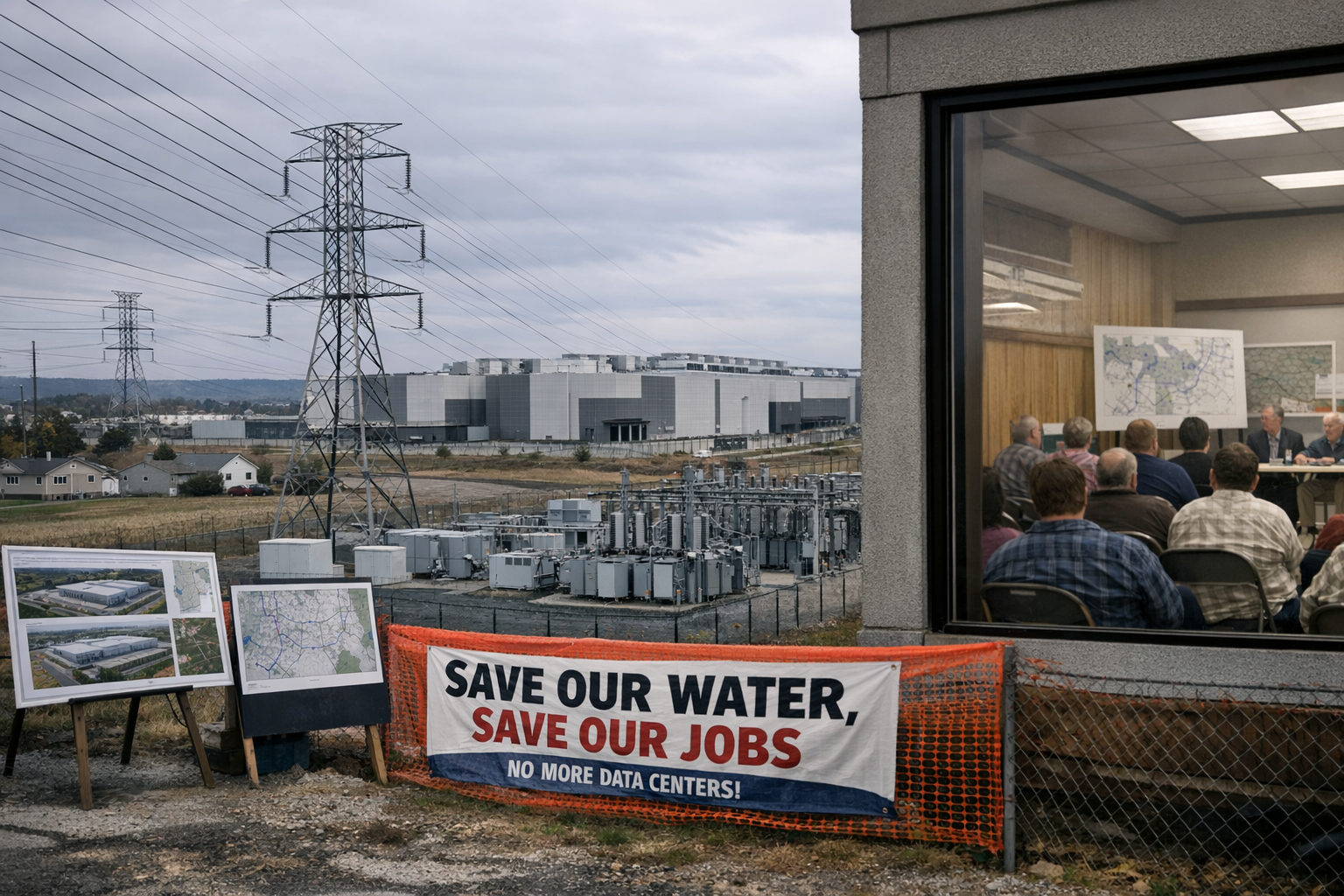
Those commitments reflect a broader reality for the industry. Across the United States, proposed data centers have begun to draw sharper scrutiny from residents and regulators who see them as land-intensive, power-hungry projects that may create fewer permanent jobs than traditional factories. For AI companies, that means local politics can be as strategic as semiconductors.
In Georgia, many major details of Project Camellia — including phasing, financing, design and operating structure — remain unresolved. But the power agreement alone underscores how central utility relationships have become to the AI business.
A new bottleneck for the AI era
The industry’s most important competitive question is increasingly whether companies can assemble the full industrial system required to run frontier AI at scale.
That system includes not only advanced chips, but also transformers, substations, fiber links, liquid cooling, construction crews and years of power planning. It also includes the less tangible assets of regulatory approval and public tolerance. The winner may not be the company with the best model on paper, but the one that can most reliably turn capital into running compute.
That is why these announcements matter now. Demand for AI capacity continues to rise as companies pour money into training larger models and serving more users. At the same time, utilities face long lead times for new generation and transmission, and data-center developers are competing for the same land, labor and electrical infrastructure.
Nvidia is betting that deeper integration will lock in its lead. AMD is betting that customers want an alternative big enough to matter. OpenAI is betting that securing power — and a durable local compact — is as crucial as improving the next model.
The AI race, in other words, is starting to look less like a software contest and more like a build-out of national-scale infrastructure.
Sources
Further reading and reporting used to add context:
- https://www.axios.com/2026/07/22/openai-savannah-georgia-data-center-project
- https://www.tomshardware.com/pc-components/gpus/nvidia-details-rubin-architectural-optimizations-for-inference-improvements-target-better-performance-and-efficiency-from-the-gpu-to-the-rack
- https://www.tomshardware.com/tech-industry/artificial-intelligence/behind-the-scenes-at-nvidias-engineering-superlab-vera-rubin-nvl72-running-openai-workloads-800vdc-demonstrated-and-more
- https://www.itpro.com/infrastructure/what-to-expect-at-amd-advancing-ai-2026
- Building AI infrastructure with the Effingham County community | OpenAI
- NVIDIA Vera Rubin Driving Performance Per Watt, Lower Token Costs for Partners Worldwide | NVIDIA Blog
- https://openai.com/careers/community-engagement-lead-effingham-county-savannah-msa-remote-us/
- https://developer.nvidia.com/blog/inside-nvidia-rubin-gpu-architecture-powering-the-era-of-agentic-ai/
- https://effinghamcounty.org/m/newsflash/Home/Detail/455
- https://openai.com/index/building-the-compute-infrastructure-for-the-intelligence-age/
- https://investor.nvidia.com/news/press-release-details/2026/NVIDIA-Unveils-Vera-the-CPU-for-Agents/default.aspx
- https://developer.nvidia.com/blog/nvidia-vera-cpu-delivers-high-performance-bandwidth-and-efficiency-for-ai-factories
- https://openai.com/index/stargate-michigan-data-center/
- https://nvidianews.nvidia.com/news/rubin-platform-ai-supercomputer
- https://developer.nvidia.com/blog/inside-the-nvidia-rubin-platform-six-new-chips-one-ai-supercomputer/
- https://www.nvidia.com/en-au/data-center/vera-cpu/
- https://images.nvidia.com/aem-dam/Solutions/documents/NVIDIA-Sustainability-Report-Fiscal-Year-2026.pdf
- https://nvidianews.nvidia.com/_gallery/download_pdf/6a1d03a23d63327d5dee4f73/
- https://www.reddit.com/r/savannah/comments/1v3jbpo/openai_data_center_in_effingham_county/
- https://nvidianews.nvidia.com/_gallery/download_pdf/695c39b23d633240d175d8e6/
- https://images.nvidia.com/nvimages/gtc/pdf/GTC26_SanJose_Highlights_Final.pdf
- https://nvidianews.nvidia.com/_gallery/download_pdf/6900f34a3d6332f95bb19c37/
- https://arxiv.org/abs/2507.02770
- https://www.amd.com/en.html
- https://www.anthropic.com/responsible-scaling-policy
- https://www.anthropic.com/news/redeploying-fable-5
- https://www.amd.com/en/newsroom/press-releases/2026-2-24-amd-and-meta-announce-expanded-strategic-partnersh.html
- https://ir.amd.com/news-events/press-releases/detail/1260/amd-and-openai-announce-strategic-partnership-to-deploy-6-gigawatts-of-amd-gpus
- https://www.anthropic.com/news/ust-claude
- https://ir.amd.com/financial-information/sec-filings/content/0000002488-26-000115/amd-20260626.htm
- https://ir.amd.com/news-events/press-releases/detail/1283/amd-announces-advancing-ai-2026
- https://www.amd.com/en/newsroom/press-releases/2025-11-19-amd-cisco-and-humain-to-form-joint-venture.html
- https://www.anthropic.com/responsible-scaling-policy/roadmap
- https://www.amd.com/en/newsroom/press-releases/2026-5-20-amd-announces-more-than-10-billion-in-taiwan-ecos.html
- https://www.amd.com/en/newsroom/press-releases/2026-5-5-amd-reports-first-quarter-2026-financial-results.html
- https://ir.amd.com/financial-information/sec-filings/content/0000002488-26-000045/0000002488-26-000045.pdf
- https://ir.amd.com/financial-information/sec-filings/content/0001193125-26-129106/0001193125-26-129106.pdf
- https://ir.amd.com/financial-information/sec-filings/content/0001193125-25-230895/0001193125-25-230895.pdf
- https://ir.amd.com/financial-information/sec-filings/content/0000002488-25-000163/0000002488-25-000163.pdf
- https://www.amd.com/content/dam/amd/en/documents/solutions/data-center/insights/idc-advancing-ai-2025-amd-report.pdf





Leave a Reply