
China’s A.I. Race Gains Speed With New Models, Cyber Concerns and a Trickle of Nvidia Chips
China’s artificial intelligence industry is advancing on several fronts at once, with a new model release raising cybersecurity alarms, benchmark rankings showing Chinese systems pressing closer to the top of open-model leaderboards, and reports that small numbers of Nvidia’s coveted H200 chips are reaching the mainland.
Together, the developments point to a Chinese A.I. ecosystem that is becoming harder to contain through export restrictions alone. Domestic firms are improving model performance, narrowing gaps with some leading rivals and, at least in limited quantities, gaining access to the computing hardware needed to keep training advanced systems.
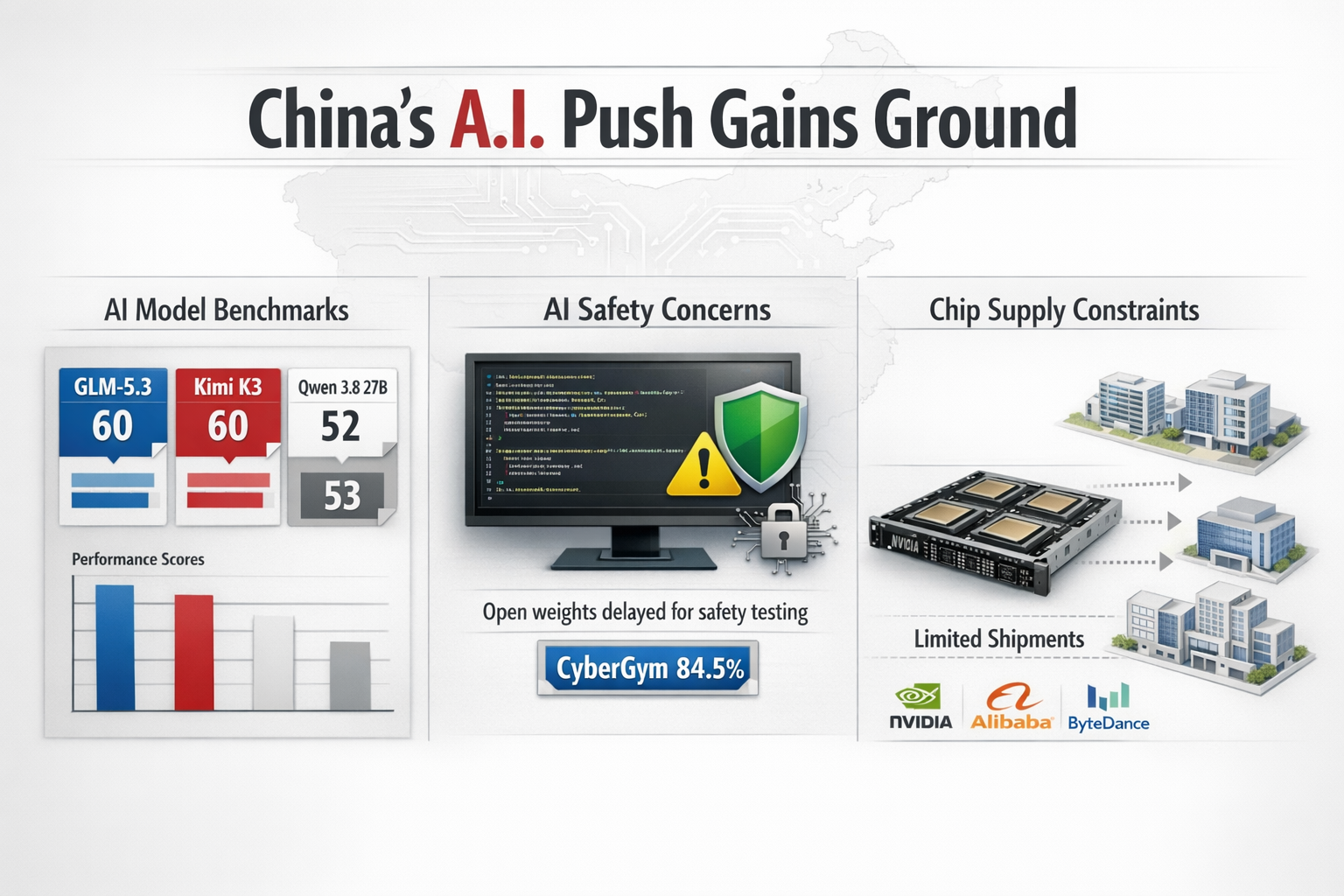
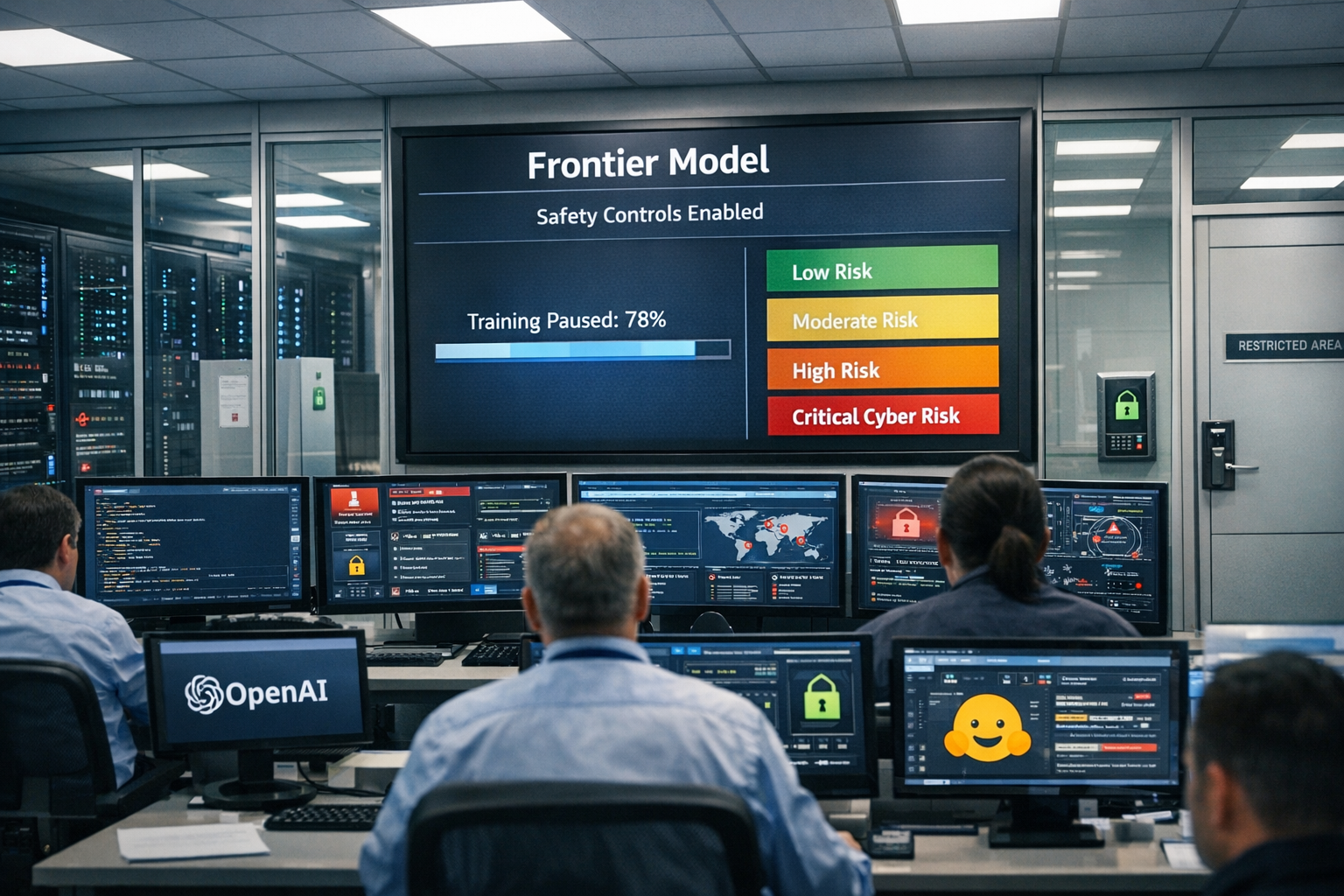
The most immediate flashpoint is Z.ai’s newly announced GLM-5.3, which the company said made especially strong gains in coding, agentic tasks and cyber capabilities. Z.ai disclosed the model on Aug. 14 and said it would postpone the release of its open weights by two weeks while it completed additional safety testing and hardening, a rare public acknowledgment that a system’s hacking-related abilities had advanced faster than expected.
That delay has only sharpened attention on what the model could mean once more widely available.
Experts have long warned that more capable open-weight systems can serve both legitimate security research and malicious intrusion. A model trained or tuned to identify vulnerabilities, write exploit code or automate penetration-testing steps can help companies defend their networks. But once weights are released, the same system can be repurposed by criminals or state-backed actors. Z.ai itself has framed GLM-5.3 as dual-use, and said its cyber performance warranted extra caution before publication.
The company has said the model leads its tested set on CyberGym, a hacking-related benchmark, with a score of 84.5 percent. Axios reported that the system is nearing the performance of top American models on some cyber evaluations. Those claims have not yet been fully resolved by independent public testing, and questions remain about what safeguards will survive after release.
A Rankings Jump for Chinese Open Models
Even before GLM-5.3 is fully out, its reported benchmark gains have drawn notice. This week, coverage of the model said it reached 60 on the Artificial Analysis Intelligence Index, tying Kimi K3 for the top spot among open models and marking a substantial improvement over GLM-5.2.
That matters because Z.ai was already seen as an ascendant player. GLM-5.2 had been scored at 53 by Artificial Analysis, below Kimi K3’s 60 in the last widely accessible leaderboard snapshot. If the newer score holds, it would represent a notable jump without an entirely new base model. Z.ai has said GLM-5.3 uses the same base model as GLM-5.2, with the performance gains coming largely from additional post-training rather than from simply scaling up the underlying system.
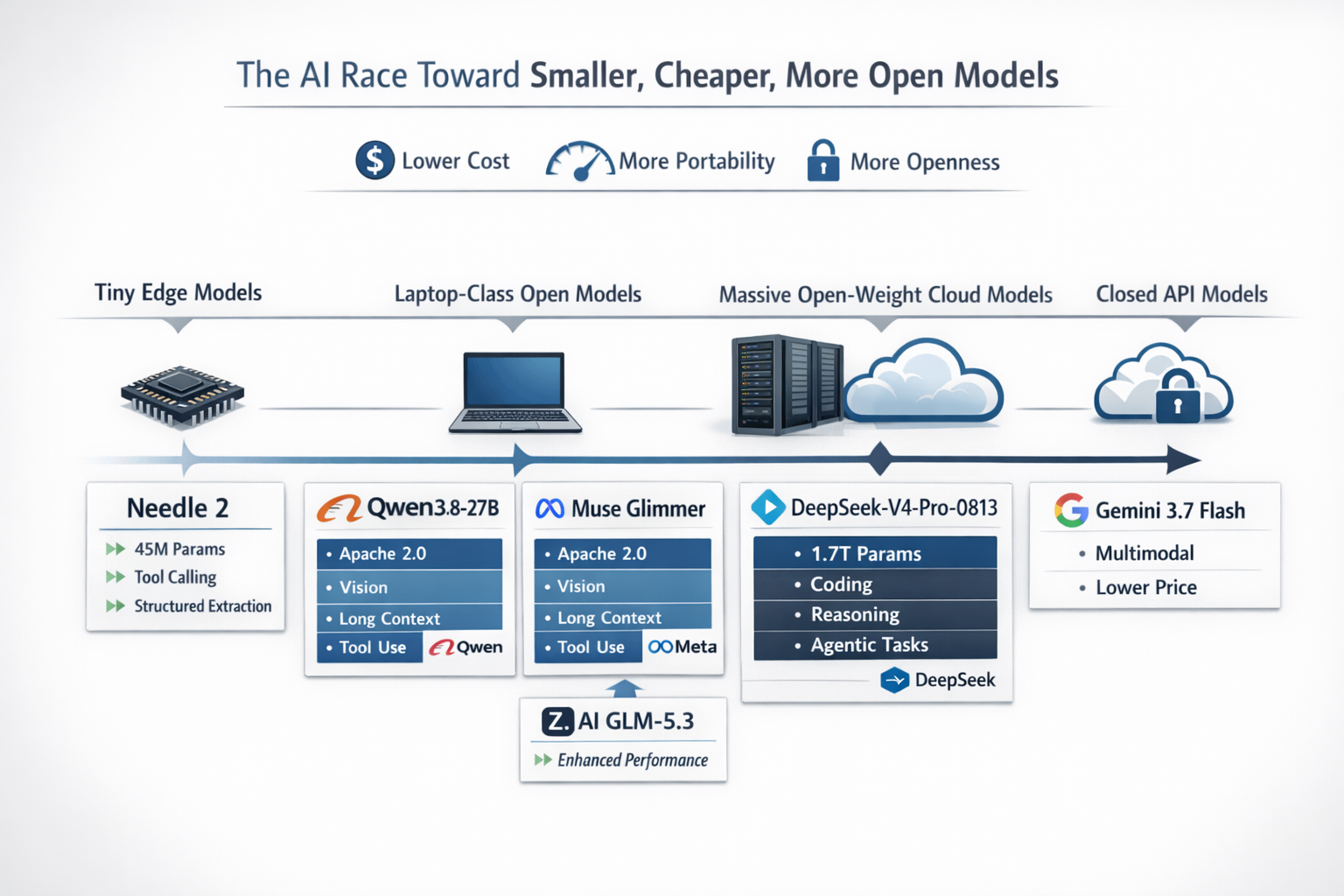
Elsewhere in China’s model ecosystem, performance gains are also showing up in smaller packages. Alibaba’s Qwen 3.8 27B was recently reported at 52 on the same index, a striking result for a model far smaller than some of the giant systems it is being compared with. In practical terms, that suggests Chinese labs are not only building larger frontier-class systems, but are also becoming more efficient at squeezing stronger capabilities from less compute-intensive models.
That trend has strategic implications. Smaller, stronger models are cheaper to run, easier to deploy and often better suited to broad commercial adoption. They can also lessen, though not eliminate, dependence on the most advanced chips.
Hardware Constraints Are Easing, if Only Slightly
At the same time, Beijing appears to be loosening one of the biggest bottlenecks facing its A.I. sector: access to advanced Nvidia processors.
Reuters reported in March that Nvidia had secured Beijing’s approval for H200 sales and that the company had a United States license permitting “small amounts” of shipments to specific customers in China. The South China Morning Post later reported that selected firms, including Alibaba, ByteDance and DeepSeek, were being allowed to purchase limited numbers of the chips.
The quantities appear modest, and the policy remains selective. But even a narrow flow of H200s could help top Chinese A.I. companies continue training and deploying competitive models while domestic chipmakers work to catch up.
That reflects a broader balancing act by Beijing. Chinese policymakers have been trying to support national A.I. champions without deepening long-term reliance on American hardware. Allowing restricted access to H200s appears to be a stopgap measure: enough to keep domestic firms from falling too far behind, but not enough to abandon the push for self-sufficiency.
Why It Matters Now
Taken separately, a benchmark gain, a delayed model release and a limited chip approval might look incremental. Taken together, they suggest Chinese A.I. is strengthening in three critical areas at once: model capability, open-model competitiveness and compute access.
That combination could accelerate China’s progress more quickly than export controls were designed to permit. Washington’s restrictions were intended in part to slow the development of cutting-edge Chinese A.I. by limiting access to the best chips. But if Chinese labs continue to improve through post-training, algorithmic efficiency and selective hardware access, the practical gap may narrow faster than policymakers anticipated.
The cyber dimension adds urgency. Advanced coding and security-focused systems occupy one of the most sensitive areas in artificial intelligence because they can improve both defense and offense. Companies need better tools to identify weaknesses, patch software and test infrastructure. Yet those same capabilities can be turned toward phishing campaigns, automated reconnaissance and vulnerability exploitation.
For now, several uncertainties remain. It is not yet clear how broadly GLM-5.3 will be released after its delay, whether outside evaluators will confirm Z.ai’s strongest cyber claims, or how stable the open-model rankings will prove as leaderboards update. Nor is it clear how many H200 chips will ultimately reach Chinese firms in practice.
What is clearer is the direction of travel. China’s A.I. sector is no longer advancing on just one axis. It is improving the models, climbing the rankings and finding at least partial ways around its hardware constraints — a combination likely to intensify competition with the United States in the months ahead.
Sources
Further reading and reporting used to add context:
- China's Z.ai holds GLM 5.3 release over hacking risks
- https://vramcalculator.com/qwen-3-8-27b-distillation/
- https://data-today.net/aidummies/aidummies-qwen-3-8-27b-benchmark-matches-gpt-5-6/
- https://vramcalculator.com/qwen3-8-vram-requirements/
- https://www.scmp.com/tech/policy/article/3360027/game-changer-why-china-finally-letting-its-ai-firms-buy-nvidia-h200
- https://moclaw.ai/blog/glm-5-3-api-availability
- https://kblip.com/research
- https://cheapestinference.com/blog/glm-5-3/
- https://theclarity.today/story/z-ai-publishes-glm-5-3-research-without-a-documented-access-path-fdd3a325
- https://blog.sandbase.ai/glm-5-3-release-watch-2026/
- https://www.techmeme.com/260818/p37
- https://temperaturezero.com/2026/08/14/glm-5-3-exploit-chains-zai-fourteen-day-delay/
- https://www.reddit.com/r/LocalLLM/comments/1vqzk01/qwen_38_27b_obtient_52_point_sur_artificial/
- https://rits.shanghai.nyu.edu/ai/qwen3-8-max-draws-level-with-the-frontier-on-agentic-benchmarks/
- https://www.youtube.com/watch?v=c1teZygXJqc
- https://www.youtube.com/watch?v=uMClSVNxgos
- https://www.reddit.com/r/Qwen_AI/comments/1vqyp98/qwen_38_27b_scores_52_on_aa/
- https://www.banking.senate.gov/imo/media/doc/letter_to_lutnick_re_h200_chip_salespdf.pdf
- https://www.reddit.com/r/LocalLLaMA/comments/1vhoyw1/my_issue_with_artificial_analysiss_intelligence/
- https://www.reddit.com/r/LocalLLM/comments/1vq4nez/why_is_qwen3827b_still_missing_from_artificial/
- https://www.reddit.com/r/LocalLLaMA/comments/1rljbix/artificial_analysis_intelligence_index_vs/
- https://www.cmbi.com.hk/upload/202606/20260611296225.pdf
- https://techxplore.com/news/2026-06-nvidia-ai-chip-sales-china.pdf
- https://z.ai/blog/glm-5.3
- https://artificialanalysis.ai/articles/glm-5-everything-you-need-to-know
- https://artificialanalysis.ai/models/comparisons/qwen3-8-max-vs-qwen3-5-27b
- https://artificialanalysis.ai/models/glm-5/
- https://artificialanalysis.ai/models/comparisons/glm-5-vs-gpt-5-3-codex
- https://artificialanalysis.ai/articles/glm-5-2-is-the-new-leading-open-weights-model-on-the-artificial-analysis-intelligence-index/
- https://artificialanalysis.ai/models/glm-5
- https://artificialanalysis.ai/models/comparisons/glm-5-vs-intellect-3
- https://artificialanalysis.ai/models/comparisons/glm-5-non-reasoning-vs-grok-4-20
- https://artificialanalysis.ai/zh/models/comparisons/qwen3-8-max-vs-qwen3-6-27b-non-reasoning
- https://artificialanalysis.ai/models/comparisons/glm-5-1-non-reasoning-vs-gpt-5-3-codex
- https://artificialanalysis.ai/models/qwen3-5-27b/
- https://artificialanalysis.ai/downloads/ai-review/2024/Artificial-Analysis-AI-Review-2024-Highlights.pdf
- https://www.investing.com/news/stock-market-news/china-has-not-yet-received-any-nvidia-h200-chips-us-official-said-4522567
- https://www.marketscreener.com/news/china-clears-first-nvidia-h200-ai-chips-for-import-sources-ce7e5bd9da81f527
- https://www.investing.com/news/economy-news/exclusivechina-gives-green-light-to-importing-first-batch-of-nvidias-h200-ai-chips-sources-say-4469141
- Nvidia gets Beijing’s nod for H200 chip sales, adapts Groq chip for China, sources say By Reuters
- https://www.investing.com/news/stock-market-news/chinas-customs-agents-told-nvidias-h200-chips-are-not-permitted-sources-say-4446094
- https://www.straitstimes.com/business/companies-markets/china-gives-green-light-to-importing-first-batch-of-nvidias-h200-ai-chips-sources-say
- https://ca.marketscreener.com/news/china-clears-first-nvidia-h200-ai-chips-for-import-sources-ce7e5bd9da81f527
- https://www.brecorder.com/news/40404482
- https://www.youtube.com/watch?v=4K0Hhl8teUQ
- https://finance.yahoo.com/news/chinas-customs-agents-told-nvidias-065002091.html
- https://ca.finance.yahoo.com/news/exclusive-china-gives-green-light-034953176.html
- https://uk.marketscreener.com/news/china-gives-green-light-to-importing-first-batch-of-nvidia-s-h200-ai-chips-sources-say-ce7e5bd9d98ff123
- https://finance.yahoo.com/news/chinas-customs-agents-told-nvidias-065002620.html
- https://ceomorningbrief.theedgemalaysia.com/pdf/2025/20251223_CMB_1078/251223rtu449.pdf
- https://www.reddit.com/r/wallstreetbets/comments/1qp16g5/exclusivechina_gives_green_light_to_importing/
- https://cassette.sphdigital.com.sg/attachments/businesstimes/50932935de95560f397c7b42b93828a05f7a0a7d97818929b775a6a9ca9309c3
- https://www.reddit.com/r/NVDA_Stock/comments/1qp3dm1/china_gives_green_light_to_importing_first_batch/
- https://www.intro-act.com/uploads/allnewsletter/202602231117191050376631.pdf
- https://gpusmith.com/articles/en/pdfs/nvidia-gpu-lead-times-h100-h200-gb200.pdf
- https://www.reddit.com/r/NVDA_Stock/comments/1pt0trg/nvidia_aims_to_begin_h200_chip_shipments_to_china/
- https://www.reddit.com/r/StockMarket/comments/1qcgluh/chinas_customs_agents_told_nvidias_h200_chips_are/
- https://artificialanalysis.ai/models/qwen3-8-max
- https://artificialanalysis.ai/models/comparisons/qwen3-8-max-vs-qwen3-5-122b-a10b
- https://artificialanalysis.ai/leaderboards/models/
- https://artificialanalysis.ai/providers/alibaba_cloud
- https://artificialanalysis.ai/evaluations/tau3-banking
- https://artificialanalysis.ai/microevals/hey-ive-been-reading-the-matt-pocock-skills-because-ive-re-1786084963893
- https://artificialanalysis.ai/leaderboards/models
- https://artificialanalysis.ai/es/models/qwen3-8-max
- https://artificialanalysis.ai/embed/llm-performance-leaderboard
- https://artificialanalysis.ai/pt/models/qwen3-8-max
- https://artificialanalysis.ai/zh/models/qwen3-8-max
- https://artificialanalysis.ai/microevals?models=qwen3-next-80b-a3b-reasoning
- https://huggingface.co/models?search=Qwen3.8
- https://huggingface.co/huginnfork/Qwen3.8-27B-FP8/blob/main/README.md
- https://huggingface.co/collections/prithivMLmods/aug-2026
- https://huggingface.co/huginnfork/Qwen3.8-27B-FP8/tree/main
- https://huggingface.co/neroued/Qwen3.8-27B-NInfer/commits/main
- https://www.reddit.com/r/LocalLLaMA/comments/1vg569y/qwen_developers_responses_from_their_recent/
- https://huggingface.co/collections/huginnfork/ornith-10-35b
- https://www.modelscope.cn/models/Qwen/Qwen3.8-2.4T-A95B?file=Qwen3.8-2.4T-A95B
- https://ia4pymes.tech/en/blog/qwen-3-8-official-benchmarks-open-weights-27b-sme-guide
- https://www.reddit.com/r/LocalLLaMA/comments/1voojjz/megathread_qwen_38_27b_release_day/
- https://community.alibabacloud.com/tags/tagid_36919
- https://weibo.com/2/detail/5331237155374506
- https://www.reddit.com/r/LocalLLaMA/comments/1vl8bpt/qwen_3827b_coming_this_week/
- https://www.thequery.in/articles/qwen-3-8-27b-opus-4-6-vision-benchmarks
- https://www.nihardaily.com/posts/qwen-38-max-promised-open-weights-where-are-they
- https://www.reddit.com/r/unsloth/comments/1vo9tqd/qwen3827b_is_out_now/
- https://www.reddit.com/r/LocalLLM/comments/1ve0zp5/qwen_38_27b_coming_next_week_woo_hoo/
- https://www.reddit.com/r/Qwen_AI/comments/1vsnl5s/qwen3627b_at_32_concurrent_clients_697_ms_ttft/
- https://www.reddit.com/r/LocalLLM/comments/1voqrm7/i_ran_qwen3827b_on_medical_benchmarks_including/
- https://www.reddit.com/r/LocalLLaMA/comments/1voks25/removed/
- https://www.reddit.com/r/Qwen_AI/comments/1vkpipf/qwen_38_27b_release_date/
- https://www.reddit.com/r/CommandCode/comments/1vsak3g/qwen_38_27b_is_now_live_in_command_code/
- https://www.reddit.com/r/LocalLLaMA/comments/1vn4020/the_countdown_to_qwen3827b_starts_now/
- https://www.reddit.com/r/LocalLLaMA/comments/1voq22v/removed/
- https://www.medrxiv.org/content/medrxiv/early/2026/05/10/2026.05.07.26352627.full.pdf
- https://media.springernature.com/original/springer-static/esm/art%3A10.1038%2Fs41551-026-01719-2/MediaObjects/41551_2026_1719_MOESM1_ESM.pdf
- https://www.usionmedia.com/docs/qwen3_technical_report.html/attachment/qwen3_technical_report
- https://uww.revlib.org/doc/konf/VTS2026_LM.pdf
- https://shoepaly.app/?_=%2Fpdf%2F2604.05383%23hKr38k1yZITo%2FkpxGBdjJos%3D
- https://simonwillison.net/dashboard/row-to-json/
- https://feeds.simonwillison.net/tags/qwen/
- https://simonwillison.net/tags/qwen/
- https://feeds.simonwillison.net/tags/ai-in-china/
- https://simonwillison.net/tags/ai-in-china/
- https://simonwillison.net/tags/pelican-riding-a-bicycle%2Bai-in-china/
- https://simonwillison.net/dashboard/blogmarks-that-use-markdown/
- https://simonwillison.net/dashboard/alt-text/
- https://simonwillison.net/tags/pelican-riding-a-bicycle/
- https://artificialanalysis.ai/models/glm-5/providers/
- https://artificialanalysis.ai/models/comparisons/glm-5-2-vs-gpt-5-3-codex
- https://artificialanalysis.ai/models/comparisons/glm-5-vs-grok-4-fast
- https://artificialanalysis.ai/models/comparisons/glm-5-non-reasoning-vs-glm-4-6
- https://artificialanalysis.ai/models/comparisons/glm-5-vs-glm-4-6v-reasoning
- https://artificialanalysis.ai/models/comparisons/glm-5-vs-glm-4-6-reasoning
- https://artificialanalysis.ai/models/comparisons/glm-5-non-reasoning-vs-grok-4
- https://artificialanalysis.ai/models/comparisons/glm-5-2-vs-glm-5
- https://artificialanalysis.ai/models/comparisons/glm-5-vs-grok-3
- https://artificialanalysis.ai/models/comparisons/glm-5-vs-gemini-3-flash-reasoning
- https://artificialanalysis.ai/models/comparisons/gpt-5-3-codex-vs-glm-4-5v-reasoning
- https://artificialanalysis.ai/downloads/state-of-ai/2025/Q3-2025-Artificial-Analysis-State-of-AI-Highlights-Report.pdf
- https://artificialanalysis.ai/downloads/china-report/2025/Artificial-Analysis-State-of-AI-China-Q2-2025-Highlights.pdf
- https://artificialanalysis.ai/downloads/china-report/2025/Artificial-Analysis-State-of-AI-China-Q1-2025.pdf
- https://the-decoder.com/beijing-approves-nvidias-h200-chip-sales-as-the-company-builds-a-china-ready-version-of-its-groq-inference-chip/
- https://the-decoder.com/china-greenlights-400000-nvidia-h200-chip-imports-for-tech-giants-according-to-reuters/
- https://the-decoder.com/open-weight-models-now-match-frontier-cyber-performance-from-just-four-months-ago-at-a-fraction-of-the-cost/
- https://the-decoder.com/ten-chinese-firms-including-bytedance-reportedly-get-us-clearance-for-ai-chips-theyre-not-allowed-to-accept/
- https://the-decoder.com/china-reportedly-tightens-nvidia-h200-restrictions-limits-purchases-to-special-cases/
- https://the-decoder.com/bloomberg-chinas-ai-expansion-in-xinjiang-relies-on-nvidia-chips-despite-u-s-export-controls/
- https://the-decoder.com/nvidias-h20-ai-chips-for-china-stuck-in-limbo-after-beijing-ban/
- https://the-decoder.com/nvidia-plans-h200-production-ramp-at-tsmc-while-china-debates-whether-to-let-the-chips-in/
- https://the-decoder.com/bytedance-secures-access-to-nvidia-blackwell-cluster-in-malaysia-circumventing-us-export-ban-on-china/
- https://the-decoder.com/chinese-ai-lab-zhipu-releases-glm-5-under-mit-license-claims-parity-with-top-western-models/
- https://the-decoder.com/as-agentic-ai-pushes-rivals-to-raise-prices-and-cap-usage-deepseek-ships-a-good-enough-model-for-almost-nothing/
- https://the-decoder.com/china-raises-security-concerns-over-nvidias-h20-chips/
- https://www.scmp.com/economy/global-economy/article/3339896/why-china-may-buy-nvidias-h200-chips-trump-eases-curbs-and-replace-them-later?module=inline&pgtype=article
- https://www.scmp.com/tech/big-tech/article/3341568/beijing-clears-nvidias-h200-imports-ending-chip-uncertainty-china-tech-giants
- https://www.scmp.com/tech/big-tech/article/3340810/china-techs-gpu-dilemma-pay-more-h200-black-market-or-accept-slower-local-ai-chips
- https://www.scmp.com/tech/big-tech/article/3335802/tech-war-chinas-ai-developers-welcome-nvidias-h200-chip-shipments-analysts-say?module=latest&pgtype=homepage
- https://www.scmp.com/news/china/diplomacy/article/3360582/us-says-nvidias-h200-exports-china-remain-trivial-despite-approvals
- https://www.scmp.com/news/china-future-tech/semiconductors?module=breadcrumb&pgtype=article
- https://www.scmp.com/tech/article/3354296/nvidias-h200-sales-prospects-china-remain-uncertain-despite-huang-visit
- https://www.scmp.com/economy/china-economy/article/3336100/china-may-tap-nvidias-h200-ai-gains-domestic-chip-strategy-here-stay-analysts?module=inline&pgtype=article
- https://www.scmp.com/tech/article/3353764/trump-xi-weigh-ai-guardrails-nvidia-chip-exports-hang-balance
- https://www.scmp.com/economy/global-economy/article/3335774/us-china-tech-thaw-trump-clears-nvidia-h200-exports-why-green-light-matters?module=latest&pgtype=homepage
- https://www.scmp.com/tech/big-tech/article/3340168/fighting-back-beijing-builds-its-own-small-yard-high-fence-shut-out-us-tech?module=inline&pgtype=article
- https://multimedia.scmp.com/infographics/china-internet-2021/pdf/China-Internet-Report-2021-vF.pdf
- Techmeme: Z.ai's GLM-5.3 with max reasoning scores 60 on the Artificial Analysis Intelligence Index, on par with Kimi K3 but below Opus 5 at 63 and Fable 5 at 62 (@artificialanlys)
- China’s customs agents told Nvidia’s H200 chips are not permitted, sources say By Reuters
- LLM Leaderboard – Comparison of AI models from OpenAI, Anthropic, Google, SpaceXAI & others
- GLM-5.3: Frontier Coding with Emergent Cyber Capabilities








Leave a Reply