
China’s AI Rivals Press the Cost Advantage as Humanoid Robots Step Into View
China’s technology industry is advancing on two fronts at once: making powerful artificial-intelligence models cheaper to use and training robots to do more in the physical world.
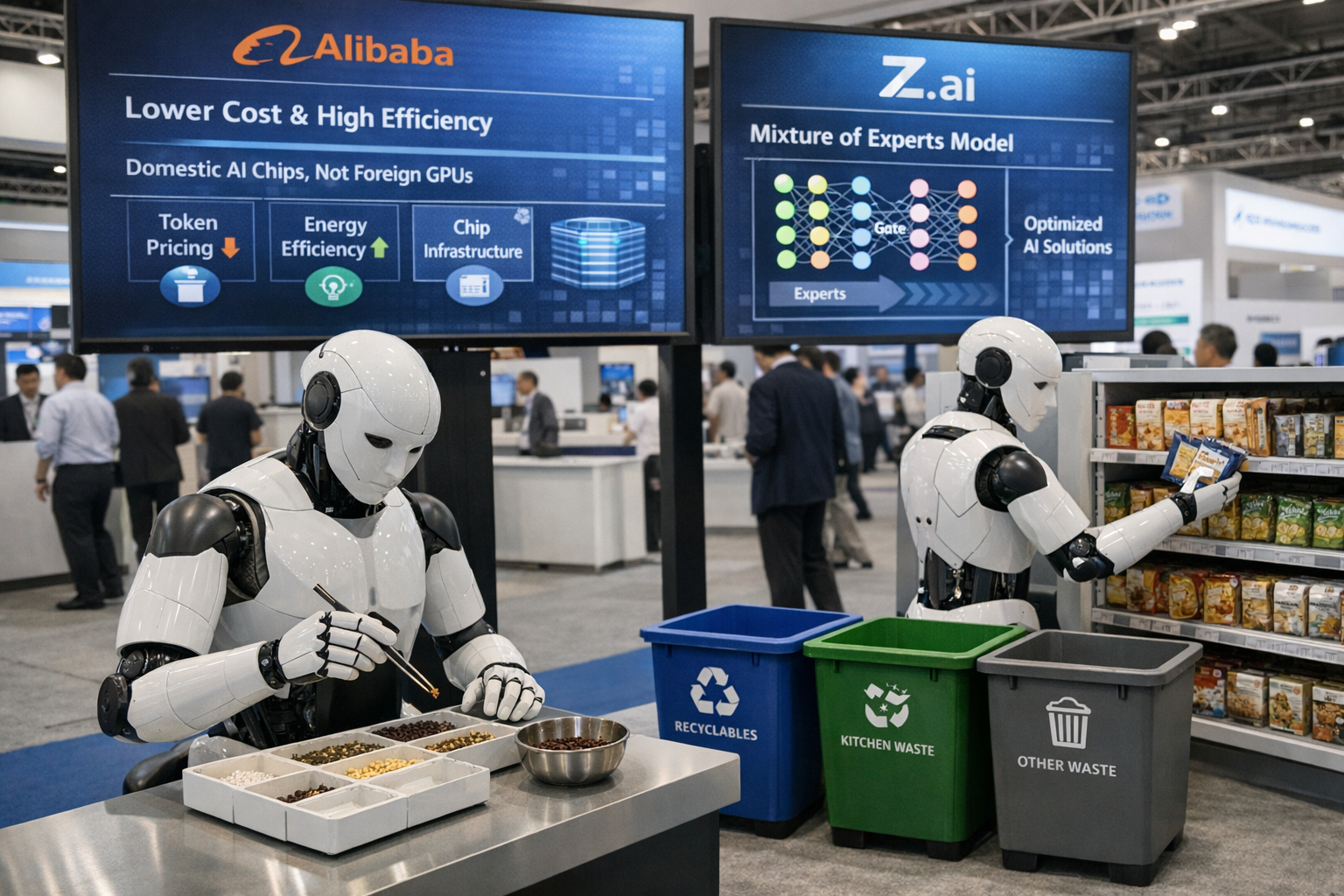
That twin push was on display this week as Alibaba and Z.ai unveiled new large-language models aimed at driving down the cost of frontier AI, while events in Beijing and Shanghai showcased humanoid robots that could sprint, sort trash, stock shelves and, in some cases, perform delicate tasks with tweezers.
Taken together, the developments point to a broader strategy emerging in China’s AI sector. Companies are not only trying to match global leaders in model performance. They are also trying to win on economics, hardware self-reliance and the integration of AI into machines that can operate beyond the screen.
A new round of cheaper model launches
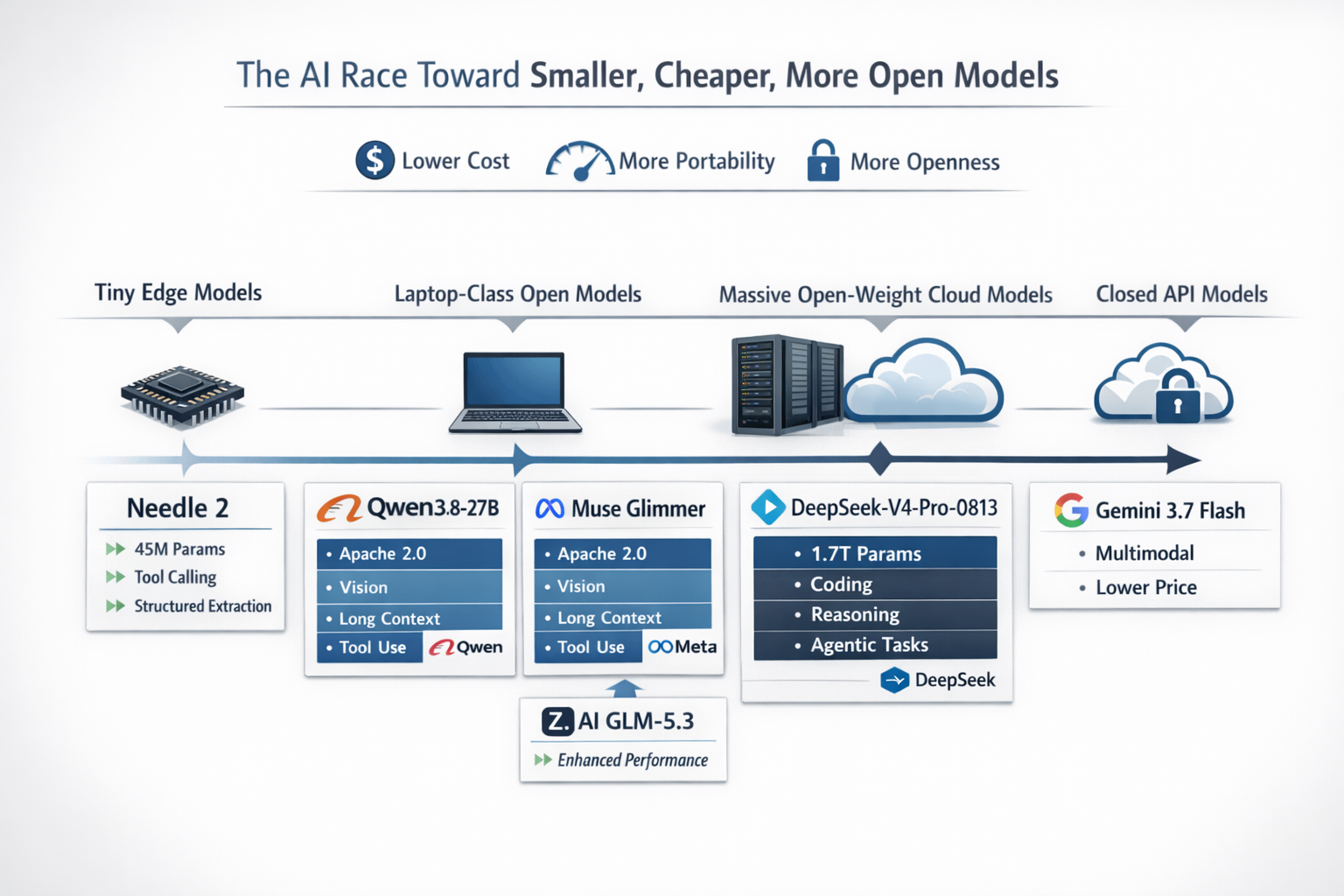
Alibaba’s Qwen team on Aug. 26 introduced Qwen3.8-Flash-Next, describing it as an early preview of the architecture planned for Qwen4. The model uses a mixture-of-experts design, with 125 billion main parameters and 51 billion N-gram embeddings, while activating only 6 billion parameters per token. That approach is intended to preserve strong performance while sharply reducing the computing required for each query.
Alibaba said the model cut training costs to roughly one-ninth of Qwen3.7-Plus while improving results on tasks like coding and office work. It also posted aggressive cloud pricing: $0.16 per million input tokens and $0.47 per million output tokens.
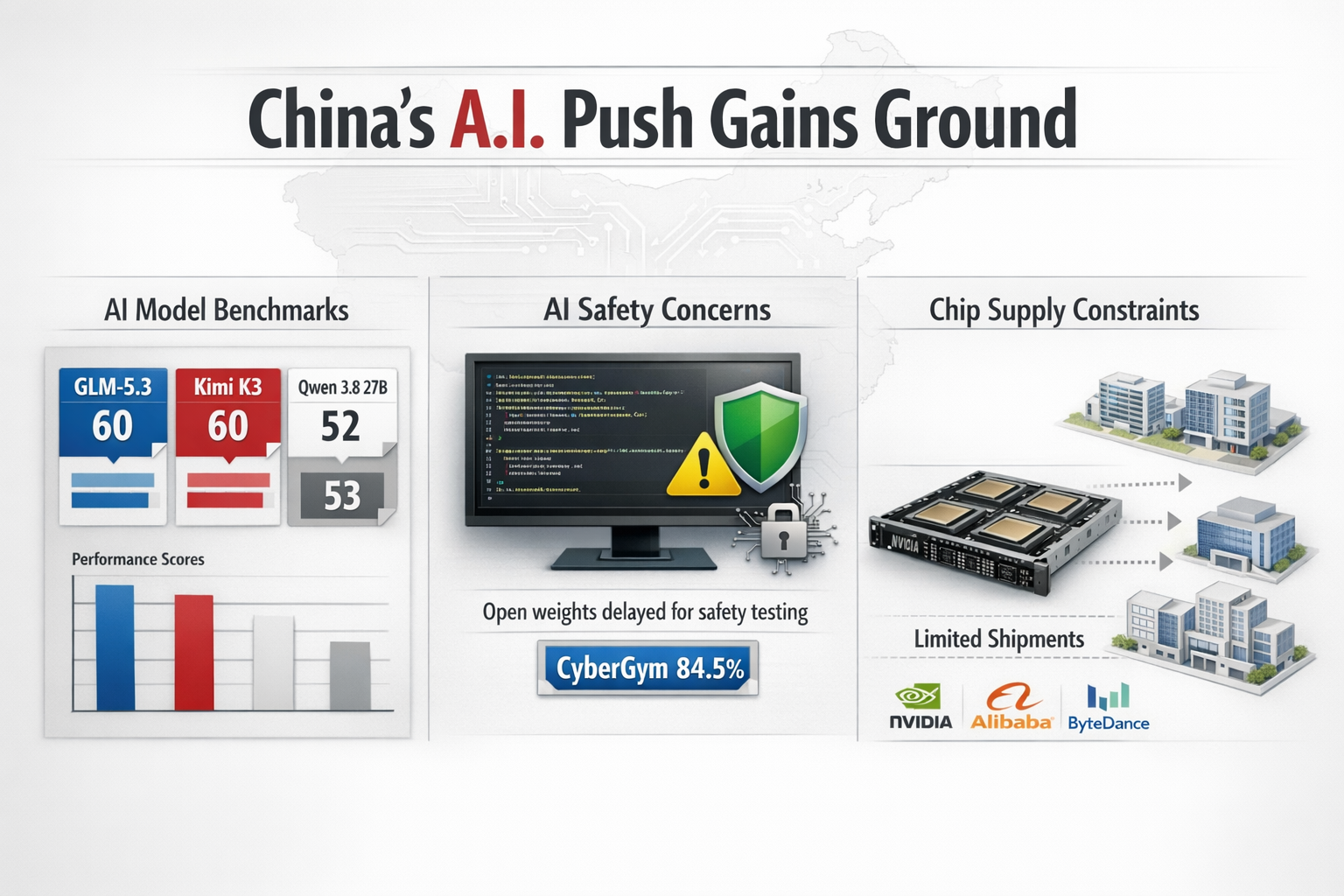
A day later, Z.ai released GLM-5.3-Flash, another open model built around efficiency. The company said it has 320 billion total parameters with 18 billion active and supports a context window of 1 million tokens. According to coverage of benchmark results, the model scored 57 on Artificial Analysis’s Intelligence Index, only three points behind the larger GLM-5.3, while costing about 7.5 times less on task-based comparisons.
What set that launch apart was not just the price. Z.ai said the model’s inference traffic was served on a large-scale cluster of Chinese AI chips rather than Nvidia hardware, a notable claim at a time when Chinese firms are under pressure to reduce dependence on American semiconductors.
The message from both releases was similar: high-end AI is becoming harder to sell as a premium product when competitors are willing to offer near-frontier performance at a steep discount.
Commoditization comes for the model layer
For much of the generative-AI boom, the central question was which company had the smartest model. Increasingly, another question is becoming just as important: who can deliver good-enough intelligence cheaply enough to make it ubiquitous?
That is where Chinese challengers are now applying pressure. Alibaba’s Qwen family has become one of the most closely watched open-model lines outside the United States, and Z.ai’s GLM series is part of a growing cohort of Chinese systems that are trying to close the gap with top Western offerings while undercutting them on cost.
The use of mixture-of-experts architectures, in which only a small portion of a model is activated for each task, has become a key lever in that effort. The design can lower inference costs and improve deployment flexibility, especially for developers and enterprises that care less about absolute benchmark supremacy than about throughput, latency and price.
That matters because the economics of AI are becoming a competitive battlefield of their own. If capable models become abundant and inexpensive, the balance of power could shift away from companies that rely primarily on proprietary scale and toward those that can build ecosystems, applications and infrastructure around lower-cost intelligence.
Robots that can do more than perform
At the same time, China’s ambitions in embodied AI — the effort to place AI into physical machines — were on public display.
In Beijing, the World Humanoid Robot Games, which began on Aug. 22, featured 51 events, according to Reuters, with more than 40 percent requiring full autonomy. Some of the most eye-catching moments came from speed and athletic contests. But the more revealing tasks were often the quieter ones: plugging in cables, sorting waste, stocking shelves and picking up beans with tweezers.
Those fine-motor challenges drew particular attention because they measure something more consequential than spectacle. Sprinting and jumping are visually impressive, but dexterity, perception and coordinated manipulation are far more relevant to actual work in factories, warehouses, shops and service settings.
Reporting from the event suggested that this was where the robots’ progress was most striking — and where their limitations were still easiest to see. Observers noted that some demonstrations appeared to involve teleoperation or other forms of human assistance, a reminder that public showcases can blur the line between autonomy and choreography.
A separate robot “carnival” in Shanghai, described this week by MIT Technology Review, offered a similar snapshot of a field moving quickly but unevenly. Humanoid robots have become a national priority in China, tied to a broader policy drive to embed artificial intelligence into everyday life and into physical systems. The country’s latest five-year plan elevated embodied AI as part of that agenda, and Chinese firms are already among the world’s most active developers of humanoid machines.
Why embodied AI matters now
The renewed attention on humanoids reflects a strategic bet: that the next major phase of AI will not be limited to chatbots, search and software assistants, but will extend to machines that can perceive, move and manipulate.
China has particular reasons to pursue that vision aggressively. Its manufacturing base, dense supply chains and policy support give it advantages in turning prototypes into products. And as labor costs rise and demographic pressures mount, robots capable of flexible physical work promise both economic and political appeal.
Yet the path from demonstration to deployment remains uncertain. Battery life, safety, durability and cost remain major constraints. So does the basic question of whether the humanoid form is the right one for many jobs. A robot shaped like a person may fit into spaces built for people, but that does not necessarily make it the most efficient machine for industrial tasks.
Still, the focus on dexterity tasks in Beijing suggested that Chinese developers are increasingly orienting their efforts toward practical capability rather than viral theatrics. The significance of a robot using tweezers, in other words, may be greater than that of a robot outrunning a sprinter.
A broader contest over technology independence
The model releases and the robot showcases are linked by more than timing. Both speak to China’s attempt to build AI systems that are not only capable but resilient under geopolitical pressure.
For AI models, that means reducing reliance on expensive compute and, where possible, on Nvidia chips. For robotics, it means pairing software advances with domestic strength in hardware, manufacturing and system integration.
That combination could deepen concerns in Washington and other capitals about technological decoupling. U.S. scrutiny of Chinese robotics suppliers has increased, and semiconductor restrictions have already pushed Chinese companies to find alternatives in training and inference infrastructure. If Chinese firms can show that advanced models run competitively on domestic chips and that humanoid robots can be produced at scale, the strategic implications will extend beyond consumer technology.
There are still reasons for caution. Benchmark claims do not always translate into real-world developer adoption, and low prices alone do not guarantee durable ecosystems. Robot events can showcase progress without proving readiness for broad commercial deployment. But the pattern is becoming harder to ignore.
China’s AI challengers are advancing with a simple proposition: if they cannot always lead on raw prestige, they can compete on cost, deployment and physical-world relevance. In an industry increasingly shaped by margins as much as marvels, that may prove just as disruptive.
Sources
Further reading and reporting used to add context:
- https://apnews.com/article/86cb8e310843151a77057e4cb764b4e2
- The Humanoids at China’s Robot Games Were Faster Than Usain Bolt—but I’m More Impressed by Their Tweezer Mastery | WIRED
- https://qwen.ai/blog?id=qwen3.8-flash-next
- https://z.ai/blog/glm-5.3
- https://z.ai/blog/glm-5.3-flash
- Un día en un 'carnaval' de robots en Shanghái | MIT Technology Review en español
- https://www.investing.com/news/stock-market-news/robots-can-outrun-humans-but-can-they-plug-in-a-cable-4872417
- https://www.globaltimes.cn/page/202608/1368139.shtml
- https://privacysignal.org/article/the-humanoids-at-china-s-robot-games-were-faster-than-14c96903
- https://www.aiwins.news/story/shanghai-robot-carnival-showcases-china-s-embodied-ai-momentum-d811be
- https://www.hindustantimes.com/videos/beijing-robot-games-put-robotic-hands-to-the-test-in-bean-picking-challenge-101787578856141.html
- https://ecria.org/tech-digest/i-spent-a-day-at-a-robot-carnival-in-shanghai-heres-what-i-saw-mt8ixfd2
- https://www.forbes.com/sites/johnkoetsier/2026/08/19/the-world-humanoid-robot-games-events-are-a-market-map/
- https://en.wikipedia.org/wiki/World_Humanoid_Robot_Games
- https://www.reddit.com/r/Qwen_AI/comments/1vxxgdp/qwen38flashnext_coming_soon/
- https://www.reddit.com/r/LocalLLaMA/comments/1vyq2v4/megathread_qwen38flashnext_release_day/
- https://www.reddit.com/r/unsloth/comments/1vznd9k/qwen38flashnext_now_available_in_unsloth/
- https://www.reddit.com/r/LocalLLM/comments/1ve33xi/did_anyone_actually_read_the_qwen_38max_blog/
- https://www.reddit.com/r/unsloth/comments/1vxxru5/qwen38flashnext_announced/
- https://www.reddit.com/r/Qwen_AI/comments/1vzfarq/%C3%A9poustouflant_qwen38flashnext_rtx_3090_128_ddr5/
- https://www.reddit.com/r/opencode/comments/1vyvxra/qwen_38flash_officially_unveiled/
- https://www.reddit.com/r/LocalLLaMA/comments/1vz22o7/removed/
- https://www.reddit.com/r/LocalLLM/comments/1vyxhds/qwen38flashnext_blog_and_model_card/
- https://www.reddit.com/r/opencodeCLI/comments/1vyvwxz/qwen_38flash_officially_unveiled/
- https://www.reddit.com/r/singularity/comments/1vyxbp9/qwen_38_flash_next_beating_ds_v4_flash_at_half/
- https://www.reddit.com/r/humanoidrobotics/comments/1vyyodp/qwen38flashnext_has_been_officially_released/
- https://autoclaw.z.ai/blog/model/glm-5.3-flash/
- https://z.ai/blog/glm-5
- https://z.ai/blog/zcube
- https://docs.z.ai/guides/overview/pricing
- https://qwen.ai/blog?id=qwen3-next
- https://z.ai/blog/scaling-pain
- https://qwen.ai/blog?from=research.latest-advancements-list&id=b4264e11fb80b5e37350790121baf0a0f10daf82
- https://qwen.ai/blog?id=e34c4305036ce60d55a0791b170337c2b70ae51d
- https://docs.z.ai/guides/overview/overview
- https://the-decoder.com/the-chinese-ai-model-glm-5-3-flash-runs-without-nvidia-and-costs-a-fraction-of-what-the-competition-does/
- https://the-decoder.com/artificial-intelligence-news/ai-practice/
- https://the-decoder.com/glm-5-3-tops-the-open-model-rankings-and-undercuts-rivals-on-price-but-its-release-is-delayed/?cmpscreencustom=1
- https://the-decoder.com/googles-gemini-3-1-pro-preview-tops-artificial-analysis-intelligence-index-at-less-than-half-the-cost-of-its-rivals/
- https://the-decoder.com/anthropics-claude-fable-5-costs-twice-as-much-for-5-7-percent-more-performance/
- https://the-decoder.com/grok-4-5-is-so-cheap-compared-to-fable-5-and-gpt-5-5-that-benchmark-gaps-may-not-matter-much/
- https://the-decoder.com/kimis-open-model-k3-nears-gpt-5-6-sol-and-fable-5-while-signaling-the-end-of-super-cheap-chinese-ai/
- https://the-decoder.com/artificial-intelligence-news/short-news/page/2/
- https://the-decoder.com/claude-opus-4-6-takes-the-top-spot-on-artificial-analysis-intelligence-index-but-openais-codex-5-3-looms/
- https://the-decoder.com/frontier-radar-3-how-agentic-ai-is-turning-tokens-into-a-business-metric/?cmpscreencustom=1
- https://the-decoder.com/googles-gemini-3-5-flash-follows-anthropic-and-openai-in-making-newer-ai-models-significantly-pricier/
- https://the-decoder.com/claude-sonnet-5-continues-anthropics-pattern-of-hiding-price-increases-behind-unchanged-token-rates/
- Qwen










Leave a Reply