
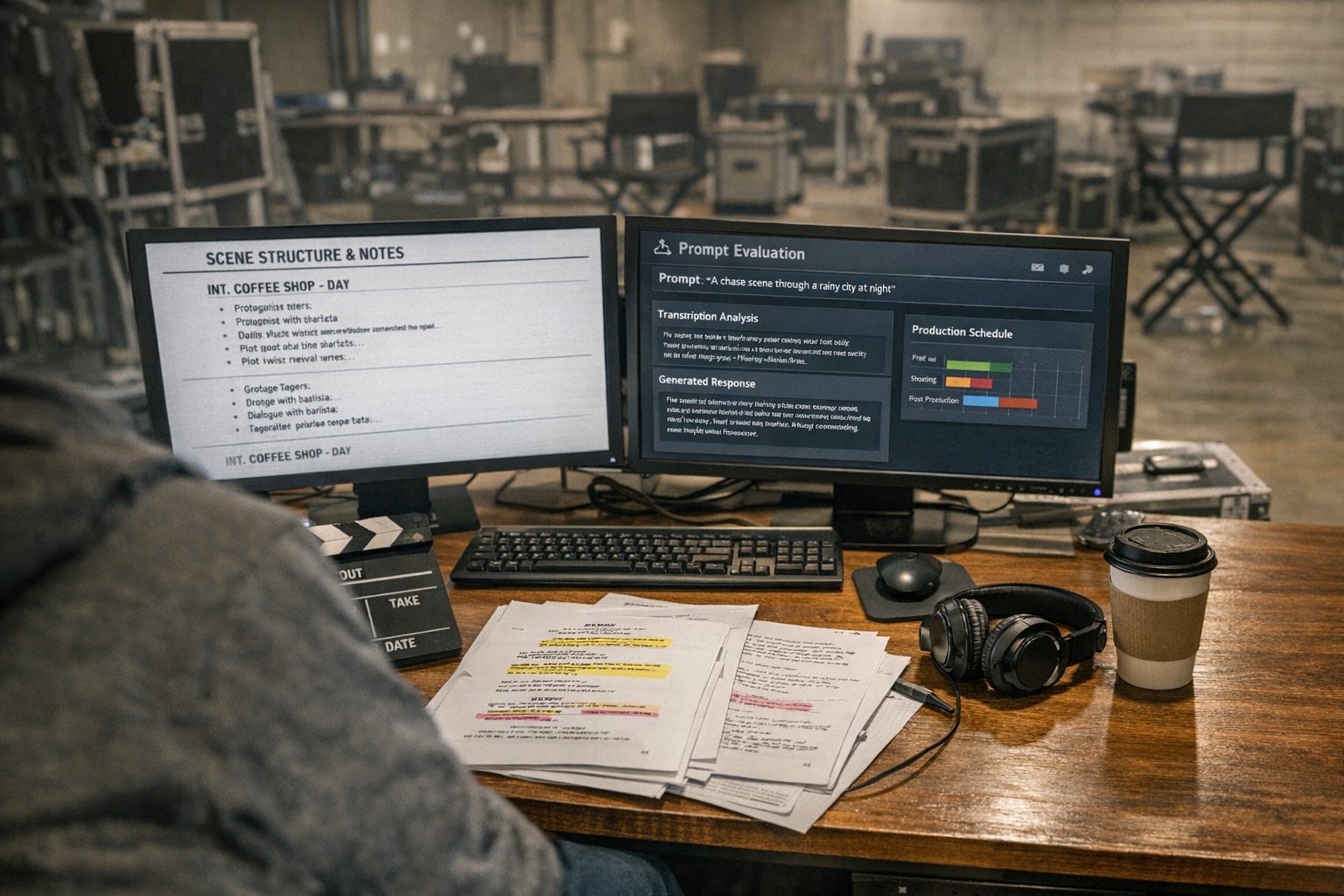
Hollywood’s long-running anxiety about artificial intelligence has taken on a more intimate and unsettling form: some of the people most likely to be displaced by the technology are now being paid to help build it.
Award-winning writers, directors, producers and documentary filmmakers have begun taking contract jobs training A.I. systems in the mechanics of creative work — shaping screenplay prompts, teaching story structure, helping models understand production planning and, in some cases, handling transcription and other workflow tasks. The pay, according to a report published this week, can range from about $12 an hour to as much as $200, a spread that reflects both the uneven nature of the work and the hierarchy of experience in Hollywood.
For many, the jobs are less a vote of confidence in the technology than a concession to a bruised labor market. After years of disruption from streaming retrenchment, industry contraction and labor strife, entertainment workers facing dry spells are turning to temporary A.I. assignments as a way to steady their income — even as some fear they are helping create tools that could eventually erode demand for their own skills.
That tension has become one of the clearest signs yet that the A.I. debate in Hollywood is no longer merely theoretical. The concern is no longer just that writers, actors and production workers may one day compete with machine-generated work. It is that some of them are already participating in the creation of those systems, converting hard-won creative judgment into training data and product feedback for technology companies.
A softer Hollywood job market
The trend is emerging against a weak employment backdrop in film and television. Federal labor data show that employment in the motion picture and sound recording industries stood at about 325,600 in May and 322,800 in June, below levels seen earlier in the year. While those figures do not capture the full volatility of freelance creative work, they underscore a broader truth across the industry: many workers are still struggling to find stable jobs.
That softness has been felt acutely among writers and producers, whose work has been squeezed by a pullback in peak-TV spending and a more cautious green-light environment. Documentary filmmakers and below-the-line workers have also faced prolonged gaps between projects. In that climate, short-term A.I. contracts can look less like an ideological choice than a practical one.
The work itself can be oddly specific. One contractor may be asked to judge whether a machine-written scene feels emotionally plausible; another to help a model understand how a shooting schedule is constructed or how a production problem would be solved on a set. Such assignments are part quality control, part imitation exercise: the systems improve by absorbing the preferences, corrections and professional instincts of the humans hired to refine them.
From abstract threat to present-tense labor issue
For years, creative workers’ warnings about A.I. centered on what might happen if studios and tech companies became able to generate scripts, mimic performances or automate planning tasks at scale. What is striking now is how directly that future is colliding with present economic need.
The result is a sharper labor-displacement story than the one that has often dominated public discussion of A.I. in the arts. It is not simply that the technology may replace some tasks. It is that a new market appears to be forming in which creative workers, during lean periods, sell pieces of their expertise to firms developing the systems that may later compete with them.
How large that market is remains unclear. It is not yet known how many entertainment workers are taking such contracts, whether the jobs are concentrated among a few companies or spread across a wider ecosystem of vendors and subcontractors, or whether the work will endure as a distinct layer of employment in the industry. There is also limited visibility into which companies ultimately benefit when trained systems are folded into production software, studio workflows or consumer-facing tools.
Unions have tried to build guardrails
The rise of these jobs comes after entertainment unions made A.I. a central issue in bargaining. The Writers Guild of America’s 2023 contract established that companies cannot require writers to use A.I. software and preserved the union’s right to challenge the use of writers’ material for A.I. training. SAG-AFTRA, meanwhile, has said its 2026 television and theatrical agreement added stronger limits on digital replicas, “synthetics” and some training-related uses.
Those protections reflect a growing recognition that A.I. in entertainment is not only about finished output — a generated script, a synthetic voice, a digital likeness — but also about inputs: scripts, footage, performances and professional know-how used to improve models. In practice, however, significant gray areas remain. Contracts can govern some employer conduct, but they may not fully settle questions about consent, compensation and ownership when expertise is extracted through temporary work arrangements or when systems are trained through layered contractor networks.
Copyright law and labor rules may eventually define some of those boundaries. But for now, many workers are navigating them one gig at a time.
Why this matters now
The development matters because it shows how quickly A.I. is moving from a speculative management tool to a lived workplace reality inside creative industries. Studios, platforms and production-adjacent companies are already experimenting with automation in areas like scheduling, development support, transcription and postproduction assistance. As those uses expand, the pressure to codify what can and cannot be automated — and on whose terms — is likely to intensify.
It also reveals a more uncomfortable truth about technological change in a precarious labor market. People who object to A.I.’s encroachment in principle may still feel compelled to participate in it in practice. For freelancers and contract workers, especially in a downturn, survival often overrides long-term misgivings.
That makes the Hollywood version of the A.I. transition especially poignant. In manufacturing or logistics, automation has long been understood as a threat to routinized labor. In entertainment, the promise of replacement cuts closer to identity: story sense, taste, emotional intelligence, aesthetic judgment and production intuition are precisely the qualities many creative workers have been told are uniquely human. Now those same qualities are being itemized, priced by the hour and fed back into machines.
Whether these jobs remain a stopgap or become a durable feature of the business will help determine more than the shape of employment in Hollywood. It may offer an early answer to a broader question confronting white-collar and creative professions alike: when A.I. systems improve by learning from human expertise, who gets paid, who gets protected and who is left training their successor?
Sources
Further reading and reporting used to add context:
- https://www.theguardian.com/technology/2026/aug/22/the-hollywood-creatives-training-ai-to-do-their-jobs
- https://www.latimes.com/business/story/2026-07-26/hollywoods-ai-hiring-is-real-inside-studios-hiring-tells-more-careful-story
- https://www.sagaftra.org/contracts-industry-resources/member-resources/artificial-intelligence
- https://www.latimes.com/entertainment-arts/business/story/2026-06-19/tool-or-or-human-replacement-how-hollywood-deals-with-ai
- https://www.cbsnews.com/amp/news/artificial-intelligence-ai-trainer-job/
- https://www.wga.org/contracts/know-your-rights/artificial-intelligence
- https://theankler.com/hollywoods-secret-ai-plan-disneys-edgy-tinker-bell-era-dga-v-wga/
- https://aidaily.wiki/2026-08-23/hollywood-creatives-ai-training/
- https://www.sagaftra.org/sites/default/files/2026-05/2026%20TV-Theatrical%20Contracts%20Summary%20of%20Tentative%20Agreement.pdf
- https://www.sagaftra.org/sag-aftra-ai-bargaining-and-policy-work-timeline
- https://www.digitaltrends.com/movies/as-hollywood-jobs-dry-up-workers-are-quietly-turning-to-ai-training-to-survive/
- https://www.sagaftra.org/sag-aftra-ai-letter-0
- https://www.forbes.com/sites/maureenkerr/2026/06/01/hollywood-studios-are-spending-on-ai-to-control-the-future-of-film/
- https://www.wga.org/uploadedfiles/contracts/2026_mba_moa.pdf
- https://www.sagaftra.org/sites/default/files/sa_documents/gapp_a.i._bills_report.pdf
- https://www.wga.org/uploadedfiles/know_your_rights/wga-letter-studios-on-ai-12-24.pdf
- https://www.sagaftra.org/sites/default/files/2025-03/Contract%20Bulletin%20-%20A.I.%20for%20TV%20Animation_0.pdf
- https://www.wgacontract.org/uploadedfiles/contracts/2026_mba_moa.pdf
- https://www.reddit.com/r/FilmIndustryLA/comments/1tb1bky/i_work_in_hollywood_everyone_who_used_to_make_tv/
- https://www.reddit.com/r/acting/comments/1tx8tde/sagaftra_members_approve_2026_tvtheatrical/
- https://arxiv.org/abs/2606.26114
- https://www.bls.gov/iag/tgs/iag512.htm
- https://www.bls.gov/news.release/archives/empsit_06052026.htm
- https://www.bls.gov/news.release/archives/empsit_06052026.pdf
- https://www.bls.gov/news.release/empsit.htm
- https://www.bls.gov/sae/notices/2026/notice-of-publication-changes-with-the-release-of-january-2026-data.htm
- https://www.bls.gov/opub/ted/2026/total-nonfarm-payroll-employment-increased-by-172000-in-may-2026.htm
- https://www.bls.gov/sae/additional-resources/list-of-published-state-and-metropolitan-area-series/california.htm
- https://www.bls.gov/news.release/archives/empsit_02112026.pdf
- https://www.bls.gov/opub/ted/2026/picture-this-a-decade-of-employment-in-the-motion-picture-and-video-industries.htm
- https://www.bls.gov/opub/btn/volume-7/pdf/so-you-want-to-be-in-pictures.pdf
- https://www.bls.gov/eag/eag.ca.htm
- https://www.bls.gov/news.release/empsit.htm?hl=en-GB
- https://www.bls.gov/opub/ted/2026/little-change-in-nonfarm-payroll-employment-in-july-2026.htm
- https://fred.stlouisfed.org/series/CES5051200001
- https://www.dol.gov/newsroom/releases/osec/osec20260605
- https://www.bls.gov/news.release/archives/empsit_03062026.pdf
- https://scag.ca.gov/sites/default/files/2025-12/26-426-ES-0357-RegionalEconomicAnalysis2025Publication_FINAL2.pdf
- https://www.motionpictures.org/wp-content/uploads/2026/02/MPA_Economic_Contribution_US_Infographic_020326.pdf
- https://about.netflix.com/en/news/netflix-gets-closer-closes-2026-us-upfront
- https://www.netflix.com/tudum/articles/whats-leaving-netflix?pubDate=20251223
- https://www.engadget.com/2217157/netflix-says-it-s-already-used-ai-in-roughly-300-titles-this-year/
- https://about.netflix.com/en/newsroom
- https://www.netflix.com/tudum/features/new-summer-movies-on-netflix-2026
- https://www.ibc.org/artificial-intelligence/news/netflix-uses-genai-on-300-titles-in-2026/22794
- https://media.netflix.com/en/
- https://about.netflix.com/en/newsroom?search=0…………………………………………………………………………………………………………………………………………………………………………………………………………………………………………………………………………………………………………………………………………………………………………………………………………………………………………………………………………………………..
- https://www.netflix.com/tudum/articles/new-on-netflix?pubDate=20250502
- https://www.travelerstoday.com/articles/60476/20260719/netflix-confirms-ai-300-shows-what-subscribers-are-actually-watching.htm
- https://www.plataformamedia.com/en/2026/07/17/netflix-ai-used-300-productions-investor-letter/
- https://nextnow.io/story/netflix-generative-ai-roughly-300-titles-2026/
- https://www.reddit.com/r/antiai/comments/1vi7mhd/netflix_says_it_has_used_ai_in_over_300_titles/
- https://www.reddit.com/r/technology/comments/1uyr0eh/netflix_brags_that_ai_tools_were_used_in_around/
- https://www.reddit.com/r/DefendingAI/comments/1vfv2yj/first_aigenerated_feature_film_in_us_to_hit/
- https://www.reddit.com/r/GameFeed/comments/1uyhfkg/netflix_brags_that_ai_tools_were_used_in_around/
- https://www.reddit.com/r/DefendingAIArt/comments/1uyidkk/netflix_reveals_that_they_used_generative_ai_in/
- https://www.reddit.com/r/aiwars/comments/1uyidga/netflix_reveals_that_they_used_generative_ai_in/
- https://www.reddit.com/r/movies/comments/1uyg881/about_300_netflix_programs_used_generative_ai/
- https://www.reddit.com/r/television/comments/1uyf1uo/about_300_netflix_programs_used_generative_ai/
- https://d18rn0p25nwr6d.cloudfront.net/CIK-0001065280/5c943b10-61c2-4e9a-a175-f61e2391fa78.pdf
- https://www.reddit.com/r/antiai/comments/1uyid94/netflix_reveals_that_they_used_generative_ai_in/
- https://www.reddit.com/r/entertainment/comments/1uyspaw/about_300_netflix_titles_used_generative_ai_this/
- https://www.netflixinvestor.com/files/doc_financials/quarterly_reports/2019/q3/FINAL-Q3-19-Shareholder-Letter.pdf
- https://www.netflixinvestor.com/files/doc_financials/quarterly_reports/2019/q2/Q2-19-Shareholder-Letter-FINAL.pdf
- https://www.netflixinvestor.com/files/doc_news/archive/c356363f-19cc-445d-b94b-1473b6ab07b5.pdf
- https://www.netflixinvestor.com/files/doc_news/archive/c2ff80aa-7ec9-43ad-9394-06f11e45516f.pdf
- ‘Digging the grave of my profession’: the Hollywood creatives training AI to do their jobs | Technology | The Guardian
- Hollywood fights AI in public while quietly building it into movies – Los Angeles Times
- Motion Picture and Sound Recording Industries: NAICS 512 : U.S. Bureau of Labor Statistics







Leave a Reply