
From Experiment to Release Process
The latest wave of coding agents is beginning to look less like a parlor trick and more like a new layer in everyday software work.
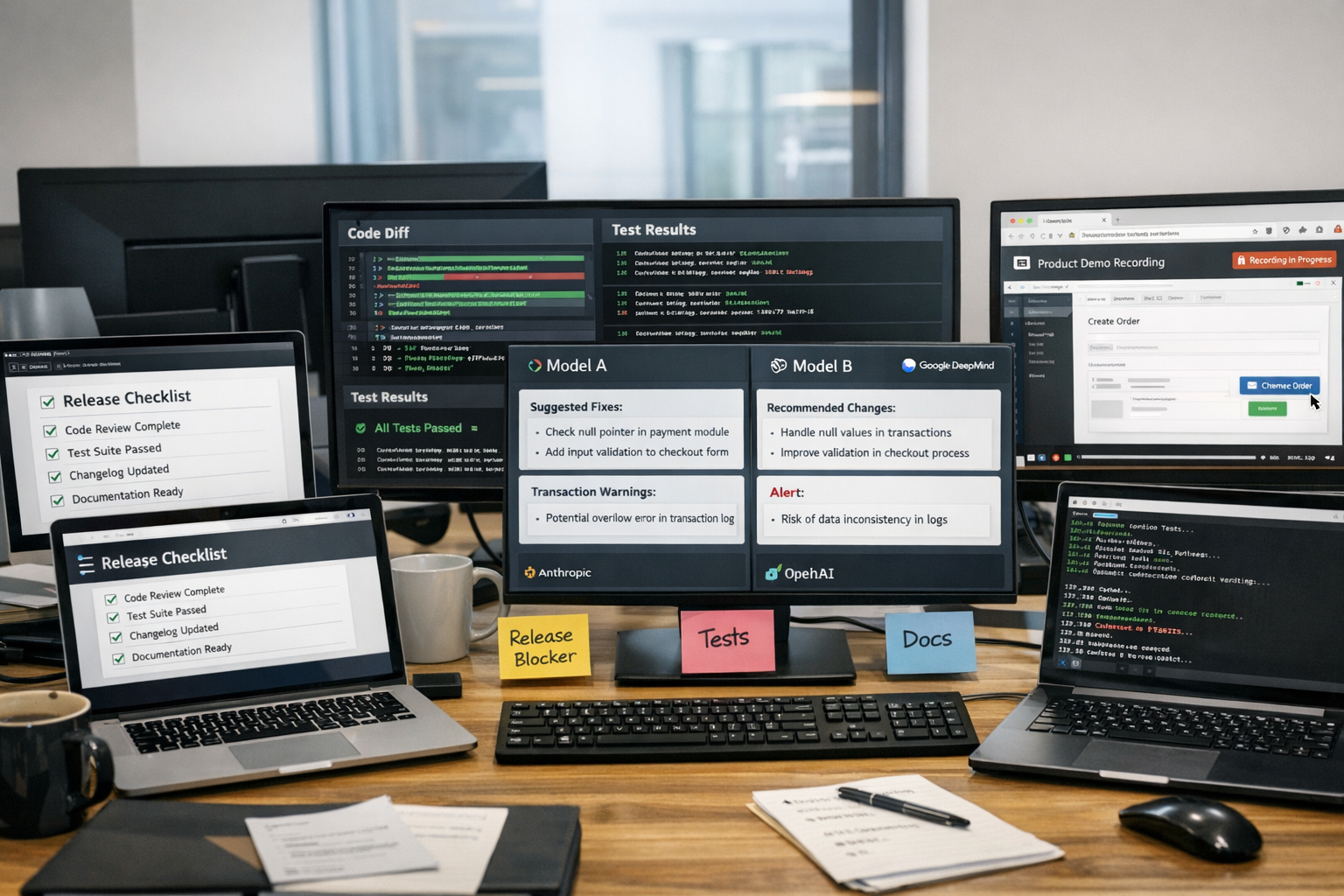
Over the past week, developers publicly described using large language models not merely to draft snippets of code, but to help run parts of the engineering cycle itself: identifying release blockers, writing tests, reviewing changelogs, generating documentation, creating demos of finished features and, in one striking example, helping port a 2003 PC strategy game to native iOS in a matter of hours.
The change is subtle but important. For much of the past two years, AI coding tools were judged by whether they could autocomplete functions or build small apps from prompts. What is emerging now is a more consequential use case: agents that sit inside the workflow of software maintenance and shipping, where the challenge is less about producing code than about navigating complexity, edge cases and the messy coordination around a release.
Simon Willison, the independent developer and open-source maintainer, offered one of the clearest examples. In pushing his Python library `sqlite-utils` toward a 4.0 release, he said he used Anthropic’s Claude Fable 5 and OpenAI’s GPT-5.5 to review pending changes, surface breaking issues and help refine transaction semantics before a stable release. Rather than accelerating a greenfield build, the models were applied to one of software engineering’s least glamorous tasks: preventing subtle bugs from escaping into production.
Among the issues the models helped surface were transaction-handling problems that could have led to writes appearing successful on a live connection but then being silently rolled back when the database closed. Willison described one flaw as a release blocker involving data loss risk. He said the review process spanned dozens of prompts and commits across roughly 30 files, with the models contributing to code changes, documentation and release notes.
That kind of work — auditing behavior, reconciling documentation with implementation, and checking whether a “fix later” decision might actually force a major version bump — is exactly where proponents of agentic coding now say the technology is maturing.
Agents Enter the Engineering Loop
Willison’s account also illustrated how developers are starting to structure these systems less like chatbots and more like collaborators with bounded jobs.
He said he had one model review another model’s work, a practice that would have seemed excessive not long ago but is increasingly common among heavy users. In his case, a final pass by GPT-5.5 found two transaction-related problems worth investigating after Claude-assisted changes had already been made. That cross-model review then fed back into another repair cycle.
He also released a prototype project, `llm-coding-agent`, intended as a lightweight coding agent framework. The tool can read and edit files, search code, execute commands and expose those actions through a Python API and command line interface. The point was not simply to build yet another agent, but to show how quickly a developer can now spin up custom harnesses for model-driven software work.
In another project, Willison introduced a new video-recording feature for his `shot-scraper` tool that lets an agent script and record a product demo using Playwright. The feature accepts a storyboard file describing browser actions, then produces a video showing a web app in use. He has argued that demos are becoming an important part of agentic workflows because they provide a kind of proof that generated code actually works.
That idea — that an agent should not only write code but also demonstrate it — reflects a broader shift in how these systems are being evaluated. The question is no longer just whether the code compiles. It is whether the agent can participate in a chain of evidence: build, test, explain, document and show.
A Faster Pace, and New Kinds of Ambition
The ambition of those workflows is expanding quickly.
The Decoder reported this week that a Google DeepMind developer used Claude Code and Fable 5 to port “Command & Conquer: Generals Zero Hour” to native iPhone and iPad builds, with the first version reportedly produced in about 40 minutes and the overall port completed in a few hours. If such timelines hold up under scrutiny, they suggest that agents may be especially useful in software adaptation work: taking a large existing code base, mapping it onto a new platform and grinding through repetitive but intricate implementation tasks.
Even if these examples remain anecdotal and often rely on unusually skilled users, they point to an important development. The most compelling cases are no longer toy websites generated from scratch. They are maintenance jobs, ports, release candidates and tooling improvements — the kinds of tasks that consume real engineering time.
That matters because software organizations rarely bottleneck on blank-page coding alone. They bottleneck on review, validation, migration and integration.
The Friction Beneath the Hype
But the same week’s examples also underscored how fragile these workflows can be.
Armin Ronacher, a prominent software developer, described a problem he encountered while working on Pi, a coding harness of his own. Newer Claude-family models, he wrote, were sometimes calling Pi’s edit tool with invented fields that did not match the expected schema. The edits themselves were often sensible; the tool arguments were not. Pi rejected the calls and asked the model to try again.
That failure is revealing. The newest models may be stronger in general, yet worse at interacting with some third-party tools. Ronacher’s theory is that they have been trained to use first-party editing tools more effectively — particularly tools resembling those built into Claude Code — and that this optimization does not transfer cleanly to other environments.
If that is right, it raises a broader standards problem for the industry. The dream of a universal agent protocol, in which any model can reliably operate any coding harness, may be giving way to a messier reality: vendor-specific tool habits, compatibility quirks and the need for translation layers. A top model may be highly capable, but only if the surrounding toolchain looks enough like the one it was trained to expect.
This is the kind of problem that tends to emerge only after a technology leaves the demo stage. Once developers begin plugging agents into real tools, hidden assumptions become expensive.
Prompting Gets Smaller, Judgment Gets Bigger
As the systems improve, some experienced users say the bottleneck is shifting away from raw model capability and toward how humans frame tasks.
Recent advice from Anthropic staff around Fable-era workflows has emphasized shorter, less prescriptive prompting and more reliance on context and model judgment. Willison has echoed that approach, saying he has had better results asking the model to decide for itself when to write tests and when to delegate simpler work to cheaper subagents.
He recently instructed Claude Code to choose lower-power models for implementation-heavy tasks while reserving the most expensive reasoning model for higher-level review and synthesis. The practice reflects a growing consensus among advanced users that one of the best ways to use a powerful coding agent is not to micromanage it, but to shape the environment, define guardrails and let it decide how to break work apart.
The Decoder similarly reported on prompting advice from Anthropic developer Thariq Shihipar, who argued that with Fable 5 the limiting factor is often not the model’s intelligence but the human user’s blind spots. The implication is that effective prompting increasingly means exposing what the user may have failed to specify — hidden assumptions, edge cases, version constraints, undocumented expectations — before the agent begins implementation.
That marks a notable change from the earlier era of prompt engineering, which often focused on crafting ever more elaborate instructions. Now, for some of the most capable coding systems, the better tactic may be strategic restraint.
The Cost Question Arrives
If there is a sobering note in the new enthusiasm, it is economics.
Willison estimated that one Claude-assisted `sqlite-utils` review and refactor session would have cost about $149.25 at unsubsidized rates. That figure has become more significant as temporary pricing conditions shift and developers contemplate what heavy agent usage might cost without bundled allowances or promotional tiers.
Cost pressure is already producing improvisation. The Decoder reported on an open-source tool called `pxpipe`, which converts long text prompts into PNG images to exploit image pricing rules. Its creator said the technique reduced some Claude Code and Fable 5 session costs by roughly 59 to 70 percent, though with trade-offs in speed and accuracy.
That sort of workaround is a sign of both demand and distortion. When developers start encoding prompt context as images to save money, it suggests the tools are useful enough to justify awkward hacks — and expensive enough to force them.
It also hints at a looming divide. If these systems remain costly to run at scale, the most effective agentic workflows may stay concentrated among well-funded companies, independent developers willing to experiment aggressively, and power users who know how to squeeze efficiency from multiple models and custom tools.
Why This Matters Now
The significance of this moment is not that AI can write more code than before. It is that developers are beginning to trust agents with more consequential parts of engineering work while simultaneously discovering the practical limits of that trust.
The models are now good enough to catch release-blocking bugs, author framework code, produce documentation and generate demos. They are also unreliable enough to misuse tools, rack up triple-digit session costs and behave differently depending on which harness surrounds them.
That tension is likely to define the next phase of AI coding.
For the industry, the open questions are becoming clearer. Can these workflows extend beyond expert early adopters? Will teams converge on common tool interfaces, or fragment into ecosystems optimized for specific vendors? And if the economics harden, will coding agents become an everyday utility or a premium acceleration layer used selectively for high-leverage work?
For now, the most telling sign of progress may be that the conversation has moved beyond whether coding agents are real. The harder question, and the more durable one, is how they fit into the ordinary frictions of software development: release timing, compatibility, cost control, review discipline and the stubborn unpredictability of real systems.
Sources
Further reading and reporting used to add context:
- https://the-decoder.com/open-source-tool-pxpipe-hides-text-in-pngs-to-cut-claude-code-and-fable-5-token-costs-up-to-70/
- https://the-decoder.com/artificial-intelligence-news/ai-practice/
- https://the-decoder.com/anthropic-says-it-cut-80-percent-of-claude-codes-system-prompt-because-fable-5-models-want-a-smaller-system-prompt/
- https://the-decoder.com/anthropics-fable-5-is-back-worldwide-after-a-two-week-government-ban-over-a-jailbreak/
- https://simonwillison.net/2026/Jul/5/sqlite-utils-fable/
- https://simonwillison.net/2026/Jul/5/
- https://the-decoder.com/anthropics-claude-fable-5-costs-twice-as-much-for-5-7-percent-more-performance/
- https://simonwillison.net/2026/jul/5/sqlite-utils/
- https://the-decoder.com/anthropic-releases-claude-fable-5-and-mythos-5-with-major-gains-in-coding-and-science/
- https://the-decoder.com/claude-fable-5-the-first-mythos-model-is-powerful-expensive-and-heavily-filtered/
- https://the-decoder.com/anthropics-new-claude-sonnet-5-closes-the-gap-to-the-pricier-opus-model-series/
- https://the-decoder.com/claude-code-sessions-now-accessible-from-any-device/
- https://the-decoder.com/wp-content/uploads/2026/06/26_O_869_26_begl_Abschrift_Urteil_v_28_05_2026_Geschwarzt_Geschwarzt_Geschwarzt.pdf
- https://simonwillison.net/2026/jul/2/llm-coding-agent/
- https://feeds.simonwillison.net/2026/Jun/30/shot-scraper-video/
- https://simonwillison.net/2026/Jul/3/judgement/
- https://feeds.simonwillison.net/elsewhere/release/
- https://simonwillison.net/entries/?page=1
- https://simonwillison.net/tags/agentic-engineering/
- https://simonwillison.net/2026/jul/3/josh-w-comeau/
- https://simonwillison.net/tags/python/
- https://simonwillison.net/2026/Jul/
- https://simonwillison.net/2026/Jun/30/
- https://simonwillison.net/tags/shot-scraper/
- https://lucumr.pocoo.org/2026/7/4/better-models-worse-tools/
- https://the-decoder.com/anthropic-developer-shares-prompting-tips-for-fable-5-that-focus-on-finding-your-own-blind-spots-first/
- https://the-decoder.com/artificial-intelligence-news/short-news/
- https://the-decoder.com/
- https://the-decoder.com/artificial-intelligence-news/ai-research/
- https://lucumr.pocoo.org/
- https://the-decoder.com/author/matthias-bastian/
- https://the-decoder.com/openai-report-suggests-gpt%E2%80%915-is-starting-to-ease-scientists-daily-workloads/
- https://the-decoder.com/yann-lecun-wants-to-replace-the-agi-concept-with-superhuman-adaptable-intelligence/
- https://the-decoder.com/anthropics-new-benchmark-claims-claude-can-match-human-experts-in-bioinformatics/
- sqlite-utils 4.0rc2, mostly written by Claude Fable
- Anthropic says it cut 80 percent of Claude Code's system prompt because Fable 5 models "want a smaller system prompt"
- Better Models: Worse Tools | Armin Ronacher's Thoughts and Writings




Leave a Reply