
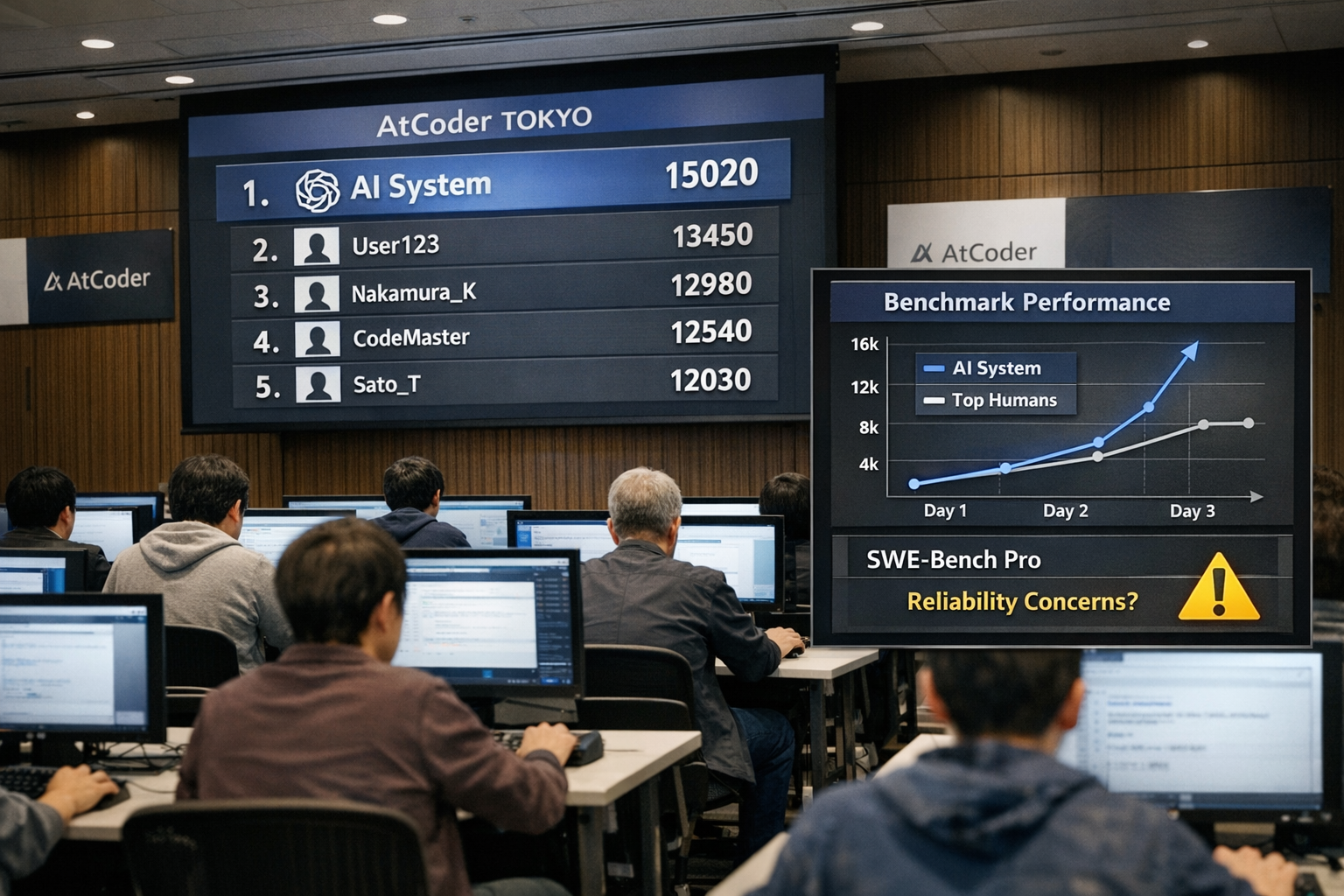
OpenAI is trying to reshape the conversation about how artificial intelligence should be judged at coding — even as it collects a new, high-profile victory of its own.
In back-to-back developments this week, the company argued that a prominent software-engineering benchmark, SWE-Bench Pro, has become too flawed to serve as a trustworthy yardstick for frontier systems. Then, a day later, an OpenAI agent was reported to have outperformed every human participant in an exhibition match at the AtCoder World Tour Finals 2026, one of the most respected competitive-programming events.
Taken together, the moves amount to something more than coincidence. OpenAI is pressing a dual case: that many of the numbers used to compare coding models are noisier than they appear, and that its systems can nevertheless demonstrate real progress in a live, public setting where speed and correctness matter.
A benchmark under attack
On July 8, OpenAI published an analysis contending that SWE-Bench Pro — a benchmark widely used to assess whether models can fix real software issues — is no longer a reliable measure of top-tier coding ability. The company said its audit found that roughly 30 percent of the benchmark’s tasks were broken and formally withdrew its earlier recommendation that researchers adopt it.
The critique went beyond a narrow methodological dispute. OpenAI argued that the benchmark suffers from several forms of task-design failure, including overly strict tests, underspecified prompts, low-coverage tests and misleading instructions. In effect, the company said, models may be penalized or rewarded for quirks in the benchmark rather than for genuine programming skill.
The argument lands at a sensitive moment for the field. Coding benchmarks have become a central part of how labs market new models and how outsiders try to compare them. A single percentage-point gain on a respected test can help define industry narratives, influence buyers and shape investor expectations.
OpenAI’s case is that those headline numbers deserve more skepticism, especially now that leading systems are performing far better than they did only months ago. The company said pass rates on the public SWE-Bench Pro split had climbed from 23.3 percent to 80.3 percent in eight months, a jump it presented as evidence that benchmark weaknesses matter more as models approach the limits of what the test can meaningfully distinguish.
This is not the first time OpenAI has challenged prevailing evaluations. The new paper follows an earlier company critique of SWE-Bench Verified, suggesting a broader push to question whether existing coding tests can keep pace with rapid model improvements.
A public win in Tokyo
If the benchmark critique was an argument about measurement, the AtCoder result offered a different kind of evidence: a live contest.
At the AtCoder World Tour Finals 2026 Algorithm event on July 9, AtCoder hosted an official Human vs. AI exhibition match featuring an OpenAI agent. Outside coverage and community accounts said the system finished ahead of all human contestants, solving all five problems in the Algorithm Division. Observers described two of those problems as especially difficult.
AtCoder itself had framed the exhibition as a serious test, even creating a “Humanity Prevails Award” for any human competitor who could beat the OpenAI system. Last year, an OpenAI system was reported to have finished second in AtCoder’s heuristic finals, so a first-place finish in this year’s exhibition would mark a notable step forward.
Some details of the final standings remain less than perfectly transparent to the broader public, because the official exhibition results page was not fully accessible without login. But the event itself was official, and the broad account of an OpenAI victory was widely circulated in reporting and by competition followers.
Why this matters now
The pairing of these developments is what gives them force.
For years, the A.I. industry has relied heavily on benchmarks as shorthand for progress. Yet benchmarks are static artifacts in a fast-moving field: once models improve, defects that were once tolerable can become decisive. A flawed task set can distort rankings, conceal weaknesses or exaggerate small differences between systems.
OpenAI is effectively arguing that coding evaluation has entered that phase. If it is right that nearly a third of SWE-Bench Pro tasks are compromised, then comparisons among leading models on that benchmark may be less meaningful than many claims suggest.
At the same time, contest performance offers a different kind of proof point. Competitive programming is not the same as day-to-day software development; writing production code involves collaboration, maintenance, product constraints and long-horizon reasoning that a timed contest does not capture. But contests do test something important: the ability to understand difficult problems quickly, devise correct algorithms under pressure and produce working code with little room for error.
That helps explain why the AtCoder result, if it holds as reported, is likely to resonate beyond programming circles. It suggests that top systems are not only getting better at benchmarked repository repair tasks, but also at harder, time-constrained algorithmic challenges that many engineers view as a purer test of technical reasoning.
The larger debate over coding A.I.
OpenAI’s position also leaves an unresolved question: if existing benchmarks are unreliable, what should replace them?
So far, the company has made a strong case that benchmark curation is fragile. It has been less clear about what common standard the field should now adopt. Any successor would need broad acceptance from researchers, independent evaluators and rival labs — a difficult task in a market where performance claims are increasingly strategic.
That tension is likely to grow as coding models become more commercially important. Companies are already selling A.I. systems as software copilots, bug-fixers and autonomous agents for engineering teams. The higher the stakes, the more pressure there will be to prove that a model’s performance is not just impressive on paper but dependable in real work.
This week’s two developments place OpenAI at the center of that debate. By attacking a benchmark while benefiting from a dramatic contest result, the company is advancing a narrative that favors both skepticism and spectacle: doubt the leaderboard, but look at what our system did under the lights.
Whether the wider field accepts that framing may depend on what comes next — not just another benchmark audit or another contest win, but a more durable answer to a problem that is becoming harder to ignore: how to measure coding intelligence when the old tests no longer seem built for the systems now taking them.
Sources
Further reading and reporting used to add context:
- https://openai.com/index/why-we-no-longer-evaluate-swe-bench-verified/
- https://openai.com/news/?author=kevin-weil
- https://atcoder.jp/contests/awtf2026algo
- https://arxiv.org/abs/2509.16941
- https://codeforces.com/blog/entry/155048
- https://www.linkedin.com/posts/openai-devs_why-swe-bench-verified-no-longer-measures-activity-7431767914006937600-lfo4
- https://codeforces.com/blog/entry/154869
- https://aiweekly.co/node/5874
- https://atcoder.jp/?lang=en
- https://info.atcoder.jp/more/contents/awtf
- https://openai.com/de-DE/index/why-we-no-longer-evaluate-swe-bench-verified/
- https://openai.com/fr-FR/index/why-we-no-longer-evaluate-swe-bench-verified/
- https://www.techmeme.com/260708/p41
- https://www.reddit.com/r/accelerate/comments/1urdf56/we_audited_swebench_pro_one_of_the_most_widely/
- https://arxiv.org/abs/2606.25530
- https://arxiv.org/abs/2310.06770
- https://arxiv.org/abs/2603.26130
- https://openreview.net/pdf/80c9d255234f96fafdf293e1a5184150ec8045d3.pdf
- https://www.reddit.com/r/accelerate/comments/1toif63/on_swebench_pro_685_of_gpt_55s_failures_were/
- https://www.reddit.com/r/singularity/comments/1urlaam/superhuman_competitive_programming_ai_is_here/
- https://www.reddit.com/r/ArtificialInteligence/comments/1tonnwa/on_swebench_pro_685_of_gpt_55s_failures_were/
- https://openreview.net/pdf?id=9R2iUHhVfr
- https://www.pcgamer.com/software/ai/openais-performance-charts-in-the-gpt-5-launch-video-are-such-a-mess-you-have-to-think-gpt-5-itself-probably-made-them-and-the-companys-attempted-fixes-raise-even-more-questions/
- https://www.tomshardware.com/tech-industry/artificial-intelligence/polish-programmer-beats-openais-custom-ai-in-10-hour-marathon-wins-world-coding-championship-possibly-the-last-human-winner
- https://www.pcgamer.com/software/ai/humanity-has-prevailed-for-now-says-former-openai-employee-admitting-hes-barely-alive-after-beating-one-of-its-ai-models-in-a-coding-world-championship-fight/
- https://atcoder.jp/posts/
- https://info.atcoder.jp/awtf2026-algorithm-en
- https://atcoder.jp/
- https://atcoder.jp/posts/1394?lang=en
- https://codeforces.com/
- https://atcoder.jp/posts/1388
- https://info.atcoder.jp/entry/worldtourfinals2025algorithm
- https://codeforces.com/stream/1019
- https://atcoder.jp/contests/?lang=en
- https://www.reddit.com/r/mlscaling/comments/1urkkza/unreleased_openai_model_wins_awtf_2026/
- https://www.reddit.com/r/accelerate/comments/1uraapv/atcoder_wtf_2026_algorithm_livestream/
- https://www.reddit.com/r/singularity/comments/1urksn4/gg_humanityawtf_algorithm_final_result/
- https://arxiv.org/abs/2505.04143
- https://www.reddit.com/r/AIGuild/comments/1m1tbuz
- https://www.reddit.com/r/accelerate/comments/1up8ldr/humanity_vs_openai_round_2_in_two_days/
- https://en.wikipedia.org/wiki/International_Collegiate_Programming_Contest
- https://codeforces.com/top?f0a28=1&locale=en&mobile=true
- https://atcoder.jp/home?lang=ja
- https://search.yahoo.co.jp/realtime/search?btid=MjAxMjUzMDAyNzIyMTY2NDExMg%3D%3D&ifr=tp_bz&p=AtCoder&rkf=1
- https://codeforces.com/top?mobile=true
- https://www.reddit.com/r/accelerate/comments/1mnlggg
- https://www.reddit.com/r/singularity/comments/1uqrbql/humanity_has_not_prevailed_at_the_awtf_heuristics/
- https://www.reddit.com/r/codeforces/comments/1unds72/atcoder_beginner_contest_465_today/
- https://www.reddit.com/r/accelerate/comments/1uq1zjw/openai_takes_massive_lead_in_coding_contest_it/
- https://www.reddit.com/r/ChatGPT/comments/1m6zmxy
- https://the-decoder.com/an-openai-ai-model-finished-second-in-the-atcoder-heuristics-world-finals/
- https://the-decoder.com/openai-outperforms-humans-and-google-at-the-worlds-top-collegiate-programming-contest/
- https://the-decoder.com/sakana-ais-ale-ai-agent-cracks-the-top-21-among-1000-code-experts/
- https://the-decoder.com/gpt-5-6-sol-cheats-on-software-tests-more-than-any-model-before-it/
- https://the-decoder.com/openais-ai-system-wins-a-gold-medal-level-score-at-the-international-olympiad-in-informatics-2025/
- https://the-decoder.com/openai-claims-a-breakthrough-in-llm-reasoning-on-complex-math-problems/
- https://the-decoder.com/chatbot-arena-openai-o1-preview-and-o1-mini-beat-the-competition/
- https://the-decoder.com/openai-unveils-gpt-5-5-claims-a-new-class-of-intelligence-at-double-the-api-price/
- https://the-decoder.com/openai-ceo-says-merging-llm-scaling-and-reasoning-may-bring-new-scientific-knowledge/
- https://the-decoder.com/sinas-open-model-vibethinker-3b-aims-to-show-reasoning-compresses-well-but-factual-knowledge-doesnt/
- https://the-decoder.com/alphacode-2-is-the-hidden-champion-of-googles-gemini-project/
- https://the-decoder.com/gpt-4s-dominance-lasted-a-year-while-todays-top-models-barely-survive-seven-weeks-at-the-top/
- https://the-decoder.com/wp-content/uploads/2024/08/openai_sb1047-letter.pdf
- https://the-decoder.com/wp-content/uploads/2025/07/IMO_2025_GDM-Proofs.pdf
- https://the-decoder.com/wp-content/uploads/2024/08/whistleblower-sb1047-letter.pdf
- https://atcoder.jp/posts/awtf2026algo_jp
- https://codeforces.com/top?f0a28=3&locale=en
- https://info.atcoder.jp/awtf2026-algorithm-ja
- https://chokudai.hatenablog.com/entry/2026/07/04/235716
- https://www.algo-artis.com/news/260703/
- https://www.reddit.com/r/AIGuild/comments/1sh593i/ai_cracks_the_code_openai_solves_five_erd%C5%91s_math/
- https://www.reddit.com/r/OpenAI/comments/1u4l1is/in_one_year_ai_went_from_being_able_to_solve_none/
- Separating signal from noise in coding evaluations | OpenAI










Leave a Reply