
OpenAI Pushes ChatGPT Further Into Office Work
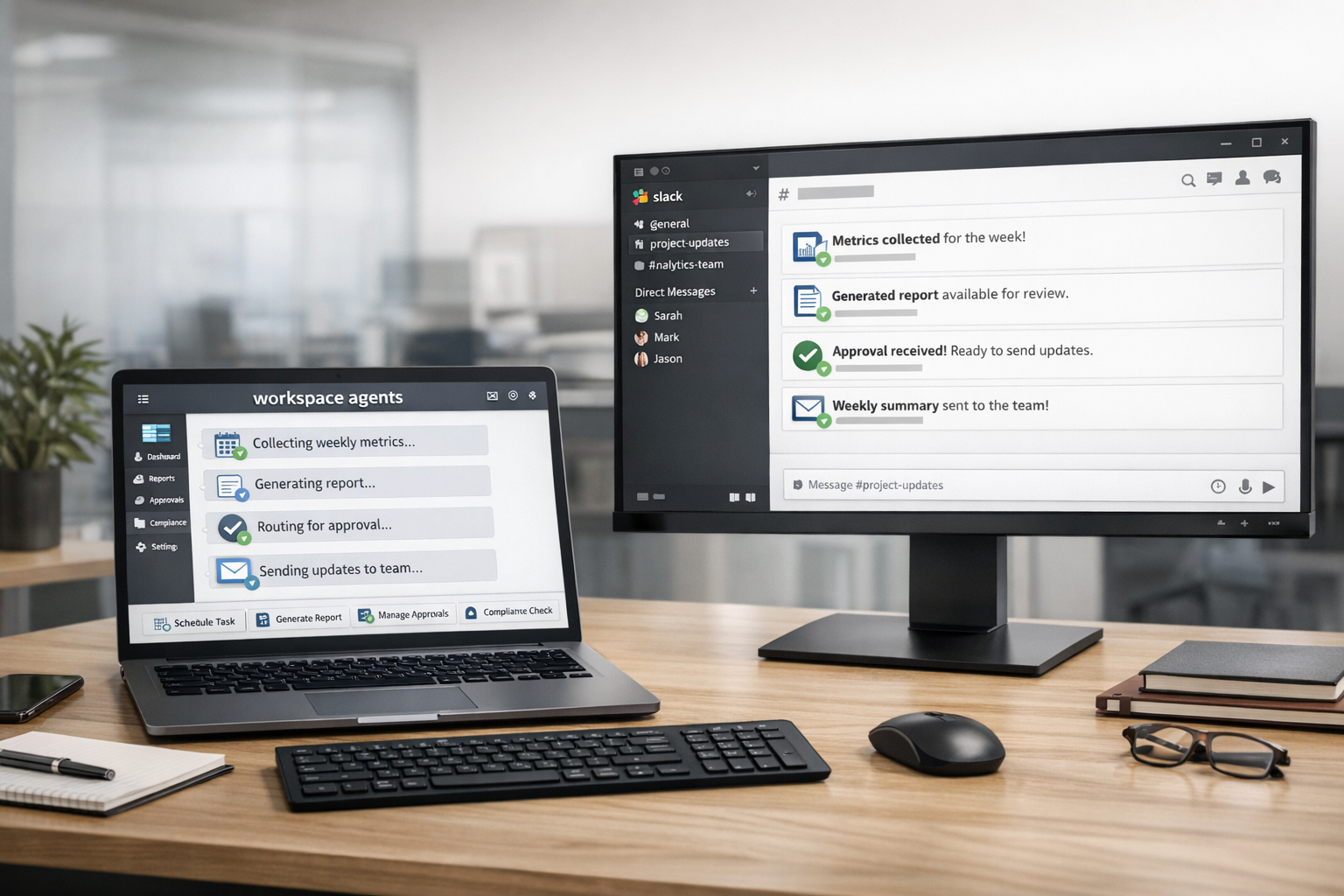
OpenAI on Tuesday introduced “workspace agents” in ChatGPT, a new feature aimed at moving the company’s flagship product beyond question-and-answer exchanges and into the daily machinery of office work.
The feature, released as a research preview, allows companies to create Codex-powered agents that can carry out multi-step tasks across workplace tools, continue running in the cloud after a user logs off, and operate inside both ChatGPT and Slack. OpenAI said the rollout would begin for customers on ChatGPT Business, Enterprise, Edu and Teachers plans, though access for Business and Enterprise customers would arrive gradually over the coming weeks.
For now, the company is offering the feature free through May 6, after which it plans to shift to credit-based pricing.
The launch marks one of OpenAI’s clearest attempts yet to turn ChatGPT into something more like a shared automation layer for teams — a system that does not simply answer prompts, but helps route requests, generate reports, move information between systems and complete routine work with limited human supervision.
From Custom GPTs to Team Workflows
OpenAI is presenting workspace agents as the next step beyond custom GPTs, the user-configurable chatbots that businesses and individuals have used to package instructions, files and tools around specialized tasks.
Unlike those earlier creations, workspace agents are designed for collaborative, repeatable business processes. OpenAI has described use cases including software-request triage, product-feedback routing, weekly metrics reporting, sales lead outreach and accounting close processes — jobs that often require pulling information from multiple systems, applying a series of rules and handing work off across teams.
The broader ambition is evident in the design. The agents can use files, code, apps and memory; they can be scheduled; and they can ask for approval before taking sensitive actions. OpenAI has also built in administrative controls, analytics and visibility through its Compliance API, features meant to reassure information-technology departments that the agents can be governed rather than simply unleashed.
That matters because many companies have experimented with ChatGPT at the edges of work — drafting emails, summarizing meetings, brainstorming code — but have remained cautious about allowing AI systems to act inside critical workflows. By emphasizing approvals, controls and auditability, OpenAI is trying to address one of the central barriers to broader enterprise adoption: trust.
A Bid to Make AI More Useful When No One Is Watching
The introduction of cloud-running agents reflects a larger shift in the artificial-intelligence industry, away from reactive chat interfaces and toward software that can persist, monitor and execute tasks on a user’s behalf.
In practical terms, that means an employee could ask an agent to gather weekly performance data, assemble it into a report, send a draft to the right people and wait for approval before distributing it — all without remaining in an active chat window. For companies, the appeal is obvious: fewer repetitive tasks handled manually, and a greater chance that AI becomes embedded in routine operations rather than confined to isolated experiments.
Outside coverage of the release has described it in similar terms, as a step that turns ChatGPT from a chatbot into more of a team automation platform.
OpenAI’s language around the product underscores the same point. These are not being framed merely as assistants for individuals, but as shared tools for departments and organizations.
The Technical Push Behind the Product
The product announcement arrives alongside technical updates that suggest OpenAI is trying to build the infrastructure needed for more ambitious agent behavior.
In a separate engineering disclosure, the company said support for WebSockets in its Responses API had reduced end-to-end latency in the “agent loop” by roughly 40 percent. The update, which uses connection-scoped caching to cut repeated overhead, is intended to make agentic workflows faster and smoother, especially for Codex-style systems that must repeatedly reason, call tools and respond in sequence.
That kind of improvement may sound esoteric, but it is crucial to whether workplace agents feel practical. An agent that pauses awkwardly between steps or struggles to maintain context across connected tools is less likely to be trusted with real business tasks. Lower latency and more efficient orchestration help make the jump from AI demo to usable work product.
The timing also fits into OpenAI’s broader push around Codex this month. The company has been expanding Codex beyond coding tasks into browser-based work, memory, ongoing automations and actions across tools, while arguing that enterprise use is spreading beyond engineering teams.
Opportunities, and Limits
Even so, important questions remain about how widely the new agents will actually be used.
The feature is off by default in eligible workspaces, meaning enterprises will have to make an affirmative decision to enable it. That alone could slow adoption, especially in large organizations where new automation tools typically require security, procurement and legal review. OpenAI has also said workspace agents are not available at launch for Enterprise workspaces using enterprise key management, or EKM, a limitation that could affect some of its most security-conscious customers.
There are financial questions as well. The company has not yet shown what usage will cost under its credit-based system after the initial free period ends, and pricing can be decisive in determining whether a tool becomes a broad operational platform or remains confined to narrow pilot projects.
There is also the question of autonomy. While OpenAI has stressed approval gates and connector controls, many companies may still hesitate to let AI systems take action inside sensitive systems, particularly in finance, customer communications or internal operations. In practice, the degree of freedom businesses permit may determine whether workspace agents become transformative or merely a more polished interface for partially automated tasks.
Why This Matters Now
The release comes at a moment when generative AI companies are under pressure to prove that their tools can do more than produce impressive text on demand. Investors, software buyers and corporate executives increasingly want systems that can save labor, integrate with existing tools and fit into durable business processes.
OpenAI’s answer is to make ChatGPT less like a conversational destination and more like an operating layer for work.
That shift could have consequences well beyond OpenAI. If workplace agents gain traction, they may accelerate competition among major technology companies to own the interface through which office software is not just accessed, but coordinated. The battle would no longer be simply over who has the smartest chatbot. It would be over whose AI gets entrusted to carry out the work itself.
For now, the feature remains an early preview, with migration tools from custom GPTs still to come and wider support beyond ChatGPT and Slack not yet in place. But the direction is unmistakable: OpenAI is betting that the future of workplace AI lies not just in answering questions, but in becoming part of the organizational workflow.
Sources
Further reading and reporting used to add context:
- https://openai.com/index/speeding-up-agentic-workflows-with-websockets/
- Introducing workspace agents in ChatGPT | OpenAI
- https://openai.com/academy/workspace-agents//
- ChatGPT Enterprise & Edu – Release Notes | OpenAI Help Center
- https://openai.com/index/the-next-evolution-of-the-agents-sdk
- https://openai.com/index/equip-responses-api-computer-environment
- https://openai.com/pt-PT/index/introducing-workspace-agents-in-chatgpt//
- https://openai.com/index/cloudflare-openai-agent-cloud/
- https://openai.com/ms-BN/index/introducing-chatgpt-agent/
- https://news.aibase.com/news/27375
- https://www.axios.com/2026/02/05/openai-platform-ai-agents
- https://geol.ai/briefing/openai-workspace-agents-and-agents-sdk-updates-apr-2026
- https://openai.com/index/new-tools-for-building-agents/
- https://en.wikipedia.org/wiki/OpenAI_Codex_%28AI_agent%29
- https://www.reddit.com/r/Storyboard18/comments/1st93js/openai_introduces_workspace_agents_in_chatgpt_for/
- https://zeronoise.ai/posts/openai-reallocates-for-agents-as-qwen-surges-and-claude-tightens-access-3e2pd9fzc6/download/pdf
- https://en.wikipedia.org/wiki/OpenAI
- https://www.reddit.com/r/AIGuild/comments/1st2t8e/ai_that_works_for_you_openai_introduces_workspace/
- https://cdn.openai.com/pdf/419b6906-9da6-406c-a19d-1bb078ac7637/oai_gpt-oss_model_card.pdf
- https://cdn.openai.com/osa/chatgpt-regulated-workspace.pdf
- https://cdn.openai.com/pdf/47c0215b-8976-4f60-8e13-d69c2ddbc15e/a-practical-guide-to-building-with-gpt-5.pdf
- https://zeronoise.ai/posts/gpt-54-rolls-out-broadly-as-coding-agents-hybrid-open-models-and-interpretability-funding-accelerate-pqpf0gbxax/download/pdf
- https://the-decoder.com/openai-launches-workspace-agents-that-turn-chatgpt-from-a-chatbot-into-a-team-automation-platform/
- https://the-decoder.com/artificial-intelligence-news/ai-practice/
- https://the-decoder.com/openai-quietly-launches-chatgpt-translate-a-standalone-tool-that-looks-like-google-translate-and-deepl/
- https://the-decoder.com/ex-openai-researcher-jerry-tworek-launches-core-automation-to-build-the-most-automated-ai-lab-in-the-world/
- https://the-decoder.com/openai-plans-to-merge-chatgpt-codex-and-atlas-browser-into-a-single-desktop-superapp/
- https://the-decoder.com/openai-reportedly-uses-a-special-version-of-chatgpt-to-hunt-down-internal-leakers-by-scanning-slack-and-email/
- https://the-decoder.com/openai-turns-codex-into-an-always-on-coding-agent-that-watches-your-screen/
- https://the-decoder.com/openai-launches-gpt-5-4-thinking-and-pro-combining-coding-reasoning-and-computer-use-in-one-model/
- https://the-decoder.com/openai-launches-powerful-chatgpt-agent-that-automates-complex-tasks-for-pro-plus-and-team/
- https://the-decoder.com/openais-frontier-gives-ai-agents-employee-like-identities-shared-context-and-enterprise-permissions/
- https://the-decoder.com/openai-launches-codex-app-for-macos-to-manage-multiple-ai-agents/
- https://the-decoder.com/chatgpt-is-turning-into-a-shopping-platform-with-product-images-prices-and-comparisons-but-no-checkout/
- https://the-decoder.com/wp-content/uploads/2024/08/whistleblower-sb1047-letter.pdf
- https://the-decoder.com/wp-content/uploads/2024/08/openai_sb1047-letter.pdf
- https://the-decoder.com/wp-content/uploads/2024/08/anthropic-sb1047-letter.pdf
- https://the-decoder.com/wp-content/uploads/2024/07/letter_to_openai.pdf
- https://the-decoder.com/wp-content/uploads/2025/12/The-Legend-of-Zelda_shrine_puzzle_gemini.pdf
- https://openai.com/index/codex-for-almost-everything/
- https://openai.com/
- https://openai.com/news/product/
- https://openai.com/amex-chatgpt-business
- https://openai.com/index/introducing-gpt-oss/
- https://openai.com/news/company-announcements/
- https://openai.com//
- https://openai.com/newsroom/
- https://openai.com/blog?topics=product
- https://openai.com/news/
- https://openai.com/?403a723f_page=3&640686c3_page=11
- https://openai.com/index/scaling-codex-to-enterprises-worldwide
- https://openai.com/is-IS/news/









Leave a Reply