
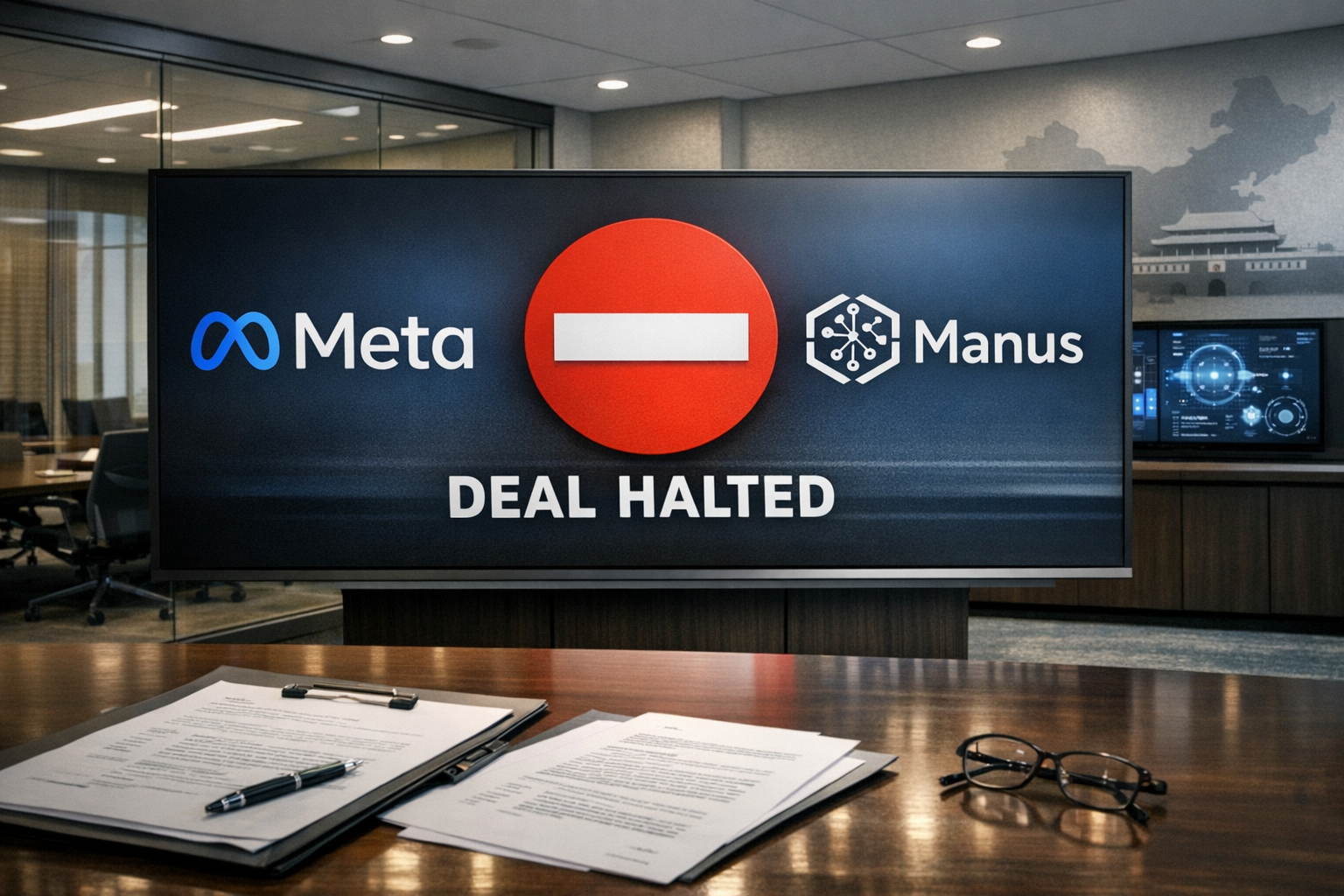
Beijing Blocks Meta’s Manus Deal, Escalating Fight Over Cross-Border AI
China has blocked Meta’s planned acquisition of Manus, an artificial intelligence startup focused on autonomous software agents, in a move that underscores how sharply the contest over advanced AI has expanded from export controls and chip restrictions into corporate dealmaking.
China’s National Development and Reform Commission said on Sunday that the transaction could not proceed and ordered the parties to withdraw it, effectively halting Meta’s roughly $2 billion takeover of the company. The intervention, reported by several outlets, appears to be one of the clearest signs yet that Beijing is treating AI companies with Chinese roots as strategic assets whose talent, models and product know-how should not be allowed to pass easily into American hands.
The decision adds a new point of friction to the intensifying technology rivalry between Washington and Beijing. It also deals a setback to Meta’s effort to strengthen its position in one of the industry’s hottest areas: so-called agentic AI, or systems designed not just to answer questions but to take actions autonomously on a user’s behalf.
A Deal Caught in a Wider Crackdown
Meta, the parent company of Facebook, Instagram and WhatsApp, announced the Manus acquisition in December 2025. Manus had been described as a Singapore-based startup with Chinese roots, a structure that reflected a broader pattern among Chinese-founded technology companies seeking international capital, access to global markets and some insulation from domestic political pressures.
But that kind of cross-border arrangement has come under growing scrutiny in China.
Earlier this year, Chinese authorities had already begun reviewing the deal. In March, reports said Manus’s co-founders had been barred from leaving China while regulators examined whether the sale ran afoul of investment restrictions or export-control rules. Over the past week, there have also been indications that Beijing has been warning AI firms more broadly against moving core research, personnel and intellectual property offshore.
The message is increasingly clear: in sectors like advanced AI, formal headquarters may matter less to regulators than where the founders come from, where the research was developed and whether the underlying capabilities could strengthen a geopolitical rival.
Why Manus Mattered to Meta
For Meta, the attraction of Manus was straightforward. Autonomous AI agents have become a central ambition for the largest technology companies, which see them as the next step beyond chatbots and assistants.
An agent can, in theory, do more than generate text or summarize information. It can carry out multistep tasks, use software tools, navigate websites, make reservations, analyze documents, coordinate workflows or serve as a digital employee inside a business system. The companies that can build reliable agent platforms stand to influence everything from office software and e-commerce to customer service and personal computing.
Meta has been trying to catch up and differentiate itself in a crowded field dominated by OpenAI, Google, Anthropic and Microsoft-backed offerings. A purchase of Manus would have given it talent and technology in a category that many executives and investors now regard as one of the most commercially promising corners of the AI market.
That makes Beijing’s intervention especially significant. This was not simply the blocking of a conventional foreign acquisition. It was the stopping of a transfer of expertise in a technology that both governments increasingly view as foundational to future economic and strategic power.
AI Mergers Become a National-Security Issue
The Manus case suggests that cross-border mergers and acquisitions in AI are becoming a geopolitical chokepoint.
For years, the fiercest disputes between the United States and China over technology centered on semiconductors, telecom equipment and hardware supply chains. More recently, attention shifted to foundation models, access to advanced chips and restrictions on investment in sensitive sectors. Now even startup acquisitions are being pulled into that same national-security logic.
Chinese authorities have not publicly offered detailed reasoning for the final prohibition, leaving unanswered which precise concern — investment law, data security, export control, talent retention or some broader national-security principle — proved decisive. But the lack of specificity may itself be meaningful. It suggests regulators want to preserve broad discretion over what counts as strategically sensitive in AI.
The move is also likely to reverberate beyond Meta. Investors, founders and acquirers have increasingly relied on complex corporate structures — including Singapore domiciles and offshore holding companies — to bridge Chinese technical talent with foreign capital. Beijing’s action indicates that such arrangements may no longer provide much protection if the state concludes that valuable AI capability is being moved abroad.
Questions Over What Comes Next
Several critical issues remain unresolved.
It is not clear whether Meta and Manus will attempt to restructure the transaction in a form acceptable to Chinese regulators, or whether the ban is effectively final. It is also uncertain what happens to any assets, code, research or personnel that may already have been integrated if parts of the deal had advanced beyond the announcement stage. Some reports have suggested the order amounts to an unwinding of a transaction that had already, in some sense, been completed.
There are also lingering questions about Manus’s founders and staff, including whether travel or operational restrictions remain in place. And for the broader market, the case raises the possibility of a new precedent: that Chinese-origin AI firms may be blocked from U.S. acquisition even when they have shifted legal domicile overseas.
That prospect could chill foreign investment into startups with Chinese ties at precisely the moment when capital is pouring into AI globally. It may also encourage Chinese founders to keep research and commercialization more firmly at home, accelerating the emergence of more separate U.S. and Chinese AI ecosystems.
A More Fragmented AI Future
The blocked Meta-Manus deal arrives as the AI race is becoming more fragmented, more political and less globalized than the internet era that preceded it.
American companies still dominate much of the commercial conversation around generative AI, but Chinese firms remain formidable in model development, consumer applications and engineering talent. As both sides seek advantage, governments are becoming more willing to intervene directly — not only in what chips can be sold or what data can move, but in who can own the companies building the technology.
That shift matters because acquisitions have long been one of the fastest ways for major platforms to absorb innovation. If those pathways narrow, the AI industry could evolve in more regionally siloed ways, with separate pools of capital, talent and infrastructure.
For Meta, the loss of Manus is a strategic setback. For China, it is a statement that advanced AI capability is no longer just a business asset. And for the global technology industry, it is another sign that the future of artificial intelligence will be shaped as much by national borders as by code.
Sources
Further reading and reporting used to add context:
- China blocks a foreign acquisition of AI startup Manus | AP News
- https://the-decoder.com/china-blocks-metas-2-billion-acquisition-of-ai-startup-manus/
- https://www.washingtonpost.com/business/2026/04/27/china-meta-manus-ai-acquisition/48136d04-4221-11f1-b19d-32431046b5b4_story.html
- https://www.theguardian.com/business/live/2026/apr/27/oil-prices-high-us-iran-peace-talks-stock-markets-house-prices-latest-news-updates/
- https://www.pymnts.com/meta/2026/metas-purchase-of-ai-startup-manus-halted-by-china/
- https://www.bloomberg.com/news/articles/2026-04-27/china-blocks-meta-s-2-billion-acquisition-of-ai-startup-manus?srnd=phx-economics-trade
- https://www.forbes.com/sites/siladityaray/2026/04/27/china-blocks-metas-2-billion-acquisition-of-ai-startup-manus//
- https://www.techloy.com/why-china-blocked-metas-2-billion-manus-ai-deal-even-after-it-closed/
- https://elpais.com/economia/2026-04-27/pekin-bloquea-la-compra-por-meta-de-manus-una-start-up-china-de-ia.html
- https://www.washingtonpost.com/world/2026/04/27/china-ai-meta-manus//
- https://www.chinamoneynetwork.com/2026/04/25/china-takes-measures-against-us-investment-in-tech-firms-post-metas-acquisition-of-manus
- https://www.founded.com/a-look-into-chinas-probe-of-metas-2b-manus-ai-acquisition/
- https://www.aol.com/news/china-blocks-metas-2bn-acquisition-122459342.html
- https://edgen.dev.edgen.tech/news/stocks/china-blocks-metas-2b-ai-deal-with-founder-exit-ban
- https://www.techradar.com/pro/meta-buys-manus-for-usd2-billion-to-power-high-stakes-ai-agent-race
- https://en.wikipedia.org/wiki/Manus_%28AI_agent%29
- https://www.techradar.com/pro/metas-usd2b-manus-acquisition-sparks-concerns-from-chinese-regulators
- https://www.reddit.com/r/GUARDIANauto/comments/1sx38wl/business_china_blocks_2bn_meta_takeover_of_ai/
- https://www.reddit.com/r/theguardian/comments/1sx09xu/china_blocks_2bn_meta_takeover_of_ai_agent/
- https://www.axios.com/2025/12/30/meta-manus-ai
- Meta buys AI startup Manus | AP News
- https://www.reddit.com/r/SymbyNews/comments/1sx2gqt/china_blocks_2bn_meta_takeover_of_ai_agent/
- https://www.reddit.com/r/technology/comments/1sx14mp/china_blocks_2bn_meta_takeover_of_ai_agent/
- https://www.reddit.com/r/DeMeta/comments/1sx0lhx/china_blocks_2bn_meta_takeover_of_ai_agent/
- https://www.reddit.com/r/ArtificialInteligence/comments/1swy7zq/metas_2_billion_manus_acquisition_blocked_by_china/
- https://www.washingtonpost.com/world/2026/04/21/china-ai-competition-manus-meta/
- https://www.bloomberg.com/news/articles/2026-03-25/china-restricts-manus-founders-from-leaving-china-ft-says
- https://news.sina.cn/2026-04-27/detail-inhvxtrc2301759.d.html?cid=56261&node_id=56261&vt=4
- https://www.meta-guide.com/news/april-2026-news
- https://cryptobriefing.com/china-blocks-metas-2b-manus-acquisition-impacts-ai-market-outlook
- https://www.weex.com/news/detail/the-chinese-ministry-of-commerce-responds-to-metas-acquisition-of-manus-and-issues-related-to-multinational-operations-617720
- https://www.objectwire.org/news/china-bars-manus-cofounders-meta-acquisition-review-2026
- https://www.reddit.com/r/ManusOfficial/comments/1sx2cb1/china_moves_to_block_metas_acquisiton_of_manus/
- https://www.scmp.com/tech/big-tech/article/3339335/review-meta-manus-deal-underlines-chinas-tightening-grip-ai-exports
- https://www.reddit.com/r/LocalLLaMA/comments/1swy9ap/metas_2_billion_manus_acquisition_blocked_by_china/
- https://perplexityaimagazine.com/ai-news/manus-ai-founders-blocked-china-meta-acquisition/
- https://www.reddit.com/r/XGramatikInsights/comments/1sx2e2n/china_moves_to_block_metas_acquisiton_of_manus_ai/
- https://www.reddit.com/r/Agent_AI/comments/1sx1la2/china_bans_metas_acquisition_of_manus/
- https://www.reddit.com/r/technology/comments/1sx00cj/china_blocks_metas_acquisition_of_ai_startup_manus/
- https://www.reddit.com/r/economy/comments/1sx1w3q/china_blocks_metas_2_billion_takeover_of_ai/
- https://www.uscc.gov/sites/default/files/2026-02/China_Bulletin_February_4_2026.pdf
- https://english.www.gov.cn/news/202604/20/content_WS69e57209c6d00ca5f9a0a828.html
- https://english.www.gov.cn/news/202604/24/content_WS69eac047c6d00ca5f9a0a9d2.html
- https://english.www.gov.cn/news/202604/26/content_WS69ee048dc6d00ca5f9a0aa48.html
- https://english.www.gov.cn/news/202604/24/content_WS69eabef0c6d00ca5f9a0a9cc.html
- https://english.www.gov.cn/news/202604/26/content_WS69ed9cd3c6d00ca5f9a0aa47.html
- https://english.www.gov.cn/news/202604/24/content_WS69eb63bbc6d00ca5f9a0aa0b.html
- https://english.www.gov.cn/english.www.gov.cn/news/202604/16/content_WS69e098aec6d00ca5f9a0a773.html
- https://english.www.gov.cn/news/202604/18/content_WS69e2e00ec6d00ca5f9a0a807.html
- https://english.www.gov.cn/news/202604/15/content_WS69df7b95c6d00ca5f9a0a6db.html
- https://english.www.gov.cn/news/202604/10/content_WS69d8910dc6d00ca5f9a0a554.html
- https://english.www.gov.cn/news/202604/21/content_WS69e6c319c6d00ca5f9a0a8ac.html
- https://english.www.gov.cn/news/202604/15/content_WS69df9648c6d00ca5f9a0a70d.html
- https://is.mofcom.gov.cn/api-gateway/jpaas-web-server/front/document/download?fileName=4th+CISCE+Brochure-English+Version%EF%BC%88EN%EF%BC%89.pdf&fileUrl=YW5UzzlvCwcM%2FNHHX%2FtT6Ccl0mHyatws3E2o6MkN01xDjMe7PJZ9AZ4a7q0SpOZQ8NGsQuSgySVTUKd8tZ6ANZI6J%2FFP%2FH0RU%2BB%2FZI2u1E%2FqYrBjq7evfghiE1g9cCZfTXpM699bh%2B90%2B7APcEi55FPnYJ52NnupRkyWDNKhQy4%3D
- https://www.ndrc.gov.cn/xxgk/zcfb/fzggwl/202012/P020201219582032130362.pdf
- https://www.ndrc.gov.cn/hdjl/yjzq/201208/W020190927558517077659.pdf
- https://english.www.gov.cn/services/investment/202602/04/content_WS69829975c6d00ca5f9a08e8a.html
- https://www.ndrc.gov.cn/xxgk/zcfb/tz/202604/P020260403656365145899.pdf
- https://english.www.gov.cn/services/investment/202411/02/content_WS68478b3ec6d0868f4e8f3388.html
- https://www.investing.com/news/company-news/metas-2-billion-manus-acquisition-blocked-by-china-93CH-4637852
- https://www.euronews.com/next/2026/03/26/china-bans-manus-founders-from-leaving-country-after-meta-acquires-ai-startup-and-reviews-
- https://www.bloomberg.com/news/articles/2026-04-27/china-blocks-meta-s-2-billion-acquisition-of-ai-startup-manus?srnd=phx-ai
- https://in.investing.com/news/company-news/metas-2-billion-manus-acquisition-blocked-by-china-93CH-5359257
- https://techweez.com/2026/03/25/meta-manus-ai-acquisition-exit-ban/
- https://www.businesstimes.com.sg/international/china-blocks-metas-us2-billion-acquisition-chinese-ai-startup-manus
- https://m.investing.com/news/stock-market-news/china-bars-manus-cofounders-from-leaving-country-as-it-reviews-sale-to-meta-ft-reports-4578993?ampMode=1
- https://economictimes.indiatimes.com/tech/artificial-intelligence/china-blocks-metas-acquisition-of-ai-firm-manus-state-planner/articleshow/130549899.cms/
- https://www.bloomberg.com/news/articles/2026-04-27/china-blocks-meta-s-2-billion-acquisition-of-ai-startup-manus?srnd=phx-technology
- https://www.reddit.com/r/LocalLLaMA/comments/1s369rn/china_bars_manus_cofounders_from_leaving_country/
- https://www.reddit.com/r/singularity/comments/1s35jec/china_bars_manus_cofounders_from_leaving_country/
- https://www.reddit.com/r/China/comments/1sc2moz/china_bans_manus_founders_from_leaving_country/
- https://www.reddit.com/r/ManusOfficial/comments/1s341yw/china_bars_manus_cofounders_from_leaving_country/
- https://www.reddit.com/r/AITrailblazers/comments/1s4hvle/china_has_banned_the_manus_founders_from_leaving/











Leave a Reply