
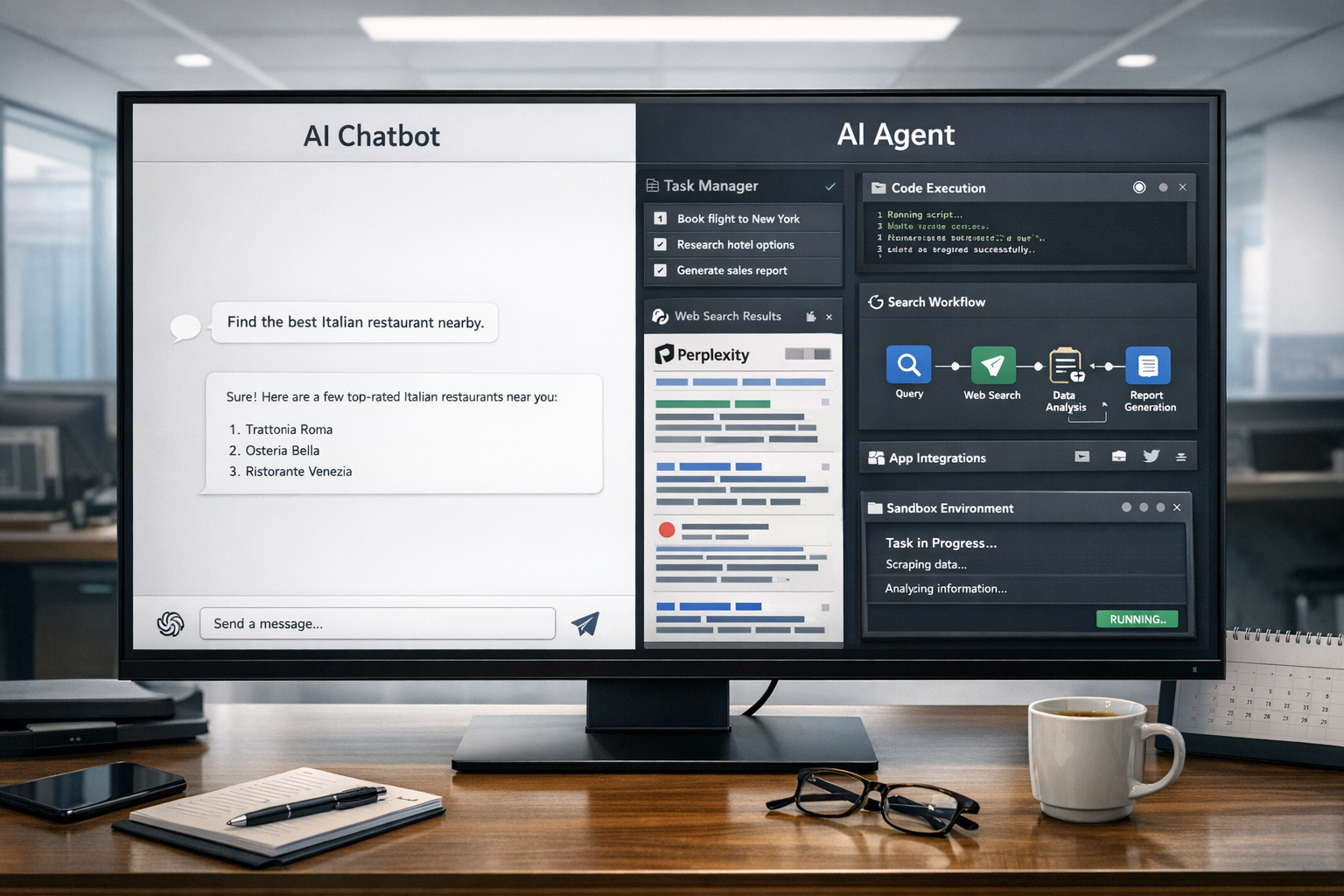
The chatbot may no longer be the product
For much of the generative A.I. boom, the chatbot has been the defining interface: a text box, a prompt, an answer. But two new developments suggest that some of the industry’s biggest players now see that model as too limited for what comes next.
OpenAI is reportedly preparing a sweeping redesign of ChatGPT that would transform it from a conversational assistant into a broader “super app” built around coding tools, autonomous agents and outside services. At nearly the same time, Perplexity has introduced a new system it calls “Search as Code,” which allows A.I. models to write their own search procedures rather than rely on a fixed retrieval pipeline.
Though the products are different, the strategic message is much the same. The race in artificial intelligence is shifting away from chat as a standalone experience and toward software agents that can plan tasks, gather information, use tools and carry out multistep work with less human hand-holding.
That shift matters because it changes what these companies are actually trying to sell. The goal is no longer merely to answer questions convincingly. It is to become the layer through which users get work done.
OpenAI’s reported overhaul
According to reports, OpenAI is planning its biggest remake of ChatGPT since the product’s debut, recasting it as a hub for agentic services and partner integrations. The reported redesign would bring together coding capabilities, autonomous task execution and connections to outside apps, potentially including travel, design and other consumer or business services.
If that vision materializes, ChatGPT would move closer to becoming a platform rather than a single-purpose assistant. Instead of responding to prompts one by one, it could be positioned to coordinate actions across tools, keep track of longer-running assignments and serve as a storefront for paid A.I. services.
OpenAI has been laying groundwork for that transition for months. The company has expanded its Agents SDK, added sandboxed execution and tool orchestration features, and introduced workspace-style agents meant to support shared, ongoing work. Recent product notes have also pointed more explicitly to “agent mode,” alongside browsing and deep research, suggesting that the company has been preparing users for a broader model of interaction.
Even so, questions remain about how much of the reported super-app plan is close to launch and how much reflects a longer-term roadmap. It is also unclear how deeply third-party services would be integrated, and whether users would embrace ChatGPT as a place to complete transactions rather than merely generate text or code.
Perplexity turns search into a runtime
Perplexity’s announcement points in a similar direction, but through the search stack.
Its new “Search as Code” architecture replaces a rigid search API with a more flexible system in which the model generates Python code to build its own retrieval workflow inside a sandboxed environment. In effect, the model can decide how to search, filter, deduplicate and combine results depending on the task at hand.
Perplexity argues that this matters because agentic tasks increasingly require many retrieval steps, not just a single web query. A system trying to research a topic, compare sources, verify facts or complete a complex assignment may need to repeatedly refine its search process as it goes. In that context, a fixed search endpoint can become a bottleneck.
The company has said its approach outperformed competing systems on certain benchmarks while reducing token costs substantially. But, as with many A.I. performance claims, the broader test will be whether those gains hold up outside internal evaluations and under real-world conditions.
The larger significance is architectural. Search, in this view, is no longer a static backend service feeding documents into a model. It becomes part of the agent’s own reasoning loop.
Why the industry is moving this way
The appeal of agents is easy to understand. Chatbots are useful for drafting emails, summarizing reports or answering questions, but they often fall short on longer workflows that involve multiple steps, outside tools or changing objectives. Users still have to break big tasks into small ones and supervise each turn.
Agent systems promise to reduce that burden. In theory, an agent can take a high-level instruction, make a plan, retrieve information, call tools, write and run code, store intermediate results and return with a completed task. That opens the door to products that feel less like search engines or chat windows and more like junior assistants.
For OpenAI, that could create new commercial opportunities in enterprise software, paid productivity tools and platform partnerships. For Perplexity, it offers a way to distinguish itself in a crowded A.I. search market by arguing that the future of retrieval belongs to programmable agents, not conventional query-response systems.
The timing is important. As leading A.I. labs face intensifying competition, simple chat interfaces are becoming easier to replicate. Models may still differ in quality, but the basic experience — type a question, get an answer — is no longer enough of a moat. Tool use, workflow integration and persistent task execution are emerging as the next battleground.
The risks are still unresolved
Yet the agent turn also introduces harder technical and safety problems.
Systems that browse the web, write code and interact with external tools can do more useful work. They can also make costlier mistakes. A flawed answer in a chat window is one thing; an agent that follows malicious instructions, mishandles data or executes the wrong action is another.
That is why security concerns such as prompt injection, data exfiltration and tool misuse loom so large over the agent push. OpenAI itself has emphasized guardrails around these risks, and they remain among the biggest barriers to mainstream deployment. Perplexity’s model-written search pipelines raise related questions about how safely and reliably such code can operate at scale, even in sandboxed environments.
For now, then, the industry’s direction is clearer than its destination. Companies are increasingly betting that the chatbot was only the first phase of consumer A.I. The next phase, they believe, will be software that does more than talk.
Whether users are ready to trust it with real work is the question that may determine who wins.
Sources
Further reading and reporting used to add context:
- https://www.tomsguide.com/news/live/microsoft-build-2026
- OpenAI is still working on that ‘super app’ | TechCrunch
- https://research.perplexity.ai/articles/rethinking-search-as-code-generation
- Introducing workspace agents in ChatGPT | OpenAI
- https://techcrunch.com/2026/04/15/openai-updates-its-agents-sdk-to-help-enterprises-build-safer-more-capable-agents/
- https://www.creativeainews.com/blog/openai-agent-builder-deprecated-november-2026/
- https://explainx.ai/blog/perplexity-search-as-code-agentic-search-2026
- https://blogs.microsoft.com/blog/2026/06/02/microsoft-build-2026-be-yourself-at-work/
- https://shshell.com/blog/perplexity-search-as-code-agent-api-architecture
- https://techcrunch.com/2025/07/17/openai-launches-a-general-purpose-agent-in-chatgpt/
- https://www.ai-primer.com/engineer/stories/perplexity-computer-adds-hybrid-agentic-inference
- https://help.openai.com/en/articles/6825453-chatgpt-release-notes
- https://techcrunch.com/2026/02/05/openai-launches-a-way-for-enterprises-to-build-and-manage-ai-agents/
- https://www.axios.com/2026/02/05/openai-platform-ai-agents
- https://www.windowscentral.com/artificial-intelligence/openai-chatgpt/openai-introduces-chatgpt-agent
- https://www.techradar.com/ai-platforms-assistants/chatgpt/your-mac-just-got-smarter-openai-has-added-chatgpt-agent-to-its-mac-app
- https://www.axios.com/2026/05/14/openai-brings-codex-to-your-phone
- https://www.techradar.com/pro/he-is-a-genius-with-a-lot-of-amazing-ideas-about-the-future-sam-altman-says-openclaw-founder-peter-steinberger-is-joining-openai
- https://en.wikipedia.org/wiki/Codex_%28AI_agent%29
- https://en.wikipedia.org/wiki/OpenAI
- https://en.wikipedia.org/wiki/GPT-5.3-Codex
- https://en.wikipedia.org/wiki/AI_agent
- https://en.wikipedia.org/wiki/ChatGPT_Deep_Research
- https://en.wikipedia.org/wiki/ChatGPT_Atlas
- https://www.reddit.com/r/AiKilledMyStartUp/comments/1txa2tj/ai_agents_are_becoming_an_os_feature_not_a/
- https://www.reddit.com/r/AIGuild/comments/1tztvdx/chatgpt_is_reportedly_getting_a_superapp_overhaul/
- https://www.reddit.com/r/simpleAIFinds/comments/1tz9q5i/openai_is_planning_its_biggest_chatgpt_overhaul/
- https://openai.com/products/release-notes/
- https://br.investing.com/news/stock-market-news/openai-planeja-reformular-chatgpt-como-superapp-antes-de-abertura-de-capital-diz-ft-1964968
- https://ca.finance.yahoo.com/news/openai-plans-chatgpt-superapp-overhaul-042143505.html
- https://openai.com/index/the-next-evolution-of-the-agents-sdk
- https://agentmarketcap.ai/blog/2026/07/28/openai-agents-sdk-enterprise-safety-three-vendor-race
- https://www.marketing-interactive.com/openai-reportedly-plans-chatgpt-superapp-overhaul
- https://www.zonebourse.com/actualite-bourse/openai-projette-de-transformer-chatgpt-en-superapp-avant-son-introduction-en-bourse-selon-le-ft-ce7f5dd2dd8cf22d
- https://presenc.ai/research/openai-operator-update-tracker-2026
- https://perplexityaimagazine.com/ai-news/openai-chatgpt-superapp-codex-ipo-2026/
- https://www.techradar.com/pro/openai-is-making-an-all-in-one-superapp-that-combines-codex-chatgpt-and-atlas-browser-for-maximum-productivity
- https://en.wikipedia.org/wiki/GPT-5.5
- https://www.reddit.com/r/BetterOffline/comments/1tzi2wy/openai_plans_chatgpt_superapp_overhaul_ahead_of/
- https://en.wikipedia.org/wiki/OpenAI_Operator
- https://en.wikipedia.org/wiki/GPT-5.2
- https://www.reddit.com/r/TradeVerseNetwork/comments/1tz1ycr/openai_plans_largest_chatgpt_redesign_since/
- https://www.reddit.com/r/CompareClaw/comments/1t70kmr/openclaw_202655_release_notes_xai_grok_fixes/
- OpenAI plans ChatGPT 'superapp' overhaul ahead of listing, FT reports







Leave a Reply