
OpenAI Pushes ChatGPT and Codex Beyond Conversation
OpenAI has introduced a pair of updates that signal a deeper shift in how its artificial intelligence products are meant to be used: not just as systems that answer questions, but as software that can keep watch, remember routines and carry out work over time.
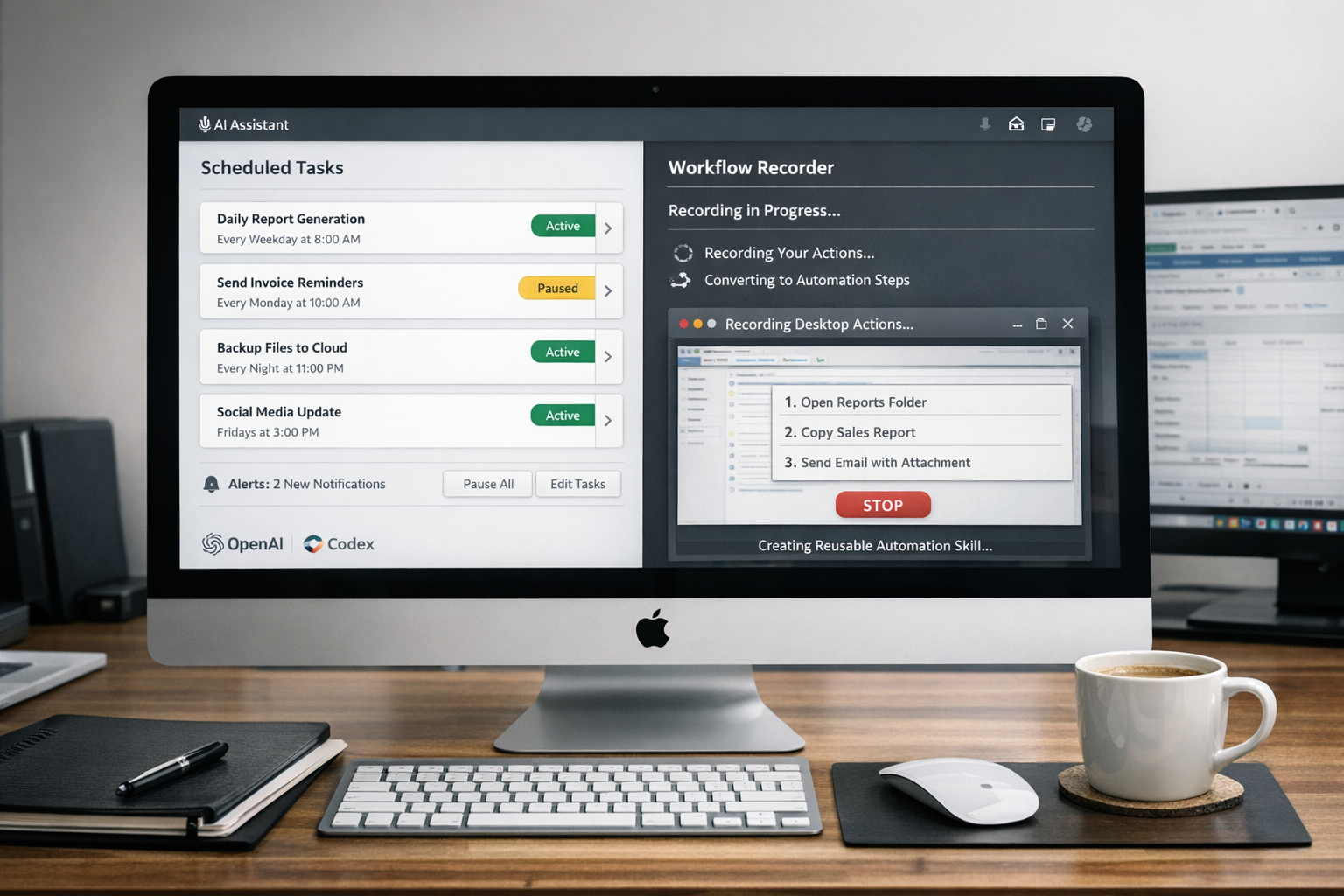
The company said this week that ChatGPT now has expanded controls for scheduled tasks, including a dedicated page where users can manage ongoing jobs and monitoring requests. A day later, OpenAI added a feature called “Record & Replay” to its Codex app for macOS, allowing users to demonstrate a workflow once and save it as a reusable skill that the software can later perform on its own.
Taken together, the changes amount to another step in the industry’s race to turn chatbots into digital assistants that operate more like junior employees or personal aides — systems that do not simply respond in a single session, but persist in the background, revisit tasks and interact with other software on a user’s behalf.
From Prompts to Repeated Work
The more striking of the two updates may be Codex’s new recording tool. In the macOS app, a user can now perform a series of actions on a computer — filing an expense report, organizing data, posting content or navigating a recurring internal workflow — while Codex observes. The software then converts those actions into an editable “skill” that can be run again later.
The feature depends on OpenAI’s “Computer Use” capability, which allows the system to interact with desktop interfaces. At launch, OpenAI said the feature would not be available in the European Union, the United Kingdom or Switzerland.
The concept is simple but consequential. For years, AI companies have trained users to type instructions. Record-and-replay tools try to lower that burden by letting people show a system what they want instead of describing every step precisely. That is especially appealing for office work that is repetitive, awkward to formalize and often spread across multiple applications.
Online, many of the early reactions focused on that distinction: the move from telling software what to do toward demonstrating it once and reusing the result repeatedly. Supporters have framed it as a practical breakthrough for nontechnical users, particularly for workflows that are easier to show than explain.
ChatGPT Becomes More Persistent
The scheduling update to ChatGPT is less flashy, but points in the same direction. OpenAI’s new “Scheduled” page puts recurring and active tasks in one place, allowing users to view, pause, edit or delete them. The company has also broadened time windows, improved notifications and added what it calls monitoring tasks — jobs that can check the web or connected apps and send an alert only when something meaningfully changes.
OpenAI is retiring an earlier feature known as Pulse in favor of this more centralized tasks system.
That means ChatGPT is inching closer to the role long imagined for personal assistant software: not just answering when summoned, but quietly watching for price changes, tracking developments on a topic, checking connected services and surfacing updates when they matter.
The distinction is important. A chatbot that answers a question exists in a moment. An assistant-style system has to operate across time.
Part of a Broader Industry Shift
These updates arrive as major technology companies increasingly pitch AI as a tool for action rather than conversation.
Microsoft has described its Copilot Tasks push as a move “from answers to actions,” with systems that can work in the background across applications and handle recurring jobs. Google, too, has been promoting agent-style features in Gemini and Search that monitor information and proactively carry out tasks.
OpenAI’s latest releases fit squarely into that competitive landscape. Over recent months, the company has been building an agent platform that stretches from consumers to businesses and developers. Codex was introduced as a kind of control center for automations and long-running tasks, while earlier updates expanded remote-control and computer-use abilities beyond narrow coding scenarios. On the enterprise side, OpenAI has also been introducing workspace agents and broader tools for deploying AI systems against company software with governance controls.
Seen that way, the June releases look less like isolated product tweaks than another layer in a larger strategy: to make OpenAI’s tools useful not only for generating text or code, but for actually carrying out day-to-day digital work.
Why the Timing Matters
The appeal is obvious. White-collar workers spend much of their time on repetitive software chores: checking dashboards, moving information between systems, updating records, re-running research, watching for changes in documents, websites or internal tools. If AI can reliably take over even a small share of that labor, it could reshape how office productivity software is used.
That promise helps explain the enthusiasm around these tools. A record-and-replay system offers a path to automation without requiring workers to write scripts. Scheduled and monitoring tasks, meanwhile, hint at a future in which AI acts less like a search box and more like a standing service.
For OpenAI, that is also a strategic necessity. As generative AI features become common across chat apps, search engines and office suites, companies are looking for more defensible uses than one-off question answering. Persistent task execution — software that keeps working after the user closes the window — is one of the clearest candidates.
The Limits of Autonomy
But the move from conversation to action also brings harder problems.
OpenAI has noted that unattended tasks can pause after periods of inactivity and that tasks cannot run more than once per hour. The company is also still working through platform and regional limitations. More fundamentally, record-and-replay systems can be fragile: a changed button, a new permission prompt or a redesigned interface can break an automated flow.
Those concerns have been a recurring theme among developers and power users testing such systems. Some have warned that autonomous loops can become costly or unreliable if they lack clear success criteria, spending time and computing resources wandering through tasks they cannot actually finish. Others have argued that inspectability and user control — the ability to review, edit and constrain what the system does — will be crucial if these products are to move beyond demonstrations.
That tension is now central to the AI assistant race. Companies want systems that feel increasingly capable, but they also need to reassure users that the software will not act unpredictably, overspend, mishandle sensitive information or make consequential decisions without consent.
For now, OpenAI’s latest updates suggest that the next contest in AI will not be over who can produce the cleverest answer in a chat window. It will be over which company can build software that quietly, reliably and safely gets things done.
Sources
Further reading and reporting used to add context:
- ChatGPT — Release Notes | OpenAI Help Center
- https://openai.com/index/codex-for-every-role-tool-workflow/
- https://help.openai.com/en/articles/10291617-scheduled-tasks-in-chatgpt?trk=public_post_reshare-text
- Introducing the Codex app | OpenAI
- https://openai.com/index/chatgpt-memory-dreaming/
- https://openai.com/index/codex-for-almost-everything/
- https://www.watch.impress.co.jp/docs/news/2118707.html
- https://www.engadget.com/2196844/chatgpt-now-has-a-hub-for-scheduled-tasks/
- https://openai.com/news/company-announcements/
- https://findskill.ai/blog/chatgpt-scheduled-tasks-examples/
- https://www.techtimes.com/articles/317074/20260524/openai-codex-becomes-desktop-agent-controls-mac-apps-watches-screen-runs-mobile.htm
- https://techcrunch.com/2026/05/14/openai-says-codex-is-coming-to-your-phone/
- https://en.wikipedia.org/wiki/GPT-5.3-Codex
- https://www.reddit.com/r/CodexAutomation/comments/1u9tv1y/codex_app_26616_codex_cli_01410_record_replay/
- https://www.reddit.com/r/CompareClaw/comments/1t70lby/openclaw_202656_release_notes_codex_oauth_route/
- https://www.reddit.com/r/AIGuild/comments/1u9nsg1/openais_codex_can_now_learn_computer_workflows_by/
- https://cdn.openai.com/pdf/96b559fa-c165-4575-805d-e636909e2f78/June-2026-Threat-Report.pdf
- https://www.reddit.com/r/Chatbots/comments/1ubytr4/openais_record_replay_shows_how_chatbots_may/
- https://www.reddit.com/r/codex/comments/1t1c4hy/if_anyone_from_openai_reads_this_can_you_please/
- https://cdn.openai.com/threat-intelligence-reports/5f73af09-a3a3-4a55-992e-069237681620/disrupting-malicious-uses-of-ai-june-2025.pdf?_bhlid=f3b3d687377f4f0ff127d45ab9a6a1ff99dd3fca
- https://www.reddit.com/r/AISEOInsider/comments/1ubjpfi/codex_ai_update_adds_record_and_replay_with/
- https://www.reddit.com/r/AI_Agents/comments/1ubrjt5/everyones_talking_about_codex_record_replay_i/
- https://www.reddit.com/r/codex/comments/1tp8ujz/openai_is_removing_gpt52_and_gpt53codex_from/
- https://www.reddit.com/r/codex/comments/1tz9j9x/gpt_55_degradation_over_time/
- https://www.reddit.com/r/openclaw/comments/1t3qn4e/context_window_for_openaicodexgpt55/
- https://www.reddit.com/r/OpenAI/comments/1td9wvq/work_with_codex_from_anywhere_openai/
- https://www.reddit.com/r/codex/comments/1tras7t/codex_update_on_windows_seems_like_remote_and/
- https://developers.openai.com/
- https://developers.openai.com/community/meetups
- https://developers.openai.com/api/docs/models/gpt-4o-audio
- https://developers.openai.com/codex/community/meetups
- https://developers.openai.com/api/docs/models/gpt-realtime-whisper
- https://developers.openai.com/api/docs/models/gpt-realtime-1.5
- https://developers.openai.com//
- https://developers.openai.com/api/docs/models/whisper-1
- https://developers.openai.com/api/docs/models/o4-mini-deep-research
- https://developers.openai.com/api/docs/models/all
- https://developers.openai.com/codex/explore
- https://developers.openai.com/showcase/api-examples
- https://www.techradar.com/pro/microsoft-makes-copilot-cowork-open-to-everyone-and-wants-to-help-you-tackle-even-the-trickiest-work-tasks
- https://www.microsoft.com/en-us/microsoft-copilot/blog/2026/02/26/copilot-tasks-from-answers-to-actions/
- https://techcrunch.com/2026/02/24/anthropic-launches-new-push-for-enterprise-agents-with-plugins-for-finance-engineering-and-design/
- https://techcrunch.com/2026/02/25/gemini-can-now-automate-some-multi-step-tasks-on-android/
- https://adoption.microsoft.com/en-us/copilot/
- https://openai.com/index/next-phase-of-enterprise-ai/
- https://support.google.com/gemini/answer/16596215?co=GENIE.Platform%3DDesktop&hl=en
- https://www.ibm.com/think/news/tale-two-models-why-it-matters-enterprise-ai-opus-codex
- https://www.axios.com/2026/02/05/openai-platform-ai-agents
- https://openai.com/index/introducing-workspace-agents-in-chatgpt//
- https://www.microsoft.com/en-us/microsoft-copilot/blog/copilot-studio/new-and-improved-computer-using-agents-a-new-workflows-experience-and-real-time-voice-experiences/
- https://learn.microsoft.com/en-us/power-platform/release-plan/2026wave1/power-automate/
- https://www.phonearena.com/news/every-gemini-update-google-announced-at-io-2026-declaring-the-agentic-era-is-here_id180486
- https://openai.com/business/frontier/
- https://www.techradar.com/pro/2026-the-year-enterprise-ai-finally-gets-to-work
- https://www.windowscentral.com/artificial-intelligence/microsoft-copilot/microsoft-just-launched-a-to-do-list-tool-that-completes-itself-using-ai-introduces-copilot-tasks
- https://www.tomsguide.com/news/live/microsoft-build-2026
- https://los40.com/2026/05/21/gemini-recibe-un-lavado-de-cara-en-el-google-io-2026/
- https://en.wikipedia.org/wiki/Codex_%28AI_agent%29
- https://en.wikipedia.org/wiki/OpenClaw
- https://en.wikipedia.org/wiki/Manus_%28AI_agent%29
- https://en.wikipedia.org/wiki/Anthropic
- https://en.wikipedia.org/wiki/Anthropic%27s_Responsible_Scaling_Policy
- https://en.wikipedia.org/wiki/OpenAI
- https://blog.google/products-and-platforms/products/gemini/
- https://blog.google/intl/ro-ro/produse/google-io-2026-da-startul-erei-agentilor-gemini/
- https://blog.google/innovation-and-ai/products/gemini-app/personal-intelligence
- https://blog.google/innovation-and-ai/technology/developers-tools/google-io-2026-collection/
- https://blog.google/innovation-and-ai/products/gemini-app/next-evolution-gemini-app/
- https://blog.google/innovation-and-ai/infrastructure-and-cloud/google-cloud/gemini-enterprise-agent-platform/
- https://blog.google/products-and-platforms/products/search/search-io-2026/
- https://blog.google/products-and-platforms/products/cloud/
- https://blog.google/intl/es-es/productos/todo-lo-que-los-clientes-de-google-cloud-deben-saber-tras-el-google-io/
- https://blog.google/intl/es-419/actualizaciones-de-producto/informacion/gemini-presenta-inteligencia-personal/
- https://blog.google/intl/pl-pl/nowosci-produktowe/sztuczna-inteligencja/next-evolution-gemini-app/
- https://www.anthropic.com/system-cards
- https://resources.anthropic.com/hubfs/The%202026%20State%20of%20AI%20Agents%20Report.pdf
- https://resources.anthropic.com/hubfs/2026%20Agentic%20Coding%20Trends%20Report.pdf?hsLang=en
- https://resources.anthropic.com/hubfs/2026%20Agentic%20Coding%20Trends%20Report.pdf







Leave a Reply