
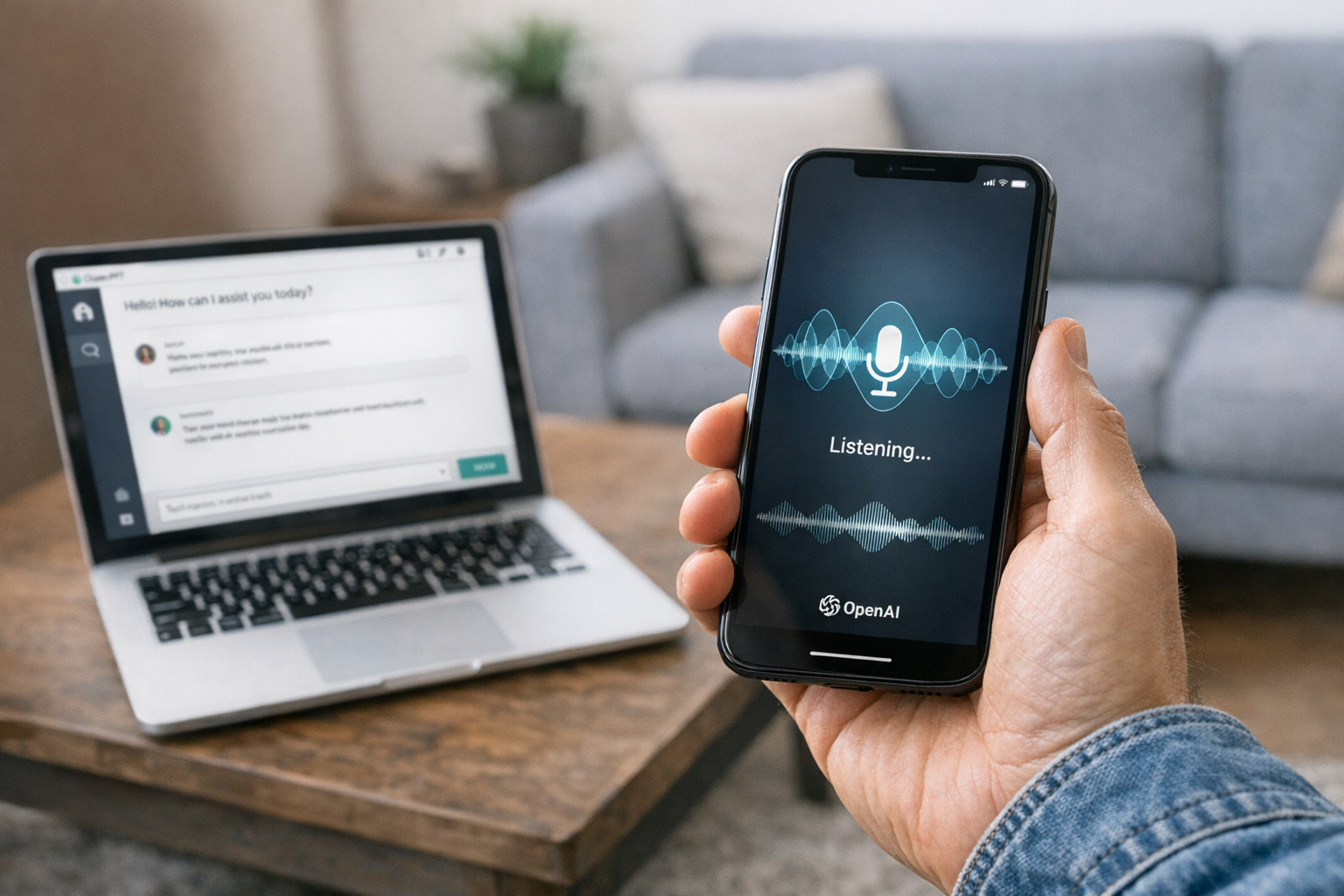
OpenAI Unveils GPT-Live, a Faster, More Conversational Voice for ChatGPT
OpenAI on Tuesday introduced GPT-Live, a new voice system for ChatGPT designed to make spoken exchanges feel less like issuing commands to a machine and more like talking with another person.
The upgrade, now rolling out across iOS, Android and the web, changes one of the most noticeable limitations of earlier A.I. voice assistants: the rigid, turn-by-turn rhythm in which a user speaks, stops, and waits for the system to answer. GPT-Live is built for “full-duplex” conversation, meaning it can listen and speak at the same time, respond to interruptions more naturally and keep talking while more demanding tasks are processed in the background.
For OpenAI, the release is both a product update and a strategic signal. Voice has become one of the company’s most visible consumer interfaces, and OpenAI says more than 150 million people each week already use ChatGPT features such as Voice and Dictation. Improving that experience could widen ChatGPT’s appeal beyond typing, bringing it closer to the ambient, always-available assistant long promised by Silicon Valley.
A Different Kind of Voice Interaction
The most consequential change may be less about sound than about flow.
In earlier versions of ChatGPT Voice, conversations often felt constrained by the underlying model’s need to wait its turn. GPT-Live aims to smooth those seams. If a user interrupts, changes direction mid-sentence or asks a more complicated follow-up, the system is meant to adapt without forcing the exchange to reset.
OpenAI said that when a request requires web search, deeper reasoning or more complex work, GPT-Live can hand the task off to GPT-5.5 behind the scenes and then bring the result back into the ongoing conversation. The live voice model continues speaking while that work is underway, an approach meant to reduce the awkward pauses that have plagued many voice assistants.
That architecture also addresses a longstanding weakness in voice A.I.: the trade-off between speed and intelligence. Real-time voice systems are often optimized for responsiveness, but that can leave them feeling less capable than their text-based counterparts. By splitting the job — maintaining a fast conversational layer while delegating harder questions to a more powerful model — OpenAI is trying to narrow that gap.
Rolling Out First to Consumers
OpenAI said GPT-Live-1 would become the default voice model for Go, Plus and Pro users, while free users would receive GPT-Live-1 mini. API access is planned for later, though the company has not said when.
At launch, the product is consumer-focused in another way: it is not initially available in Business, Enterprise or Edu workspaces. And some features that existed in earlier voice experiences, including video and screen sharing, are not yet supported inside Live. Those remain available in older Voice modes for now.
The company is also adding visual answer cards for categories like weather, stocks and sports, extending the experience beyond pure audio. GPT-Live can work with search, memory, images and files in the same chat, suggesting OpenAI sees voice not as a novelty layer but as another front end for the broader ChatGPT platform.
Early Reactions Suggest a More Natural Experience
Initial hands-on impressions have been broadly positive, with reviewers describing the new system as faster, more fluid and better suited to extended conversations. One early tester said the older voice mode had become less useful as a brainstorming partner because its underlying model felt dated, while the new version was strong enough to sustain hourlong exchanges.
That said, early use has also surfaced the kinds of quirks that often accompany more humanlike systems. One reviewer described a preview bug in which the model would occasionally interrupt to laugh at comments that were not intended as jokes, making the interaction feel oddly condescending. The issue appeared to improve after feedback, but it underscored how delicate voice behavior can be. Small timing or tonal mistakes that might seem trivial in text can feel jarring when spoken aloud.
That is especially important as A.I. companies compete to make their products sound warmer, quicker and more emotionally legible. The closer a system gets to natural conversation, the more users notice when it misreads social cues.
Why the Timing Matters
The launch comes at a moment when the major A.I. firms are racing to define the next dominant interface. For the past few years, chat windows have been the default way most people interacted with large language models. But voice is increasingly seen as a more natural entry point, especially on phones and in on-the-go use cases where typing is cumbersome.
A voice assistant that can talk over pauses, handle interruptions and maintain context during a walk, a commute or a household task begins to look less like a chatbot with speech and more like a companion service woven into daily life. That shift could have implications for search, mobile computing and the way people delegate routine cognitive work.
OpenAI’s emphasis on background delegation to GPT-5.5 also points to another industry trend: invisible orchestration among models. Rather than asking users to choose among “fast,” “smart” or “web-enabled” modes, companies increasingly want the software to make those decisions itself, routing each part of a conversation to the most suitable system.
Limits and Open Questions
The broader promise of GPT-Live will depend on how it performs outside polished demos. OpenAI has acknowledged that some languages may still show gaps in accent handling or fluency, and outside testing has found uneven translation quality in at least some cases.
There are practical questions, too. Availability may vary by region, the company has not yet pinned down when developers will get API access, and Live still lacks video and screen-sharing support. For business users, the absence from Enterprise, Business and Edu workspaces may delay adoption in professional settings where voice could be useful for meetings, tutoring or customer support.
OpenAI has also said it has added voice-specific safeguards, including protections for teenagers and interventions for higher-risk conversations. As voice systems become more natural and persistent, how those safeguards work in practice is likely to receive closer scrutiny. The challenge is not only whether the model is helpful, but whether it knows when to slow down, redirect or refuse.
For now, GPT-Live represents a notable step in the evolution of consumer A.I. assistants: less a new feature than an attempt to make talking to a machine feel ordinary. Whether users embrace it at scale may depend on something harder to measure than latency or model size — whether the conversation feels genuinely easy.
Sources
Further reading and reporting used to add context:
- https://the-decoder.com/chatgpt-can-now-listen-and-talk-at-the-same-time-making-ai-conversations-seem-more-human/
- Introducing GPT-Live | OpenAI
- https://help.openai.com/en/articles/20001274/
- https://openai.com/live/
- https://the-decoder.com/artificial-intelligence-news/ai-practice/
- https://www.macrumors.com/2026/07/08/openai-gpt-live-voice/
- https://openai.com/news/product/?limit=18&sortBy=old
- https://techcrunch.com/2026/07/08/openai-releases-new-voice-models-for-more-natural-live-conversations/
- https://help.openai.com/en/articles/11909943-gpt-53-and-52-in-chatgpt
- https://help.openai.com/en/articles/6825453-chatgp
- https://www.reddit.com/r/ChatGPT/comments/1uqztym/introducing_gptlive_a_new_generation_of_voice/
- https://www.digitaltrends.com/computing/chatgpt-live-could-make-talking-to-ai-feel-straight-out-of-the-movies/
- https://www.pcworld.com/article/3187234/chatgpt-might-actually-be-worth-talking-to-now.html
- https://www.reddit.com/r/AIGuild/comments/1ura5xt/openai_launched_gptlive_a_new_voice_model_for/
- https://www.reddit.com/r/ChatGPT/comments/1ur13ib/openai_launches_gptlive_voice_models_that_listen/
- https://www.reddit.com/r/singularity/comments/1ur2apg/introducing_gptlive/
- https://www.reddit.com/r/OpenAI/comments/1uqzj4g/introducing_gptlive/
- https://www.reddit.com/r/codex/comments/1uqyff3/openai_livestream_at_10am_pt_7pm_cet/
- https://www.reddit.com/r/ChatGPT/comments/1ur83mz/gpt_voice_limit/
- https://www.reddit.com/r/ChatGPT/comments/1ur848w/wow_a_new_gpt_audio_is_incredible/
- https://www.reddit.com/r/ChatGPT/comments/1urbi7l/my_first_impression_of_the_new_chatgptlive1/
- https://en.wikipedia.org/wiki/Simon_Willison
- https://www.reddit.com/r/ChatGPT/comments/1umc4c7/why_does_chat_gpt_have_no_concept_of_time/
- https://www.reddit.com/r/accelerate/comments/1urc7db/has_anyone_in_this_sub_tried_the_new_voice_mode/
- https://cdn.openai.com/global-affairs/be0fe9e0-eb97-43d1-9614-99f2bd948bcc/OpenAI_Productivity-Note_Jul-2025.pdf
- https://www.reddit.com/r/ChatGPTcomplaints/comments/1tg52f7/title_chatgpt_voicelive_is_not_the_same_assistant/
- https://simonwillison.net/2026/Jul/8/introducing-gptlive/
- https://simonwillison.net/
- https://simonwillison.net/?_bhlid=c7dc84246bbe34d49a53c0ce9dacbf4c5e1acf84
- https://feeds.simonwillison.net/tags/llms/
- https://simonwillison.net/2026/May/19/5-minute-llms/
- https://feeds.simonwillison.net/tags/openai/
- https://feeds.simonwillison.net/tags/prompt-engineering/
- https://simonwillison.net/2026/Jun/1/may-newsletter/
- https://feeds.simonwillison.net/tags/ai-ethics/
- https://feeds.simonwillison.net/tags/audio/
- https://simonwillison.net/?trk=article-ssr-frontend-pulse_little-text-block
- https://simonwillison.net/2026/
- https://static.simonwillison.net/static/2024/chrome-headless-page.pdf
- https://static.simonwillison.net/static/2025/django-birthday.pdf






Leave a Reply