
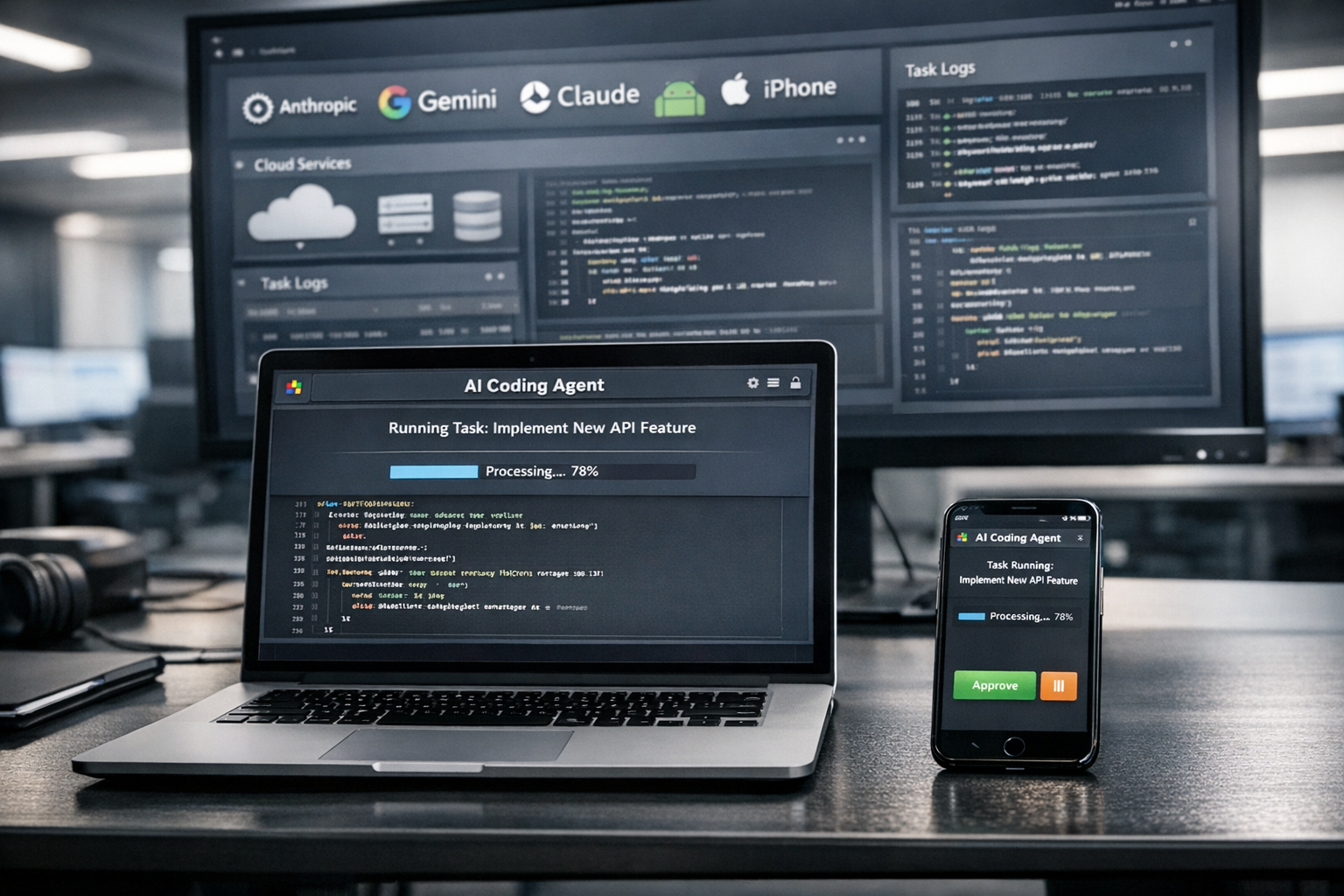
The biggest change in artificial intelligence software this summer may be less about what the models say than what they keep doing after a user stops watching.
In a series of announcements and developer case studies this week, the leading A.I. companies and some of their most visible users offered a clearer picture of a shift that has been building for months: from chatbots that answer prompts to software agents that can run tasks in the background, connect to outside tools, carry state across devices and, in some cases, take on significant pieces of real engineering work.
Anthropic said it was expanding Claude Cowork from desktop to the web and to iPhones and Android phones, letting users start a task on a computer and then monitor, approve or redirect it from a phone while it continues running. Google, on the same day, added background execution and direct connections to remote Model Context Protocol, or MCP, servers for managed agents in its Gemini API, alongside support for custom functions and credential refresh without losing state.
Taken together, the updates suggest that one of the industry’s most-hyped ideas — “agentic” software — is starting to harden into product features and working practices.
From chat windows to long-running work
For much of the past two years, A.I. coding tools have been sold on speed: autocomplete a function, draft a block of code, explain an error. What the latest releases emphasize instead is duration and autonomy.
Anthropic’s latest version of Claude Cowork is designed around a simple premise: a user should not have to keep a laptop open to keep an A.I. task alive. The service, which began as a desktop research preview for Max subscribers in January, later added persistent phone control in March and became generally available on desktop in April. Its broader web and mobile rollout now pushes that idea further, with cross-device handoff and phone-based oversight for jobs still running in the background.
Google’s additions to Gemini managed agents address a similar problem from the developer side. By allowing agents to execute asynchronously, connect directly to remote MCP servers and preserve state while refreshing credentials, Google is trying to make agents more suitable for production systems that take longer than a single chat session and rely on external tools and data sources.
Those are the sorts of details that tend to matter less in demos than in deployment. They also point to where competition between the major labs has moved: not just model quality, but whether an agent can keep working, use the right tools and remain controllable while doing so.
A rewrite once considered taboo
If the platform announcements show what the companies want developers to build, a pair of recent engineering write-ups show what some are already attempting.
One of the most striking came from Jarred Sumner, the creator of Bun, the JavaScript runtime and toolkit, who described using Claude-powered workflows to help rewrite Bun’s code base from Zig to Rust in 11 days. According to the account, the effort involved roughly 50 Claude Code workflows, extensive automated testing and adversarial review, and consumed a volume of model usage that Sumner estimated would have cost about $165,000 at standard API pricing.
The rewrite was not presented as a simple act of machine generation. It depended on an existing language-independent test suite with more than a million assertions, as well as sustained human oversight. Sumner wrote that for most of the process he monitored outputs, adjusted the workflow and focused on fixing the system that generated the code rather than patching code manually line by line.
That distinction matters. Full rewrites have long been treated in software culture as a near-proverbial mistake, a high-risk effort that can introduce new bugs while discarding years of accumulated hardening. The Bun case does not erase that warning. But it does suggest that, under some conditions — mature tests, strong review processes, large budgets and high tolerance for experimentation — frontier models may be changing the economics of projects that were once considered all but irresponsible.
Sumner said the Rust version has already been deployed inside Claude Code releases since mid-June and that Linux startup times improved by about 10 percent, while most users barely noticed the transition.
Smaller, more practical uses
Not every example is so dramatic. In some ways, the more revealing case study came from Simon Willison, an independent developer and longtime observer of A.I. coding tools, who described using Claude and GPT systems to help ship version 4.0 of sqlite-utils, a Python library.
There, the agents were used less as wholesale code authors than as participants in a release process: reviewing open issues, helping with API design, writing upgrade documentation, generating test scripts and surfacing bugs before launch. Willison said one Claude-driven review produced a set of scratch scripts that identified release blockers and other defects he then worked through before shipping the software.
That use case — release quality assurance, migration support, documentation and bug discovery — may prove more representative in the near term than giant rewrites. It is narrower, cheaper and easier to audit. It also aligns with what many software teams say they want from A.I.: not a fully autonomous programmer, but a tireless assistant that can inspect edge cases, draft repetitive material and widen the scope of pre-release checking.
Even so, the trade-offs remain visible. Willison also highlighted criticism from Kenton Varda, the Cloudflare engineer, who said he had declared a moratorium on A.I.-written change descriptions from his team because they were “worse than useless” in code review, summarizing details visible in the code while failing to provide the higher-level framing reviewers needed.
That complaint underscores a broader truth about agentic software: progress in generating and executing code does not automatically translate into better communication, judgment or accountability.
Why this matters now
The timing is significant because the industry appears to be crossing from experimentation into infrastructure.
Anthropic and Google are not merely showing off what an agent can do in a supervised session. They are building around the operational features required for agents to fit into daily work: background runtime, statefulness, approvals, tool access, credential management and cross-device control. Those are the foundations of software that sits alongside ordinary productivity and development systems rather than apart from them.
At the same time, developers are beginning to publish examples that move beyond toy demos. The Bun rewrite, whatever its limits, is a prominent claim that A.I.-assisted workflows can be used on large, risky engineering efforts. The sqlite-utils release suggests a more modest but immediately credible pattern for many teams.
There are still reasons for caution. The Bun project relied on unusual advantages: exceptional testing infrastructure, intense human supervision and enormous token consumption. It is not clear how well such methods generalize to weaker code bases, thinner teams or companies with stricter cost controls. And as agents gain the ability to run in the background and reach into remote tools through protocols like MCP, the unresolved questions multiply: security, permissions, audit logs, failure recovery and who, exactly, is responsible when an always-on agent makes a bad decision.
Still, the week’s developments offered a sharper answer to a question hanging over the A.I. industry: whether “agents” would remain a marketing slogan or become a practical category of software.
The answer, increasingly, appears to be that they are becoming real — unevenly, expensively and with plenty of caveats, but real enough to start changing how software gets built and how work gets done.
Sources
Further reading and reporting used to add context:
- https://blog.google/innovation-and-ai/technology/developers-tools/expanding-managed-agents-gemini-api/
- Claude Cowork on web and mobile: hand off work anywhere | Claude by Anthropic
- https://simonwillison.net/entries/
- https://simonwillison.net/series/
- https://www.anthropic.com/news
- https://claude.com/blog-category/announcements?2f226f2c_page=4&f80ce999_page=2
- https://www.wired.com/story/shut-those-laptops-anthropic-puts-its-claude-cowork-agent-on-your-phone/
- https://platform.claude.com/docs/en/release-notes/overview
- https://cloud.google.com/blog/topics/developers-practitioners/io26-news-for-agent-developers-on-google-cloud
- https://www.reddit.com/r/bun/comments/1ur8pyq/rewriting_bun_in_rust/
- Release notes | Claude Help Center
- https://www.engadget.com/2209495/now-you-can-direct-anthropic-claude-cowork-ai-from-your-phone/
- https://sqlite-utils.datasette.io/en/latest/changelog.html
- https://www.reddit.com/r/rust/comments/1ur8ca1/rewriting_bun_in_rust/
- https://www.reddit.com/r/Zig/comments/1urgj7v/rewriting_bun_in_rust/
- https://www.reddit.com/r/rust/comments/1tcrmjs/rewrite_bun_in_rust_has_been_merged/
- https://www.reddit.com/r/ClaudeCode/comments/1urazyg/rewriting_bun_from_zig_to_rust/
- https://www.reddit.com/r/mcp/comments/1uq70dm/google_adds_background_tasks_and_remote_mcp_to/
- https://www.reddit.com/r/ClaudeAI/comments/1uqdohx/anthropic_quietly_folded_the_cowork_tab_into/
- https://arxiv.org/abs/2607.01418
- https://www.techradar.com/pro/anthropic-could-be-about-to-release-claude-cowork-for-mobile
- https://www.axios.com/2026/05/13/anthropic-claude-small-business-smb
- https://www.tomsguide.com/ai/google-gemini/google-unveils-gemini-spark-a-24-7-personal-ai-agent-that-could-be-a-game-changer-for-agentic-ai
- https://www.androidcentral.com/phones/live/google-i-o-2026-live-blog-android-17-android-xr-glasses-and-all-the-gemini-ai-news
- https://www.techradar.com/ai-platforms-assistants/claudes-latest-upgrade-is-the-ai-breakthrough-ive-been-waiting-for-5-ways-cowork-could-be-the-biggest-ai-innovation-of-2026
- https://sqlite-utils.datasette.io/en/stable/
- https://sqlite-utils.datasette.io/en/latest/index.html
- https://simonwillison.net/?ck_subscriber_id=3232816595
- https://sqlite-utils.datasette.io/en/stable/changelog.html
- https://sqlite-utils.datasette.io/en/latest/plugins.html
- https://sqlite-utils.datasette.io/en/latest/
- https://sqlite-utils.datasette.io/_/downloads/en/latest/pdf/
- https://sqlite-utils.datasette.io/en/3.6/cli.html
- https://bun.com/
- https://sqlite-utils.datasette.io/en/3.39/installation.html
- https://sqlite-utils.datasette.io/en/latest/contributing.html
- https://sqlite-utils.datasette.io/en/3.33/cli-reference.html
- https://simonwillison.net/2026/Jul/7/
- https://feeds.simonwillison.net/elsewhere/release/
- https://simonwillison.net/2026/Jul/
- https://simonwillison.net/elsewhere/release/
- https://simonwillison.net/dashboard/all-recent-content/
- https://simonwillison.net/tags/sqlite-utils/
- https://feeds.simonwillison.net/2026/Jun/21/sqlite-utils-40rc1/
- https://simonwillison.net/?tag=bradneuberg
- https://simonwillison.net/tags/sqlite/
- Rewriting Bun in Rust | Bun Blog




Leave a Reply