
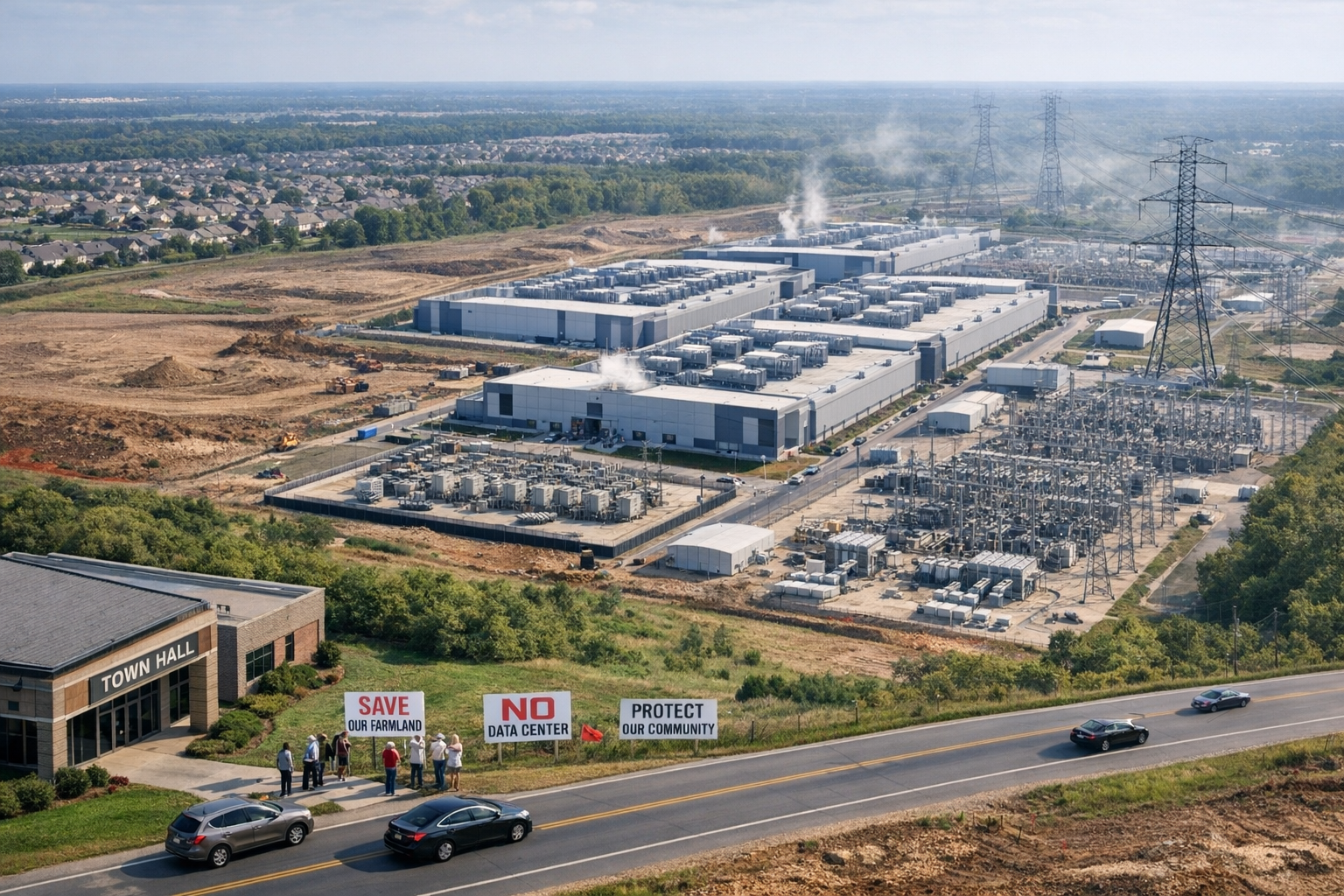
For years, the race to build the physical backbone of artificial intelligence seemed to move in only one direction: faster, larger and with little public notice. That is beginning to change.
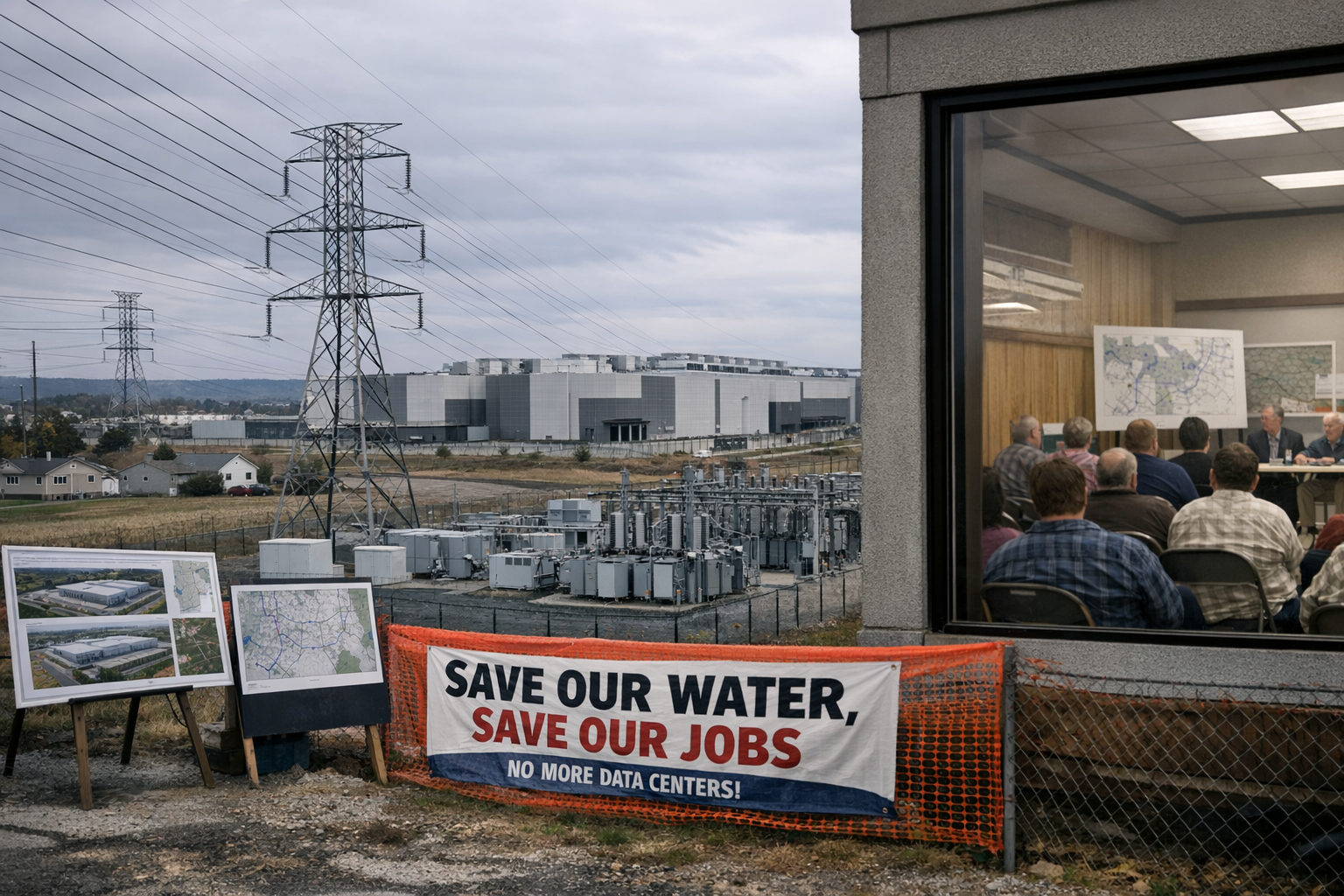
In recent weeks, resistance to the data-center boom has spread well beyond environmental campaigners and nearby residents. What was once a narrow fight over noise, water and power consumption is becoming a broader political and financial argument over whether the industry’s expansion can proceed on the timetable — and at the scale — that technology companies and investors have promised.
In Britain, plans for a vast data-center campus on green-belt land in outer London have drawn renewed scrutiny after planning documents indicated that the project could generate more than one million tonnes of carbon dioxide emissions a year. In the United States, data centers have become an unexpected issue in midterm politics, surfacing in gubernatorial races, local permitting battles and calls for moratoriums. And on Wall Street, investors and analysts are arguing over whether the debt and partnership structures supporting the AI buildout are prudent infrastructure finance or the early signs of overreach.
Taken together, the disputes suggest that the next phase of the AI boom may be shaped less by advances in chips and software than by planning boards, power regulators, local elections and credit markets.
From Growth Story to Political Liability
The sharpest sign of change may be the speed with which data centers have entered electoral politics.
Until recently, the facilities were often marketed as a quiet economic development win: new tax revenue, some construction jobs, and a role in the digital economy. But as proposed campuses have grown larger and more power-hungry — especially those designed for AI computing — they have become easier targets for politicians attuned to voter anger over energy costs, land use and subsidies for large corporations.
That shift is now visible in statewide campaigns, where candidates are treating local fights over permits and grid access as shorthand for broader concerns about who benefits from the AI economy and who absorbs its costs. Historian Jill Lepore, speaking recently about the issue’s political resonance, argued that the backlash reflects a deeper anxiety over the growing reach of what she has called the “artificial state” — the way digital systems and their infrastructure increasingly shape daily life without meaningful public consent.
The issue has already shown it can produce concrete political consequences. Earlier this year, voters in Monterey Park, Calif., backed a ban on data centers, a result that gave anti-data-center organizers elsewhere a powerful example of how quickly local unease can harden into policy.
Public opinion appears to be moving in the same direction. An Annenberg survey published last week found that 61 percent of Americans somewhat or strongly oppose new data centers in their area, up from 49 percent just four months earlier. The increase suggests that opposition is no longer confined to a handful of communities directly facing controversial projects.
Climate and Land Use at the Center
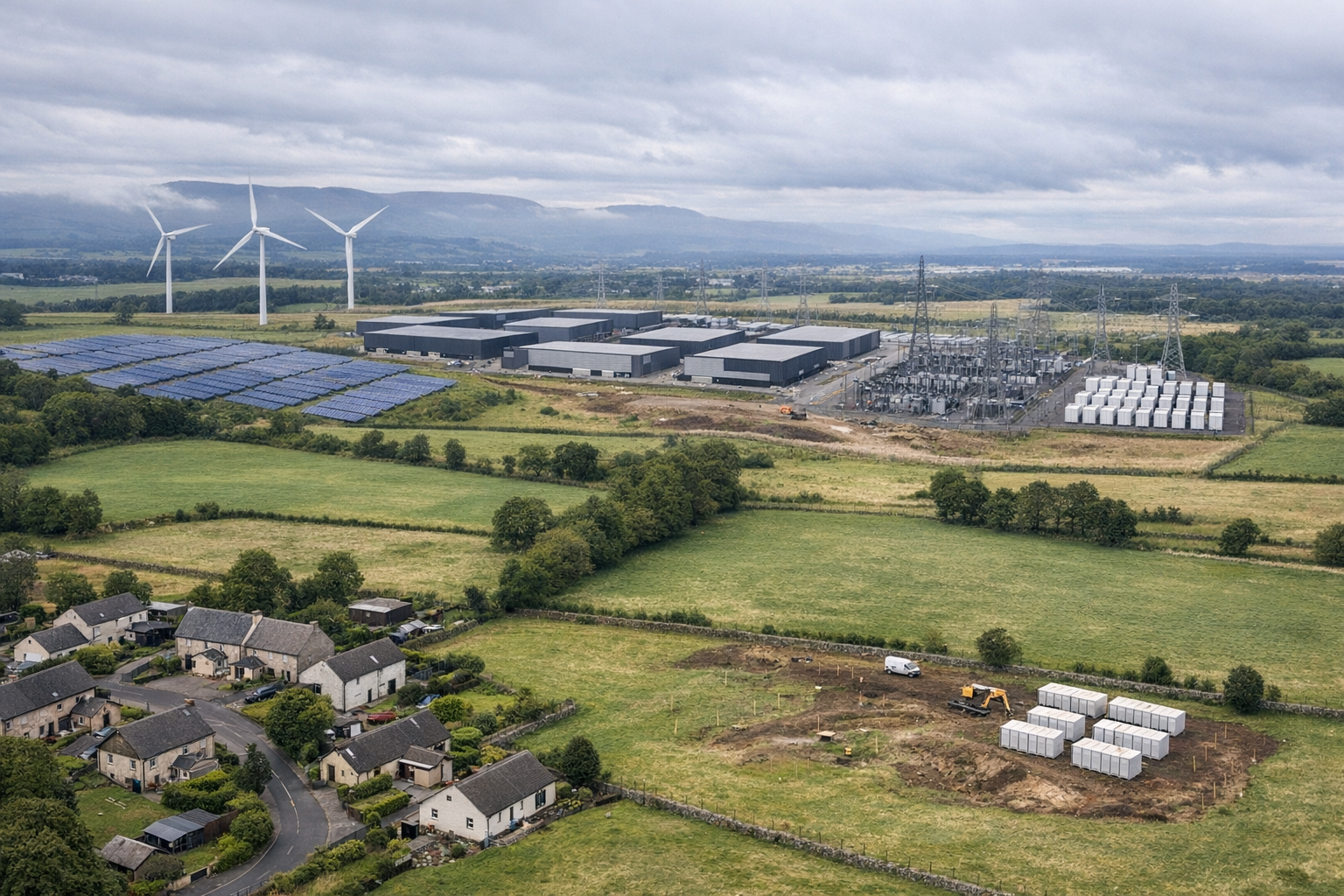
In Britain, the proposed East Havering Data Centre Campus in North Ockendon has become a particularly vivid symbol of the tensions surrounding AI infrastructure. The project would occupy 218 hectares of green-belt land and, according to planning documents, produce annual emissions exceeding one million tonnes of carbon dioxide.
That scale has intensified objections from critics who say the development is incompatible with climate goals and emblematic of the disconnect between governments’ net-zero ambitions and the energy demands of the AI industry. Even when developers describe such projects as sustainable or future-oriented, opponents increasingly ask a simpler question: sustainable for whom?
The conflict also underscores a widening gap between the abstract language of digital transformation and the material footprint required to sustain it. Data centers are not merely warehouses of computers. Hyperscale AI facilities require vast amounts of electricity, heavy grid upgrades, cooling systems, backup generation and, in many cases, large tracts of land near major transmission links. In dense or politically sensitive areas, each of those requirements can become a point of confrontation.
Those pressures are likely to intensify. Governments in both Europe and the United States have been trying to reconcile competing priorities: encouraging AI leadership while also reducing emissions, protecting scarce land and managing already strained power systems. As more projects move from announcement to permitting, communities are being asked to weigh diffuse promises of national technological competitiveness against immediate local burdens.
The Money Behind the Boom
The argument is not only about carbon and politics. It is also about how this building spree is being financed.
The AI infrastructure surge depends on enormous and sustained capital spending, much of it structured through joint ventures, project finance and other arrangements that can keep long-term obligations off a company’s balance sheet. Critics argue that such structures may obscure the scale of the risk if demand cools or if projects fail to secure power, tenants or adequate pricing.
Meta, for example, said in 2025 that its Hyperion campus would be developed through a joint venture with funds managed by Blue Owl, with total development costs of about $27 billion and Blue Owl taking an 80 percent ownership stake. CoreWeave, one of the companies most closely associated with the AI compute boom, had a revenue backlog approaching $100 billion as of March 31, according to S&P, which in June rated its proposed unsecured notes at B, a speculative-grade level.
To skeptics, those numbers evoke the kind of late-cycle exuberance that often accompanies booms. To defenders, the comparison is misplaced. They argue that these are not hidden liabilities in the style of Enron-era accounting, but recoverable infrastructure bets backed by long-term customer demand from some of the world’s largest technology companies.
That debate matters because even a limited pullback in financing conditions could have real effects on construction schedules. The AI buildout assumes not only strong demand for computing power, but also continued willingness from lenders and investors to fund expensive, energy-intensive assets over many years. If financing becomes more costly — or if risk appetites change — projects that looked viable on paper may be delayed, downsized or abandoned.
Why This Matters Now
For much of the past two years, the central question surrounding AI infrastructure was how quickly enough capacity could be built. Now a different question is emerging: whether it can still be built under the expected terms.
Political resistance can slow zoning approvals, tax incentives, power contracts and grid interconnections. Climate objections can force redesigns, legal challenges and higher mitigation costs. Financing concerns can make backers more selective at precisely the moment when the industry requires vast sums to maintain momentum.
The uncertainty is not yet enough to stop the boom. Demand for AI computing remains powerful, and the largest technology companies continue to signal that they will spend aggressively. But the easy phase — in which data centers were treated as a mostly technical necessity — appears to be over.
What is replacing it is a more contested reality, one in which AI’s physical infrastructure is no longer invisible. It is becoming a matter of public argument, electoral leverage and financial scrutiny. And that may prove just as important to the future of the industry as any breakthrough in the technology itself.
Sources
Further reading and reporting used to add context:
- https://www.axios.com/2026/08/23/flock-cameras-data-centers-ai-midterms-2026-tech
- https://www.axios.com/2026/08/23/greg-abbott-texas-data-centers-ai-backlash
- https://www.axios.com/2026/08/23/trump-data-centers-michael-cohen-interview
- https://www.axios.com/2026/08/23/2028-democrats-ai-bernie-sanders
- https://apnews.com/article/f96176c2bcb76cbe8e823ed79fbdf196
- https://www.axios.com/2026/08/19/gop-data-center-memo-ai-election
- https://apnews.com/article/78e057313386bada1326b5c0ae03f2a0
- https://www.thedailybeast.com/data-centers-emerge-as-key-issue-in-ohio-senate-race/
- https://www.theguardian.com/uk-news/2026/aug/21/proposed-london-datacentre-will-have-annual-carbon-footprint-of-27000-flights-to-new-york
- https://www.axios.com/2026/08/20/data-center-uproar-2026-midterms
- https://www.brookings.edu/articles/data-center-backlash-signals-a-fight-over-ai-power/
- https://www.annenbergpublicpolicycenter.org/opposition-to-local-data-centers-rises-sharply-annenberg-survey-finds/
- https://www.spglobal.com/ratings/%5Blang%5D/regulatory/article/-/view/type/HTML/id/3579057
- https://www.washingtonpost.com/business/2026/06/05/voters-monterey-park-california-overwhelmingly-back-data-center-ban//
- https://www.eenews.net/articles/democratic-governors-chafe-as-calls-grow-louder-to-reject-data-centers/
- https://www.spotlightpa.org/news/2026/08/data-center-midterm-legislative-elections-voters-shapiro-garrity-polls/
- https://www.washingtonpost.com/business/2026/01/06/data-centers-backlash-impact-local-communities-opposition//
- https://www.csmonitor.com/layout/set/amphtml/Environment/2026/0624/data-center-elections-republicans
- https://investor.atmeta.com/investor-news/press-release-details/2025/Meta-Announces-Joint-Venture-with-Funds-Managed-by-Blue-Owl-Capital-to-Develop-Hyperion-Data-Center/
- https://www.fastcompany.com/91545823/oracle-and-the-ai-booms-hidden-debt-bomb?amp=&partner=rss
- https://www.spglobal.com/ratings/en/regulatory/article/-/view/type/HTML/id/3543327
- https://www.datacenterdynamics.com/en/news/nvidia-to-invest-in-xai-special-purpose-vehicle-cash-to-be-used-to-buy-nvidia-gpus/
- https://investor.atmeta.com/financials/sec-filings-details/default.aspx?FilingId=18667241
- https://www.fastcompany.com/91557832/orcl-stock-today-why-oracle-shares-are-falling-ai-bubble-debate
- https://www.fastcompany.com/91563655/oracle-layoffs-orcl-stock-21000-jobs-cut-amid-ai-shift-saas-apocalypse
- https://investor.atmeta.com/investor-news/default.aspx
- https://www.datacenterdynamics.com/en/news/us-investment-lead-for-100bn-brookfield-ai-infrastructure-fund-joins-anthropic/
- https://www.datacenterdynamics.com/en/news/valor-equity-partners-raises-54bn-to-buy-nvidia-gpus-for-xai/
- https://www.fastcompany.com/91485608/oracle-chases-50-billion-ai-buildout-wall-street-doubts
- https://main.prospectus.spglobal.com/api/PdfDownload/101171?action=Get
- https://assets.marketplace.spglobal.com/_assets/documents/marketplace/dataset-docs/ratingxpressmetadata.pdf
- https://main.prospectus.spglobal.com/api/PdfDownload/101143?action=Get
- https://investor.atmeta.com/files/doc_financials/2025/q3/Meta-09-30-2025-Exhibit-99-1-Final.pdf
- Proposed London datacentre ‘incompatible’ with net zero with 1m-tonne carbon footprint | Datacentres – UK | The Guardian
- Data centers "dug their own grave," says Texas Gov. Greg Abbott
- Meta – Meta Announces Joint Venture with Funds Managed by Blue Owl Capital to Develop Hyperion Data Center
- Governors' races are being increasingly buffeted by the toxic politics of data centers







Leave a Reply