
Google Recasts Its A.I. Leadership as Jeff Dean Departs for a New Start-Up
Alphabet has overhauled the top ranks of its artificial intelligence organization, elevating Demis Hassabis into a broader science role across the company while Jeff Dean, one of Google’s most influential technical leaders, leaves after nearly three decades to help start a new venture focused on A.I.-driven discovery.
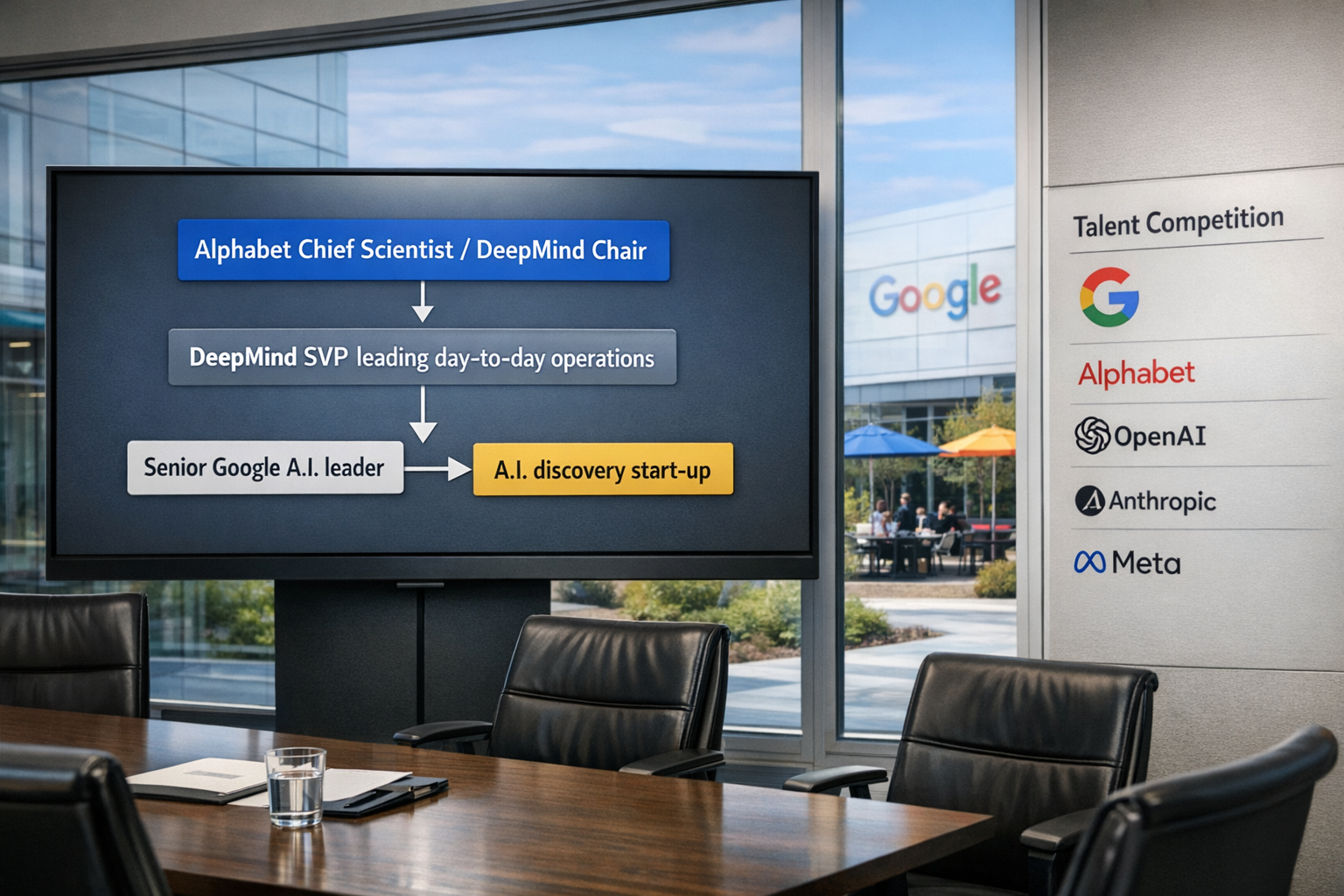
The moves, announced Tuesday, amount to one of the most consequential leadership shifts inside Google’s A.I. effort since the company combined DeepMind with the Google Brain team in 2023. Mr. Hassabis, the Nobel Prize-winning scientist who has led Google DeepMind, is stepping away from the chief executive role to become chair of the lab and chief scientist of Alphabet, Google’s parent company. Koray Kavukcuoglu, DeepMind’s chief technology officer, will take over day-to-day leadership of the unit as a senior vice president.
At the same time, Mr. Dean is departing Google to help launch Discovery Loop, a start-up that aims to use artificial intelligence to accelerate scientific and engineering advances in areas including drug discovery and chip design.
Taken together, the changes reshape the command structure of the company’s most important research engine at a moment when Google is under intense pressure to prove it can convert world-class A.I. science into products and businesses quickly enough to keep pace with rivals.
A Defining Moment for Google’s A.I. Strategy
The significance of the reshuffle extends beyond titles. Mr. Hassabis has been one of the central architects of Google’s modern A.I. strategy, especially since the company merged DeepMind and Google Brain in April 2023 in an effort to reduce internal competition and focus its resources on a unified push. That combined organization became the core of Gemini, the family of models that now sits at the center of Alphabet’s consumer and enterprise A.I. plans.
Mr. Dean’s exit adds a different kind of jolt. Over 27 years at Google, he became one of the company’s most revered engineers, helping shape much of its technical infrastructure and research culture. His name has long carried unusual weight inside the company and across Silicon Valley, making his departure both symbolically and operationally significant.
Discovery Loop, the company he is reported to be launching with other senior figures, is aimed at a part of the A.I. market that many researchers see as especially promising: the use of advanced models not just for chatbots or coding assistants, but for generating breakthroughs in science and industrial design. If successful, such a company would compete for precisely the kind of elite talent Google and other major labs have been trying to keep.
The Pressure of the Talent Race
The reorganization lands amid mounting concern in the industry over the movement of top researchers among a small circle of companies. In recent months, Google has faced visible churn as rivals and start-ups alike have offered researchers more autonomy, bigger compensation packages and the chance to help define the next generation of A.I. systems.
Those concerns have been sharpened this year by reports of departures from Google to competitors, including the exit of Gemini co-lead Noam Shazeer to OpenAI. Even as Mr. Hassabis has argued publicly that Google remains highly competitive in attracting and retaining top researchers, the latest changes are likely to intensify scrutiny of whether the company can hold on to the people most critical to its long-term ambitions.
For Alphabet, this matters not only because A.I. is now central to its future, but because leadership stability has become part of the competitive equation. Investors, employees and partners are looking for signs that the company can move decisively in a market where OpenAI, Anthropic, Meta and a growing crop of start-ups are all competing for the same scarce expertise.
A Promotion, or a Step Back?
Google is presenting Mr. Hassabis’s new position as an expansion of his influence rather than a retreat. As chief scientist of Alphabet, he will have a wider remit across the company’s scientific agenda, while remaining chair of Google DeepMind. That arrangement could give him greater latitude to guide long-range research and broader strategy, even as Mr. Kavukcuoglu assumes operating control.
Still, the practical balance of power is likely to be closely watched. One open question is how much direct authority Mr. Hassabis will continue to exercise over DeepMind’s product and research agenda from his new perch. Another is whether the handoff to Mr. Kavukcuoglu, a longtime senior lieutenant with deep technical credibility, will help streamline decision-making inside an organization that has had to bridge pure research, product development and commercialization.
Those questions carry unusual weight because Alphabet has recently emphasized strong momentum in A.I., pointing to rapid growth in Gemini usage and continued investment in frontier models. A leadership transition at the very center of that effort creates both opportunity and risk: it could sharpen execution by clarifying roles, or it could feed concerns that Google is still searching for the right structure in a fast-moving race.
Why It Matters Now
For years, Google was widely seen as the company with the deepest A.I. bench. But the competitive environment has changed. The industry’s center of gravity has shifted from breakthrough research alone to the difficult task of turning that research into products people use every day and businesses will pay for.
That is why this week’s moves are so important. They are not simply personnel changes at a prestigious lab. They are a test of whether Google can preserve scientific leadership while adapting to a more volatile market for talent and a more unforgiving timetable for execution.
If Mr. Hassabis’s broader role helps unify Alphabet’s science efforts and if Mr. Kavukcuoglu can run DeepMind with greater speed, Google may emerge from the transition stronger. But if Mr. Dean’s departure proves to be part of a wider exodus, the reshuffle could deepen doubts about whether even one of the world’s most powerful technology companies can hold its top minds through the next phase of the A.I. boom.
Sources
Further reading and reporting used to add context:
- https://deepmind.google/about/
- https://deepmind.google/careers/
- https://deepmind.google/blog/announcing-google-deepmind/
- https://blog.google/innovation-and-ai/technology/ai/april-ai-update/
- https://deepmind.google/blog/10-years-of-alphago/
- https://deepmind.google/public-policy/ai-for-science/
- https://deepmind.google/blog/ai-and-neuroscience-a-virtuous-circle/
- https://deepmind.google/blog/demis-hassabis-john-jumper-awarded-nobel-prize-in-chemistry/
- https://deepmind.google/blog/securing-the-future-of-ai-agents/
- https://blog.google/innovation-and-ai/technology/ai/io-2026-dialogues-recap/
- https://deepmind.google/blog/our-collaborations-with-academia-to-advance-the-field-of-ai/
- https://deepmind.google/blog/from-unlikely-start-up-to-major-scientific-organisation-entering-our-tenth-year-at-deepmind/
- https://deepmind.google/gemini/gemini_1_report.pdf
- https://abc.xyz/assets/99/21/46cafdba41089a12a2d86ea47d44/goog026-annualreport2024-web.pdf
- https://www.axios.com/2026/08/05/google-deepmind-demis-hassabis-ai
- https://www.reddit.com/r/GoogleGeminiAI/comments/1vgcdpa/google_deepmind_leadership_reshuffle_demis/
- https://www.reddit.com/r/Bard/comments/1vgcclh/google_deepmind_leadership_reshuffle_demis/
- https://www.reddit.com/r/GeminiAI/comments/1vgcd3a/google_deepmind_leadership_reshuffle_demis/
- https://www.reddit.com/r/deeplearning/comments/1vgcopg/demis_hassabis_steps_down_as_ceo_of_google/
- https://www.reddit.com/r/accelerate/comments/1vgbmdx/breaking_google_deepmind_ceo_demis_hassabis_is/
- https://www.reddit.com/r/accelerate/comments/1vgqfez/welcome_to_august_5_2026_dr_alex_wissnergross/
- https://www.reddit.com/r/stocks/comments/1vgituq/google_deepmind_ceo_and_four_other_ai_leaders/
- https://www.investing.com/news/stock-market-news/exclusivebridgewaters-chief-scientist-sekhon-to-join-googles-deepmind-ai-unit-4569590
- https://www.theinformation.com/articles/googles-new-ai-architect-plans-spread-gemini-everywhere/
- https://www.axios.com/2026/07/14/demis-hassabis-ai-regulation-google-deepmind
- https://www.semafor.com/article/05/20/2026/google-exec-demis-hassabis-predicts-were-at-the-foothills-of-the-singularity
- https://www.reddit.com/r/Wiseek/comments/1vgbgwe/goog_google_ai_chief_demis_hassabis_steps_back_as/
- https://www.reddit.com/r/whoathatsinteresting/comments/1vggl7o/the_engineers_who_literally_helped_build_google/
- https://de.tradingview.com/news/reuters.com%2C2025%3Anewsml_L8N3SE1K2%3A0/
- https://www.semafor.com/article/06/23/2026/deepmind-chief-demis-hassabis-says-googles-still-winning-ai-talent
- https://www.reddit.com/r/actutech/comments/1vggw6j/demis_hassabis_quitte_son_poste_de_pdg_de/
- https://www.reddit.com/r/singularity/comments/1vgbkq5/breaking_google_deepmind_ceo_demis_hassabis_is/
- https://qz.com/google-gemini-noam-shazeer-openai-061826
- https://www.reddit.com/r/SEO_Digital_Marketing/comments/1vgeykv/googles_ai_reshuffle_chief_scientist_jeff_dean/
- https://m.economictimes.com/news/international/business/davos-2026-china-has-caught-up-a-lot-with-us-but-yet-to-innovate-beyond-frontier-says-google-deepmind-ceo-demis-hassabis/amp_articleshow/126853497.cms
- https://www.sahmcapital.com/news/content/artificial-intelligencer-googles-demis-hassabis-goes-on-the-offensive-2026-05-20
- https://blog.google/company-news/inside-google/message-ceo/
- https://blog.google/company-news/inside-google/message-ceo/alphabet-earnings-q1-2025/
- https://blog.google/company-news/inside-google/message-ceo/alphabet-earnings-q2-2026/
- https://blog.google/company-news/inside-google/message-ceo/the-ai-platform-shift-and-the-opportunity-ahead/
- https://blog.google/company-news/inside-google/message-ceo/january-update/
- https://blog.google/company-news/inside-google/message-ceo/google-25th-birthday-sundar-pichai/
- https://blog.google/company-news/inside-google/message-ceo/alphabet-earnings-q1-2026/
- https://blog.google/company-news/inside-google/message-ceo/google-sustainable-future-global-progress/
- https://blog.google/company-news/inside-google/company-announcements/building-ai-future-april-2024/
- https://blog.google/company-news/inside-google/message-ceo/stanford-commencement-speech-2026/
- https://blog.google/company-news/inside-google/company-announcements/changes-knowledge-information-gemini-app-deepmind/
- https://blog.google/company-news/inside-google/around-the-globe/google-asia/google-ai-china-center/
- https://blog.google/documents/90/building_on_workplace_commitments_2020.pdf
- https://blog.google/documents/222/Open_Call_Response_-_catalog.pdf
- https://blog.google/documents/37/How_Google_Fights_Disinformation.pdf
- https://arxiv.org/abs/2603.19782
- https://arxiv.org/abs/2603.20988
- https://arxiv.org/abs/2605.27571
- https://s3-euw1-ap-pe-df-pch-content-store-p.s3.eu-west-1.amazonaws.com/9781003221579/21f879e5-cd08-4470-a4f8-2f09a0ed07ab/preview.pdf?AWSAccessKeyId=ASIAQFVOSJ57QZXFD6CA&Expires=1773470861&Signature=4826T73GWTTi3eTqdGSH5ryBIt4%3D&response-content-disposition=attachment%3B+filename%3D%2210.1201_9781003221579_previewpdf.pdf%22&x-amz-security-token=IQoJb3JpZ2luX2VjENT%2F%2F%2F%2F%2F%2F%2F%2F%2F%2FwEaCXVzLWVhc3QtMSJHMEUCIDEUX90gneDrv22BFh0XldPxfRqTpprxrl0GhAPLvowgAiEA%2B7mJvVx2xaKXEdh1UTb%2FV3zhOeE0szv%2FHUhz4c5zNAkqlgQInf%2F%2F%2F%2F%2F%2F%2F%2F%2F%2FARAEGgwwMTIxNzcyNjQ1MTEiDJyQKZaJTxaU%2BA1bPCrqA%2FEgVxdzkKGnTelwTsbVQ1635cHqFzD%2BBu4IA1jFV6CcYBTgXKkfNwE5%2FPEUMg0F2c5r8OM0mfCtX3gUSQJ7mWdpVpBNkwk26owFtxLl7ISIWB7aI5gcYYPCnAH6%2BwiKcpCydP3RJ5q7u%2BJyva2iTu6tZibRNbIH6fIcGzsn15CK3QRhg5VJ5AaPlzzOQoW2nh6ppM8bx5FNYp0PmEm8hW2pGMEVLEOmcfblQkhWMvfcNDe08lRhNJAChDceVZQ4XqQ%2Brjn%2FcIub5MzlNJ0xb4FtD2U8h3TYDxn3XoNGf8Qh7putYWDkMNQmG%2FZmv6d3ApD8Zf5f8fkGO3coAbnwz1smllgKarUs4%2Fh3fTpEmcj3gid5YB6nHiT0PAVmbKmBigkhwf9B6NFnv%2B5W48PhF8Eeiaw21vxEdweNGtwI64qRKMG62Hy5HDvBjtJUT1WIFXz0bTR%2F4RUxrp5AJd9DrUsgorZEGvoDqhtlO%2FuGHA2wmDBSJXlCHoafDmy1q%2BDxdJ3Zg9sNP1mGzfXF1hGCUOE%2FSf8TFtYlP2U4%2Bx8A0BNfZGE7u0CnI8vCGHw2RRD5usU%2FGN%2BJCuHXZbBl47Z2cEEBFt%2BUms76h3NoPx32sB%2B5rqAE%2F8up9%2BDKqGWGa5JkxLCcA2cggwqFYXMwtrzTzQY6pQGbADmrjl7Yhqa%2FRBXpLTphUb08Zm%2F%2BSmpqh%2BDFTOHHlscskk9%2FU%2FjuZ0oYn15Ji03KBOHWxhr9HumfW9N7k%2Byd0qKyNZZNJcV56AM1aXOFOLFy05mIWXI%2B0gkuAjzmWttMON6E2OolKROQjeA6o9sgSJGqkGAKdQYU92l70dfDjYsRsYgvMdFVldCaemifAEhj94Vt7y8mHKhzSls7BcxoBY2Exa4%3D
- https://arxiv.org/abs/2607.16127
- https://www.loop.ai/about-us
- https://www.scribd.com/document/923421931/Continuous-Delivery-2-0-Business-leading-DevOps-Essentials
- https://www.oreilly.com/library/view/devops-culture-and/9781800202368/Text/B16297_Section_3_ePub.xhtml
- https://patents.justia.com/patent/20260050613
- https://loganlincoln.com/blog/discovery-died-prototyping-ate-it
- https://loopindustries.com/about/
- https://www.loop.ai/team
- https://university-academy.org/ourpages/auto/2024/7/25/43716136/UA%20Parent%20and%20Student%20Handbook%2025-26.pdf?rnd=1753966377107
- https://www.panamacity.gov/DocumentCenter/View/1693/Official-Map10_07_15
- https://live.laborstats.alaska.gov/cen/maps/censustracts/ct170.pdf
- https://product-blueprint.com/discovery-loops-youll-actually-run-next-sprint-2/
- https://www.dimensional.com/us-en/who-we-are/about-us
- https://openreview.net/attachment?id=iqOqbnjZQT&name=pdf
- https://lanpdt.com/product-discovery-process/
- https://centralarizonacactus.org/newsletters/Central_Spine_2015_07.pdf
- https://learn-leadership-net.kit.com/posts/customer-discovery-loops
- https://www.iterative.vc/apply
- https://www.reddit.com/r/OfferEngineering/comments/1vgqvm5/google_lost_four_ai_legends_todayand_this_l6_ds/
- https://www.reutersconnect.com/item/google-deepmind-ceo-demis-hassabis-attends-google-for-korea-2026/dGFnOnJldXRlcnMuY29tLDIwMjY6bmV3c21sX1JDMlFZS0FFMDkyMg
- https://www.reutersconnect.com/item/google-deepmind-ceo-demis-hassabis-speaks-at-google-for-korea-2026-with-google-deepmind/dGFnOnJldXRlcnMuY29tLDIwMjY6bmV3c21sX01UMU5VUlBITzAwMEVKSVVBUg
- https://www.wired.com/story/demis-hassabis-ai-layoffs-deepmind-google-io/
- https://live.euronext.com/en/financial-news/paramount-warner-bros-deal-paused-through-august-17-judge-rules
- https://www.reddit.com/r/GeminiAI/comments/1vgchei/googles_top_ai_brains_are_leaving_to_launch/
- https://www.reddit.com/r/technology/comments/1vgcpac/google_chief_scientist_jeff_dean_leaving_in_ai/
- https://nl.marketscreener.com/beursnieuws/sekhon-hoofdwetenschapper-van-bridgewater-stapt-over-naar-google-s-ai-eenheid-deepmind-ce7e5ed9de8df323
- https://www.reddit.com/r/singularity/comments/1vghb3m/google_deepmind_ceo_demis_hassabis_steps_down_to/
- https://www.reddit.com/r/GeminiAI/comments/1vgbro9/the_end/
- https://www.reddit.com/r/singularity/comments/1vgeatr/was_demis_demoted_or_promoted/
- https://www.reddit.com/r/SNDK_Stock/comments/1vgbptd/4_google_stock_in_half_hour_will_it_affect_sndk/
- https://es.marketscreener.com/noticias/sekhon-jefe-cient-fico-de-bridgewater-se-une-a-la-unidad-de-ia-deepmind-de-google-ce7e5ed9de8df323
- https://economictimes.indiatimes.com/ai/ai-insights/india-ai-summit-2026-artificial-general-intelligence-requires-careful-navigation-says-google-deepmind-ceo/articleshow/128545987.cms
- https://blog.google/company-news/inside-google/around-the-globe/google-asia/turning-ai-momentum-in-southeast-asia-into-tremendous-economic-growth/
- https://blog.google/intl/en-in/company-news/technology/sundar-pichai-io-2026/
- https://blog.google/company-news/inside-google/around-the-globe/google-asia/sea-economy-2025/
- https://www.reddit.com/r/singularity/comments/1vge7hk/removed/
- https://blog.google/company-news/inside-google/around-the-globe/google-asia/more-accessible-internet-india/
- https://perplexityaimagazine.com/ai-news/google-bard-vs-gemini-difference/
- https://blog.google/innovation-and-ai/infrastructure-and-cloud/google-cloud/
- https://servier.com/en/newsroom/digital-transofrmation-ai/
- https://in.linkedin.com/in/satyam-malwade-73493b378
- https://www.ey.com/en_us/government-public-sector/ey-in-new-york
- https://co.linkedin.com/company/sada
- https://d-nb.info/1000088057/34
- https://prjdg-unstruc.s3.ca-central-1.amazonaws.com/Others/News/c76d3c99-db6e-475e-95ed-8b6565da1c39
- https://www.theinformation.com/briefings/googles-ai-unit-reorganizes-product-work-announces-changes-to-gemini-app-team
- https://www.theinformation.com/articles/googles-demis-hassabis-chafes-under-new-ai-push
- https://9to5google.com/
- https://www.reddit.com/r/accelerate/comments/1vge6rz/35_pro_gemini_soon/
- https://io.google/2026/explore/pa-keynote-16
- https://www.theinformation.com/briefings/google-replaces-search-and-ads-chief-moves-gemini-chatbot-to-ai-group
- https://techcrunch.com/2026/06/24/ai-researchers-continue-to-leave-google-for-its-rivals/
- https://www.theguardian.com/technology/computing
- https://arxiv.org/abs/2608.02569
- https://yifanqian.com/uploads/wang2026figures.pdf
- https://www.mithrl.com/news/from-insight-to-impact-mithrl-s-evolution-as-the-scientific-decision-engine-for-enterprise-r-and
- https://www.preprints.org/manuscript/202509.0193/v1/download
- https://pubs.rsc.org/en/content/articlepdf/2025/dd/d5dd00072f
- https://arxiv.org/abs/2608.02858
- https://www.sciencedirect.com/science/article/abs/pii/S0048733324000386
- https://clima.caltech.edu/wp-content/uploads/2024/05/AI-aided-Scientific-Discovery.pdf
- https://music.amazon.fr/podcasts/2900b435-dc74-4bc3-99f5-904b1c897d3e/episodes/2ba11136-e6f7-42f8-ac88-f0940eedfe3f/discovery-loop-why-drug-discovery-breakthroughs-are-failing-to-reach-patients
- https://www.soluntech.com/blog/rewriting-startup-growth-stages-ai-era
- https://www.panamacity.gov/AgendaCenter/ViewFile/Agenda/_01272026-813?packet=true
- https://www.drugtargetreview.com/the-data-fragmentation-problem-holding-drug-discovery-back/681456.article
- https://www.anl.gov/sites/www/files/2023-05/158802_0.pdf
- https://www.linkedin.com/pulse/age-discovery-markus-j-buehler-k1due
- https://pelzlab.science/public_presentations/materials_genomics/13_uncertainty_aware_discovery_and_gaussian_processes/01_intro.html
- https://learn.marsdd.com/article/the-customer-development-model-cdm-product-development-and-technology-startups/
- https://www.axios.com/2026/08/03/ai-talent-wars-openai-google-meta-anthropic
- https://techcrunch.com/tag/google/
- https://techcrunch.com/2026/06/
- https://9to5google.com/2026/06/17/geminis-co-lead-is-leaving-google-to-join-openai/
- https://aibulletin.in/news/aHR0cHM6Ly90ZWNoY3J1bmNoLmNvbS8_cD0zMTM1OTEx
- https://www.axios.com/2026/06/18/noam-shazeer-google-openai-characterai
- https://www.latimes.com/business/story/2026-05-18/inside-ai-compute-crunch-driving-google-researchers-to-quit
- https://finance.yahoo.com/technology/ai/articles/openai-poach-noam-shazeer-google-174327996.html
- https://www.printingpressai.com/article/generative-ai/ai-researchers-continue-to-leave-google-for-its-rivals
- https://www.investing.com/news/stock-market-news/googles-gemini-colead-noam-shazeer-to-join-openai-4748809
- https://www.reddit.com/r/stocks/comments/1uaacua/google_gemini_colead_noam_shazeer_to_join/
- https://www.reddit.com/r/stocks/comments/1uepyvn/google_set_to_lose_two_more_lead_ai_researchers/
- https://www.reddit.com/r/Bard/comments/1uap0vc/noam_shazeer_and_john_jumper_both_leave_google/
- https://www.reddit.com/r/singularity/comments/1ua6gv6/in_the_span_of_3_days_noam_shazeer_transformer/
- https://www.reddit.com/r/stocks/comments/1ub8yux/google_loses_two_top_ai_researchers_to_openai_and/
- https://arxiv.org/abs/2607.19733
- https://www.reddit.com/r/WTFisAI/comments/1ug0qe1/google_spent_27_billion_to_get_one_ai_researcher/
- https://www.reddit.com/r/AIbuff/comments/1ualgjw/two_titans_just_walked_out_the_door_at_google/
- https://www.reddit.com/r/AIGuild/comments/1u9nqi1/googles_gemini_colead_noam_shazeer_is_leaving_to/
- https://www.reddit.com/r/TheBusinessMix/comments/1uhupnt/google_to_lose_highprofile_ai_staffers_to_rival/
- https://www.reddit.com/r/CharacterAI/comments/1tmavuz/quick_question_what_happened_to_the_old_ceo_of_cai/
- https://www.reddit.com/r/ArtificialInteligence/comments/1ukp0sv/openai_vs_anthropic_vs_deepmind_talent_movement/
- https://www.theguardian.com/technology/2026/jul/16/google-workers-layoff-protections-ai
- https://www.theguardian.com/technology/2026/mar/08/block-ai-layoffs-jack-dorsey
- https://www.theguardian.com/technology/2026/feb/04/google-alphabet-earnings-report
- https://www.theguardian.com/technology/deepmind
- https://www.theguardian.com/technology/2026/mar/05/trump-anthropic-ai-pentagon
- https://www.theguardian.com/technology/2026/jul/20/china-google-ai-race
- https://www.theguardian.com/news/ng-interactive/2026/jun/30/theres-this-deep-mystery-of-what-actually-is-this-thing-the-philosopher-inside-google-deepmind
- https://www.theguardian.com/technology/2026/mar/13/anthropic-pentagon-artificial-intelligence
- https://www.theguardian.com/technology/2026/jul/27/silicon-valley-ai-open-source-china
- https://www.theguardian.com/technology/2025/aug/04/demis-hassabis-ai-future-10-times-bigger-than-industrial-revolution-and-10-times-faster
- https://www.theguardian.com/books/2009/aug/09/idea-love-louise-dean-review
- https://www.theguardian.com/technology/eric-schmidt
- https://advertising.theguardian.com/assets/files/the-guardian-advertising-awards-2025-t%26cs-%281%29.pdf
- https://advertising.theguardian.com/assets/files/media-kit-2026-1772022840.pdf
- https://advertising.theguardian.com/assets/files/rate-card-2026-%281%29.pdf
- https://recruiters.theguardian.com/assets/files/hr_tech/HRTechGuide_GuardianJobs.pdf
- Google DeepMind CEO Demis Hassabis is stepping aside
- Alphabet earnings call Q2 2026: Sundar Pichai remarks
- Google DeepMind: Bringing together two world-class AI teams


Leave a Reply