

A More Complicated AI Jobs Story Is Taking Shape
For months, the public argument over artificial intelligence and work has been dominated by a stark question: Which jobs will the machines take first?
Now, a more complicated answer is emerging.
In Britain, Centrica, the owner of British Gas, has become one of the clearest large-company examples yet of an employer explicitly tying job reductions to AI adoption, even as it says the cuts are also being driven by changing customer habits. The company said this week that it would eliminate 1,300 roles across call centers and back-office operations, part of a broader transformation in which AI tools, lower call volumes and greater reliance on digital self-service are reshaping customer operations.
But elsewhere, especially among smaller businesses, the picture looks less like wholesale replacement than quiet augmentation: software that drafts quotes, automates paperwork, reduces errors and helps workers handle more tasks without adding staff.
Taken together, the developments point to a labor-market story that is becoming less apocalyptic and more uneven — one in which the effects of AI depend heavily on the size of the company, the kind of work being done and whether the technology is being used to eliminate labor or stretch it.
Centrica’s Cuts Put a Number on the Shift
Centrica’s latest results offered a blunt illustration of how corporations are starting to describe the connection between AI and staffing. The company said targeted deployment of AI tools was helping support a roughly 14 percent reduction in customer-operations staffing. It also reported that customer calls had fallen 20 percent from a year earlier and that about 90 percent of customers now use digital self-service channels first.
Chris O’Shea, Centrica’s chief executive, defended the changes by arguing that many customers prefer digital interactions, including AI chatbots, over speaking with call-center workers.
That framing matters. For years, companies have spoken in broad terms about efficiency, digitization and modernization. Centrica’s language was more direct, presenting AI as one element — though not the only one — in a workforce reduction that can be measured in the hundreds.
Even there, however, the story is not one of AI acting alone. The company has also emphasized that customer behavior is shifting, with fewer people calling and more using apps and online tools. That makes Centrica a useful case study in a central ambiguity of the AI era: how much of today’s job cutting is genuinely caused by artificial intelligence, and how much is being accelerated by a wider corporate push toward automation, self-service, restructuring and cost control.
Small Businesses Are Using AI Differently
If large companies are more likely to use AI as part of a reorganization that removes roles, smaller firms often appear to be taking a different approach.
In recent months, business owners have described using AI less to replace workers than to make existing employees more effective. In one example, a seller of windows and doors invested in an AI tool that listens to showroom conversations and automatically generates price quotes for sales staff to review. The point was not to eliminate salespeople, the owner said, but to let them spend less time on paperwork, serve more customers and make fewer mistakes.
That pattern is showing up in broader survey data, too. The Federal Reserve’s 2025 Small Business Credit Survey found that 46 percent of employer firms reported some AI use. Yet most small-business respondents said AI had not changed their labor costs.
That suggests that, at least for now, many smaller employers are treating the technology as a productivity tool rather than a substitute for head count. For firms that struggle to hire, cannot easily afford large-scale restructuring and often rely on workers performing many tasks at once, AI may be most attractive as a way to preserve staffing while easing administrative burdens.
It is a very different use case from the one that tends to generate headlines.
The Apocalypse Case Has Run Ahead of the Evidence
The mismatch between the rhetoric and the data has become harder to ignore.
Some of the loudest warnings about AI’s labor effects have come from leaders of AI companies themselves. Dario Amodei, the chief executive of Anthropic, has warned that AI could wipe out a large share of entry-level white-collar jobs within one to five years and has described the technology as a possible “general labor substitute for humans.”
Yet Anthropic’s own labor-market research, published in March, found only limited evidence so far that AI has materially affected employment.
That caution is echoed in government data. Census measures showed AI use hovering at roughly 17 to 20 percent of U.S. businesses in late 2025 through early 2026 — meaningful adoption, but far from universal. Federal Reserve officials and other analysts have noted that while businesses are experimenting with AI more rapidly, many have not fundamentally redesigned work around it.
In other words, the tools are spreading faster than the measurable economic upheaval.
Why the Distinction Matters Now
The distinction between replacement and augmentation is not academic.
For policymakers, it shapes whether the immediate priority should be mass unemployment planning or a more targeted response focused on retraining, worker mobility and sector-specific disruptions. For investors, it affects which companies are likely to realize AI gains quickly: those with large volumes of routine service work may see cost savings sooner than smaller firms using the technology mainly to support existing employees. And for workers, it may determine whether AI arrives first as a rival or as a demanding assistant.
What the latest evidence suggests is not that fears of displacement are unfounded, but that they may be premature as a description of the economy as a whole. The near-term reality appears to be more fragmented: significant cuts in some large organizations, modest productivity gains in many smaller ones, and an overall labor market in which the aggregate signal is still hard to read.
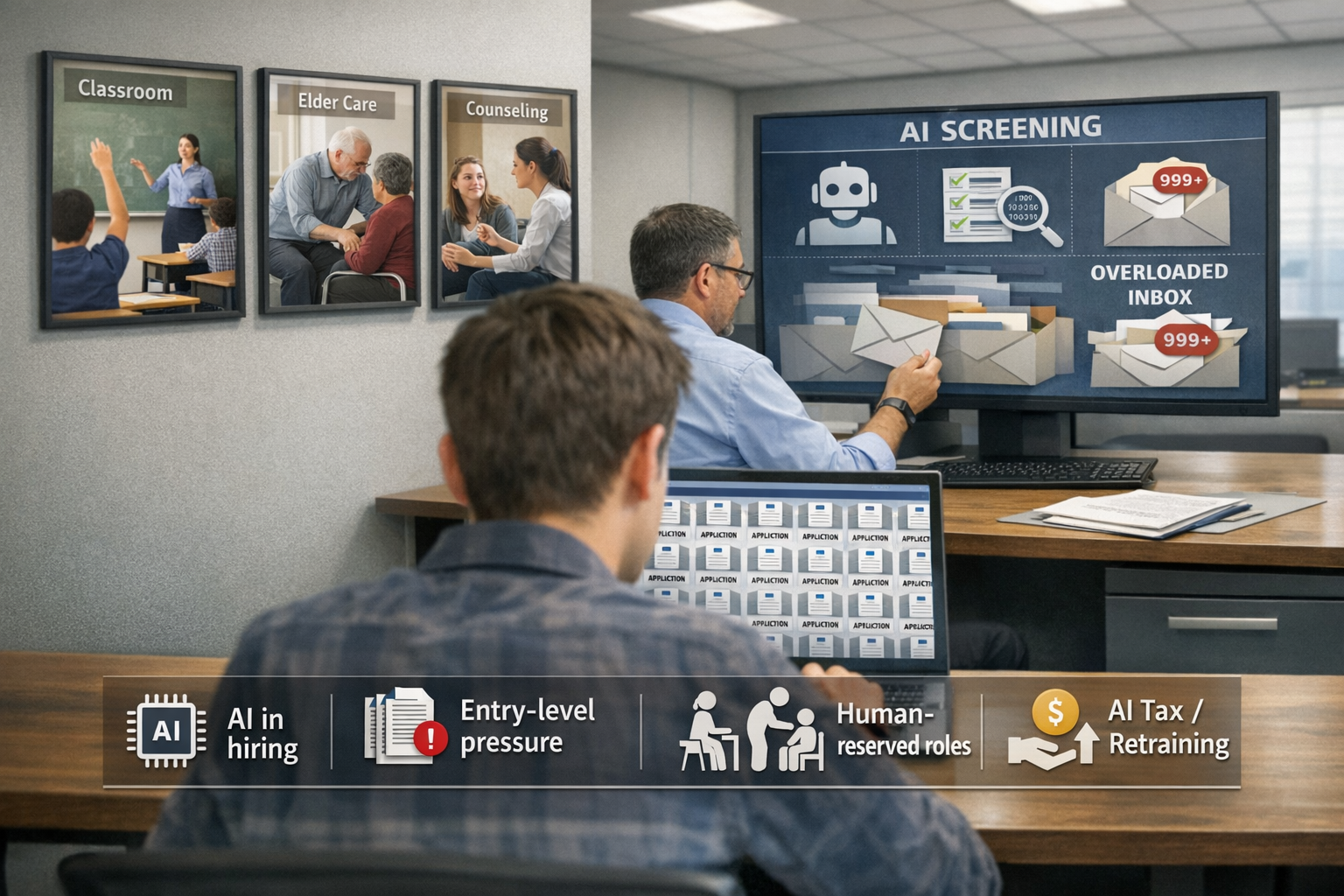
That could change. Better models and deeper integration into daily workflows may eventually push more businesses from assistance toward substitution. Entry-level office work remains especially exposed because so much of it involves the kind of drafting, summarizing and data handling that AI systems are already good at.
But for now, the workplace impact of AI looks less like a single wave of destruction than a piecemeal reorganization — one that is already painful in some corners, barely visible in others and still far from settled.
Sources
Further reading and reporting used to add context:
- Labor market impacts of AI: A new measure and early evidence \ Anthropic
- Corporate America may be using AI to cut jobs, but small businesses are using it to keep them | Gene Marks | The Guardian
- The AI jobs apocalypse probably isn’t coming anytime soon | Eduardo Porter | The Guardian
- https://www.theguardian.com/technology/artificialintelligenceai/2026/jul/26/all
- https://www.theguardian.com/technology/anthropic
- Customers prefer AI chatbots, says British Gas owner as 1,300 call centre and back office jobs axed | Centrica | The Guardian
- https://www.theguardian.com/business/business%2Bsmall-business
- https://www.theguardian.com/technology/2026/feb/26/workers-training-ai-to-do-their-jobs
- https://www.theguardian.com/commentisfree/2026/jun/17/anthropic-ai-rsi-fable
- https://www.anthropic.com/research/economic-index-june-2026-report
- https://www.anthropic.com/research/economic-index-march-2026-report?_bhlid=6f871d8b4233ba74f65adc5c09615c5944fdc405
- https://www.washingtonpost.com/opinions/2026/07/12/ai-apocalypse-that-isnt-coming/
- https://arxiv.org/abs/2605.23159
- https://arxiv.org/abs/2603.27497
- https://arxiv.org/abs/2507.08244
- https://arxiv.org/abs/2503.19159
- https://www.reddit.com/r/technology/comments/1v778zm/the_ai_jobs_apocalypse_probably_isnt_coming/
- https://www.federalreserve.gov/econres/feds/files/2026018pap.pdf
- https://www.searchyour.ai/archivos/anthropic-labor-market-impacts-ai-march-2026.pdf
- https://www.pwc.com/gx/en/issues/artificial-intelligence/job-barometer/2026/2026-global-ai-jobs-barometer-full-report.pdf
- https://www.reddit.com/r/Anthropic/comments/1rqgpmx/labor_market_impacts_of_ai_a_new_measure_and/
- https://www.hks.harvard.edu/sites/default/files/2026-07/Final_AWP_276%20FINAL.pdf
- https://www.spglobal.com/content/dam/spglobal/global-assets/en/special-reports/The%20AI%20and%20Labor%20Landscape%202026.pdf
- https://www.reddit.com/r/ArtificialInteligence/comments/1rm50db/anthropic_labor_market_impacts_of_ai_a_new/
- https://assets.carnegieendowment.org/files/Tawil_AI%20Labor%20Debate_final.pdf
- https://www.reddit.com/r/FPandA/comments/1rs983k/the_impact_of_ai_on_the_labor_market_a/
- https://editor.centrica.com/media-centre/news/2026/agm-statement/
- https://editor.centrica.com/investors/results-reports-and-presentations/2025-preliminary-results/
- https://editor.centrica.com/investors/results-reports-and-presentations/results-reports-and-presentations/2026/
- https://editor.centrica.com/investors/results-reports-and-presentations/2025-interim-results/
- https://www.centrica.com/media-centre/news
- https://www.centrica.com/media-centre?topic=1142
- https://www.investegate.co.uk/announcement/rns/centrica–cna/half-year-financial-report/9682988
- https://www.centrica.com/media-centre/news/company-news/
- https://editor.centrica.com/media-centre/
- https://editor.centrica.com/investors/results-reports-and-presentations/results-reports-and-presentations/archive/
- https://www.investegate.co.uk/company/CNA
- https://editor.centrica.com/media/2hjf1fyl/centrica-plc-2025-preliminary-results-announcement.pdf
- https://www.centrica.com/media/v0bg1g4d/centrica-plc-2024-interim-results-announcement.pdf
- https://webcasts.centrica.com/results/2024-interim-results/files/Centrica-plc-2024-Interim-Results-Announcement.pdf
- https://www.centrica.com/media/zlenineb/centrica-plc-2025-interim-results-announcement.pdf
- https://www.directorstalkinterviews.com/wp-content/uploads/2026/02/5817T_1-2026-2-18.pdf
- https://www.reddit.com/r/Layoffs/comments/1v4gxle/british_gas_owner_centrica_plans_overhaul_with/
- https://www.reddit.com/r/TradingEdge/comments/1ug5elk/premarket_news_report_2606/
- https://www.reddit.com/r/UKJobs/comments/1to2l08/removed/
- https://www.reddit.com/r/LayoffHedge/comments/1t2b971/layoffs_30_day_recap/
- https://en.wikipedia.org/wiki/Centrica
- https://www.reddit.com/r/technology/comments/1sfzw39/tech_industry_lays_off_nearly_80000_employees_in/
- https://www.reddit.com/r/EverHint/comments/1ughmmm/layoff_news_digest_june_26_2026/
- https://www.reddit.com/r/UKJobs/comments/1sihmx3/removed/
- https://www.reddit.com/r/ai_trading/comments/1ttvbju/the_fed_and_jobs_forecast_how_this_weeks_labor/
- https://www.reddit.com/r/UKJobs/comments/1smw3nb/removed/
- https://www.reddit.com/r/BritishGas/comments/1v496sr/british_gas_and_centrica_profits_exceed_60/
- https://www.federalreserve.gov/econres/notes/feds-notes/monitoring-ai-adoption-in-the-u-s-economy-20260403.html
- https://www.pwc.com/gx/en/services/ai/ai-jobs-barometer.html
- https://www.minneapolisfed.org/article/2026/ai-adoption-in-business-grows-steadily-but-unevenly
- https://www.federalreserve.gov/newsevents/speech/barr20260217a.htm
- https://www.federalreserve.gov/newsevents/speech/barr20260714a.htm
- https://www.federalreserve.gov/newsevents/speech/waller20260224a.htm
- https://www.census.gov/library/stories/2026/05/ai-use-businesses.html
- https://www.federalreserve.gov/newsevents/speech/cook20260527a.htm
- https://www.federalreserve.gov/newsevents/speech/files/barr20260217a.pdf
- https://www.federalreserve.gov/newsevents/speech/bowman20260714a.htm
- https://www.federalreserve.gov/newsevents/speech/bowman20260501a.htm
- https://www.pwc.ch/en/insights/transformation/2026-ai-global-jobs-barometer-swiss-cut.html
- https://www.fedsmallbusiness.org/-/media/project/clevelandfedtenant/fsbsite/reports/2026/2026-report-on-employer-firms/2026-report-on-employer-firms.pdf
- https://www.bostonfed.org/news-and-events/news/2026/03/tech-innovations-conference-businesses-workers-economy-ai-federal-reserve.aspx
- https://www.federalreserve.gov/newsevents/speech/files/barr20250509a.pdf
- https://www.federalreserve.gov/newsevents/speech/files/barr20251111a.pdf
- https://www.atlantafed.org/-/media/Project/Atlanta/FRBA/Documents/research/publication/working-paper/2026/03/24/03-firm-data-on-ai.pdf
- https://arxiv.org/abs/2607.08920
- https://arxiv.org/abs/2607.01904
- https://arxiv.org/abs/2602.02607
- https://arxiv.org/abs/2505.14721
- https://www.reddit.com/r/PwC/comments/1ur6y4x/us_based_what_is_your_genuine_concern_of_being/
- Centrica plc 2026 Interim Results Announcement




Leave a Reply