
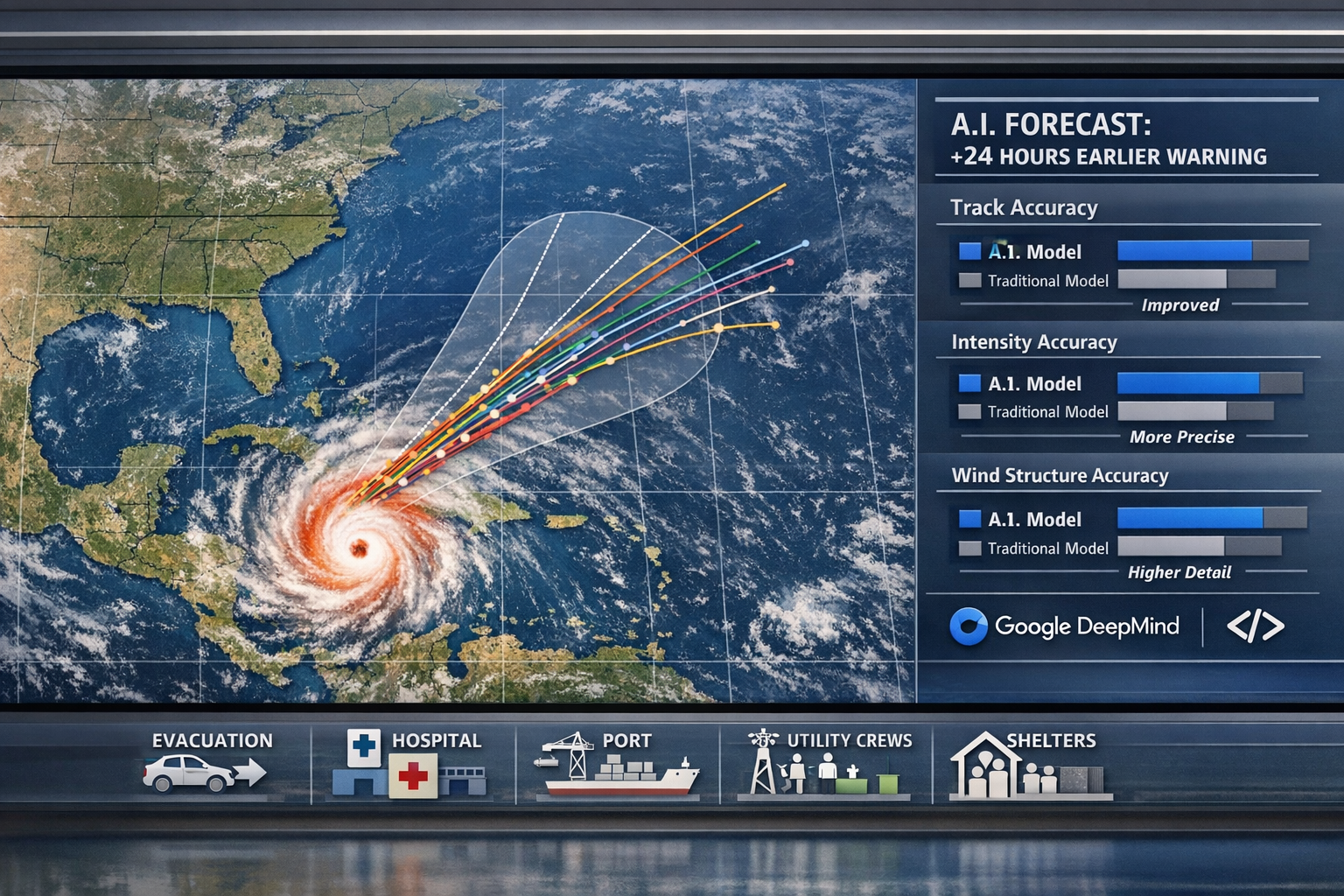
Google DeepMind said on Wednesday that a new artificial intelligence system can predict the path and strength of hurricanes and other tropical cyclones with roughly an extra day of useful warning compared with leading operational models, a claim that, if borne out in future storm seasons, could carry significant implications for evacuations and disaster planning.
The company said the system, called WeatherNext Cyclones, outperformed established forecasting tools on storm track, intensity and wind structure in results published in the journal *Nature*. DeepMind also said it was releasing the code and model weights for WeatherNext 2 and WeatherNext Cyclones as open-source software, allowing outside researchers to test the technology more broadly.
The announcement arrives as forecasters, emergency managers and insurers are increasingly searching for ways to sharpen hurricane predictions in a warming world, where rapid intensification and erratic storm behavior can compress the time available for communities to prepare.
A potential extra day of warning
In hurricane forecasting, time is often the most precious commodity. A reliable forecast even 12 hours earlier can alter decisions about whether to evacuate coastal neighborhoods, pre-position utility crews, close ports or stock hospitals and shelters. DeepMind said its system provided about 24 hours of additional useful lead time on average.
That is a striking claim in a field where progress has typically come incrementally. Traditional forecasting has long involved a difficult balance: broader, lower-resolution global models have generally been stronger at projecting where a storm will go, while finer-resolution regional models have been more useful for estimating how powerful it will become. DeepMind says WeatherNext Cyclones narrows that divide, producing forecasts of both track and intensity in one model.
The company said the system also improves forecasts of wind structure, another crucial measure because a storm’s danger is not defined only by the category assigned to its peak winds. The size and shape of a storm’s wind field can help determine storm surge risks and the geographic spread of damaging conditions.
An unusual result from coarser data
Part of what has drawn attention from researchers is not only the level of performance DeepMind claims, but how it says the model achieves it.
According to the company, WeatherNext Cyclones works from weather input data at a resolution of roughly 28 by 28 kilometers — much coarser than the detailed data typically relied on for intensity-focused hurricane models. Despite that, DeepMind says the system was able to generate more accurate forecasts, raising a scientific question that is not yet fully answered: why a model using relatively low-resolution inputs can perform so well on a task that has usually rewarded finer detail.
DeepMind has said the model uses what it calls Functional Generative Networks and can produce large forecast ensembles quickly. Ensemble forecasting, which examines many plausible evolutions of a storm rather than a single path, is particularly valuable to forecasters because it captures uncertainty as well as the most likely outcome.
But even with strong retrospective results, the company’s system remains a research and decision-support tool, not a replacement for official advisories. Meteorologists have long cautioned that benchmark performance on historical data does not always translate neatly into operational success when storms are unfolding in real time.
From experiment to wider scrutiny
DeepMind has been moving toward this moment for more than a year. Since June 2025, the company has been testing cyclone forecasts with the National Hurricane Center through its Weather Lab platform, where it said experimental forecasts were often as accurate as or better than physics-based baselines. The platform has been used to display predictions for storm formation, track, intensity, size and shape as far as 15 days ahead.
In discussing its latest work, DeepMind pointed to Hurricane Melissa in 2025 as an example in which the system helped support an unusually early warning for Jamaica. Such cases are likely to be studied closely, though researchers generally prefer to judge forecasting tools over many storms and seasons rather than through a single notable event.
The open-source release could accelerate that scrutiny. By making the code and model weights publicly available, DeepMind is inviting universities, government labs and private forecasters to probe the model’s strengths and limitations, and to test whether the gains hold up under independent evaluation.
Why this matters now
The race to improve weather forecasting has become one of the most consequential contests in applied artificial intelligence. Over the past several years, machine-learning systems have shown that they can rival or exceed some conventional numerical weather models on certain tasks while requiring less computing power and producing forecasts more quickly.
Tropical cyclones, however, remain among the hardest tests. Their behavior depends on interactions across scales, from broad atmospheric steering currents to compact inner-core changes that can trigger sudden strengthening. Intensity forecasting in particular has lagged behind track forecasting for decades, and the gap has had real consequences for coastal populations.
That is why DeepMind’s claim is likely to resonate beyond the technology sector. If one system can more reliably estimate where a storm is headed, how strong it will become and how its winds will spread — and do so early enough to change public action — it could influence how meteorological agencies use A.I. in the years ahead.
For now, the central question is less whether WeatherNext is promising than whether its apparent advantage endures outside carefully measured comparisons. Hurricane forecasting is a field where credibility is earned storm by storm, season by season. DeepMind has made an ambitious case that A.I. can compress a decade of forecasting gains into a shorter leap. The coming seasons will determine whether that promise holds when the next major storm begins to turn toward land.
Sources
Further reading and reporting used to add context:
- https://deepmind.google/blog/how-weathernext-helped-the-national-hurricane-center-better-predict-hurricane-melissas-historic-landfall-in-jamaica/
- How we're supporting better tropical cyclone prediction with AI — Google DeepMind
- https://github.com/google-deepmind/weathernext
- https://pubmed.ncbi.nlm.nih.gov/37962497/
- https://www.nature.com/articles/d41586-023-03552-y
- https://research.google/blog/a-new-era-of-innovation-google-research-at-io-2026/
- https://deepmind.google/blog/graphcast-ai-model-for-faster-and-more-accurate-global-weather-forecasting/
- https://www.nature.com/articles/s41586-024-07744-y
- https://deepmind.google/discover/blog/gencast-predicts-weather-and-the-risks-of-extreme-conditions-with-sota-accuracy/?_bhlid=b564f693e6b4a78bda8724d6288a6817a1d815f3
- https://research.google/pubs/neural-general-circulation-models-for-weather-and-climate/
- https://www.nature.com/articles/s41586-024-08252-9
- https://doi.org/10.1038/s41586-023-06185-3
- https://arxiv.org/abs/2010.05783
- https://arxiv.org/abs/2603.22314
- https://arxiv.org/abs/2508.17903
- https://www.nature.com/articles/s41586-025-08897-0.pdf
- https://arxiv.org/abs/2409.06735
- https://www.reddit.com/r/singularity/comments/1vh8hzi/google_deepmind_is_opensourcing_weathernext_its/
- https://www.reddit.com/r/u_NewsFromGoogle/comments/1vhchea/our_weathernext_2_ai_model_from_google_deepmind/
- https://storage.googleapis.com/deepmind-media/DeepMind.com/Blog/how-we-re-supporting-better-tropical-cyclone-prediction-with-ai/skillful-joint-probabilistic-weather-forecasting-from-marginals.pdf
- https://www.nature.com/articles/s44304-026-00223-6_reference.pdf
- https://www.nature.com/articles/s41586-025-09005-y.pdf
- https://thrlvemurket.com/?_=%2Fpdf%2F2601.23268%232LHwtQTrZ4XkLaecG94sHNc%3D
- https://github.com/google-deepmind
- https://deepmind.google/science/weathernext/?authuser=01&hl=zh-tw
- https://www.nature.com/articles/d41586-026-00842-z
- https://www.sciencedirect.com/science/article/pii/S222560322600038X
- https://pubmed.ncbi.nlm.nih.gov/37407823/
- https://rmets.onlinelibrary.wiley.com/doi/full/10.1002/wea.70043
- https://rmets.onlinelibrary.wiley.com/doi/10.1002/wea.70043
- https://arxiv.org/abs/2602.22533
- https://www.nature.com/articles/s44304-026-00219-2
- https://agupubs.onlinelibrary.wiley.com/doi/10.1029/2026GL122172
- https://www.mdpi.com/2073-4433/17/4/418
- https://www.sciencedirect.com/science/article/pii/S0957417426008857
- https://www.sciencedirect.com/science/article/abs/pii/S0029801826025576
- https://www.researchgate.net/publication/408184176_Track-Dependent_Links_Between_Tropical_Cyclones_and_Extratropical_Predictability_in_Physical_and_AI_Models
- https://doaj.org/article/32ba3287b6b047fca0b1ea9fba48b506
- https://arxiv.org/abs/2011.06125
- https://www.nature.com/articles/s43247-026-03754-y_reference.pdf
- https://blog.google/innovation-and-ai/models-and-research/google-deepmind/weathernext-2/
- https://blog.google/innovation-and-ai/products/google-ai-updates-november-2025/
- https://blog.google/innovation-and-ai/products/2025-research-breakthroughs/
- https://blog.google/innovation-and-ai/technology/research/helping-communities-prepare-for-natural-disasters/
- https://blog.google/innovation-and-ai/technology/ai/google-io-2026-all-our-announcements/
- https://blog.google/innovation-and-ai/models-and-research/google-deepmind/reconstructing-peles-lost-goal/
- https://blog.google/alphabet/investor-presentation-june-2026/
- https://blog.google/innovation-and-ai/technology/developers-tools/gemma-4/
- https://blog.google/innovation-and-ai/models-and-research/google-deepmind/project-genie/
- https://blog.google/innovation-and-ai/infrastructure-and-cloud/google-cloud/google-cloud-next-2025-sundar-pichai-keynote/
- https://blog.google/innovation-and-ai/products/google-ai-updates-august-2025/
- https://blog.google/innovation-and-ai/technology/developers-tools/google-io-2026-collection/
- https://blog.google/documents/77/Googles_submission_to_EC_AI_consultation_1.pdf
- https://blog.google/documents/213/AI_Sprinters_Report.pdf
- https://blog.google/documents/160/MBG_Podcast_S2E6_Fall_Detection.pdf
- https://www.linkedin.com/pulse/tech-insights-2025-week-48-johan-sanneblad-gtutf
- https://www.techmeme.com/251116/p7
- https://community.windy.com/topic/42615/weathernext-2-on-windy-com
- https://decrypt.co/348969/google-new-ai-weather-model-
- https://www.linkedin.com/posts/adam-elman_weathernext-ai-climateaction-activity-7396506531132882945-WURb
- https://www.linkedin.com/posts/andy-hopkinson-82012327_weathernext2-googledeepmind-activity-7401922455344160768-OloD
- https://theoutpost.ai/news-story/google-deep-mind-unveils-weather-next-2-revolutionary-ai-model-transforms-weather-forecasting-with-8x-speed-boost-21754/
- https://neuronex-automation.com/blog/specialist-ai-models-business-moat-weathernext-2-dr-tulu
- https://ethanbholland.com/2025/11/22/ai-news-112-week-ending-november-21-2025-with-68-executive-summaries/
- https://parameter.io/google-ai-weather-model-expands-maps-search/
- https://blog.juanbretti.com/en/posts/2026-04-16_weather/
- https://www.business-standard.com/technology/tech-news/weathernext-2-google-adds-ai-weather-forecasts-to-gemini-search-pixels-125111800758_1.html
- https://www.nature.com/articles/s41586-023-06185-3
- https://developers.google.com/weathernext/guides/models
- https://www.nature.com/articles/s41612-026-01374-z
- https://www.nature.com/articles/s41612-025-01009-9
- https://www.nature.com/articles/s41586-025-09005-y
- https://www.nature.com/articles/s43247-025-02502-y
- https://www.nature.com/articles/s41586-025-08897-0
- https://www.nature.com/articles/s41612-025-00926-z
- https://www.nature.com/articles/s41612-025-01279-3
- https://www.nature.com/articles/s41612-024-00638-w
- https://www.nature.com/articles/s41612-026-01424-6_reference.pdf
- https://www.nature.com/articles/s44304-026-00219-2_reference.pdf
- https://www.nature.com/articles/s41467-025-61087-4
- https://www.nature.com/articles/s41598-025-15522-7
- https://doi.org/10.1038/s41586-025-09005-y
- https://www.star.nesdis.noaa.gov/star/NOAAScienceSeminars_2026.php
- https://journals.ametsoc.org/view/journals/aies/4/4/AIES-D-24-0085.1.xml
- https://wpo.noaa.gov/spark/
- https://egusphere.net/conferences/EGU25/AS/
- https://www.aoml.noaa.gov/hrd/about_hrd/publications.html
- https://www.researchgate.net/publication/337511707_Current_and_potential_use_of_ensemble_forecasts_in_operational_TC_forecasting_results_from_a_global_forecaster_survey
- https://www.researchgate.net/publication/393267913_Benchmark_dataset_and_deep_learning_method_for_global_tropical_cyclone_forecasting
- https://rsmcnewdelhi.imd.gov.in/uploads/home/conference/PTC_50.pdf
- https://www.reddit.com/r/TropicalWeather/comments/1vhcdjc/googles_deepmind_weathernext_says_its_ai_can/
- https://blog.google/innovation-and-ai/models-and-research/google-deepmind/weather-lab-ai-cyclone-prediction-tracking/
- https://www.wired.com/story/google-deepmind-ai-weather-forecast/
- https://research.google/blog/how-ai-is-helping-us-build-a-more-resilient-planet/
- https://www.reddit.com/r/antiai/comments/1vk77og/ai_model_achieves_breakthrough_in_forecasting/
- https://www.reddit.com/r/Agent_AI/comments/1vixre8/deepminds_weathernext_ai_model_revolutionizes/
- https://www.fastcompany.com/91548095/ai-just-changed-everything-about-how-we-forecast-the-weather
- https://www.engadget.com/ai/google-deepmind-is-sharing-its-ai-forecasts-with-the-national-weather-service-173506456.html
- https://www.aon.com/getmedia/3fd8e3d3-1e2f-4df8-89a8-d376b753b3a0/20260120-cci-2026.pdf?utm_cr_stl-cci=
- https://www.nature.com/articles/d41586-024-03957-3
- https://www.theguardian.com/science/2024/dec/04/google-deepmind-predicts-weather-more-accurately-than-leading-system
- https://www.space.com/google-deepmind-ai-weather-forecasts-artificial-intelligence
- https://openai.com/index/sharing-the-latest-model-spec/
- https://www.reddit.com/r/aiwars/comments/1vh9h8a/ai_saves_lives_with_better_cyclone_forecasts/
- https://next-state.github.io/open-dreamer/
- https://wcd.copernicus.org/articles/7/915/2026/wcd-7-915-2026.pdf
- https://www.linkedin.com/posts/thomasturnbull_over-the-last-year-weve-seen-promising-signs-activity-7339033191028015107-eB1p
- https://opensource.googleblog.com/2013/08/learning-meaning-behind-words.html
- https://winbuzzer.com/2025/11/17/weather-ai-google-deepmind-unveils-weathernext-2-a-faster-and-more-accurate-forecasting-model-xcxwbn/
- https://arxiv.org/abs/2603.15594
- https://note.com/tagtag/n/n32a3b4431cc8?hl=en
- https://www.unsw.edu.au/newsroom/news/2026/07/storm-chasing-sea-turtles-can-protect-communities-from-cyclones
- https://discovery.ucl.ac.uk/10126220/1/Jack%20Rae%20-%20Final%20Thesis.pdf
- https://www.2020games.metro.tokyo.lg.jp/taikaijyunbi/torikumi/yusou/2020tdm/pdf/Flyer%28EnglishVer.%29_20190925.pdf
- https://opensource.googleblog.com/2018/03/open-sourcing-hunt-for-exoplanets.html
- https://ethanbholland.com/2026/04/17/technical-and-dev-ai-news-week-ending-04-17-2026/
- https://arxiv.org/abs/2405.15802
- https://openreview.net/pdf/e5523ba06498e81b83866faccd29d349f5685f06.pdf
- https://www.hstoday.us/subject-matter-areas/emergency-preparedness/google-has-a-new-ai-model-and-website-for-forecasting-tropical-storms/
- https://pub-acdf6530d4ec4347a63b00e889605f94.r2.dev/osint-pdfs/openalex-editorial/2026/06/12/openalex-editorial_Digital_Oceans_Artificial_Intelligence_IoT_and_Sensor_Technologies_for_Marine_Monitoring_and_Climate_Resilience_20260612183520.pdf
- AI model achieves breakthrough in forecasting cyclones — Google DeepMind




Leave a Reply