
OpenAI and Microsoft Recast Their Alliance as Musk’s Lawsuit Heads to Trial
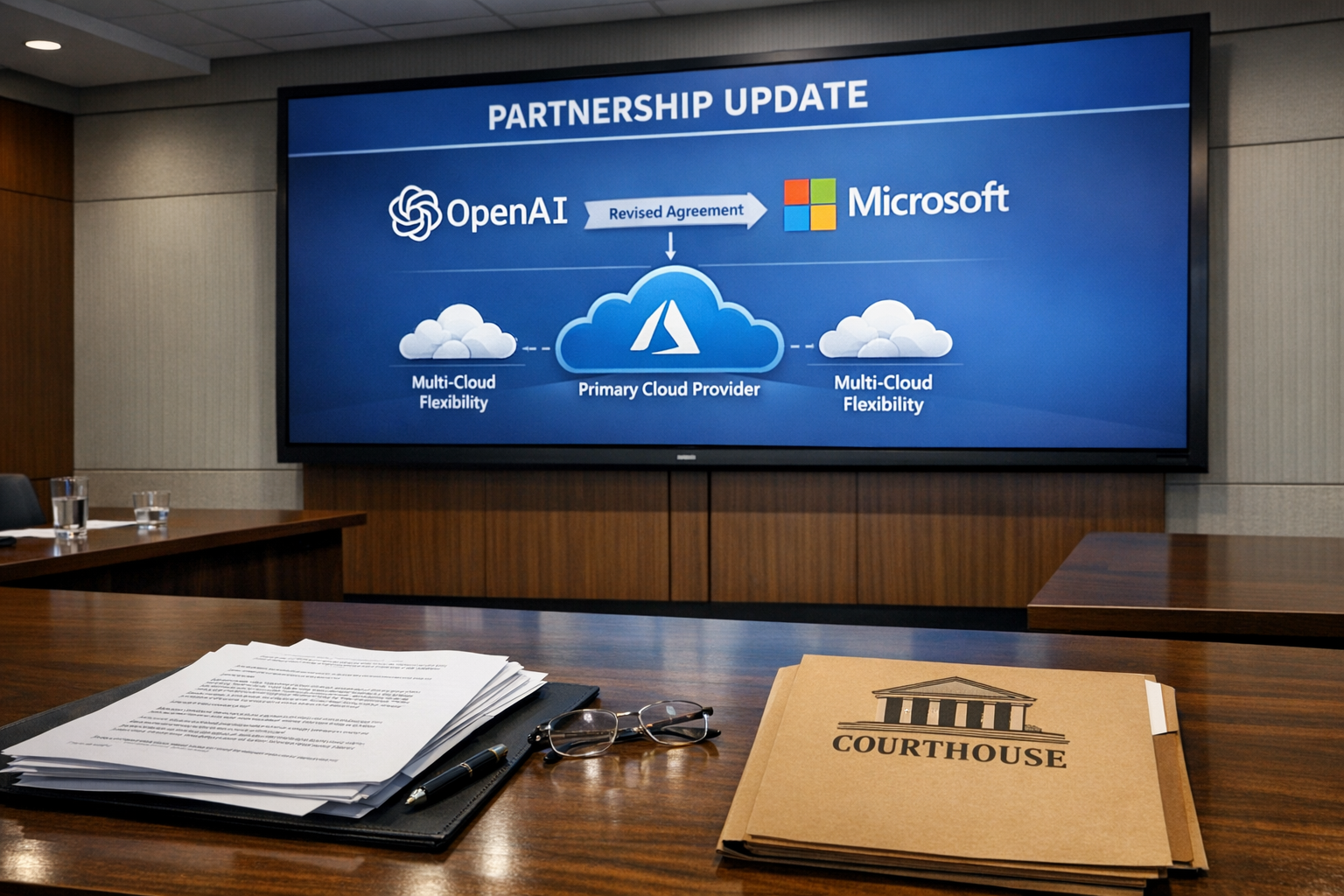
OpenAI and Microsoft on Monday announced a significant revision to their multibillion-dollar partnership, loosening some of Microsoft’s exclusive rights while preserving its central role in OpenAI’s business, just as Elon Musk’s long-running legal challenge to OpenAI’s evolution from nonprofit lab to commercial powerhouse was set to go before a jury in federal court in Oakland, Calif.
The timing placed two of the most consequential questions hanging over OpenAI into unusually sharp relief: how much independence the company really has from Microsoft, and whether its transformation into one of the world’s most valuable and influential artificial intelligence companies is compatible with the mission on which it was founded.
Under the amended agreement, Microsoft will remain OpenAI’s primary cloud provider, and OpenAI’s products will still launch first on Microsoft’s Azure cloud unless Microsoft cannot supply the required capabilities. But OpenAI will now be able to serve products across any cloud platform, according to the companies, a notable shift for a partnership that has helped define the modern A.I. industry.
The revised terms also give Microsoft a nonexclusive license to OpenAI’s model and product intellectual property through 2032. Microsoft will no longer pay revenue share to OpenAI, while OpenAI’s revenue-sharing payments to Microsoft will continue through 2030, subject to a cap.
In practical terms, the deal appears less like a break and more like a recalibration. Microsoft remains deeply embedded in OpenAI’s computing, distribution and commercialization strategy. But OpenAI gains more room to maneuver as demand for A.I. services grows and as cloud capacity, chip access and global distribution have become strategic constraints as much as technical ones.
A Reset, Not a Rupture
The two companies have been intertwined since 2019, when Microsoft first made a major investment in OpenAI and began supplying the enormous computing power needed to train and deploy advanced A.I. systems. That relationship only deepened as OpenAI’s products, especially ChatGPT, became global hits and as Microsoft built OpenAI technology into products across its software empire.
As recently as late 2025, the companies had framed their future in notably tighter terms. In October, they announced a definitive agreement for what they called the next chapter of their alliance, including Microsoft’s support for OpenAI’s path toward a public-benefit-corporation structure and continued Azure API exclusivity until the arrival of so-called artificial general intelligence. Microsoft was also set to hold roughly 27 percent of the recapitalized OpenAI Group P.B.C. on an as-converted diluted basis.
Then, in February, after OpenAI announced new funding and additional partners, both companies said those moves did not alter the October agreement.
That makes Monday’s amendment notable. It suggests that, as OpenAI’s ambitions have expanded, both sides saw a need for clearer and perhaps more flexible rules. OpenAI, racing to serve consumers, developers and large corporate customers, has strong incentives to avoid bottlenecks and preserve optionality. Microsoft, for its part, appears to have secured long-term access to OpenAI technology while giving up some exclusivity that may have become harder to maintain in practice.
The unresolved issue is how much this flexibility will matter. Azure remains OpenAI’s primary cloud partner, and its products are still expected to debut there first. That means Microsoft remains the default infrastructure backbone for one of the most important A.I. companies in the world, even if OpenAI now has more freedom on paper to operate elsewhere.
The Court Fight Over OpenAI’s Origins
At the same time, a very different challenge to OpenAI was arriving in court.
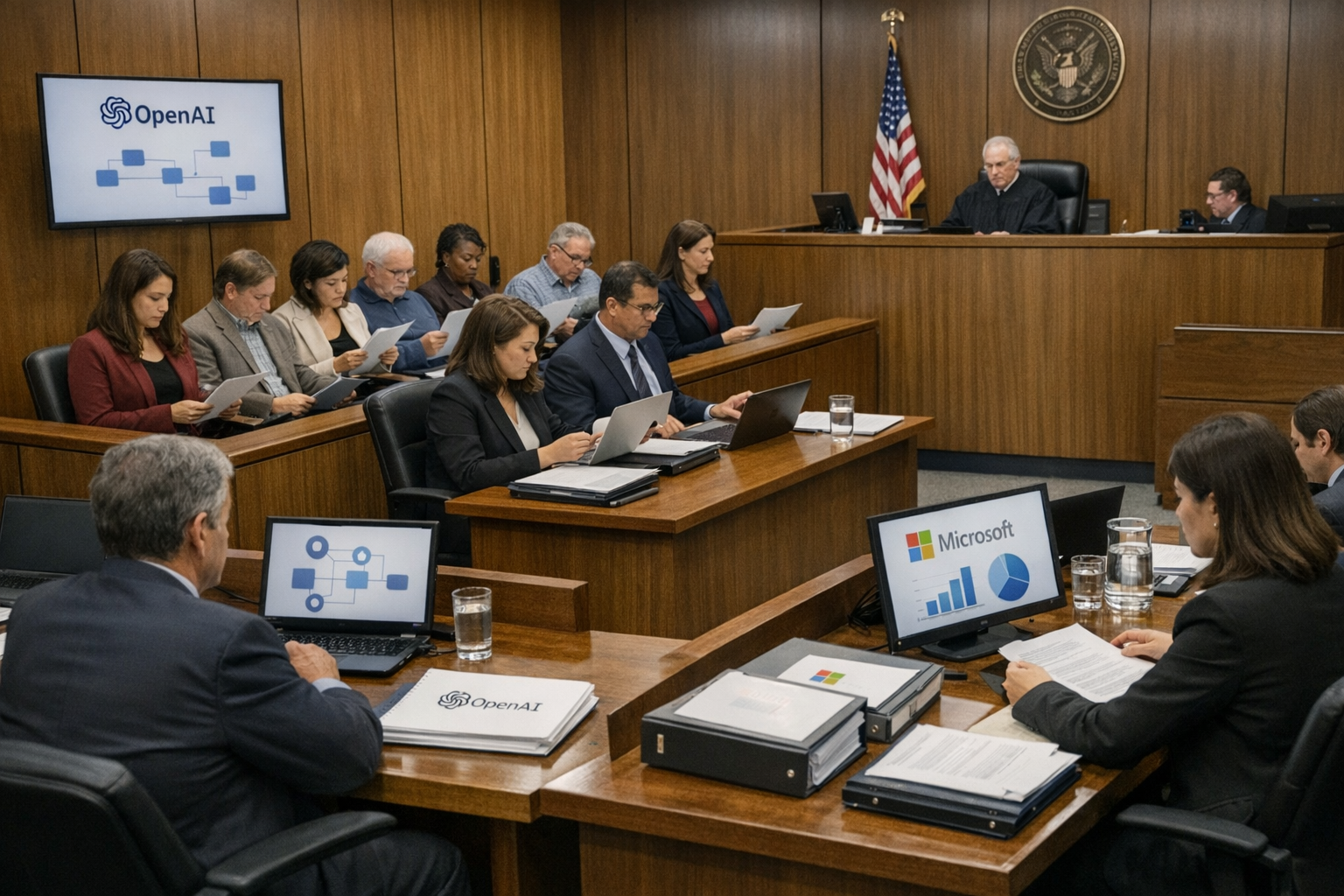
Musk’s lawsuit against OpenAI, its chief executive, Sam Altman, its president, Greg Brockman, and Microsoft was scheduled to begin with jury selection on Monday. The case, filed after years of increasingly public acrimony between Musk and OpenAI’s leadership, argues that the company abandoned its founding mission by moving away from its nonprofit roots and building a profit-driven enterprise closely aligned with Microsoft.
Just before trial, Musk narrowed the case, dropping fraud claims. The trial is expected to proceed on claims including breach of charitable trust and unjust enrichment.
Even in that narrower form, the case could prove consequential. Musk, who helped found OpenAI before later breaking with the organization, is asking the court to scrutinize whether the company’s structure and behavior remained faithful to the principles under which it was created. OpenAI has rejected those accusations and has portrayed Musk as a disgruntled rival.
The courtroom battle is expected to feature testimony from some of Silicon Valley’s most prominent executives, including Musk, Altman and Microsoft’s chief executive, Satya Nadella, as well as internal communications that could shed light on how OpenAI’s leaders understood the trade-offs between mission and commercialization.
Why This Matters Beyond the Case
For much of the past three years, the A.I. boom has been driven not only by scientific advances but by a handful of relationships controlling the things every serious A.I. company needs: chips, cloud computing, distribution and capital. OpenAI’s tie to Microsoft became the most important of those arrangements, serving as both a model and a warning for the industry.
The revised agreement indicates that both companies are trying to adapt to a new phase, one in which OpenAI is too large and too central to the market to remain tightly confined, but still too dependent on computing scale and enterprise reach to operate without a giant partner.
The trial, meanwhile, goes to the legitimacy of that evolution. A verdict may or may not alter OpenAI’s structure directly. But the testimony and records aired in court could shape how regulators, business partners, customers and policymakers understand the company’s governance and obligations.
That matters at a moment when leading A.I. firms face intensifying scrutiny over concentration of power, nonprofit control structures, investor influence and whether public-interest commitments can survive the pressures of a fiercely competitive market.
Taken together, Monday’s developments amount to a pivotal moment for OpenAI. The company is trying to present itself as both more independent and more durable, even as it remains bound to Microsoft and forced to defend, under oath, the choices that made it a titan of the A.I. era.
Sources
Further reading and reporting used to add context:
- https://www.windowscentral.com/artificial-intelligence/microsoft-partnership-has-limited-our-ability-leaked-memo-reveals-openais-open-hostility-towards-one-of-its-biggest-investors
- https://apnews.com/article/eb854fa682675f70267abd8a7b9a6a43
- https://blogs.microsoft.com/blog/2025/10/28/the-next-chapter-of-the-microsoft-openai-partnership/
- https://techxplore.com/news/2026-01-musk-openai-trial-april.html
- https://en.wikipedia.org/wiki/Musk_v._Altman
- https://www.mlex.com/mlex/articles/2429796/us-trial-between-musk-openai-set-to-begin-april-27-in-oakland
- https://www.ktep.org/business/2026-04-27/musk-vs-altman-tech-ceos-head-to-court-monday-over-fate-of-openai
- https://www.lemonde.fr/en/economy/article/2026/04/27/elon-musk-vs-sam-altman-silicon-valley-s-ai-mavericks-face-off-in-court_6752881_19.html
- https://www.wsls.com/news/2026/04/24/elon-musk-and-openai-ceo-sam-altman-head-to-court-in-high-stakes-showdown-over-ai/
- https://cases.justia.com/federal/district-courts/california/candce/4%3A2024cv04722/433688/446/0.pdf
- https://www.investing.com/news/stock-market-news/musks-lawsuit-against-openai-microsoft-heads-to-april-jury-trial-4450989
- https://www.theguardian.com/technology/2026/apr/26/musk-altman-openai-court
- https://www.tomshardware.com/tech-industry/artificial-intelligence/openai-and-microsoft-sign-agreement-to-restructure-openai-into-a-public-benefit-corporation-with-microsoft-retaining-27-percent-stake-non-profit-open-ai-foundation-to-oversee-open-ai-pbc
- https://letsdatascience.com/blog/musk-sued-openai-for-134-billion-the-jury-decides-in-34-days
- https://www.axios.com/2026/02/27/openai-funding-nvidia-amazon
- https://www.sec.gov/Archives/edgar/data/2021728/000162828026025762/cerebras-sx1april2026.htm
- https://aihola.com/article/openai-musk-lawsuit-analysis-2026
- https://fortune.com/2026/04/25/elon-musk-fraud-claims-openai-sam-altman-trial/
- https://arstechnica.com/ai/2025/09/openai-and-microsoft-sign-preliminary-deal-to-revise-partnership-terms/
- https://techxplore.com/news/2026-01-musk-openai-trial-april.pdf
- https://en.wikipedia.org/wiki/OpenAI
- https://www.reddit.com/r/OpenAI/comments/1sx3l9i/the_next_phase_of_the_microsoftopenai_partnership/
- https://www.reddit.com/r/WTFisAI/comments/1sl1j99/elon_musk_is_trying_to_get_sam_altman_fired_by_a/
- https://openai.com/it-IT/index/continuing-microsoft-partnership/
- https://openai.com/index/our-agreement-with-the-department-of-war/
- https://news.microsoft.com/source/asia/features/the-next-chapter-of-the-microsoft-openai-partnership/?lang=ja&msockid=1f93523006536ff73046448a07b76e5a
- https://openai.com/index/accelerating-the-next-phase-ai/
- https://openai.com/nl-NL/index/continuing-microsoft-partnership/
- https://blogs.microsoft.com/blog/author/cdemaria/
- https://blogs.microsoft.com/page/3/
- https://openai.com/de-DE/index/continuing-microsoft-partnership/
- https://openai.com/index/openai-acquires-tbpn
- https://openai.com/index/making-chatgpt-better-for-clinicians/
- https://openai.com/fil-PH/index/continuing-microsoft-partnership/
- https://cdn.openai.com/pdf/8d90a5cb-f93e-45f2-aeb2-0df51cb72f17/20250415-statement-of-recent-decision.pdf
- https://cdn.openai.com/pdf/0ada8797-a5ae-4577-857e-94598d5234d5/2025-04-09-openai-defendants-counterclaims-answer-and-defenses.pdf
- https://cdn.openai.com/pdf/gov.uscourts.nysd.612697.514.0_1.pdf
- https://www.fxleaders.com/news/2026/04/25/elon-musk-drops-fraud-claims-against-openai-sam-altman-before-trial/
- https://cybernews.com/ai-news/musk-drops-fraud-claims-in-openai-lawsuit-two-claims-head-to-trial/
- https://www.obnews.co/Index/newsDetail/id/14885403.html?val=54c8f3cee890b6fbeeb4a681f3995d12
- https://wixx.com/2026/04/24/us-judge-dismisses-musks-fraud-claims-in-openai-case-at-his-request-plans-to-proceed-to-trial/
- https://www.thenews.com.pk/latest/1400339-musk-drops-fraud-claims-against-openai-before-april-trial
- https://www.mlex.com/mlex/articles/2467975/musk-pledges-no-direct-financial-benefit-in-us-openai-case-drops-fraud-claims
- https://news.az/news/judge-clears-fraud-claims-in-musk-vs-openai
- https://www.trustfinance.com/en-US/blog/musk-vs-openai-lawsuit-heads-to-april-jury-trial
- https://www.windowscentral.com/microsoft/microsoft-watched-openai-collect-110-billion-dollars-and-said-were-still-cool-right
- https://www.axios.com/2026/02/27/amazon-openai-stateful-ai-deal
- https://www.windowscentral.com/artificial-intelligence/openai-wont-sever-its-ties-with-microsoft-even-after-declaring-agi
- https://www.skadden.com/-/media/files/publications/2026/02/the_ftc_enters_a_new_chapter_in_its_approach_to_artificial_intelligence_and_enforcement.pdf?rev=7fbe6108113c46edb5757ca9270f5be4
- https://www.reddit.com/r/ElonChat_Commentary/comments/1sv4sbx/elon_musk_dropped_his_fraud_allegations_against/
- https://chatgptiseatingtheworld.com/wp-content/uploads/2026/03/Pretrial-Order-No-1-in-Musk-v.-Altman-Mar-16-2026.pdf
- https://www.reddit.com/r/Optionmillionaires/comments/1sx3e3a/microsoft_says_openai_license_will_now_be/
- https://www.reddit.com/r/ChatGPTcomplaints/comments/1svhkb0/musks_legal_complaint_against_openai/
- https://openai.com/index/joint-statement-from-openai-and-microsoft
- https://openai.com/es-419/index/continuing-microsoft-partnership/
- https://openai.com/id-ID/index/continuing-microsoft-partnership/
- https://openai.com/pl-PL/index/continuing-microsoft-partnership/
- https://openai.com/pt-BR/index/continuing-microsoft-partnership/
- https://openai.com/index/openai-and-microsoft-extend-partnership/
- https://openai.com/index/next-chapter-of-microsoft-openai-partnership//
- https://openai.com/tr-TR/index/continuing-microsoft-partnership/
- https://openai.com/index/openai-nvidia-systems-partnership/
- https://cdn.openai.com/pdf/21b88bb5-10a3-4566-919d-f9a6b9c3e632/openai-ostp-rfi-oct-27-2025.pdf
- https://cdn.openai.com/pdf/openai-ending-the-capability-overhang.pdf
- https://cdn.openai.com/pdf/8e938d69-0b67-4994-b9ff-683733ed587e/openai-letter-minister-solomon.pdf
- The next phase of the Microsoft-OpenAI partnership – The Official Microsoft Blog
- Musk v. Altman et al
- Elon Musk and OpenAI CEO Sam Altman head to court in high-stakes showdown over AI
- The next chapter of the Microsoft–OpenAI partnership – The Official Microsoft Blog
- Joint Statement from OpenAI and Microsoft | OpenAI




Leave a Reply