
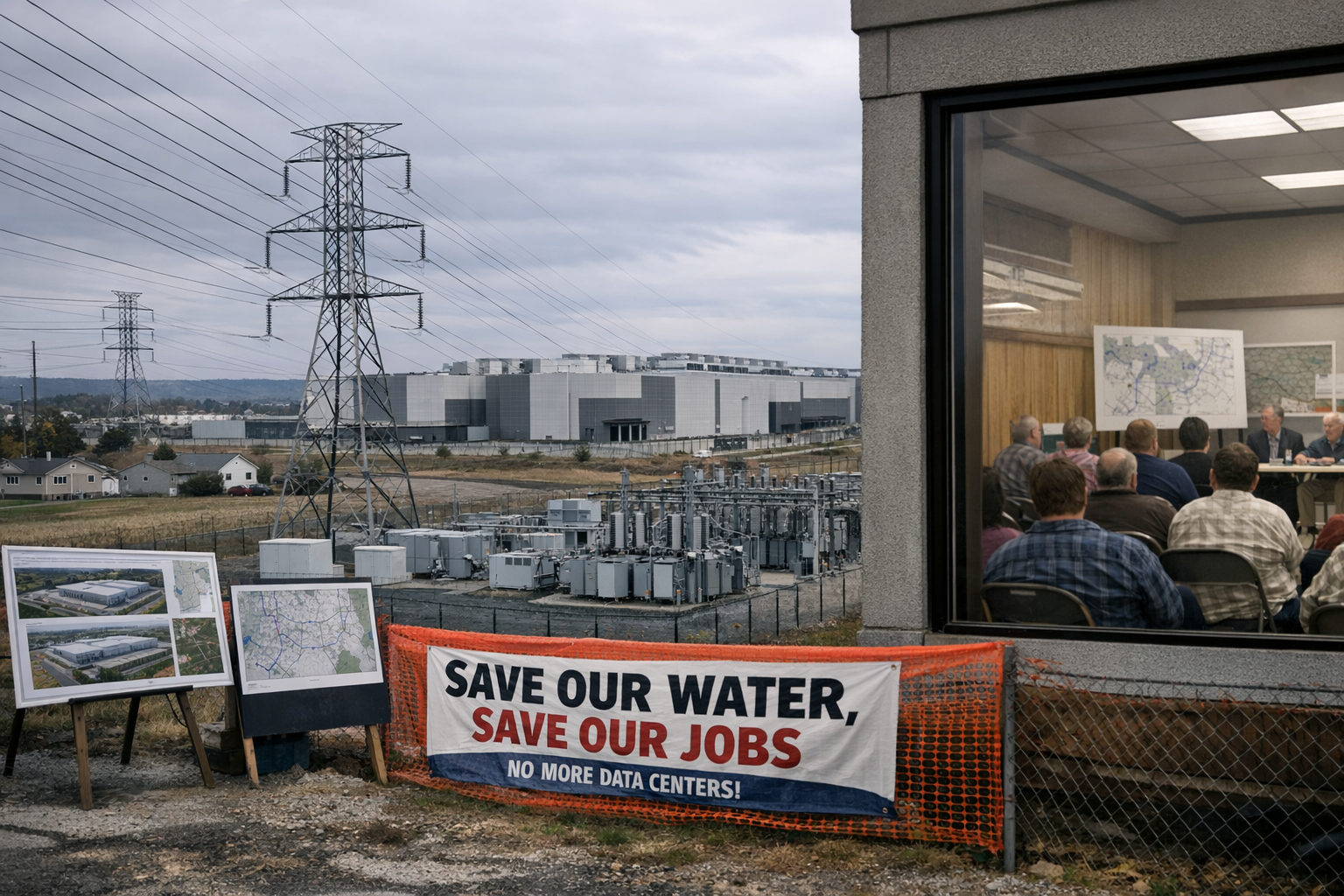
From local fights to national flashpoint
What began as scattered local resistance to new data centers — objections over noise, water use, diesel generators and land consumption — is hardening into something larger: a political struggle over who gets access to scarce electricity, who pays for grid upgrades, and whether the economic promises of the artificial-intelligence boom are real enough to justify its growing footprint.
In Britain, regulators are trying to stop speculative projects from clogging the power queue. In the United States, candidates are turning data-center regulation into a campaign issue. In Australia, a dispute over whether new facilities should run on renewable power has exposed tensions between climate goals and industrial ambition. And in southern Ohio, a vast planned campus has become a proxy for the country’s broader argument over jobs, energy and environmental risk.
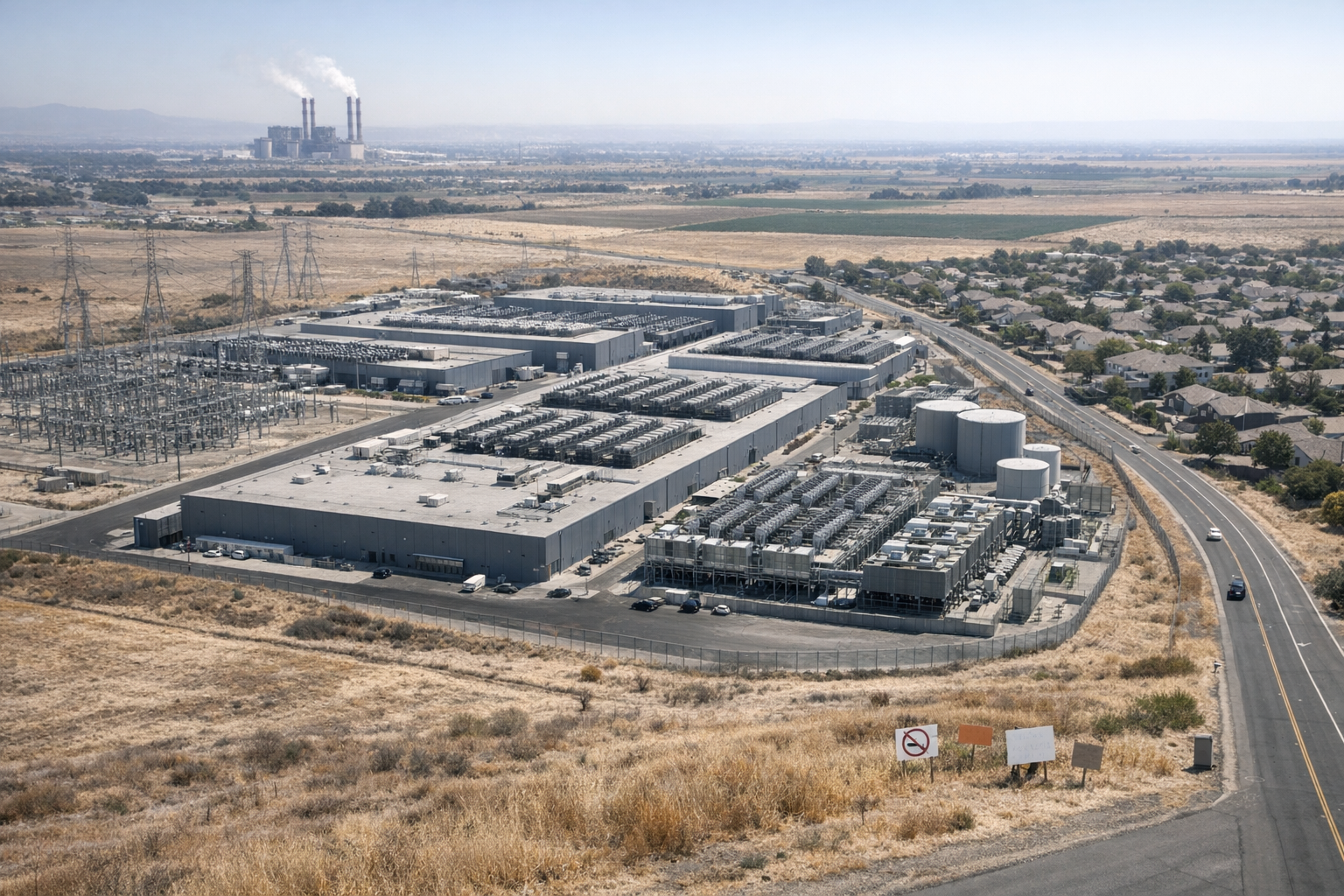
The shift reflects a simple reality. AI systems require immense computing power, and computing power requires electricity — often on a scale that rivals heavy industry. As governments court investment and tech companies race to build, data centers are no longer merely warehouse-like buildings on the edges of town. They are becoming central to debates about energy policy, industrial strategy and public trust.
Britain’s “phantom” projects
In the United Kingdom, the pressure is showing up first in the grid queue.
Ofgem, the energy regulator, is trying to address what officials describe as a proliferation of speculative or “phantom” data-center proposals that have sought grid connections without clear signs they will ever be built. The concern is that such projects can hoard capacity, slowing legitimate developments and complicating Britain’s effort to support both economic growth and its AI ambitions.
The regulator has proposed tougher rules, including nonrefundable commitment fees and milestone requirements meant to force developers to show they are serious. The backdrop is a dramatic surge in contracted demand offers: Ofgem has said those offers rose to 125 gigawatts in June 2025 from 41 gigawatts in November 2024, with data centers a major driver.
That increase far exceeds what many analysts believe will actually materialize. But even if only a fraction of the projects are built, the scramble for access has become intense. Britain’s challenge now is to filter out speculation without deterring real investment in a sector that ministers see as strategically important.
Australia’s uneasy compromise
In Australia, the fight has centered on whether the AI build-out should be tied firmly to clean energy.
Prime Minister Anthony Albanese had been pushing for new AI data centers to be powered entirely by renewables. This week, however, he softened that position, opening the door to carveouts for jurisdictions including Queensland and the Northern Territory after resistance from states and concerns about practical constraints.
The retreat underscored how politically difficult it is to align digital-industrial expansion with climate commitments when grid conditions vary sharply across a country. Nationally consistent standards are still being developed, but the shape of those rules — covering energy, water and land use — remains unsettled ahead of expected federal legislation next year.
The stakes are not trivial. Australia’s market operator, AEMO, has identified data centers as one of the fastest-growing sources of electricity demand. It has projected their consumption could rise to about 12 terawatt-hours by 2030 and 34 terawatt-hours by 2050. By March 2026, 11 large projects totaling 5.4 gigawatts were already moving through the transmission connection process.
Supporters of expansion argue that Australia should seize the opportunity to attract capital and position itself in the AI economy. Skeptics question whether the boom will deliver broad gains in living standards or mostly leave behind power-hungry facilities, construction activity and higher pressure on infrastructure.
Ohio and the politics of promise
In the United States, the most vivid example may be in Piketon, Ohio, where a massive planned AI data-center campus backed by OpenAI, Nvidia and Japanese investors has stirred both excitement and alarm.
The project, announced with great fanfare and described as one of the largest AI computing developments in the world, promises thousands of jobs and billions in investment. For a region long associated with industrial decline and the legacy of uranium enrichment, that promise carries obvious appeal.
But environmental groups and some residents have raised questions about energy demand, water use, long-term employment and who will bear the broader system costs. Mega-projects like this often create large construction work forces, while employing far fewer people once operational. That has sharpened doubts over whether local communities are being asked to absorb enduring environmental and infrastructure burdens in exchange for benefits that may prove narrower than advertised.
Those concerns are increasingly intersecting with electoral politics. More than 15 candidates around the country have signed an “AI Pact” pledging action on data centers and AI safety, an indication that the issue has moved beyond neighborhood hearings and into campaign messaging. In states such as Ohio, where energy, manufacturing and rural land use carry particular political weight, both parties are beginning to treat data centers as a salient voter issue rather than a niche technology story.
A new kind of infrastructure politics
At the heart of these disputes is a more fundamental question: should data centers be treated like any other commercial development, or as a special class of infrastructure with obligations reflecting their outsized demand on public systems?
That question matters because grid capacity is finite, and building more of it is expensive, slow and politically fraught. When a data-center developer secures a place in the queue, it can affect when housing, factories, transit systems or other projects get connected. When utilities upgrade transmission or generation to accommodate large new loads, someone eventually pays — whether through higher rates, public subsidies or both.
The AI boom is forcing countries to confront those trade-offs faster than many expected. What looked at first like a contest to attract the next wave of digital investment is turning into a broader reckoning over how much power should be devoted to it, under what rules, and for whose benefit.
The answers remain unsettled. Britain does not yet know whether stricter queue requirements will remove speculators without chilling investment. Australia has not resolved how stringent its eventual standards will be. In the United States, it is still unclear whether opposition to data centers will coalesce into a durable political movement or remain project-by-project resistance.
What is clear is that the backlash has entered a new phase. Data centers are no longer just a land-use dispute on the edge of town. They are becoming a defining test of how governments balance technological ambition with the costs imposed on the grid, the climate and the communities asked to host the future.
Sources
Further reading and reporting used to add context:
- https://www.axios.com/2026/08/23/2028-democrats-ai-bernie-sanders
- https://apnews.com/article/cd2cfd73e3d41e2baf65bf82702a589b
- The UK Power Grid Has a Phantom Data Center Problem | WIRED
- https://www.wired.com/story/candidates-are-signing-a-pact-promising-action-on-data-centers-and-ai-safety/
- https://www.theguardian.com/australia-news/2026/aug/26/albanese-backs-down-on-states-powering-ai-datacentres-using-sustainable-energy
- https://www.theguardian.com/us-news/2026/aug/26/ohio-datacenter-reaction
- Ofgem acts to free up grid capacity by tackling speculative data centre projects | Ofgem
- https://www.theguardian.com/australia-news/2026/aug/05/chris-bowen-vows-to-override-queensland-and-nt-to-force-renewables-powered-ai-datacentres
- https://www.theguardian.com/australia-news/2026/aug/25/albanese-seeks-to-quell-datacentre-disquiet-as-climate-expert-warns-weve-got-one-shot-to-get-the-rules-right
- https://www.ofgem.gov.uk/consultation/proposed-data-centre-connection-reforms
- https://www.reddit.com/r/politics/comments/1vz3ka5/candidates_are_signing_a_pact_promising_action_on/
- https://www.reddit.com/r/USNewsHub/comments/1vz3kni/candidates_are_signing_a_pact_promising_action_on/
- https://www.reddit.com/r/AnythingGoesNews/comments/1vz3kha/candidates_are_signing_a_pact_promising_action_on/
- https://www.publish-nexus.com/articles/ai-pact-puts-data-centres-and-safety-on-the-ballot
- https://cryptobriefing.com/politicians-ai-pact-data-center-regulation/
- https://www.abc.net.au/news/2026-08-26/gun-licences-restricted-to-citizens-data-centre-carve-out/107079926
- https://www.axios.com/2026/08/19/gop-data-center-memo-ai-election
- https://www.reddit.com/r/inthenews/comments/1vz3kdh/candidates_are_signing_a_pact_promising_action_on/
- https://www.reddit.com/r/theguardian/comments/1vyrf3g/albanese_backs_down_on_states_powering_ai/
- https://www.reddit.com/r/australia/comments/1vys6r2/albanese_backs_down_on_states_powering_ai/
- https://www.reddit.com/r/ausenviro/comments/1vyt78q/albanese_backs_down_on_states_powering_ai/
- https://www.theguardian.com/business/grogonomics/2026/aug/27/ai-boom-noisy-energy-hungry-datacentres-construction-economy
- https://www.theguardian.com/technology/computing/2026/aug/25/all
- https://newsletter.politicalintegrity.us/p/introducing-the-ai-pact
- https://www.aemo.com.au/newsroom/media-release/2026-esoo
- https://www.theguardian.com/technology/2026/aug/11/ai-will-do-more-to-boost-fossil-fuel-production-than-green-energy
- https://www.aemo.com.au/-/media/files/electricity/wem/planning_and_forecasting/esoo/2026/2026-wem-electricity-statement-of-opportunities.pdf?hash=8F07B31AF06B19451ACCF1F085BB76A8&rev=80281c368251452c84bfa16ab4eb9fcd&sc_lang=en
- https://www.aemo.com.au/newsroom/news-updates/digital-demand-surge
- https://www.epa.gov/newsreleases/president-trump-expands-historic-ratepayer-protection-pledge-protect-american
- https://www.aemo.com.au/energy-systems/major-publications/integrated-system-plan-isp
- https://www.aemo.com.au/-/media/files/stakeholder_consultation/consultations/nem-consultations/2024/2025-iasr-scenarios/final-docs/oxford-economics-australia-data-centre-energy-consumption-report.pdf
- https://www.theguardian.com/technology/technology%2Benvironment/environment
- https://www.newstg24.com/the-guardian/
- https://www.ai.gov/
- https://www.aemo.com.au/newsroom/media-release/aemo-publishes-draft-electricity-roadmap-for-consultation
- https://www.hsgac.senate.gov/wp-content/uploads/2026-03-31-Letters-from-Ranking-Member-Blumenthal-to-Public-Utility-Commissions.pdf
- https://announcements.asx.com.au/asxpdf/20260506/pdf/06z8z9fh0cqrf4.pdf
- https://www.whitehouse.gov/wp-content/uploads/2025/07/Americas-AI-Action-Plan.pdf?inline=1
- https://www.aemc.gov.au/sites/default/files/2026-03/Draft%20determination%20-%20Package%202.pdf








Leave a Reply