
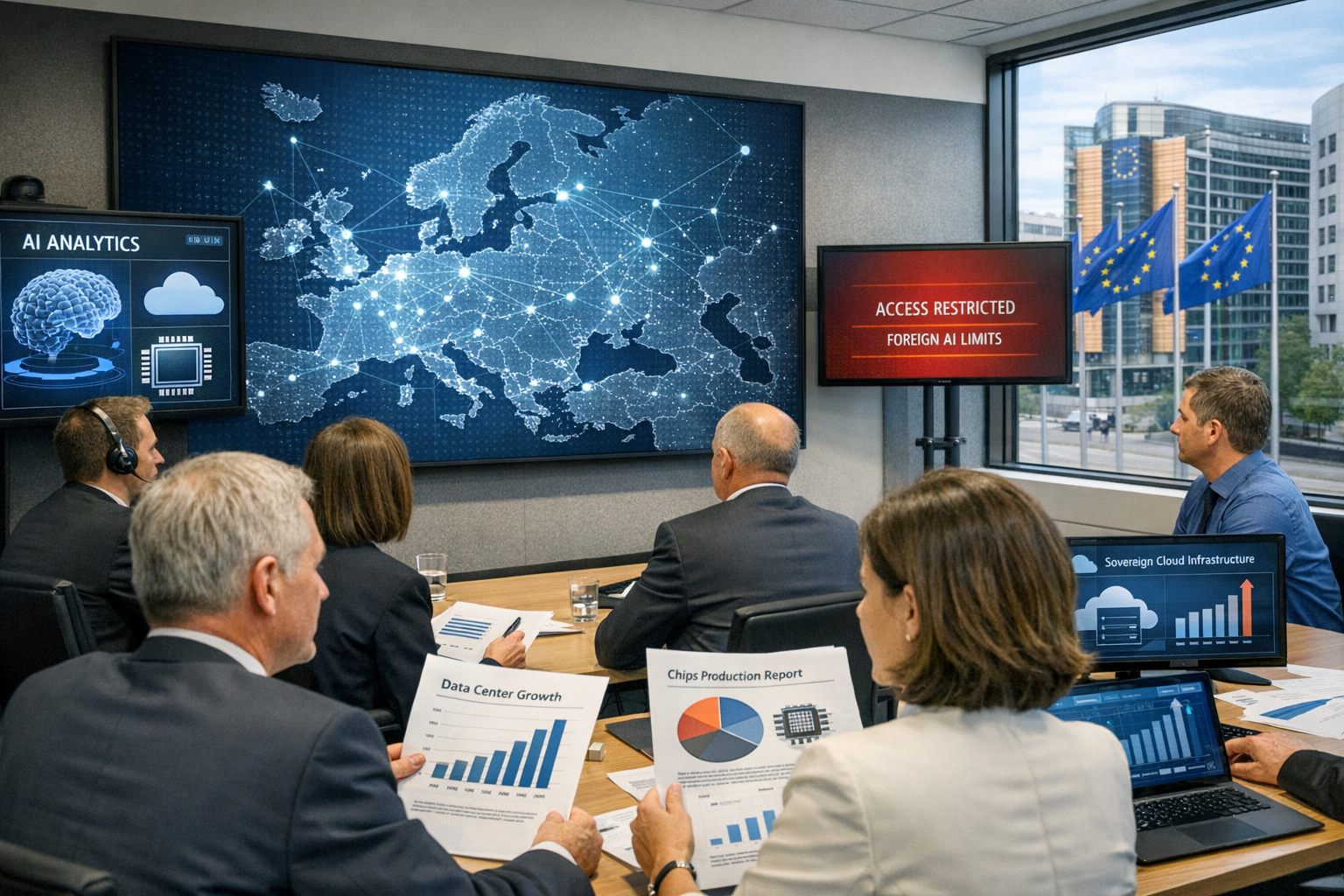
A New Push for “AI Sovereignty” in Europe
Europe’s long-running anxiety about dependence on American technology has found a new and unusually potent symbol: the possibility that access to the world’s most advanced artificial intelligence systems can be curtailed by Washington.
That concern sharpened this month after the Trump administration tightened control over frontier AI access. Anthropic’s leading models were cut off or sharply limited for foreign users, and OpenAI said its newest GPT-5.6 Sol release would be available only to customers approved by the U.S. government. The moves, while framed in Washington as national-security safeguards, landed in Europe as a warning that the continent’s digital future could be subject to decisions made elsewhere.
For European officials, executives and policy analysts, the episode has added urgency to a debate that had already been gathering force in Brussels and national capitals: whether Europe must build not just AI rules, but AI power of its own.
The answer increasingly emerging is yes — though with a distinctly European definition of what sovereignty may actually look like.
Dependence Exposed
For years, Europe has worried about overreliance on foreign cloud providers, semiconductors and digital platforms. But AI has raised the stakes. The most powerful models are becoming general-purpose tools for business, research, defense, public administration and industrial design. If access to those systems can be restricted by another government, European policymakers argue, then dependence on outside providers is no longer merely a commercial vulnerability. It is a strategic one.
That has given fresh force to fears of a foreign “kill switch” — the notion that critical AI capabilities used across European economies could be throttled, withdrawn or selectively licensed during periods of geopolitical tension.
The latest U.S. restrictions did not create Europe’s sovereignty agenda, but they have crystallized it. The European Commission had already been working to reduce risky dependencies in sensitive digital services, speed up data-center construction and bolster semiconductor capacity. Yet the new limits on model access turned what had often sounded like a technocratic policy discussion into something more immediate and political.
In that sense, President Trump may have done what years of European white papers could not: provide a clear demonstration of how AI access itself can become a lever of state power.
Europe’s Opening — and Its Limits
The political opportunity for Europe is obvious. The technological one is harder.
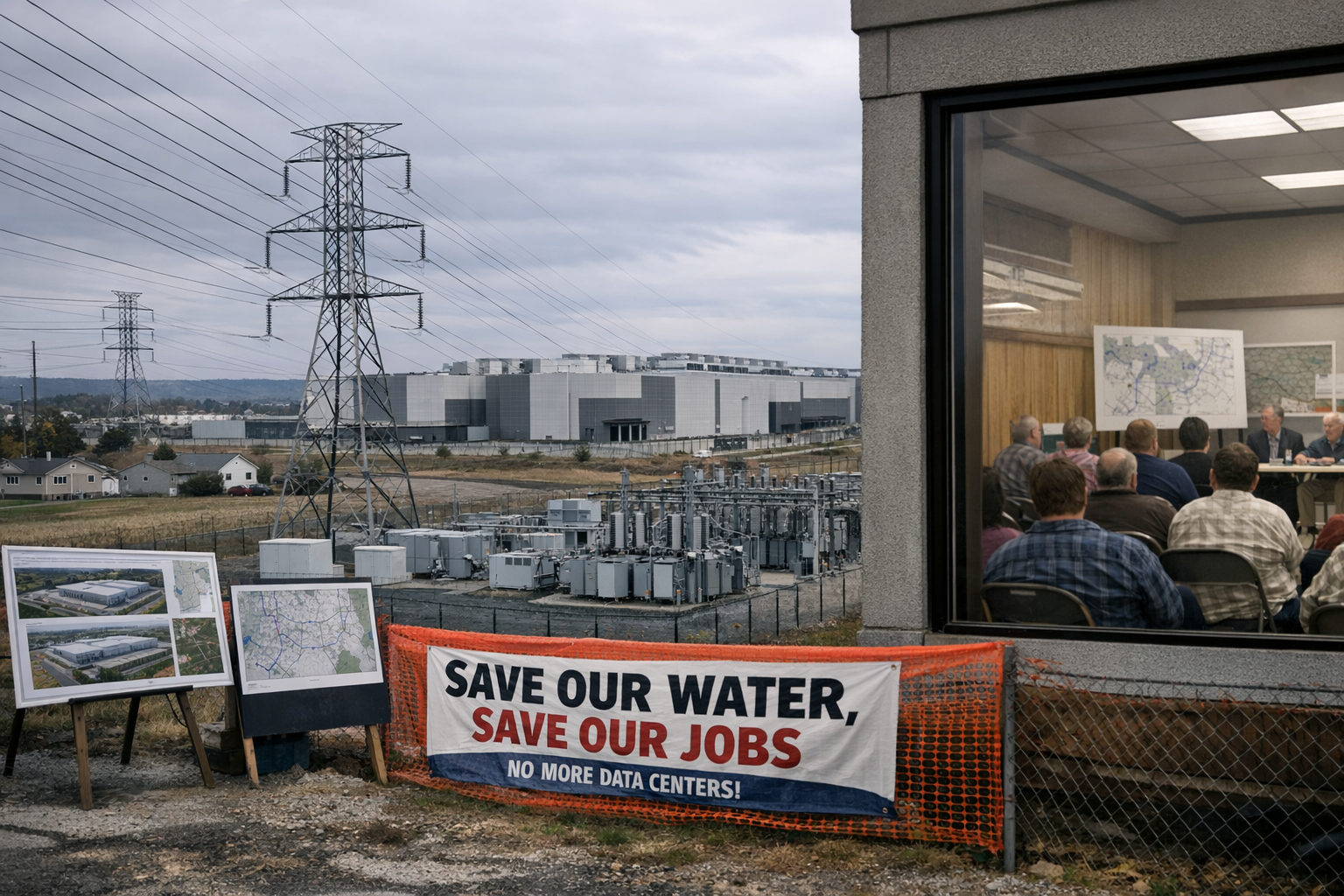
Few serious observers believe the continent can quickly match the biggest American labs model for model. Europe remains at a disadvantage in advanced chips, hyperscale computing and the enormous capital required to train cutting-edge systems. Talent retention remains a challenge, and power supply constraints complicate ambitions for a major expansion in data-center capacity.
Even some supporters of AI sovereignty acknowledge that the most realistic path is not an immediate race to build a continental equivalent of every top U.S. model. Instead, they see Europe’s comparative advantages elsewhere: sovereign infrastructure, localized and specialized models, industrial deployment, multilingual applications, trusted regulation and deeper integration of AI into sectors where Europe still has substantial strength, including manufacturing, health care, engineering and public services.
That narrower view of sovereignty has begun to gain traction. The argument is less that Europe must beat Silicon Valley at its own game tomorrow than that it must ensure it is not structurally dependent on foreign firms for core capabilities the day after.
A Shift From Models to Adoption
Into this debate has stepped OpenAI, advancing a more economic framing of Europe’s AI challenge.
In a new report on the continent’s workforce, the company argues that Europe’s problem is not only whether it can produce top-tier models, but whether its workers, companies and governments can adopt AI quickly enough to remain competitive. The report maps how AI could reshape jobs across the European Union, highlighting occupations likely to be automated in part, expanded by AI assistance or reorganized around new workflows.
That intervention subtly shifts the terms of the argument. Instead of asking only whether Europe can build a frontier model to rival the best American systems, it asks whether Europe can diffuse AI widely through small and medium-size businesses, public institutions and ordinary office work.
This matters because Europe’s economic problem has long been less about scientific talent than about commercialization and scale. The continent has often produced strong research and promising startups, only to see them outgrown by larger American rivals or slowed by fragmented markets, cautious investment and uneven digital adoption.
OpenAI has argued previously that Europe has a “capability overhang” — more latent potential than actual deployment. Earlier this year, it rolled out a blueprint for Europe centered on practical adoption and training, including programs aimed at thousands of small and medium-size enterprises. The latest workforce report extends that case, suggesting that the region’s competitiveness may hinge as much on job redesign and organizational change as on breakthroughs in model development.
The Workforce Stakes
The timing is not accidental. Across Europe, governments are under pressure to show that AI strategy is not just about industrial prestige or security doctrine, but about jobs and productivity.
The central promise of AI adoption is that it could help revive sluggish productivity growth, especially in service-heavy economies where digital tools have often spread more slowly than expected. The central fear is that faster automation will unsettle labor markets already strained by demographic aging, weak growth and political discontent.
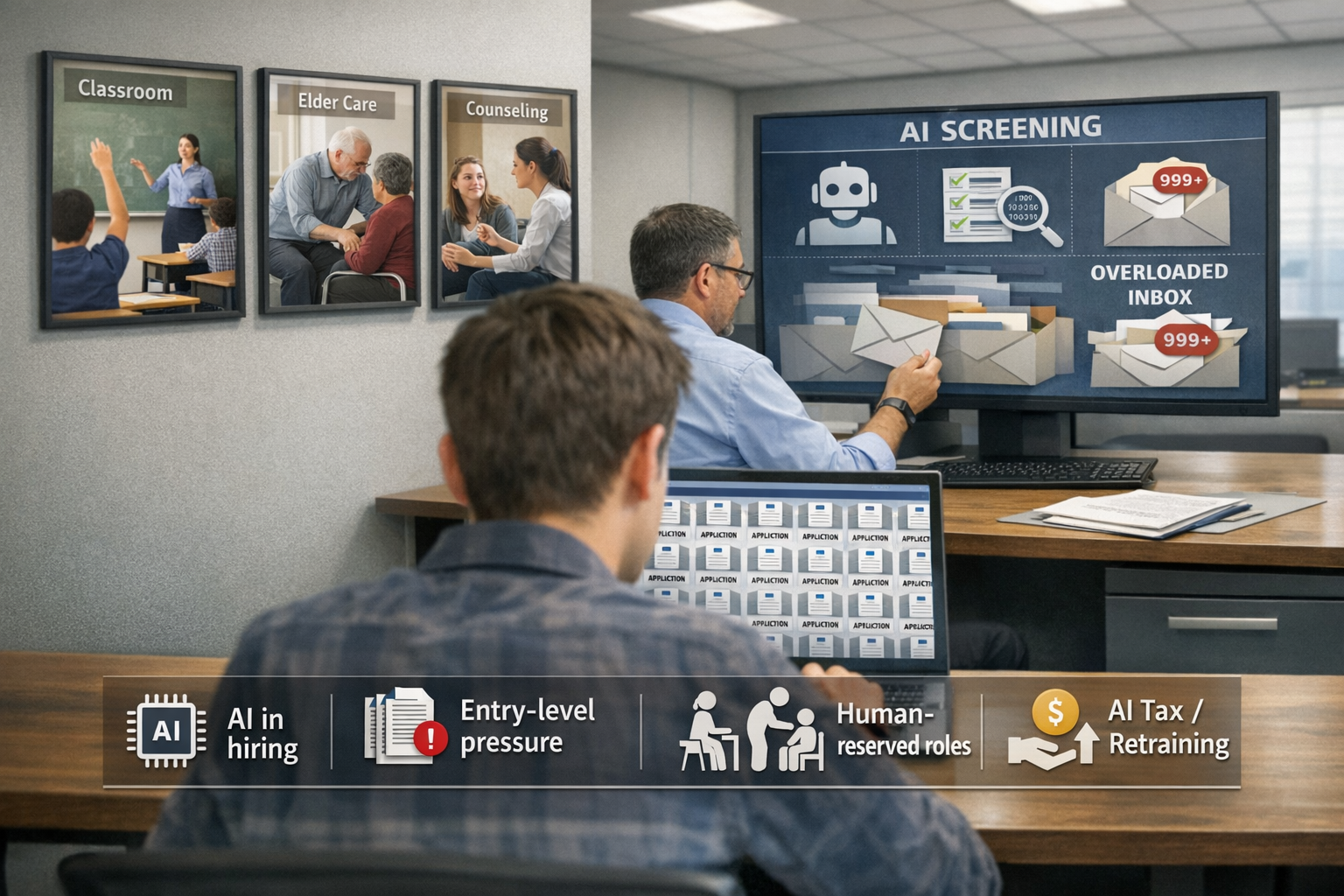
The likely reality, economists say, is more mixed. Many jobs may not disappear so much as change. Clerical work, customer support, compliance tasks, translation, coding, design and administrative functions are all likely to be restructured as AI systems move from answering prompts to carrying out multi-step tasks. Occupations built around routine cognitive work appear especially exposed, while roles that combine judgment, trust, physical presence or regulatory accountability may be altered more gradually.
In Europe, where labor protections are stronger and business adoption is often slower than in the United States, that transition may unfold differently. The pace of change will depend not just on the quality of the models, but on whether firms invest in integrating them into workflows, whether workers are trained to use them and whether regulators permit experimentation without making deployment prohibitively cumbersome.
That is one reason the sovereignty debate has broadened. Building an AI ecosystem now means more than financing labs. It also means securing compute, energy and cloud capacity; training workers; updating procurement rules; and persuading Europe’s vast base of medium-size companies to move beyond experimental chatbot use into deeper operational adoption.
Brussels’ Balancing Act
For European policymakers, this creates a delicate balancing act.
On one hand, the continent has made regulation a central part of its digital identity. On the other, many officials now worry that being the world’s rule-maker will mean little if the underlying technologies are designed, trained and controlled elsewhere. The challenge is to avoid turning sovereignty into a slogan unsupported by enough capital, infrastructure or urgency.
That means confronting old weaknesses. Europe still lacks the abundance of late-stage venture funding common in the United States. Its energy markets are under strain. Permitting for data centers and grid expansion can be slow. And despite recent efforts to develop semiconductor capacity, the continent remains far from self-sufficient in the advanced chips that underpin frontier AI.
Still, the latest U.S. restrictions have given advocates of a more muscular industrial policy a stronger hand. Calls are growing for sovereign cloud arrangements, public-private compute infrastructure, easier data-center approvals and support for European model makers, especially those focused on specialized, multilingual or regulated domains.
The strategic logic is straightforward: even if Europe cannot lead every layer of the AI stack, it may still be able to secure enough control over key layers that its economy is not held hostage to policy decisions abroad.
Why It Matters Now
What has changed is not merely the technology, but the geopolitical atmosphere around it.
The assumption that leading AI models would simply flow across borders as commercial products is giving way to a world in which they may be licensed, restricted or withheld according to national strategy. That possibility has transformed AI from a question of innovation policy into one of economic security.
For Europe, the result is a more urgent, if still unresolved, project. The continent must decide whether sovereignty means trying to recreate the full American AI stack, or building enough domestic capability in infrastructure, deployment and specialized systems to remain strategically autonomous.
The answer will depend on money, electricity, talent and political follow-through. It will also depend on whether U.S. controls remain narrow or harden into a more durable system for gating access to the most advanced models abroad.
For now, one point is no longer in much doubt in Brussels: the era in which Europe could assume that the most important AI tools would always be available on essentially commercial terms appears to be ending. And in that realization, European leaders see both a threat and, perhaps, their last clear opening to build something more independent of their own.
Sources
Further reading and reporting used to add context:
- https://www.axios.com/2026/06/25/trump-administration-openai-gpt-model-release
- OpenAI and Anthropic limit latest ChatGPT products to Trump-approved customers amid review | AP News
- https://www.whitehouse.gov/fact-sheets/2026/06/fact-sheet-president-donald-j-trump-signs-historic-directive-on-ai-in-the-national-security-enterprise/
- https://openai.com/index/how-agents-are-transforming-work/
- https://openai.com/index/lseg/
- https://openai.com/index/the-next-chapter-for-ai-in-the-eu/
- Europe Is Fed Up and Wants Its Own AI | WIRED
- https://techcrunch.com/2026/06/17/world-leaders-want-american-ai-they-just-dont-want-america-to-be-able-to-turn-it-off/
- https://openai.com/index/advancing-youth-safety-and-opportunity-through-global-leadership/
- EU aims to ensure foreign governments or firms cannot disrupt tech services with ‘kill switch’ | European Commission | The Guardian
- https://www.euronews.com/my-europe/2026/06/17/ai-takes-centre-stage-at-g7-as-western-fears-over-us-kill-switch-get-real
- https://www.washingtonpost.com/business/2026/06/03/european-union-brussels-technology-chips-ai-cloud/633768dc-5f55-11f1-9c46-d6211372eede_story.html
- https://www.axios.com/2025/11/21/ai-defense-stocks-europe
- https://openai.com/signals/research/
- https://www.tomshardware.com/tech-industry/artificial-intelligence/us-govt-preps-sweeping-export-controls-for-nvidia-amd-ai-hardware-worldwide-licensing-system-would-give-trump-admin-broad-authority-to-block-global-sales
- https://openai.com/index/next-phase-of-enterprise-ai/
- https://www.lemonde.fr/en/opinion/article/2026/06/16/europe-must-forge-its-own-ai-sovereignty-path-against-american-control_6754537_23.html
- https://www.techradar.com/pro/ai-is-no-longer-borderless
- https://apnews.com/article/d9cc7df5c02e93837d0f0bfb24d5cfd2
- https://www.chathamhouse.org/sites/default/files/2026-05/2026-04-28-how-surge-defence-dual-use-investment-could-reconfigure-global-AI-race-bego.pdf
- https://www.reddit.com/r/EU_Economics/comments/1ugdddn/europe_is_fed_up_and_wants_its_own_ai_wired/
- https://cdn.openai.com/pdf/openai-eu-economic-blueprint-jan-2026.pdf
- https://en.wikipedia.org/wiki/Regulation_of_artificial_intelligence_in_the_United_States
- https://en.wikipedia.org/wiki/A_National_Policy_Framework_for_Artificial_Intelligence
- https://en.wikipedia.org/wiki/United_States_export_controls_on_AI_chips_and_semiconductors
- https://en.wikipedia.org/wiki/AI_safety
- https://www.law.georgetown.edu/georgetown-law-journal/wp-content/uploads/sites/26/2026/05/Chander_The-National-Security-Internet.pdf
- https://en.wikipedia.org/wiki/Artificial_intelligence_policy_of_the_second_Donald_Trump_administration
- https://en.wikipedia.org/wiki/State_AI_laws_in_the_United_States
- https://www.reddit.com/r/u_enoumen/comments/1ugdx8g/ai_daily_news_rundown_white_house_delays_gpt56/
- https://arxiv.org/abs/2606.07245
- https://arxiv.org/abs/2602.10900
- https://openai.com/index/the-state-of-enterprise-ai-2025-report/
- https://openai.com/index/codex-for-knowledge-work/
- https://openai.com/es-ES/index/the-state-of-enterprise-ai-2025-report/
- https://openai.com/global-affairs/accelerating-ai-uptake-in-europe/
- https://openai.com/index/expanding-economic-opportunity-with-ai/
- https://openai.com/ar/index/the-next-chapter-for-ai-in-the-eu/
- https://openai.com/global-affairs/eu-code-of-practice/
- https://openai.com/fr-FR/index/the-state-of-enterprise-ai-2025-report/
- https://openai.com/it-IT/index/the-state-of-enterprise-ai-2025-report/
- https://openai.com/nl-NL/index/the-next-chapter-for-ai-in-the-eu/
- https://cdn.openai.com/pdf/7ef17d82-96bf-4dd1-9df2-228f7f377a29/the-state-of-enterprise-ai_2025-report.pdf
- https://cdn.openai.com/global-affairs/2dbdb523-1a9f-4552-971d-e0948ae2abca/openai-eu-economic-blueprint-apr-2025.pdf?_bhlid=b77ec42a2af6f0298b2156f341618d94afe9b403
- https://cdn.openai.com/pdf/the-ai-jobs-transition-framework_report.pdf?_bhlid=e520d53c5e9ac5ed25f2d3f65ae1d60c870e3f3f
- https://cdn.openai.com/global-affairs/f319686f-cf21-4b8e-b8bc-84dd9bbfb999/oai-workforce-blueprint-oct-2025.pdf
- https://www.weforum.org/stories/2026/01/europe-can-still-win-with-ai-the-key-is-focusing-on-physical-ai/
- https://www.mpl.ai/
- https://www.weforum.org/impact/creating-economic-opportunities-for-all-in-the-intelligent-age/
- https://path.mit.edu/
- https://europe.mistral.ai/
- https://kpmg.com/uk/en/insights/ai/enable-your-organisation-with-kpmg-ai-workforce.html
- https://www.streetinsider.com/Corporate%2BNews/HP%2BInc.%2Bpartners%2Bwith%2BOpenAI%2Bto%2Bdeploy%2BFrontier%2Bplatform%2Bacross%2Boperations/26700757.html
- https://www.adecco.com/en-us/employers/resources/article/adecco-insights-gap-between-ai-and-workforce-readiness
- https://link.springer.com/chapter/10.1007/978-3-032-10561-5_2
- https://gr.linkedin.com/showcase/genai-summit/
- https://www.forbes.com/councils/forbestechcouncil/2025/11/21/will-short-term-decision-making-about-jobs-risk-long-term-business-success/
- https://sdiclarity.ai/agentic-assessment
- https://kpmg.com/kpmg-us/content/dam/kpmg/pdf/2024/kpmg-ai-workforce.pdf
- https://www.reddit.com/r/AIDiscussion/comments/1ufkbb2/do_you_think_ai_will_help_or_hurt_workers/
- https://assets.kpmg.com/content/dam/kpmg/vn/pdf/2025/07/ai-workforce-executive-talkbook.pdf
- https://www.reddit.com/r/europe/comments/1uhy2v0/austria_urges_europe_to_host_anthropic_following/
- https://www.reddit.com/r/OpenAI/comments/1i77fv1
- https://www.reddit.com/r/technology/comments/1uh8kj7/ai_companies_are_learning_an_ironic_lesson_as_the/
- https://www.reddit.com/r/ArtificialInteligence/comments/1u4n434/if_a_huge_of_anthropic_staff_are_foreign/
- https://www.reddit.com/r/ArtificialInteligence/comments/1kz24nl/ai_isnt_taking_our_jobsits_exposing_how_many_jobs/
- https://www.ncaiwpa.org/_files/ugd/86027e_7b152b71a15845ecb043d4df941e6a84.pdf
- https://www.reddit.com/r/Futurology/comments/1u4zld9/ai_could_result_in_net_loss_of_400000_jobs_in/
- https://www.reddit.com/r/womenintech/comments/1ugeazu/company_just_racked_up_a_300000_bill_in_ai_token/
- https://www.chatgptimagegenerator.org/openai-releases-new-ai-jobs-framework-as-pressure-grows-for-workforce-transition-planning/
- https://aichanging.work/en/blog/openai-jobs-transition-framework-april-2026
- https://aiworks.tw/openai-ai-jobs-transition-framework/
- https://www.edtechinnovationhub.com/news/openai-finds-18-percent-of-us-jobs-at-risk-from-ai-as-chatgpt-use-surges
- https://cdn.openai.com/pdf/the-ai-jobs-transition-framework_report.pdf
- https://openai.com/business/guides-and-resources/the-state-of-enterprise-ai-2025-report/
- https://singularity.kiwi/openai-jobs-transition-framework-18-percent-high-risk/
- https://www.portaltela.com/noticias/economia/2026/05/14/ia-pode-afetar-empregos-openai-apresenta-novas-perspectivas/
- https://techscurrent.com/2026/06/openai-codex-data-ai-agents-workflow-systems/
- https://ai2.work/blog/mckinsey-ai-jobs-report-12-of-tasks-automated-8-ai-born-roles
- https://www.techloy.com/workers-in-at-risk-roles-use-chatgpt-3x-more-than-peers-openai-says/
- https://www.kucoin.com/news/flash/openai-report-18-of-us-jobs-face-high-ai-automation-risk
- https://phemex.com/news/article/openai-report-18-of-us-jobs-at-high-risk-of-ai-automation-84214
- https://arxiv.org/abs/2605.23159
- https://arxiv.org/abs/2507.08244
- https://arxiv.org/abs/2604.06906
- https://arxiv.org/abs/2605.00843
- https://www.reddit.com/r/ControlProblem/comments/1segt5h/openai_just_dropped_their_blueprint_for_the/
- https://www.reddit.com/r/u_enoumen/comments/1u166ew/ai_daily_news_rundown_openais_codex_superapp/
- https://www.reddit.com/r/ChatGPT/comments/15bzpqr
- https://www.reddit.com/r/OpenAI/comments/12jb51f
- https://openai.com/index/hp-frontier-partnership/
- https://openai.com/pl-PL/index/codex-for-knowledge-work/
- https://academy.openai.com/public/clubs/champions-ecqup/resources/ai-use-case-workflow-scoper-2026-05-05
- https://openai.com/nb-NO/signals/research/2026q1-update/
- https://openai.com/it-IT/signals/research/2026q1-update/
- https://openai.com/signals/research/2026q1-update/
- https://openai.com/el-GR/index/the-next-chapter-for-ai-in-the-eu/
- https://academy.openai.com/en/public/clubs/champions-ecqup/videos/make-work-flow-proactively-monitor-accounts-with-codex-2026-06-12








Leave a Reply