
Anthropic Moves Claude Code Closer to Self-Directed Teams
Anthropic is pushing its coding product, Claude Code, into a new phase: one in which the software not only acts more independently, but can also coordinate with other instances of itself.
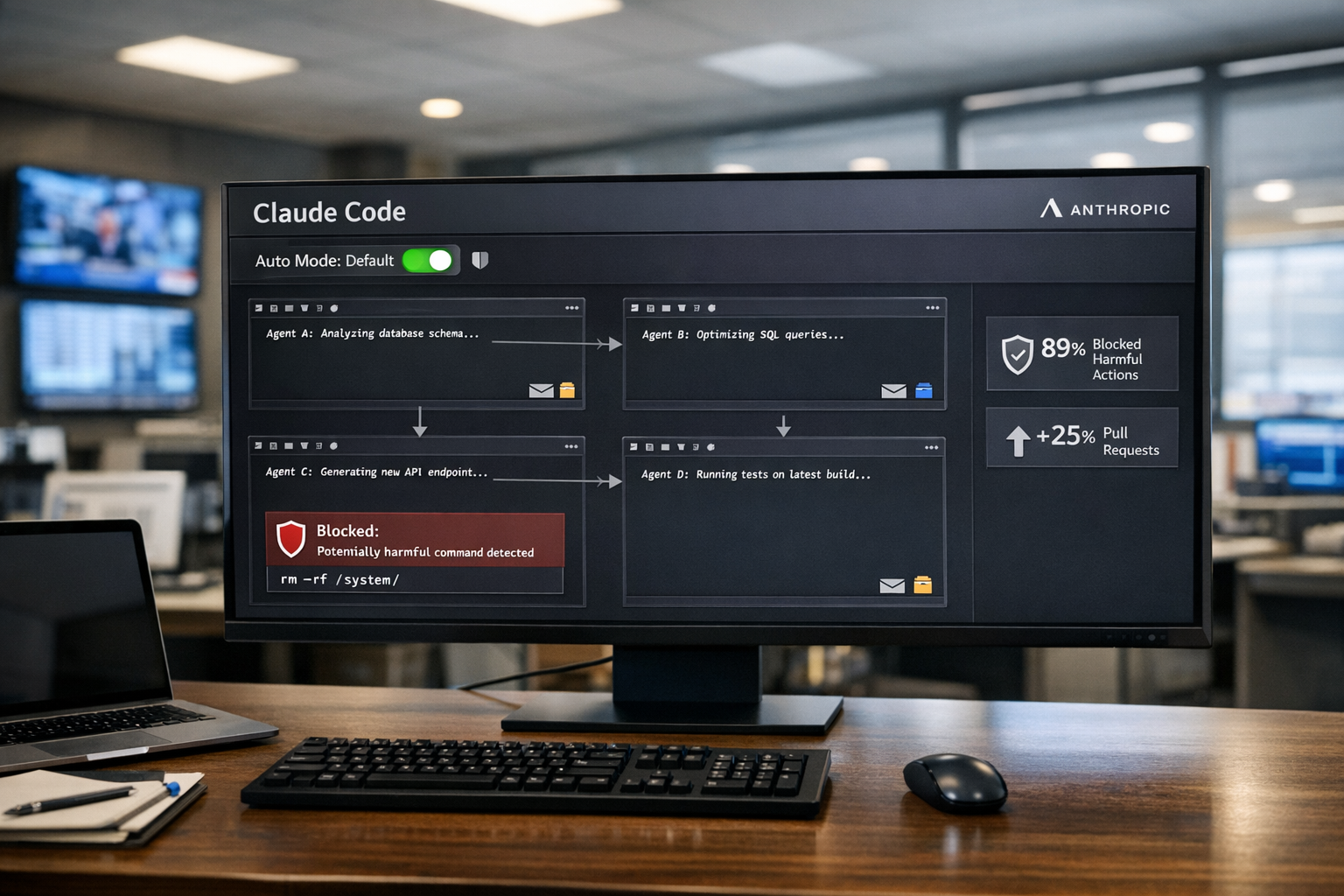
The company said this week that its “Auto Mode” will become the default for new Claude Code sessions on Pro, Max and Team plans beginning Aug. 14, a notable shift for a tool that had previously relied more heavily on user-by-user approvals for sensitive actions. At the same time, Anthropic has introduced features that allow Claude Code sessions to message one another, share summaries and coordinate work across parallel terminals — a set of capabilities that begins to resemble an early operating system for multi-agent software work.
Taken together, the changes signal a broader ambition. Anthropic is no longer simply refining an A.I. coding assistant that responds to prompts. It is building toward a more autonomous system that can sustain longer stretches of work, divide tasks among specialized agents and reduce the amount of human oversight required in the moment.
Replacing the Click-to-Approve Model
Anthropic’s argument for the Auto Mode switch is, in part, a familiar one in software safety: humans are not always reliable gatekeepers.
Auto Mode, introduced earlier this year, uses a classifier to review tool calls and block actions deemed destructive or outside the intended environment, rather than asking users to approve each step manually. Starting next week, that setting will be the default for most paid Claude Code users, though Anthropic is keeping it opt-in for Enterprise, API and cloud-partner deployments for now. The company also said it would stop charging paid-plan customers for the classifier overhead required to run Auto Mode.
In a controlled study cited by Anthropic, 1,053 paid testers were presented with a dangerous command inserted into a session. Just 13.6 percent of human reviewers refused the harmful action. Auto Mode, the company said, blocked 89 percent of those actions. Anthropic has also said that when users are forced to confront many approvals in a row, performance degrades further — a sign of what security researchers and interface designers have long described as confirmation fatigue.
The message is blunt: frequent permission prompts may create the appearance of safety without reliably delivering it.
Anthropic has paired that case with productivity claims. The company says Teams and Enterprise customers using Auto Mode ship roughly 25 percent more pull requests, suggesting that fewer interruptions may translate into faster software output.
From One Agent to Many
If Auto Mode reduces friction within a single coding session, the new messaging features address a different bottleneck: coordination.
Claude Code sessions on macOS and Linux can now send one another targeted messages, status updates and task summaries. Anthropic’s documentation describes a shared task list and mailbox-style communication system that allows parallel sessions to operate as “agent teams.” One instance might investigate a bug, another update documentation and a third test a fix — then pass compressed summaries back and forth without a human manually relaying context.
That is a meaningful step in the architecture of so-called agentic systems. Much of the recent A.I. boom in programming has centered on a single assistant drafting code or executing commands in one thread. Multi-agent workflows require something more: a coordination layer that lets separate workers divide labor, hand off discoveries and avoid stepping on one another’s changes.
Anthropic’s implementation still has constraints. The messages are summaries, not full shared memory or unrestricted file exchange, and some cross-computer communication is routed through Anthropic’s servers. Some features also remain unavailable on platforms such as Amazon Bedrock, Google Cloud’s Agent Platform and Microsoft Foundry.
Still, the design direction is increasingly clear. Anthropic’s own documentation now emphasizes subagents, workflow-based architectures and agent teams, while a recent guide from the company on building effective A.I. agents outlines when developers should use a single agent, a workflow or a multi-agent system.
Safety Claims, and the Questions They Leave Behind
Anthropic has framed the new default not merely as more convenient, but as safer.
In addition to the harmful-command study, the company said a third-party evaluation by Trajectory Labs tested 72 indirect prompt injection scenarios across the latest public versions of Claude Code and OpenAI’s Codex as of mid-July. According to Anthropic, none of 720 attack attempts succeeded against Claude Fable 5, Opus 5 or Sonnet 5 running in Auto Mode.
Those are strong claims in an area where security experts have been especially wary. Coding agents are exposed to untrusted material constantly — package documentation, bug reports, pull requests, code comments and test instructions — all of which can potentially hide malicious instructions. The core fear is prompt injection: that an agent will mistake attacker-controlled text for legitimate guidance and then use its access to execute harmful actions or exfiltrate data.
The company’s data suggests progress, but not finality. An 89 percent block rate still implies failures. And controlled evaluations, while useful, do not always predict how systems will behave in messier real-world toolchains, where attacks may be indirect, adaptive and buried inside ordinary development workflows.
Anthropic itself has stopped short of presenting Auto Mode as foolproof. For high-stakes production work, layered controls and manual review remain relevant. The central debate now is less whether coding agents can be useful than whether their growing autonomy can be made dependable enough for widespread enterprise use.
Why This Matters Now
The timing reflects a broader shift across the A.I. industry. Companies are racing to move beyond chatbots and copilots toward systems that can carry out longer, more complex assignments with less supervision. In software development, that means not just generating code, but planning work, delegating subtasks, testing changes and coordinating specialized processes.
Claude Code is already one of the most closely watched products in that transition. By making Auto Mode the default and adding inter-session communication, Anthropic is betting that the next competitive frontier will be agent orchestration — not simply better answers in a single window, but teams of A.I. workers that can operate semi-independently.
That could have immediate implications for how programming work is organized. Developers may spend less time approving actions step by step and more time supervising outcomes, reviewing pull requests and setting higher-level objectives. The role shifts from direct operator to manager of machine collaborators.
Whether that model proves durable will depend on trust. Anthropic’s updates suggest it believes the technology has matured enough to remove some of the friction that once seemed necessary. The larger question — for customers, rivals and security researchers alike — is whether those safeguards will hold once autonomous agents move from controlled demos into the unpredictable sprawl of real software systems.
Sources
Further reading and reporting used to add context:
- https://www.anthropic.com/research/claude-code-expertise?level=0
- https://www.anthropic.com/news/claude-code-remote-mcp?t=n
- https://www.anthropic.com/news/claude-code-on-team-and-enterprise?t=n
- https://support.anthropic.com/en/articles/9487310-what-are-artifacts-and-how-do-i-use-them
- https://support.anthropic.com/en/articles/9517075-what-are-projects
- https://www.anthropic.com/engineering/how-we-contain-claude
- https://www.anthropic.com/claude?source=syndication
- https://resources.anthropic.com/building-effective-ai-agents
- https://www.anthropic.com/news/introducing-claude-tag?invite=1
- https://support.anthropic.com/en/articles/11817150-connect-your-tools-to-unlock-a-smarter-more-capable-ai-companion
- https://www.anthropic.com/research/economic-index-june-2026-report
- https://www.anthropic.com/news/projects
- https://resources.anthropic.com/hubfs/Claude%20Code%20Advanced%20Patterns_%20Subagents%2C%20MCP%2C%20and%20Scaling%20to%20Real%20Codebases.pdf
- https://resources.anthropic.com/hubfs/Building%20Effective%20AI%20Agents-%20Architecture%20Patterns%20and%20Implementation%20Frameworks.pdf
- https://resources.anthropic.com/hubfs/Scaling%20agentic%20coding%20across%20your%20organization.pdf
- https://www-cdn.anthropic.com/files/4zrzovbb/website/c95395f754f3ca24d46eb352f0c0a71266c36c13.pdf
- https://www-cdn.anthropic.com/8b8380204f74670be75e81c820ca8dda846ab289.pdf
- https://code.claude.com/docs/en/auto-mode-config
- https://claude.com/blog/auto-mode?5a5b91bc_page=4
- https://claude.com/blog/best-practices-for-using-claude-opus-4-7-with-claude-code
- https://code.claude.com/docs/en/configuration
- https://code.claude.com/docs/en/permission-modes
- https://code.claude.com/docs/id/auto-mode-config
- https://claude.com/blog/preview-review-and-merge-with-claude-code
- https://claude.com/blog/introducing-dynamic-workflows-in-claude-code
- https://code.claude.com/docs/en/cli-reference
- https://code.claude.com/docs/es/auto-mode-config
- https://code.claude.com/docs/en/changelog
- https://code.claude.com/docs/en/desktop
- https://code.claude.com/docs/en/sessions
- https://code.claude.com/docs/en/common-workflows
- https://code.claude.com/docs/en/worktrees
- https://code.claude.com/docs/en/how-claude-code-works
- https://code.claude.com/docs/en/agents
- https://code.claude.com/docs/en/glossary
- https://code.claude.com/docs/en/hooks-guide
- https://code.claude.com/docs/en/features-overview
- https://code.claude.com/docs/en/agent-sdk/sessions
- https://code.claude.com/docs/en/agent-teams
- https://code.claude.com/docs/en/channels
- https://code.claude.com/docs/en/settings
- https://code.claude.com/docs/en/security
- https://code.claude.com/docs/es/agent-teams
- https://code.claude.com/docs/en/legal-and-compliance
- https://code.claude.com/docs/de/agent-teams
- https://code.claude.com/docs/ko/agent-teams
- https://code.claude.com/docs/pt/agent-teams
- https://code.claude.com/docs/en/hooks
- Auto mode is now the default in Claude Code for Pro, Max, and Team plans | Claude by Anthropic
- Auto mode for Claude Code | Claude by Anthropic


Leave a Reply