
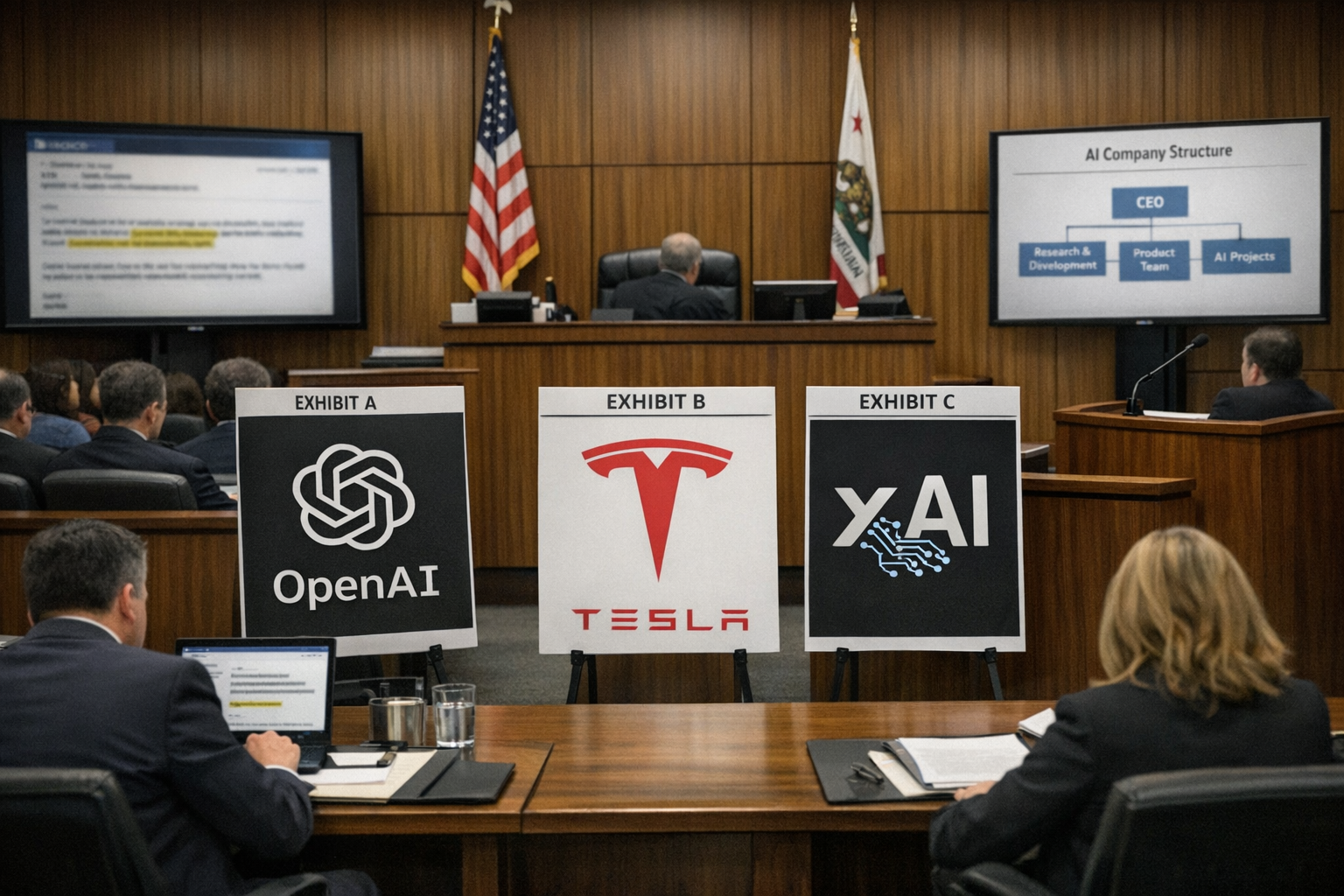
New testimony sharpens the fight over OpenAI’s origins
The courtroom battle over OpenAI’s future took a more combustible turn this week, as jurors heard testimony portraying Elon Musk not simply as a disillusioned co-founder defending a nonprofit mission, but as a powerful figure willing to threaten funding, reshape leadership and, at one point, consider building a competing artificial intelligence effort at Tesla.
In federal court in Oakland, Calif., fresh testimony and internal messages pushed the case into a more personal and strategically consequential phase. Greg Brockman, OpenAI’s president and one of its co-founders, told jurors that a 2017 meeting with Mr. Musk grew so heated that he feared the Tesla chief executive might strike him. And newly disclosed exhibits, along with testimony from Shivon Zilis, showed that people close to Mr. Musk later discussed recruiting Sam Altman — now OpenAI’s chief executive and Mr. Musk’s chief adversary in the case — to lead a Tesla-based A.I. lab.
Those disclosures add new weight to OpenAI’s central defense: that the dispute is not only about whether the company drifted from its founding ideals, but also about power, control and competition in the race to dominate artificial intelligence.
Mr. Musk sued OpenAI in 2024, accusing Mr. Altman, Mr. Brockman and the company of violating a founding understanding that OpenAI would remain devoted to a charitable mission rather than evolve into a profit-seeking enterprise. He is seeking sweeping remedies, including damages and changes to OpenAI’s structure and leadership. OpenAI has denied wrongdoing and argues that Mr. Musk himself supported more commercial approaches before leaving the organization after failing to gain control.
Brockman describes a threatening 2017 confrontation
The most dramatic testimony came from Mr. Brockman, who described an August 2017 meeting over OpenAI’s direction and control. According to his account, Mr. Musk became enraged during the discussion, and the encounter felt sufficiently menacing that Mr. Brockman said, “I actually thought he was going to hit me.”
Mr. Brockman said Mr. Musk then threatened to cut off funding unless important leaders left their roles, a claim that, if credited by jurors, could reinforce OpenAI’s contention that Mr. Musk’s break with the organization was driven at least in part by a struggle for influence.
That testimony goes to the heart of one of the trial’s biggest factual disputes. Mr. Musk has cast himself as the defender of OpenAI’s original mission to build advanced A.I. for the public good. OpenAI, by contrast, has tried to show that long before ChatGPT transformed the company into a global force, tensions with Mr. Musk centered on governance, authority and who would steer the lab.
The vividness of Mr. Brockman’s account may matter. Trials involving corporate structure can often descend into abstractions about charters, board votes and financing terms. A witness describing fear of physical intimidation gives jurors a more visceral narrative — one that could shape how they interpret the rest of the documentary evidence.
Tesla recruitment plans complicate Musk’s narrative
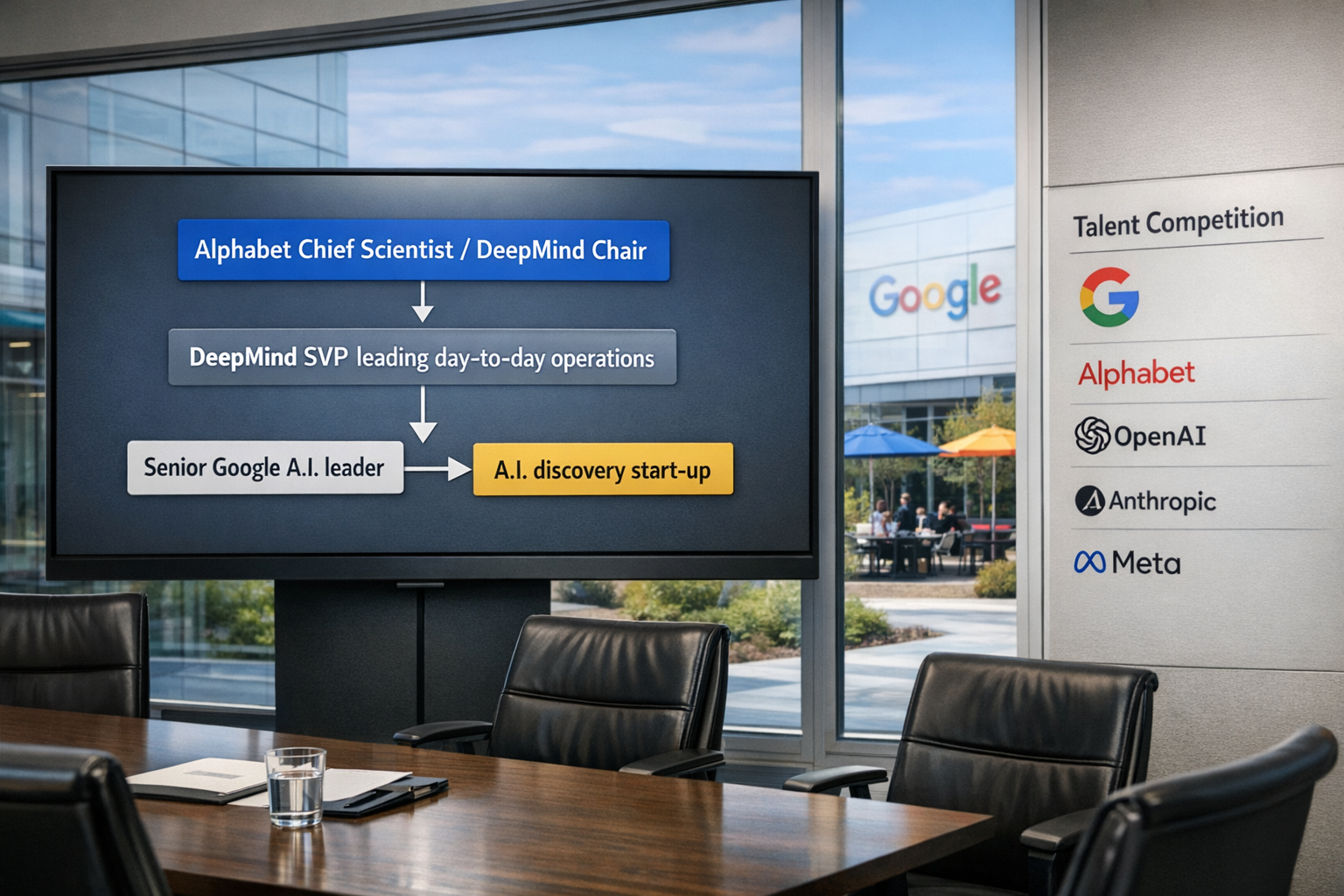
If Mr. Brockman’s testimony cast the breakup in emotional terms, newly aired messages offered a strategic dimension. Court exhibits showed that in late 2017, Mr. Musk’s allies explored the creation of a Tesla A.I. lab and considered high-profile candidates to lead it, including Mr. Altman and Demis Hassabis, the prominent A.I. researcher and executive.
The discussions also included the possibility of giving Mr. Altman a Tesla board seat, according to the exhibits.
That evidence could prove especially awkward for Mr. Musk’s legal theory. His case depends heavily on persuading jurors that OpenAI’s later commercialization represented a betrayal of its founding purpose. But if jurors conclude that Mr. Musk and his allies were themselves weighing a more conventional corporate vehicle for frontier A.I. work outside OpenAI, the moral clarity of that claim may erode.
The recruitment discussions do not by themselves resolve the legal questions in the case. Mr. Musk’s lawyers can argue that exploring alternatives after a governance rupture is different from endorsing OpenAI’s eventual transformation. Still, the messages give OpenAI a concrete way to argue that Mr. Musk was not only objecting to commercialization in principle, but also contemplating his own rival path.
Zilis’s testimony adds another layer to the governance fight
Ms. Zilis, a Neuralink executive who served on OpenAI’s board from 2020 to 2023, took the stand as one of the trial’s most closely watched witnesses. Her testimony touched on internal concerns about OpenAI’s governance and communication, including around the launch of ChatGPT, the product that turned the company into one of the most important — and valuable — businesses in technology.
OpenAI has suggested that Ms. Zilis acted, in effect, as an informant for Mr. Musk while maintaining ties to the company, a contention that adds still more intrigue to a case already filled with former allies accusing one another of concealment and self-interest. Her testimony gave jurors a window into the internal frictions that followed OpenAI’s explosive growth, when questions about who knew what — and when — became central to board oversight.
That line of testimony arrives as the case broadens beyond a simple argument over nonprofit doctrine. Earlier testimony from former OpenAI leaders, including the company’s former chief technology officer, Mira Murati, raised broader concerns about management and governance. Together, those accounts suggest a company whose internal structure struggled to keep pace with its technical and commercial ascent.
Why the stakes extend beyond the personalities
The legal fight is, on one level, an exceptionally bitter dispute among Silicon Valley insiders who helped start one of the defining companies of the A.I. era. But the case also carries unusually high stakes for the industry.
OpenAI sits near the center of a worldwide contest over generative A.I., with products and partnerships that have helped reset expectations for search, software, education and office work. Any ruling that forces changes to its governance, limits its commercial structure or removes top executives could ripple far beyond the company itself.
Mr. Musk is seeking not only enormous damages but structural remedies that could alter OpenAI’s trajectory. At issue is whether the organization’s hybrid model — rooted in a nonprofit parent but operating through profit-seeking entities — is a permissible evolution or a deviation from what founders and donors were originally promised.
The timing matters, too. The trial is unfolding as competition in advanced A.I. has intensified and as concerns about safety, corporate control and concentration of power have become more urgent. The question of whether frontier A.I. should be governed primarily as a mission-driven public trust or as a conventional business is no longer theoretical. It sits at the center of the industry’s future.
A case increasingly about motive
As proceedings continue, likely through later this month, the jurors will have to decide how to interpret the swelling pile of messages, memories and competing motives. Did Mr. Musk fight OpenAI because it abandoned its founding principles? Or did he turn against it after losing influence and then seek alternate ways to control or compete in A.I.?
This week’s evidence does not settle that question. But it has made the picture messier, and perhaps more revealing.
The image emerging from the courtroom is not of a clean ideological rupture, but of an organization born from grand ideals and shaped from the start by personality clashes, boardroom maneuvering and the immense pressure of a technology that quickly became too important, and too lucrative, for anyone involved to treat casually.
Sources
Further reading and reporting used to add context:
- https://apnews.com/article/4f8810743d6ef9a72f91f8721a3f4027
- https://www.techradar.com/ai-platforms-assistants/the-worst-case-situation-is-where-it-is-a-terminator-situation-elon-musk-invokes-killer-robots-in-openai-trial
- https://www.techradar.com/ai-platforms-assistants/chatgpt/without-me-openai-wouldnt-exist-says-elon-musk-as-courtroom-clash-with-sam-altman-turns-personal-and-exposes-a-deeper-fight-over-who-really-built-the-company-behind-chatgpt
- https://apnews.com/article/837bdc3fbced2a02f0f93a1899260bdd
- https://www.axios.com/2026/05/05/musk-open-ai-idealism
- https://www.theguardian.com/technology/2026/may/06/shivon-zilis-testimony-elon-musk-openai-lawsuit
- https://techcrunch.com/2026/05/06/how-elon-musk-left-openai-according-to-greg-brockman/
- https://www.theguardian.com/technology/artificialintelligenceai
- https://techcrunch.com/2026/05/04/elon-musk-sent-ominous-texts-to-greg-brockman-sam-altman-after-asking-for-a-settlement-openai-claims/
- https://www.forbes.com/sites/aliciapark/2026/05/05/i-thought-he-was-going-to-hit-mebrockman-recalls-musks-anger-after-being-denied-openai-control/
- https://arstechnica.com/tech-policy/2026/05/openai-president-explains-to-jury-why-his-diary-entries-sound-greedy/
- Elon Musk’s Last-Ditch Effort to Control OpenAI: Recruit Sam Altman to Tesla | WIRED
- ‘I Actually Thought He Was Going to Hit Me,’ OpenAI’s Greg Brockman Says of Elon Musk | WIRED
- https://www.investing.com/news/stock-market-news/musk-sought-settlement-with-openai-before-oakland-trial-filing-shows-4655614
- https://www.theringer.com/2026/04/30/tech/elon-musk-testimony-open-ai-trial-sam-altman-greg-brockman
- https://letsdatascience.com/news/musk-faces-new-trial-evidence-on-openai-governance-e61b9f78
- https://www.latimes.com/business/story/2026-04-27/elon-musk-openai-ceo-sam-altman-head-to-court-in-high-stakes-showdown-over-ai
- https://en.wikipedia.org/wiki/Musk_v._Altman
- https://cand.uscourts.gov/news/2026/05/01/musk-v-altman-trial-listen-live
- https://www.wired.com/story/greg-brockman-testifies-musk-v-altman-trial/
- https://www.wired.com/story/livestream-musk-v-altman-trial/
- https://www.wired.com/story/model-behavior-elon-musk-cross-examined-sam-altman/
- https://www.wired.com/story/model-behavior-elon-musk-testifies-at-musk-v-altman-trial/
- https://www.wired.com/story/model-behavior-why-everything-in-musk-v-altman-leads-back-to-shivon-zelis/
- https://www.wired.com/story/some-musk-v-altman-jurors-dont-like-elon-musk/
- https://www.wired.com/story/elon-musk-boost-new-yorker-article-sam-altman-x/
- https://www.wired.com/story/musk-v-altman-trial-openai-xai/
- https://www.wired.com/story/elon-musk-distill-openai-models-partly-xai/
- https://files.cand.uscourts.gov/files/18-cv-04865-EMC%20In%20re%20Tesla%20Inc.%20Securities%20Litigation/Trial%20Exhibit%200083%20-%208.03.18%20Minutes%20for%20BOD%20Meeting.pdf
- https://files.cand.uscourts.gov/files/18-CV-07591_CCSF_v_Purdue/2022.06.01%20The%20People%27s%20Exhibits/P-02419_00001.pdf
- https://files.cand.uscourts.gov/files/18-cv-04865-EMC%20In%20re%20Tesla%20Inc.%20Securities%20Litigation/Trial%20Exhibit%200102%20-%20Social%20Media%20Policy.pdf
- https://files.cand.uscourts.gov/files/18-CV-07591_CCSF_v_Purdue/2022.05.17%20The%20Peoples%20Exhibits/P-08057_00001.pdf
- https://files.cand.uscourts.gov/files/18-cv-04865-EMC%20In%20re%20Tesla%20Inc.%20Securities%20Litigation/Trial%20Exhibit%201008%20-%208.15.2018%20NYT%20Article.pdf
- https://www.techradar.com/ai-platforms-assistants/this-is-a-real-risk-we-all-could-die-as-a-result-of-artificial-intelligence-the-openai-trial-took-a-dramatic-turn-as-elon-musk-and-sam-altman-faced-off-over-ais-real-world-danger
- https://www.techradar.com/ai-platforms-assistants/gen-z-hate-ai-the-musk-vs-altman-trial-heats-up-openai-phone-rumors-buzz-and-more-of-the-weeks-most-surprising-developments
- https://www.tomsguide.com/ai/i-was-a-fool-elon-musk-calls-openais-mission-a-safety-risk-but-courtroom-gaffe-proves-hes-out-of-the-loop
- In OpenAI trial, former technology chief says Altman sowed ’chaos,’ distrust among top executives By Reuters
- https://www.forbes.com/sites/aliciapark/2026/05/04/musk-suggested-settling-with-openai-just-before-trial-then-went-on-attack-new-court-filing-shows/
- https://news.bloomberglaw.com/california-brief/musk-weighed-offering-altman-tesla-board-seat-jury-told-1
- https://techcrunch.com/2026/04/29/on-the-stand-elon-musk-cant-escape-his-own-tweets/
- https://yro.slashdot.org/story/26/05/05/2259238/brockman-rebuts-musks-take-on-startups-history-recounts-secret-work-for-tesla
- https://www.bloomberg.com/news/articles/2026-04-11/openai-accuses-musk-of-ambush-as-100-billion-plus-trial-looms
- https://www.washingtonpost.com/technology/2026/05/02/musk-altman-openai-trial/
- https://www.indiatoday.in/technology/news/story/elon-musk-knows-cars-knows-rockets-but-is-clueless-about-ai-openai-exec-tells-court-on-day-6-of-trial-2907337-2026-05-06
- https://en.wikipedia.org/wiki/OpenAI
- https://www.reddit.com/r/AIGuild/comments/1t3yin8/openai_wants_to_use_elon_musks_pretrial_message/
- https://en.wikipedia.org/wiki/Removal_of_Sam_Altman_from_OpenAI
- https://en.wikipedia.org/wiki/Greg_Brockman



Leave a Reply