
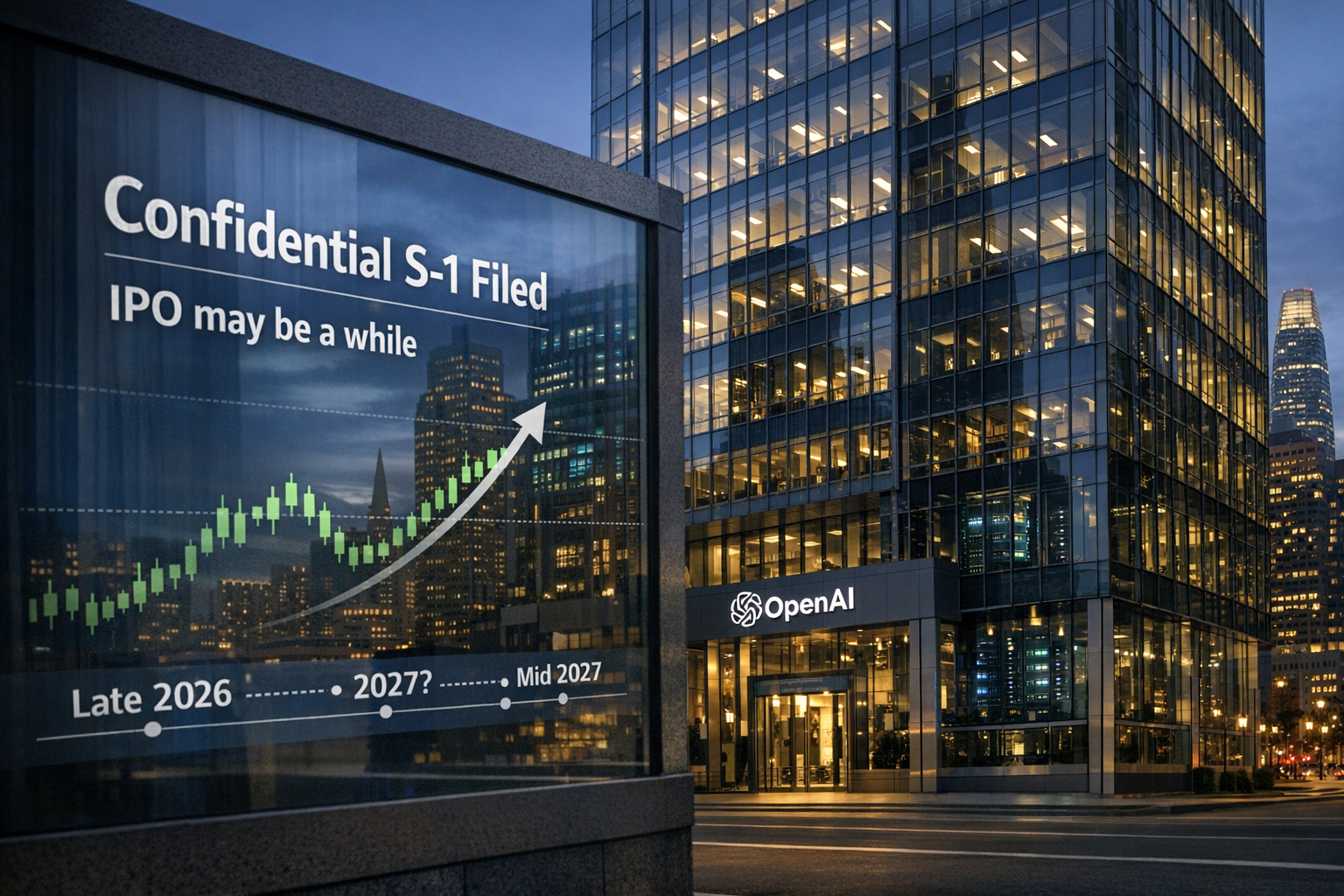
OpenAI Signals Its Stock Market Debut May Not Be Imminent
OpenAI, the maker of ChatGPT, has moved a step closer to the public markets while making clear that investors should not expect an immediate debut.
The company said on June 8 that it had confidentially submitted a draft S-1 registration statement to the Securities and Exchange Commission, a standard step for companies preparing for an initial public offering. But in announcing the filing, OpenAI emphasized that it had not settled on a timetable, saying an IPO “may be a while” because some of the things it wants to accomplish are easier to do as a private company.
That caution was reinforced days later, when Sam Altman, OpenAI’s chief executive, told employees that he expected a public offering “within the next year,” according to follow-up reporting — language that suggests the company sees the listing window as flexible rather than fixed.
The result is a notable shift in how OpenAI’s plans are being read on Wall Street and in Silicon Valley. A confidential filing often stokes expectations that a flotation is near. In OpenAI’s case, however, the message appears to be that the company wants to preserve the option to go public without committing to a rapid launch.
A Filing That Creates Options, Not a Deadline
For a company of OpenAI’s scale and prominence, the distinction matters.
A confidential IPO filing allows a company to begin the regulatory process away from public view, giving executives time to respond to SEC questions and prepare investor materials before financial disclosures become public. It also gives management flexibility: if market conditions worsen, or if strategic priorities change, the company can wait.
That appears to be what OpenAI is signaling now. Mr. Altman’s “within the next year” formulation leaves open several scenarios: a listing later in 2026, a delay into 2027, or a faster move if conditions become favorable. For prospective investors, employees and rivals, that means the company’s arrival on the public markets remains a moving target.
The ambiguity is unusual only in degree. OpenAI is not a conventional software company coming to market after years of steady expansion. It sits at the center of an AI boom that has reshaped capital markets, corporate strategy and the broader technology industry. Any public offering by the company would be among the most consequential tech listings in years.
Why the Timing Matters
OpenAI is expected to command a valuation above $850 billion, which would make its debut one of the largest and most closely watched in market history.
That helps explain why even a subtle change in timetable is significant. If OpenAI goes public soon, it could become the defining test of how public investors value generative AI companies: not just on revenue growth and market share, but on the enormous cost of building and operating advanced models. A later offering, by contrast, would suggest the company believes it can create more value — or reduce uncertainty — by staying private longer.
The timing also matters because going public would force OpenAI to reveal more about its finances, risks and governance. Investors have so far had only a partial picture of the economics behind the company’s rapid ascent. A public filing would begin to answer basic questions about revenue concentration, spending on chips and data centers, profitability and the legal and regulatory risks surrounding advanced AI systems.
For now, the confidential filing means those disclosures remain out of sight.
Part of a Broader Rush to Market
OpenAI’s move came just after Anthropic disclosed its own IPO step, underscoring how quickly the leading AI companies are gravitating toward public markets. The clustering is unlikely to be coincidental.
The artificial intelligence race has become extraordinarily expensive, with companies spending heavily on computing infrastructure, talent and partnerships. Public markets offer access to a much deeper pool of capital than private fundraising alone. At the same time, they impose scrutiny that many fast-growing AI companies have, until now, been able to avoid.
OpenAI has already taken steps that suggested it was preparing for that transition. The company recently converted to a public benefit corporation while remaining under nonprofit control, a structure intended to balance its commercial ambitions with its stated public-interest mission. It also cleared a significant legal overhang after prevailing against Elon Musk in a federal jury trial, removing one source of uncertainty as it moves closer to a listing.
Its finance chief had previously said the company wanted to be ready for public markets, though without offering a timetable.
Strategic Hesitation in a Fast-Moving AI Race
OpenAI’s reluctance to lock itself into a near-term IPO likely reflects more than market mechanics.
Remaining private gives the company more freedom to pursue governance changes, product launches and long-term investments without the pressure of quarterly reporting. That flexibility may be especially valuable for a company whose leadership has repeatedly argued that advanced AI raises unusual safety and policy questions.
At the same time, competitive pressures are intensifying. Anthropic is moving toward its own market debut. Google and other technology giants continue to pour money into rival AI systems. In that environment, the ideal IPO window is not just about stock market sentiment; it is also about relative momentum.
If OpenAI believes it can enter the public market from a position of greater strength a few quarters from now, waiting could be advantageous. If competitive or financing dynamics shift, it may decide speed is more important.
What Investors Still Do Not Know
The central unanswered question is simple: when, exactly, will OpenAI go public?
“Within the next year” is broad enough to encompass a range of outcomes. Just as important are the questions that will come once the filing becomes public: how fast OpenAI is growing, how much cash it is burning, what risks it sees from regulation and litigation, and how it describes the balance between its nonprofit oversight and its commercial operations.
Until then, the company has achieved something valuable in itself. It has put itself in position to go public while preserving maximum room to wait.
For the market, that means one of the most anticipated offerings of the AI era is no longer merely a question of whether it is coming, but of when OpenAI decides the moment is right.
Sources
Further reading and reporting used to add context:
- OpenAI files confidential SEC paperwork for Wall Street debut | AP News
- https://www.kiplinger.com/retirement/retirement-planning/spacex-anthropic-openai-ipos-what-retirees-need-to-know-now
- https://moneyweek.com/investments/tech-stocks/anthropic-ipo-process
- https://www.axios.com/newsletters/axios-am-6d44c1b6-e593-4cfd-bb3b-33f1451a81b5
- https://www.theatlantic.com/technology/2026/06/spacex-ipo-anthropic-openai/687443/?utm_source=apple_news
- Confidential submission of draft S-1 to the SEC | OpenAI
- https://techcrunch.com/2026/06/08/following-anthropic-openai-files-confidentially-for-ipo/
- https://www.moneycontrol.com/technology/openai-says-it-has-confidentially-filed-for-an-ipo-but-public-listing-may-still-take-time-article-13945000.html
- https://www.techrepublic.com/article/news-openai-confidential-sec-ipo-filing/
- https://thetechportal.com/2026/06/09/openai-confidentially-files-for-ipo-through-draft-s-1-submission-to-us-sec/
- https://finance.yahoo.com/markets/stocks/articles/openai-expects-public-within-next-154927345.html
- https://aitoolly.com/ai-news/article/2026-06-09-openai-files-confidential-s-1-draft-with-sec-as-ai-giant-weighs-strategic-tradeoffs-for-potential-pu
- https://enterprisedna.co/resources/news/openai-ipo-confidential-s1-filing-852-billion-2026/
- https://www.bloomberg.com/news/newsletters/2026-05-20/openai-faces-ipo-unknowns-even-after-victory-over-musk
- https://www.axios.com/2026/06/08/openai-ipo
- https://www.theinformation.com/briefings/exclusive-openai-preps-new-ai-model-expects-go-public-within-next-year
- https://finance.yahoo.com/markets/stocks/articles/openai-takes-step-toward-potential-214132569.html
- https://www.tomshardware.com/tech-industry/anthropic-files-to-go-public-claude-maker-races-openai-and-spacex-to-ipo
- https://www.reddit.com/r/artificial/comments/1u0m9ct/openai_says_it_has_confidentially_filed_for_an_ipo/
- https://www.reddit.com/r/ChatGPT/comments/1u0m8fe/openai_says_it_has_confidentially_filed_for_an_ipo/
- https://www.reddit.com/r/newswall/comments/1u0pp72/openais_ipo_race_intensifies_amid_industry/
- https://www.reddit.com/r/TradeVerseNetwork/comments/1u0n1j8/openai_takes_major_step_toward_ipo_files/
- https://www.reddit.com/r/AIGuild/comments/1u0op4w/openai_takes_its_first_official_step_toward_an_ipo/
- https://www.reddit.com/r/techbootcamp/comments/1u1tqy8/openai_just_filed_for_ipo_and_it_changes/







Leave a Reply