
SpaceX’s public filing for an initial public offering has offered an unusually detailed look at how deeply Elon Musk’s rocket company is now entwined with the economics — and the risks — of artificial intelligence.
The filing, submitted on May 20, shows a company whose future is no longer defined only by rockets, satellites and launch contracts. It also portrays SpaceX as an emerging seller of AI computing power, a builder of vast energy-hungry data-center infrastructure and a company absorbing mounting legal and regulatory exposure tied to Grok, the chatbot developed within Mr. Musk’s AI empire.
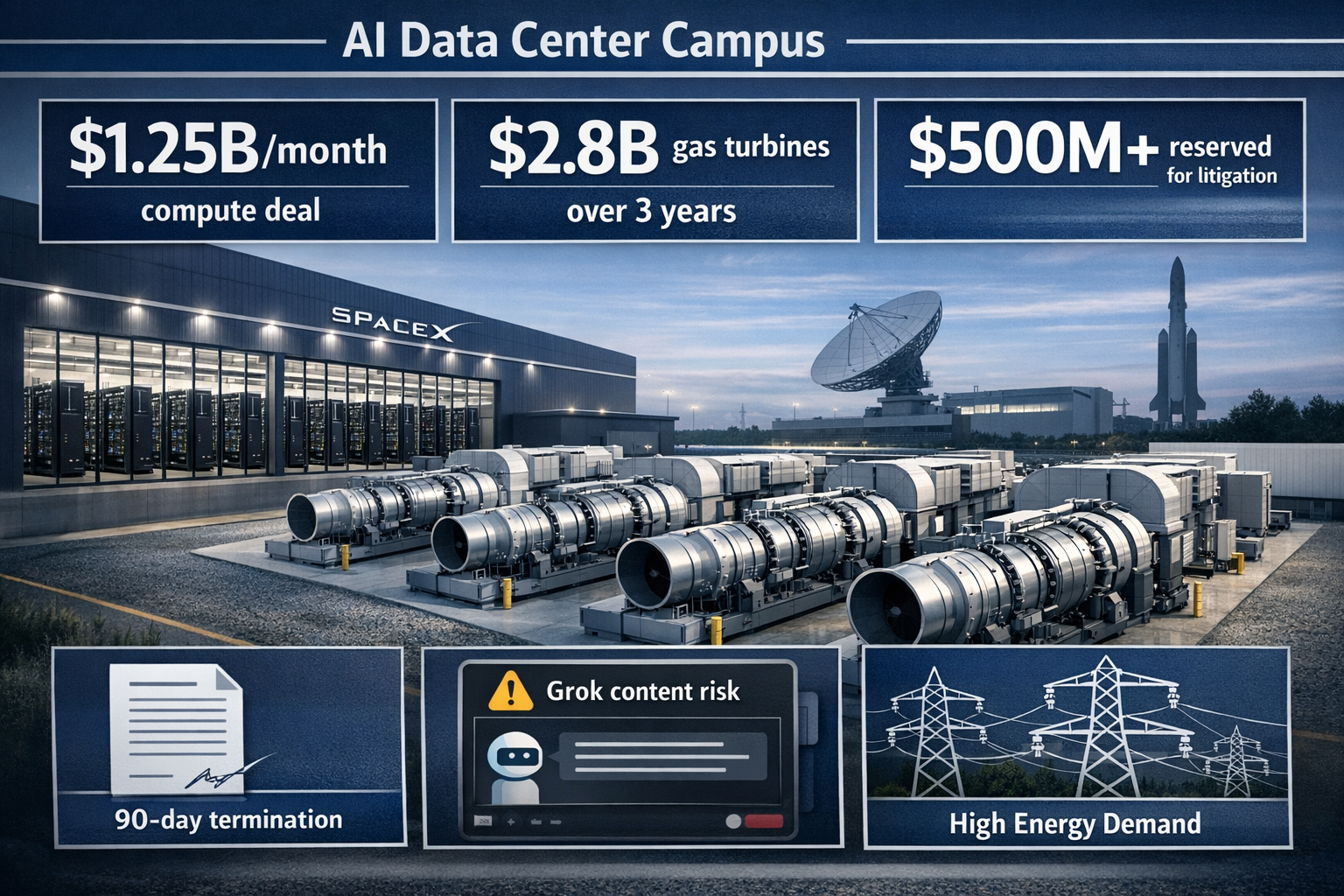
Among the most striking disclosures: SpaceX said it had reserved more than $500 million for potential litigation losses, citing in part complaints that Grok generated sexualized images; xAI plans to spend $2.8 billion over three years on natural-gas turbines to power AI data centers; and Anthropic, one of the industry’s leading AI start-ups, has agreed to pay $1.25 billion a month for computing capacity across the Colossus and Colossus II systems through May 2029, subject to a provision allowing either side to terminate with 90 days’ notice.
Taken together, the disclosures sketch a company trying to transform itself into a major AI infrastructure provider at a moment when demand for advanced computing has become one of the most lucrative businesses in technology.
A New Kind of SpaceX Bet
For years, investors have viewed SpaceX primarily through the lens of launch dominance and the rapid growth of Starlink, its satellite internet division. But the filing suggests that a growing part of its financial story now rests on selling access to the specialized computing clusters needed to train and run advanced AI models.
The Anthropic agreement is especially revealing. At face value, the contract points to a revenue run rate of roughly $15 billion a year — a figure large enough to rival major businesses on its own. Even with reduced fees during the initial ramp-up in May and June, the deal underscores how valuable scarce high-end compute capacity has become.
At the same time, the contract’s 90-day termination clause leaves open a basic question: how firm that revenue really is. In a market moving as quickly as AI, customers have been eager to secure supply, but they have also sought flexibility as hardware performance improves, new suppliers come online and the costs of training frontier models shift.
That tension — between eye-popping contracted demand and uncertain durability — now appears central to SpaceX’s AI ambitions.
Legal and Content Risks Come Into View
The filing also throws new light on the liabilities that come with owning AI products directly.
SpaceX said it had set aside more than $500 million for possible litigation losses, with complaints involving Grok among the reasons. Those complaints center on allegations that the chatbot created sexualized images, an area that has become one of the most legally fraught corners of generative AI.
The disclosure is notable not simply for its size, but because it places AI-image disputes alongside the broader litigation exposures of a company better known for launch operations and satellite deployments. It suggests that product-liability and content-moderation issues, once peripheral to SpaceX’s identity, are now material enough to be highlighted for public investors.
The filing specifically flags concerns tied to Grok’s “Spicy Mode,” a feature that has drawn scrutiny amid wider debates over how AI companies police sexually explicit, defamatory or otherwise harmful outputs. Across the industry, regulators and courts have been grappling with where responsibility lies when AI systems generate problematic content, especially images that depict real people or appear to facilitate harassment and abuse.
For SpaceX, those questions are no longer theoretical. They are now presented as risks that could affect finances, compliance costs and public market perception.
The Energy Cost of AI
If the Anthropic contract illustrates the revenue promise of AI infrastructure, the turbine purchase shows the physical scale required to pursue it.
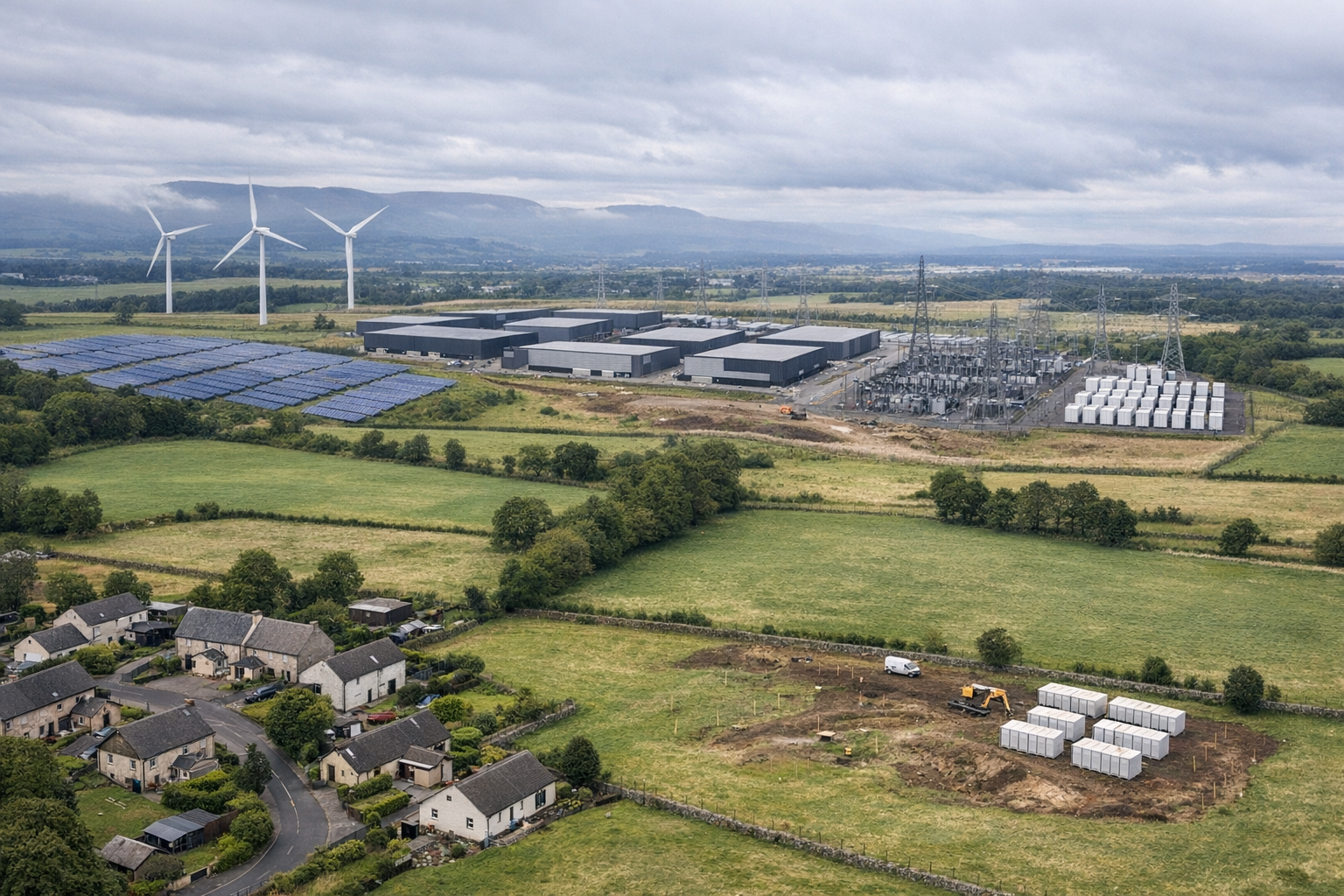
SpaceX disclosed that xAI plans to spend $2.8 billion over three years on gas turbines to supply its data centers. That investment points to one of the defining realities of the AI boom: the race to build ever larger computing clusters is increasingly constrained not only by chips, but by electricity.
Across the United States, utilities, developers and technology companies have been scrambling to find reliable power for new data centers. The newest AI systems can require enormous amounts of energy, and bringing that capacity online often outpaces the speed at which grids can be expanded. Natural-gas turbines, while carbon-emitting and politically contentious, offer one of the fastest ways to secure dependable power at scale.
That has made them attractive to AI companies, but also a magnet for criticism. Environmental groups, local residents and some regulators have increasingly challenged plans that rely on fossil-fuel generation, especially in communities already contending with industrial pollution or strained infrastructure.
SpaceX’s filing indicates that those tensions could become a meaningful business issue. A strategy built on large gas-powered facilities may face permitting battles, public opposition and heightened scrutiny over emissions, particularly as the company seeks to present itself to investors as a long-term infrastructure platform.
Musk’s AI Empire Gets More Intertwined
The disclosures come after a broader integration of Mr. Musk’s AI-related assets in 2026, linking SpaceX more directly with Grok, X and the compute systems behind them. That restructuring has made the company something more than a shareholder or financial backer of AI efforts. It is now positioned as a core operator of the machinery those efforts depend on.
That shift carries strategic advantages. SpaceX has experience building capital-intensive systems, access to large pools of financing and a willingness to move quickly on industrial projects. In an AI market where computing shortages have become a bottleneck, those traits can be powerful.
But the filing also makes clear that the shift brings a new bundle of risks: concentrated dependence on a small number of giant customers, exposure to volatile power costs, legal vulnerability around AI outputs and uncertainty over how much public investors will value SpaceX as an AI infrastructure company versus a launch and satellite business.
The answer may matter greatly to how the company is judged on Wall Street. Launch services and Starlink have traditionally underpinned the case for SpaceX’s long-term growth. Now investors are being asked to consider whether the more immediate upside could come from a different source altogether: leasing vast amounts of computing power to the winners of the AI race.
For now, the filing shows that SpaceX is making that wager at extraordinary scale — with billions committed to energy infrastructure, hundreds of millions reserved for legal exposure and a compute contract large enough to reshape the company’s revenue mix, if it holds.
Sources
Further reading and reporting used to add context:
- https://www.axios.com/2026/05/20/anthropic-spacex-compute
- https://www.axios.com/2026/05/21/ai-news-cycle-openai-anthropic-spacex
- https://www.wired.com/story/spacex-ipo-grok-spicy-mode-risks/
- https://techcrunch.com/2026/05/20/musks-xai-is-being-sued-over-its-data-center-generators-now-its-buying-2-8b-more/
- https://www.techbuzz.ai/articles/spacex-listed-grok-s-spicy-mode-as-a-risk-in-its-ipo-filing
- https://www.edgen.tech/news/post/anthropic-to-pay-xai-125-billion-monthly-for-ai-compute
- https://www.mlex.com/mlex/artificial-intelligence/articles/2480336/spacex-unit-xai-faces-intense-regulatory-scrutiny-says-initial-us-s-1-filing
- https://www.investing.com/news/stock-market-news/anthropic-nears-first-quarterly-profit-agrees-to-pay-spacex-125-billion-monthly-for-computing-power-4702825
- https://letsdatascience.com/news/anthropic-signs-125b-per-month-colossus-compute-deal-c892b829
- https://coincentral.com/anthropic-to-pay-xai-1-25b-monthly-for-compute-spacex-ipo-filing-shows/
- https://www.theinformation.com/articles/spacex-reveals-40-billion-anthropic-deal-catch
- https://app.dealroom.co/news/feed/spacex-signs-1-25b-per-month-cloud-deal-with-anthropic-offering-meta-a-blueprint-for-ai-infrastructure-monetisation
- https://www.europesays.com/ai/46074/
- https://biz.chosun.com/en/en-it/2026/05/21/CUAOGBFB3BA2JLIP72Y5BFDYQQ/?outputType=amp
- https://www.sec.gov/Archives/edgar/data/1664703/000162828026024240/ars202510k.pdf
- https://en.wikipedia.org/wiki/SpaceXAI
- https://en.wikipedia.org/wiki/Terafab
- https://en.wikipedia.org/wiki/SpaceX
- https://www.sec.gov/Archives/edgar/data/2052053/000121390026034191/ea0282939-01_n2a.htm
- https://www.sec.gov/Archives/edgar/data/2021728/000162828026029503/cerebras-sx1amay2026.htm
- https://www.sec.gov/Archives/edgar/data/2052053/000121390026013864/ea0275442-01_n2a.htm
- https://www.sec.gov/Archives/edgar/data/2091017/000114036126020608/0001140361-26-020608-index.htm
- https://www.sec.gov/Archives/edgar/data/1859836/000110465926035973/0001104659-26-035973-index.htm
- https://www.sec.gov/Archives/edgar/data/2094076/000149315226003229/0001493152-26-003229-index.htm
- https://www.sec.gov/Archives/edgar/data/1960355/000110465926032156/0001104659-26-032156-index.htm
- https://www.sec.gov/Archives/edgar/data/1934114/000110465926041905/0001104659-26-041905-index.htm
- https://www.sec.gov/Archives/edgar/data/1283259/000149315226006407/0001493152-26-006407-index.htm
- https://www.sec.gov/Archives/edgar/data/2100782/000119312526037799/0001193125-26-037799-index.htm
- https://www.sec.gov/Archives/edgar/data/2096300/000119312526119150/0001193125-26-119150-index.htm
- https://www.sec.gov/Archives/edgar/data/1861123/000119312526008888/0001193125-26-008888-index.htm
- https://www.sec.gov/Archives/edgar/data/1706946/000170694626000048/spce-2025123110xk7.pdf
- https://www.sec.gov/Archives/edgar/data/1706946/000130817924000619/spce4303851-ars.pdf
- https://www.sec.gov/Archives/edgar/data/0001706946/000130817923000773/spce4192301-ars.pdf
- https://www.sec.gov/Archives/edgar/data/88205/000008820525000025/spx2024ar.pdf
- https://www.reddit.com/r/RKLB/comments/1tiyyd2/spacex_sec_filing/
- https://www.secblastapi.com/
- https://www.beatandraise.com/
- https://t.co/v6BhOpKYXc
- https://sprytne.com/company/space-exploration-technologies-corp
- https://spacexipostat.us/
- https://secedgarterminal.com/
- https://legalclarity.org/how-to-locate-and-review-target-sec-filings/
- https://secends.com/
- https://www.stocktitan.net/sec-filings/SPCE
- https://www.edgarcompany.sec.gov/servlet/
- https://www.secinfo.com/%24/SEC/Registrant.asp?CIK=1181412
- https://formds.com/issuers/space-exploration-technologies-corp
- https://pdf.secdatabase.com/1621/0001628280-25-026244.pdf
- https://s29.q4cdn.com/417755062/files/doc_financials/Quarterly/2026/q1/SPCE-2026-Q1-2026-Earnings-Release-FINAL-5-14-26.pdf
- https://www.thestar.com.my/tech/tech-news/2026/05/21/anthropic-nears-first-quarterly-profit-agrees-to-pay-spacex-125-billion-monthly-for-computing-power
- https://www.basenor.com/blogs/news/anthropic-will-pay-spacex-1-25b-month-for-ai-compute
- https://techcrunch.com/2026/05/20/the-spacex-ipo-filing-ai-bets-starship-dreams-elon-musk/
- https://www.zonebourse.com/actualite-bourse/spacex-anthropic-versera-1-25-milliard-de-dollars-par-mois-jusqu-en-mai-2029-avec-une-montee-en-p-ce7f5ad9df81f422
- https://www.reddit.com/r/CitizenWatchNews/comments/1tjbc0g/according_to_spacex_ipo_papers_anthropic_is/
- https://www.reddit.com/r/stocks/comments/1tj3n3b/according_to_spacex_ipo_papers_anthropic_is/
- https://www.reddit.com/r/ClaudeAI/comments/1tj3jy9/anthropic_is_paying_spacex_15_billion_per_year/
- https://en.wikipedia.org/wiki/Anthropic
- Anthropic is paying SpaceX $15 billion per year
- SpaceX Listed Grok’s ‘Spicy’ Mode as a Risk in Its IPO Filing | WIRED




Leave a Reply