
The Buildout Meets Resistance
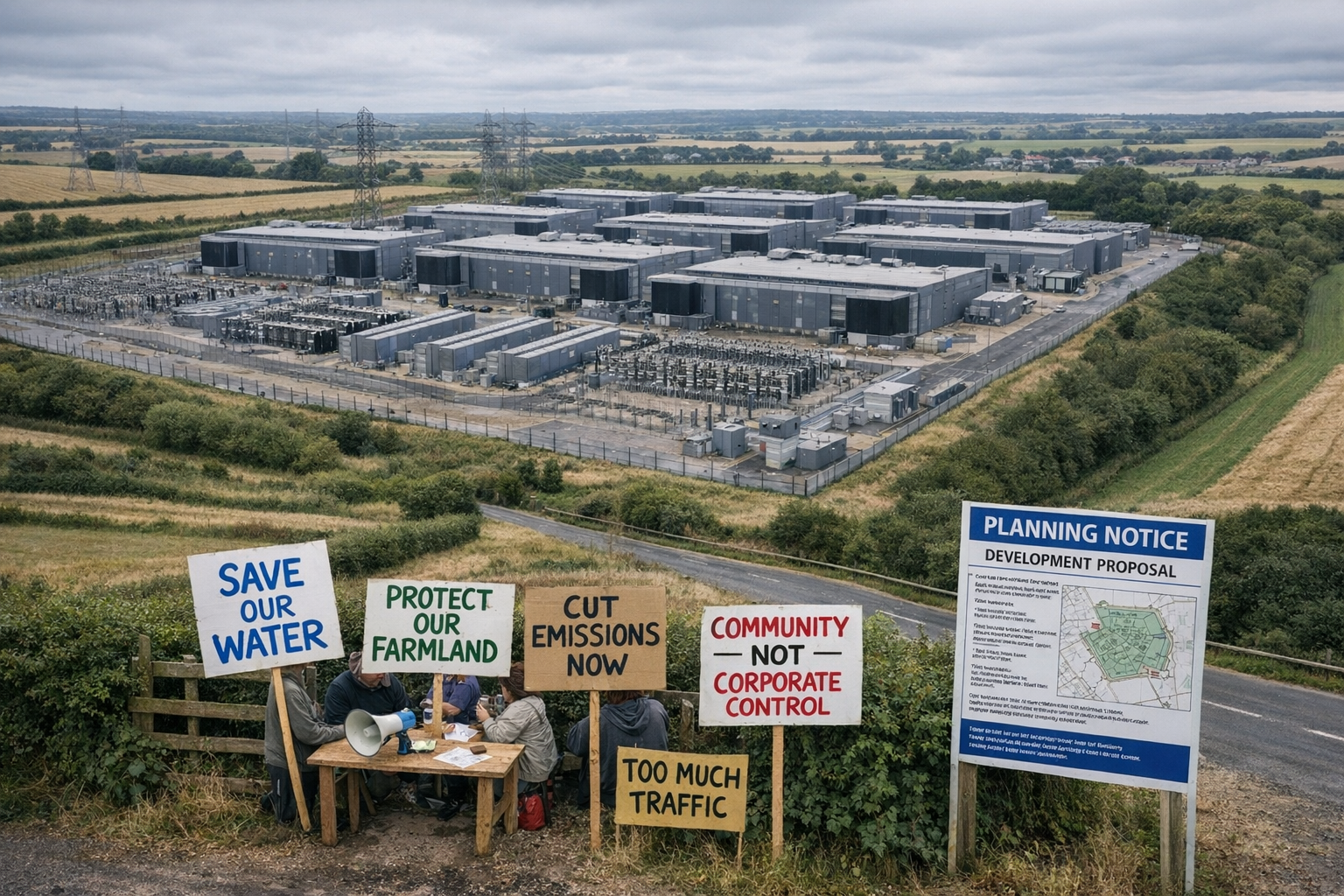
The race to build the physical backbone of artificial intelligence is running into a sharper, more organized backlash, as disputes over carbon accounting, local control and the sheer scale of new computing projects move from the margins into the center of public debate.
In Britain, scrutiny has intensified around proposed data centers linked to Google after planning documents for two sites in Essex appeared to substantially understate their contribution to national emissions. At the same time, critics of new AI facilities are increasingly casting their objections not as reflexive local opposition, but as a broader fight over who gets to decide how land, power and water are used in the name of technological growth.
Taken together, the clashes suggest that the next phase of the AI boom will be shaped as much by permitting battles and environmental math as by breakthroughs in software.
A Carbon Dispute in Essex
The immediate flashpoint is a set of planning documents filed for two large proposed data centers in Essex, one in Thurrock and another at North Weald. According to an investigation by The Guardian, the documents appear to have compared one year of emissions from the sites with the country’s five-year carbon budget, making the projects’ significance look about five times smaller than it would under a like-for-like comparison.
A similar issue was reported in planning material for a separate project in Lincolnshire. Taken together, those three developments would account for more than 1 percent of Britain’s carbon budget for 2033, according to the reporting.
The dispute lands at an awkward moment for Britain’s government, which has spent the past two years urging faster construction of AI infrastructure while also publishing updated analysis showing that the sector’s climate effects could be far from trivial. Revised government estimates released in April found that AI compute could add between 34 million and 123 million metric tons of carbon dioxide from 2025 to 2035, depending on how quickly demand grows and how fast the power grid decarbonizes. That would amount to roughly 0.9 percent to 3.4 percent of projected national emissions over the period.
In other words, even in a country with legally binding climate targets and a stated commitment to cleaner electricity, data centers are no longer easily treated as an invisible layer of the digital economy. They are becoming measurable pieces of the national carbon ledger.
Britain’s Pro-Build Push
The Essex controversy also exposes a growing tension inside Britain’s industrial strategy.
Last September, the government designated data centers as Critical National Infrastructure, placing them in the same strategic category as sectors considered vital to national resilience. Ministers have since promoted “AI Growth Zones,” intended to accelerate approval and development of major computing sites. Officials have said Britain will need at least 6 gigawatts of AI-capable data-center capacity by 2030, with the zones expected to support facilities of 500 megawatts or more and at least one site exceeding 1 gigawatt by the end of the decade.
Those figures point to an infrastructure program of enormous consequence. A one-gigawatt campus is not simply another commercial development; it is, in effect, an industrial-scale power user with implications for grid planning, water systems, traffic, land use and local air quality, even before accounting for construction emissions.
Supporters argue that such buildouts are necessary if Britain hopes to remain competitive in AI and cloud computing. But the planning disputes in Essex and Lincolnshire underscore how quickly the national ambition to secure more compute can collide with the slower, more contentious realities of local review.
Whether the contested calculations will be revised, and whether any revisions would materially affect approval decisions, remains unclear.
Not Just a Land-Use Fight
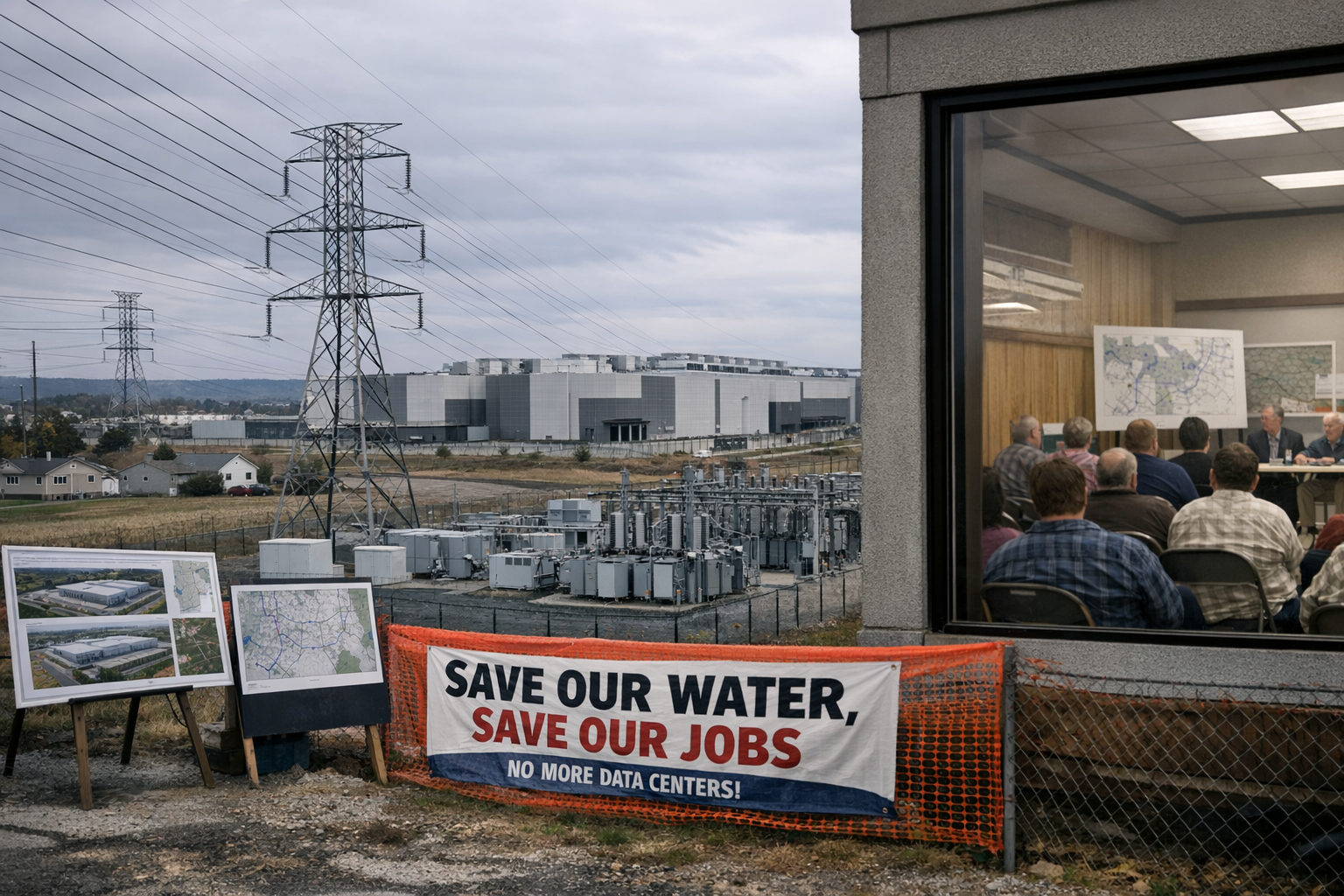
Opposition to data centers has often been dismissed as a familiar form of nimbyism. But activists and some scholars are trying to reframe the issue in more structural terms: not whether communities dislike nearby development, but whether residents have any meaningful say over projects being justified as inevitable in the name of AI progress.
That argument has gained traction as the facilities themselves have grown larger and more resource-intensive. Data centers consume extraordinary amounts of electricity, and many also place demands on water supplies and transmission networks. Their benefits, meanwhile, can feel abstract or unevenly distributed, especially when the economic upside accrues mainly to global technology companies while the physical footprint is borne locally.
The democratic critique is also sharpened by the way AI infrastructure is increasingly being advanced through top-down national strategy. In Britain, that has meant special designations and growth zones intended to speed construction. In the United States, federal support and procurement have helped reinforce a wider push for AI capacity. Critics say such policies risk narrowing the space for public input precisely when the stakes are rising.
The result is that fights over server farms are becoming proxies for a larger question: who gets to govern the material expansion of AI?
A Global Spending Surge
Those questions are surfacing just as the scale of the global buildout is becoming harder to ignore.
In China, ByteDance, the parent company of TikTok, is reported to be planning more than 200 billion yuan, or roughly $30 billion, in AI spending in 2026, a significant increase from earlier plans. The company is said to be relying more heavily on Chinese-made chips as export controls continue to constrain access to some advanced foreign hardware.
Even that sum looks modest beside the spending plans of the largest American technology companies. Google, Amazon, Microsoft and Meta are together expected to pour well over $700 billion into AI-related capital expenditures, according to the research estimates cited in the latest reporting. Chinese cloud providers are also ramping up, with projected spending around $105 billion.
The spending spree reflects a basic truth about the current AI race: success depends not only on algorithms and talent, but on access to land, electricity, specialized chips, cooling systems, construction capacity and political permission. Compute has become a strategic asset, and building it now resembles a contest in industrial policy as much as one in computer science.
Why the Politics Are Changing Now
What makes the current moment distinct is not simply that data centers use energy; it is that governments are openly planning for a dramatic expansion at the same time that the climate costs are coming into sharper focus.
For years, the digital economy benefited from a certain rhetorical lightness — software felt weightless, the cloud sounded ethereal. AI has ended that illusion. Training and running advanced systems requires dense clusters of hardware, and those clusters must be housed somewhere, powered somehow and approved by someone.
Britain’s own analysis now acknowledges that AI compute could become a notable contributor to emissions over the next decade. The government nevertheless wants to move quickly, arguing that capacity constraints could leave the country dependent on foreign infrastructure and unable to capture AI’s economic gains.
That places planners, local officials and communities in a difficult position. To delay projects may be framed as obstructing innovation and competitiveness. To approve them without rigorous scrutiny invites accusations that the carbon costs have been minimized and democratic oversight weakened.
The backlash, then, is not a rejection of technology so much as a demand that the infrastructure behind it be treated as real infrastructure — subject to honest accounting, public debate and political accountability.
As the AI boom enters its concrete-and-substations phase, that demand is likely to become harder for governments and technology companies to wave aside.
Sources
Further reading and reporting used to add context:
- Google developers significantly misstate carbon emissions of proposed UK datacentres | Google | The Guardian
- https://www.theguardian.com/commentisfree/2026/may/08/ai-datacenters-democracy
- https://www.theguardian.com/technology/2026/apr/24/officials-hugely-underestimated-impact-of-ai-datacentres-on-uk-carbon-emissions
- https://www.aitechsuites.com/ai-news/bytedance-commits-30-billion-dollars-to-ai-while-pivoting-to-domestic-chinese-hardware
- https://www.reddit.com/r/GUARDIANauto/comments/1t799qa/environment_the_fight_against_ai_data_centers/
- https://www.tomshardware.com/pc-components/gpus/tiktok-owner-bytedance-to-reportedly-purchase-usd14-billion-worth-of-nvidia-ai-gpus-in-2026-company-betting-on-beijings-approval-following-trump-admins-ease-on-ai-export-controls
- https://www.reddit.com/r/unitedkingdom/comments/1t89u5t/google_developers_significantly_misstate_carbon/
- https://www.reddit.com/r/GUARDIANauto/comments/1t79396/us_the_fight_against_ai_data_centers_isnt_just/
- https://www.reddit.com/r/GUARDIANauto/comments/1t79as4/opinion_the_fight_against_ai_data_centers_isnt/
- https://letsdatascience.com/news/bytedance-raises-2026-capex-for-ai-investment-ded4ef30
- https://inshorts.com/en/news/google-misstated-emissions-from-planned-data-centres-in-uk–report-1778413437205
- https://www.theguardian.com/news/ng-interactive/2026/mar/14/datacentre-boom-is-uk-ai-bubble-about-to-burst
- https://www.scmp.com/tech/big-tech/article/3338191/bytedance-pour-us14-billion-nvidia-chips-2026-computing-demand-surges
- https://www.theguardian.com/technology/2025/sep/15/google-datacentre-kent-co2-thurrock-uk-ai
- https://www.reddit.com/r/ukpolitics/comments/1t8a3wn/google_developers_significantly_misstate_carbon/
- https://www.reddit.com/r/LabourUK/comments/1t8axbo/google_developers_significantly_misstate_carbon/
- https://www.reddit.com/r/GUARDIANauto/comments/1t895rb/uk_google_developers_significantly_misstate/
- https://www.reddit.com/r/grAIve/comments/1t96b1n/bytedance_plans_over_30b_for_ai_expansion/
- https://www.reddit.com/r/AutoNewspaper/comments/1t89lhy/uk_google_developers_significantly_misstate/
- https://en.ain.ua/2025/12/31/chinas-bytedance-plans-to-spend-14-billion-on-nvidia-ai-chips-in-2026/
- https://www.reddit.com/r/GUARDIANauto/comments/1t89b0a/world_google_developers_significantly_misstate/
- https://www.scmp.com/tech/big-tech/article/3352533/chinas-chipmakers-pour-revenue-rd-outpacing-us-ratios
- https://www.scmp.com/tech/big-tech/article/3350346/tsmc-targets-over-30-revenue-surge-2026-ramps-capex-amid-booming-ai-demand?module=china_future_tech&pgtype=homepage
- https://www.scmp.com/tech/article/3352751/kimi-developer-moonshot-ai-valued-us20b-it-navigates-chinas-new-ipo-rules
- https://www.scmp.com/tech/big-tech/article/3352068/chinese-firms-face-pressure-ai-investments-us-peers-spending-keeps-soaring
- https://www.scmp.com/tech/big-tech/article/3344017/chinas-tech-giants-report-huge-gains-spring-festival-marketing-blitz
- https://www.scmp.com/tech/article/3346234/chinas-midea-pledges-us87-billion-ai-and-robotics-pivot-automation
- https://www.scmp.com/tech/tech-trends/article/3347160/huawei-capitalises-openclaw-frenzy-boost-computing-demand-its-chips
- https://www.scmp.com/tech/big-tech/article/3350521/bytedance-tencent-step-ai-talent-battle-amid-reported-departure-deepseek-researcher
- https://www.scmp.com/tech/big-tech/article/3338308/nvidia-asks-chipmaker-tsmc-ramp-h200-production-china-demand-jumps-sources-say
- https://www.scmp.com/tech/big-tech/article/3347023/chinas-tencent-meets-expectations-fourth-quarter-results-ai-wave-lifts-all-boats
- https://www.scmp.com/tech/big-tech/article/3294738/bytedance-invest-us614-million-computing-centre-china-amid-high-ai-demand
- https://multimedia.scmp.com/news/china/article/sichuan-earthquake/pdf/7962571.PDF
- https://cdn-osc.scmp.com/assets/media/2025/call%20for%20proposal/OSC%20Call%20for%20funding%20application_FAQ_revised%20on%2017June2025.pdf
- https://the-decoder.com/wp-content/uploads/2024/08/whistleblower-sb1047-letter.pdf
- https://multimedia.scmp.com/PDF/7879919.PDF
- https://www.recruitment.scmp.com/mt/2016.pdf
- https://www.gov.uk/government/publications/ai-opportunities-action-plan-one-year-on/ai-opportunities-action-plan-one-year-on
- Compute Evidence Annex: changes corrected (23 April 2026) – GOV.UK
- https://www.gov.uk/government/news/data-centres-to-be-given-massive-boost-and-protections-from-cyber-criminals-and-it-blackouts?icid=learn_more_content_click
- https://www.gov.uk/government/publications/delivering-ai-growth-zones
- https://www.gov.uk/government/publications/uk-compute-roadmap/uk-compute-roadmap
- https://www.gov.uk/government/publications/public-switched-telephone-network-critical-national-infrastructure-charter/pstn-critical-national-infrastructure-charter
- https://www.gov.uk/government/news/uk-us-and-australia-sign-supply-chain-resilience-pact
- https://www.gov.uk/government/news/uk-defence-supply-chain-bolstered-to-support-armed-forces
- https://www.business.gov.uk/invest-in-uk/investment/sectors/ai-and-data-centres/
- https://www.gov.uk/government/publications/the-nda-group-strategy-effective-from-march-2026/the-nda-group-strategy-effective-from-march-2026
- https://www.gov.uk/government/news/targeted-energy-bill-support-and-simpler-access-to-legal-guidance-among-plans-to-put-data-to-work-to-improve-lives
- https://www.gov.uk/government/news/new-online-hub-launches-for-national-infrastructure-projects
- https://assets.publishing.service.gov.uk/media/697a36873c71d838df6bd400/ai_opportunities_action_plan-one-year-on.pdf
- https://assets.publishing.service.gov.uk/media/6781447061e7988536018452/ai_opportunities_action_plan_government_repsonse.pdf
- https://assets.publishing.service.gov.uk/media/6784eb3b3ef063b15dca0ec0/ai_opportunities_action_plan.pdf
- https://assets.publishing.service.gov.uk/media/69417a0958a21370f58f3010/December_2025_NPPF_Consultation_document.pdf
- https://assets.publishing.service.gov.uk/media/688cb407dc6688ed50878367/Water_use_in_data_centre_and_AI_report.pdf
- Data centres to be given massive boost and protections from cyber criminals and IT blackouts – GOV.UK











Leave a Reply